Showing posts with label Campania. Show all posts

Monday, 13 February 2023

The frescoes from a wealthy seaside villa

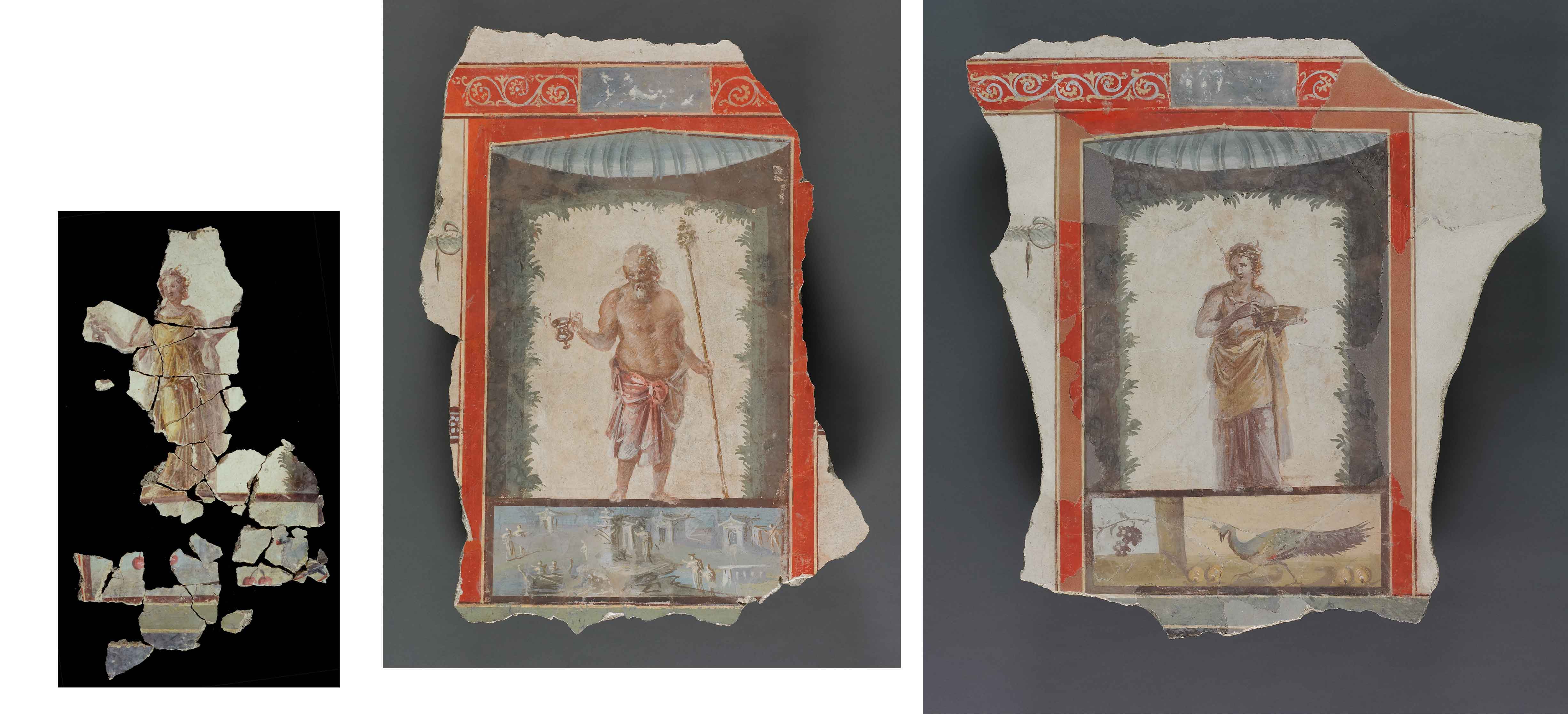
Three panels acquired by the J. Paul Getty Museum in 1983.
Inv. 83.AG.222.2, 4, 8.

In 1983 the J. Paul Getty Museum acquired a series of Roman frescoes on the 'European market', in fact from Palladion Antike Kunst in Basel. The Getty's handbook suggests that they are derived from ‘a wealthy Roman’s seaside villa in the area of the Bay of Naples’. 

Elizabeth Marlowe has commented on the displayed fragments, suggesting that the panels had been removed from a single room somewhere in the vicinity of Vesuvius. Indeed, there are fragments that were acquired at the same time that clearly come from a third panel, presumably from the same room. Daniela Rizzo and Maurizio Pellegrini have recently drawn attention to the problematic nature of these frescoes and published an image of a further section of the decoration that appears in the Becchina photographic archive. 

How does the Getty interpret the history of the fragments? Is the museum actively seeking to return the sequence of fragments to Italy?


References
Lapatin, K. D. S., and K. Wright. Editors. 2010. The J. Paul Getty Museum: Handbook of the Antiquities Collection. Los Angeles: J. Paul Getty Museum.
Marlowe, E. 2020. "The reinstallation of the Getty Villa: plenty of beauty but only partial truth." AJA 124: 321–32. [Online]
Rizzo, D., and M. Pellegrini. 2021. "The Italian Archaeological Heritage Abroad: Between Agreements, Debates and Indifference." In Stolen Heritage: Multidisciplinary Perspectives on Illicit Trafficking of Cultural Heritage in the EU and the MENA Region, edited by A. Traviglia, L. Milano, C. Tonghini, and R. Giovanelli, Antichistica, vol. 29: 99–114. Venezia: Edizioni Ca’ Foscari. [Online]

| |
Bookmark and Share so Your Real Friends Know that You Know

Wednesday, 19 April 2017

The Drusus and Tiberius portraits from Sessa Aurunca

Drusus Minor. Source: Cleveland Museum of Art
The return of the head of Drusus Minor to Italy from the Cleveland Museum of Art has been in part thanks to the diligent research of Giuseppe Scarpati. He has discovered the photographic records of sculptures discovered during the mid-1920s during the excavations of Sessa Aurunca.

The head of Drusus Minor is clearly recognisable from the archive photographs (Scarpati 2008-11: 357, fig. 7, 358 fig. 10). The head passed through PIASA in Paris in 2004, a source that is not without some interest. It was acquired from Phoenix Ancient Art in 2012. (See Gill 2013: 72 for oral histories and objects linked to this dealer, and with a specific mention to the portrait of Drusus.)

David Franklin, the then director of the Cleveland Museum of Art, defended the acquisition of the head at the time. (He resigned from the museum in 2013.) The museum is probably wishing that it had not claimed that the collecting history had been traced back to the 19th century.

The trail of the Drusus portrait had been identified by a companion piece. The head of Tiberius appears to be the one in a North American private collection ("The Magdalene Tiberius")  and published by John Pollini (Pollini 2005; Scarpati 2008-11: 361 figs. 11-14). It was reported to have formed an old French collection in Marseilles dating to the 1960s. It was said to have been found in North Africa (a good reminded of the intellectual consequences of collecting recently surfaced archaeological material). It was acquired by its present proprietors in 2004. The source appears to have been the Royal-Athena Galleries (Art of the Ancient World 15 [2004] no. 24; Scarpati 2014: 33 fig. 9). Will those owners be contacting the Italian authorities in the light of the return of the Drusus portrait?

It is interesting that the (recent) collecting histories of both portraits now do not seem to go back beyond 2004 (i.e. 34 years after the UNESCO Convention). What were their collecting histories immediately prior to 2004?

The Drusus Minor return is merely serving to open up the discussion. Was the Cleveland Museum of Art aware of Scarpati's research prior to the portrait's acquisition?

Now is probably also a good time for the museum staff to revisit the documented collecting history of the Leutwitz Apollo.

Bibliography

Gill, D. W. J. 2013. "Context matters: The Cleveland Apollo goes public." Journal of Art Crime 10: 69-75. [academia.edu]
Pollini, J. 2005. "A new marble head of Tiberius. Portrait typology and ideology." Antike Kunst 48: 55-72. [JSTOR]
Scarpati, G. 2008-11. "Un ritratto di Tiberio da Sessa Aurunca ritrovato note su un probabile ciclo Suessano di statue onorarie Giulio-Claudie." Rendiconti della Accademia di Archeologia Lettere e Belle Arti 75: 345-68. [Academia.edu]
Scarpati, G. 2014. "Il ritratto di Druso minore dal ciclo statuario Giulio-Claudio di Sessa Aurunca." Bollettino d’Arte 24: 29-38. [Academia.edu]

Press Release
"Cleveland Museum of Art to Transfer Roman Sculpture of Drusus Minor to the Republic of Italy", Cleveland Museum of Art April 18, 2017. [press release]
"Il Cleveland Museum of Art restituisce all’Italia una scultura romana di Druso Minore", MiBACT April 18, 2017. [press release]

Bookmark and Share so Your Real Friends Know that You Know

Krater fragments in Princeton

Greek, Attic, probably by the Kleophrades Painter, ca. 490–480 BCE, Two non-joining fragments from a calyx-krater (mixing bowl) depicting ar...