Showing posts with label Edoardo Almagià. Show all posts

Thursday, 21 September 2023

Bothmer, Almagià and the Michael C. Carlos Museum

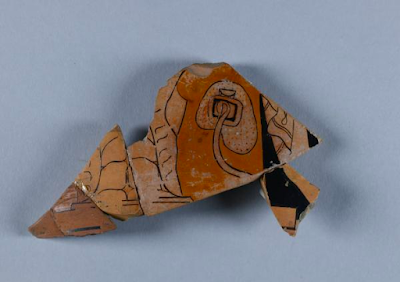
Red-figured calyx-krater fragment
attributed to the Kleophrades painter.
Michael C. Carlos Museum inv. 2006.051.011B

I have noted that Dietrich von Bothmer acquired a fragment of a cup from Edoardo Almagià and then gave it to the J. Paul Getty Museum: the rest of the fragments were supplied by Galerie Nefer (D.W.J. Gill 2022. "Context Matters: Fragmented Athenian Cups." Journal of Art Crime 27: 77–84. ). 

A fragmentary calyx-krater attributed to the Kleophrades painter was presented to the Michael C. Carlos Museum by Bothmer in 2006. It is interpreted as showing the funeral mound of Hektor. Bothmer acquired the first fragment in July 1972, followed by further fragments in September 1978: the sources for these are unknown. However in 1978 another fragment was acquired from Bruce McNall of the Summa Galleries; this was followed by further fragments from Nikolas Koutoulakis in 1981, Edoardo Almagià in 1993, and Harry Bürki in 1994. 

This network of names would suggest that the origins of this krater deserve further investigation. Tsirogiannis and I will be exploring a parallel network, also including Bothmer, in a forthcoming article.

Incidentally, a fragmentary calyx-krater showing the funerary mound of Achilles (?), and compared by Bothmer to the Kleophrades painter, had resided in the private collection of Cornelius C. Vermeule (BAPD 3197). Both kraters seem to have surfaced around the same time.

| |
Bookmark and Share so Your Real Friends Know that You Know

Tuesday, 11 April 2023

Developments at Princeton

Etruscan amphora inv. y1984-19.
Source: Daily Princetonian
It seems that five objects relating to Edoardo Almagià are to remain in Princeton University Art Museum (Sandeep Mangat and Miriam Waldvogel, "Five artifacts linked to alum under investigation for art smuggling will remain at University Art Museum", Daily Princetonian April 11, 2023). I am a little confused as the earlier report included pictures and some of the pieces mentioned in the most recent article, for example the Roman doll (inv. y1993-13), the Campanian stamnoid pyxis (inv. 87-3a–b) and fragments of a Roman Arretine bowl (inv. y1992-67), do not feature among the images. 

However, among the pieces staying in Princeton is the Etruscan amphora attributed to the Paris painter (inv. y1984-19). This is stated as: "Gift of Peter Glidewell through Edoardo Almagia, Class of 1973".

It should be remembered that Princeton has already returned a series of Etruscan architectural terracottas that were given by Almagià. These are discussed in: D.W.J. Gill, "Context matters: Princeton and recently surfaced antiquities," Journal of Art Crime 7 (2012): 59-66; id., Context matters: Collating the past, Amelia: ARCA, 2020, pp. 106–14; id., "Returning archaeological objects to Italy," International Journal of Cultural Property 25 (2018): 283–321 [DOI].

The latest article in the Daily Princetonian seems to confuse items that had been loaned by Almagià and those that had been given by him.

The article does include an interesting statement attributed to Almagià: 
"He added that he gave these fragments to Dietrich von Bothmer, a prominent German-American art historian."
We are aware that Almagià appears to have been the source for fragments in Bothmer's collection that had been acquired in 1984, 1986 and 1987. Does this imply that the fragments appearing in the original article were derived from Almagià? And was the Psiax fragment from the Centre Island private collection also from this source?

The Daily Princetonian mentions the seizure of fragments from Bothmer's collection although as far as I am aware no connection with Almagià had been made. These are discussed in: D.W.J. Gill, "Context matters: Fragmented pots, attributions and the role of the academic," Journal of Art Crime 8 (2012): 79-84. However other Bothmer fragments were included in the recent seizure from New York's Metropolitan Museum of Art.

Other figure-decorated fragments derived from Almagià have been returned from the San Antonio Museum of Art that had acquired them in 1985. Material derived from Almagià has featured in the Steinhardt return

I am aware of other Almagià material in a north American university collection that appears to have been derived from Crustumerium in Lazio. (A discussion of the piece along with other items from the same place features in a forthcoming article.)

Is it time for Princeton to provide additional so-called "provenance" information on its website?

| |
Bookmark and Share so Your Real Friends Know that You Know

Saturday, 8 April 2023

Amphora fragment seized from Princeton

Amphora fragment attributed to Psiax
Source: Daily Princetonian


An Attic belly amphora fragment attributed to Psiax (by Dietrich von Bothmer) was among the 11 objects seized from Princeton University Art Museum by the Manhattan DA (inv. 1997-469: BAPD 902285). The fragment was acquired by 1997 as an anonymous gift by exchange, though we also know that it was derived from a "Centre Island private collection". 

Among the other objects seized were six pieces on loan from Edoardo Almagià. Further details have yet to be released.

We know of another calyx-krater attributed to Psiax that had also formed part of a "Centre Island private collection". 

| |
Bookmark and Share so Your Real Friends Know that You Know

Wednesday, 21 September 2022

The Intellectual Consequences of Collecting an Attic Black-Figured Amphora

Source: Manhattan DA

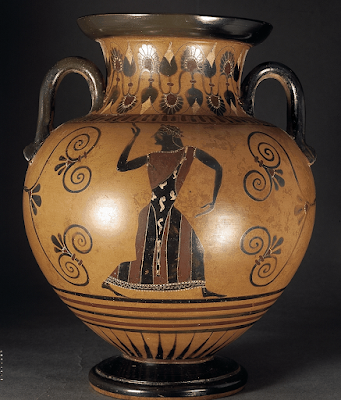
Among the returns to Italy from the Michael Steinhardt collection was an Attic black-figured amphora showing a Maenad. The amphora is known from the Almagià archive (Exhibits 33A and 33B).

The Manhattan DA Statement of Facts notes:
Almagià’s Green Book lists one “Attic BF [Black-Figure] Amphora” purchased from a tombarolo for $6,500, and then sold for $13,000. Almagià’s day planner lists “Steinhardt” on March 18, 1997, preceding a note on April 2, 1997, “prendere vase da [sic] Steinhardt” (take vase of Steinhardt). Although Steinhardt’s records note that there is “no record of purchase,” the records also indicate that Steinhardt accessioned the Attic Black-Figure Amphora in 1997 from Almagià.
Essentially all we know is that Steinhardt acquired this amphora in 1997, and that Almagià had purchased it from a tombarolo.

The mention of the tombarolo suggests that the find-spot was somewhere in Italy: the Statement of Facts suggests both Etruria and Sicily as possibilities. Note that we cannot be sure of the part of Italy where the amphora was found, let alone the specific place or cemetery. That information has been lost for good.

The relatively complete nature of the amphora suggests that it was discovered in a substantial tomb. But what other objects were found alongside it? Was there a single burial or multiple burials? What was the gender of the main person buried in the tomb? If the tomb was in Etruria, were there decorations on the wall? Would other associated finds have helped with the dating? Could it have been older that other pieces in the tomb?

Vasologists may be even now seeking to provide an attribution for the amphora. Perhaps they will note that it has certain characteristics in the potting. Will it be placed in a particular class of pot? But what about the parallels? Where were they found? Or were they, too, without context? 

The looting of this unusual amphora has stripped it of its useful archaeological information. That is one of the intellectual consequences of collecting newly surfaced material.

| |
Bookmark and Share so Your Real Friends Know that You Know

Friday, 12 August 2022

Further returns from the Getty announced


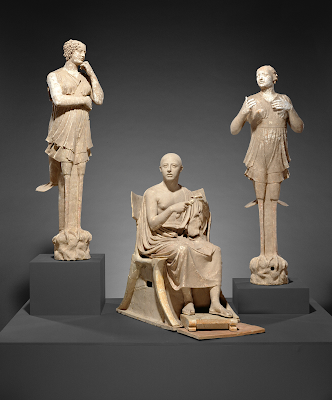
The items include three terracotta figures known as 'Orpheus and the Sirens' acquired in 1976 (inv. 76.AD.11). They were purchased from Bank Leu in Zurich. (For further information see the catalogue of terracottas at the Getty.)

Four other items from the Getty will be returned:
Recent research by Getty and independent scholars also determined that it is appropriate to return a second-century AD colossal marble head of a divinity; a second-century AD stone mold for casting pendants; an oil painting entitled Oracle at Delphi, 1881, by Camillo Miola; and a fourth-century BC Etruscan bronze thymiaterion. The first three of these objects were acquired by J. Paul Getty and the Getty Museum in the 1970s; the fourth in 1996. None of these objects have been on public view in recent years. Getty is currently working with the Ministry of Culture to arrange their returns.
There is no indication in the press statement about the sources though I understand that several feature in the photographic archives seized in Switzerland and Greece. 

The colossal marble head (inv. 72.AL.96) was acquired from Robin Symes. An Etruscan bronze thymiaterion was acquired in 1996 from the Fleischman collection (inv. 96.AC.253). It was sold to the  Fleischmans in 1987 by Edoardo Almagià. (This would be the second Almagià piece to be returned by the Getty.)

The story also appears in The Art Newspaper (incorrectly stating that the thymiaterion was purchased in 1996).


Bookmark and Share so Your Real Friends Know that You Know

Thursday, 21 July 2022

Crustumerium material


I am aware of an impasto amphora in a North American university collection that appears to come from Crustumerium and was handled by Edoardo Almagià. I presume that curators are checking their items for material from these sources.

| |
Bookmark and Share so Your Real Friends Know that You Know

Wednesday, 20 July 2022

New Returns to Italy Announced: Some Linked to Edoardo Almagià

Source: Manhattan DA

It was announced today that 142 antiquities will be returning to Italy (Press Release, "D.A. Bragg Returns 142 Antiquities Valued at Nearly $14 Million to the People of Italy", July 20, 2022). The returns consisted of 
"60 were recovered from Royal-Athena Galleries, 48 were recovered from STEINHARDT, and an additional 34 were seized pursuant to other ongoing investigations".
The Steinhardt material included:
Among the items being repatriated today is the Ercolano Fresco, which was seized as part of the investigation into STEINHARDT. Depicting an infant Hercules strangling a snake, the piece dates to 50 C.E. and was looted in 1995 from a villa in Herculaneum, an archaeological site that was buried for millennia under volcanic ash from the fiery eruption of Mount Vesuvius. STEINHARDT purchased the Ercolano in 1995 for $650,000 with no verifiable prior provenance. It is currently valued at $1,000,000.
Other items identified include:
Three fresco paintings dating to the 4th century B.C.E. from Paestum, an ancient Greek city located in southern Italy, which were seized pursuant to an ongoing investigation. These paintings depict scenes of mourning women, and were hacked from the wall of a tomb by looters.
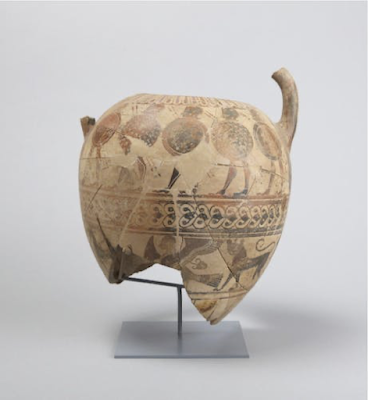
An Archaic pithos (storage jar) dating back to 700 B.C.E. that was seized pursuant to an ongoing investigation into Edoardo ALMAGIÀ, an Italian native and former New York resident.
The press release also acknowledges the following museums and a single gallery:
Indiana University’s Eskenazi Museum of Art, the Museum of Fine Arts-Boston, Royal-Athena Galleries, and the Toledo Museum of Art
One wonders if the Indiana material is linked to Almagià. 

The Boston material includes 9 pots apparently derived from Crustumerium in Latium that was acquired in 1995:
Probably about 1993/1994, illicitly excavated from Crustumerium, Italy and sold to Edoardo Almagià, New York; 1995, sold by Almagià to Jonathan Kagan and Sallie Fried, New York; 1995, year-end gift of Jonathan Kagan and Sallie Fried to the MFA (Accession Date: January 24, 1996); December 16, 2021, deaccessioned by the MFA for transfer to the New York County District Attorney and return to the Republic of Italy.
So far Boston is the only museum that appears to have provided full information.

| |
Bookmark and Share so Your Real Friends Know that You Know

Monday, 24 January 2022

The whole history of a Little Master cup

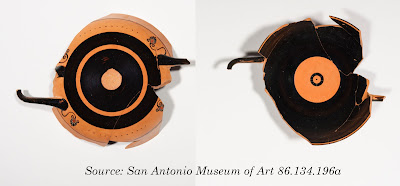
These fragments of an Athenian Little Master cup, decorated with 'nonsense' inscriptions are among the pieces being returned to Italy by the San Antonio Museum of Art.

It is a reminder of the way that museums restrict information. The published catalogue, by H. Alan Shapiro, Carlos A. Picón and Gerry D. Scott III merely note that it was a gift of Gilbert M. Denman, Jr in 1986. The Beazley Archive records nothing about its history (BAPD 20266). Yet now it seems that the fragments, including this Little Master cup, had been found at Barbarano Romano, and had been purchased by Edoardo Almagià in 1985. How was such information deemed to have been unknown to those preparing the catalogue? 

Were these fragments processed by Almagià with the help of an academic?

Are there other pieces remaining in San Antonio that also derive from Barbarano Romano or other sites in Italy?

Why were such large numbers of fragments acquired by San Antonio? Was there an expectation that other fragments from these figure-decorated pots would be acquired in future years? Was the museum following the pattern of other collections? 


| |
Bookmark and Share so Your Real Friends Know that You Know

Monday, 17 January 2022

The ownership trail of an Apulian krater

Apulian volute-krater
attributed to the Virginia Exhibition painter
Source: Fordham University

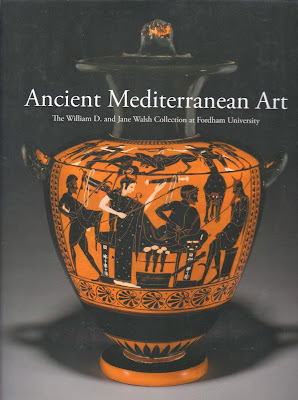
In February 2018 I drew attention to the Fordham Apulian volute-krater, attributed to the Virginia Exhibition painter, and its association with Edoardo Almagià (formerly inv. 8.001). I subsequently asked the question, 'Has the curatorial team at Fordham contacted the Italian authorities to check the history of the Apulian krater?' One of my concerns was that the name of the pot-painter is derived from the display, at Virginia, of five pieces all said, according to Dale Trendall, 'to come from the same tomb'. We do not, however, know the location of that tomb.

The krater was presented to Fordham in 2006 by William D. Walsh. Walsh had declared that it had been purchased from Arte Primitivo in 1994. Yet Trendall and Cambitoglou recorded the krater in 1992 as residing with Almagià on the New York market.

What other pieces from the Walsh collection were acquired from Arte Primitivo? When did the Apulian krater pass from Almagià to Arte Primitivo?

| |
Bookmark and Share so Your Real Friends Know that You Know

Tuesday, 11 January 2022

A Bothmer fragment sourced from Almagià


When 40 of Bothmer pot fragments were returned to Italy from New York's Metropolitan Museum of Art there was the statement from the museum's spokesperson, Elise Topalian, reported by Chasing Aphrodite:
Von Bothmer was a client of Almagia for many years, Topalian said. The fragments von Bothmer obtained from the dealer were returned to Italy “to serve as evidence in the investigation and possible trial of Edoardo Almagia.”
In the statement of fact relating to Michael Steinhardt's collection an example of Almagià's sales from the summer of 1994 is provided. This suggests that Almagià provided "Frammenti Attici" that had been purchased from Mauro Morani $22,000.

One of the pieces purchased by Bothmer from Almagià in 1987 was a fragment, measuring 1.9 cm, of an Attic red-figured cup attributed to the Triptolemos painter (Malibu inv. 87.AE.154). 103 fragments of the same cup were purchased in 1990 from Galerie Nefer (Malibu inv. 90.AE.35). 

Where did Almagià acquire his fragment? Where did the Galerie Nefer acquire its fragments? 

Were other Bothmer fragments in the Getty acquired from Almagià?
| |
Bookmark and Share so Your Real Friends Know that You Know

Friday, 7 January 2022

Cleveland Museum of Art: material from Latium


Two of the three antiquities returned to Italy from the Cleveland Museum of Art appear to be impasto amphorae with 'spiked handles' of the type that have been found at Crustumerium in Latium. The two pieces were acquired in 1995 (inv. 1995.64–65). 

The third piece is a Near Eastern head pendant (inv. 1994.97). 

| |
Bookmark and Share so Your Real Friends Know that You Know

Thursday, 6 January 2022

Cleveland Museum of Art: further returns to Italy

Etruscan silver bracelets
Gift of Edoardo Almagià
Returned from Cleveland Museum of Art

The Cleveland Museum of Art has returned three further items associated with Edoardo Almagià to Italy. These have been described as ("Valuable artifacts considered stolen being returned to Italy, including items from Cleveland Museum of Art", December 15, 2021 cleveland.com): 
The Cleveland Museum of Art said in a statement that it acquired three items from Almagià in 1994 and 1995, two Roman amphora with spiked handles and a tiny ancient near eastern glass bead in the shape of a head.
Are the 'two Roman amphora with spiked handles' the same as the distinctive impasto ware amphorae with spiked handles from Crustumerium in Latium? Certainly material from Crustumerium is featuring in material returned from other sources.

Back in 2010 the museum was reluctant to reveal what else had been acquired from Almagià (in addition to the pair of silver Etruscan bracelets given by him and Courtney Keep in 1996). 

There does not yet seem to be a press release about the latest returns from Cleveland. Why is there reluctance to be transparent about the objects? 

| |
Bookmark and Share so Your Real Friends Know that You Know

Broken pot fragments matter

Source: San Antonio Museum of Art

Among the material linked to Edoardo Almagià  and returning to Italy are 192 Attic cup fragments from the San Antonio Museum of Art. These are in addition to the calyx-krater fragments attributed to Euphronios that were returned from Princeton University Art Museum. 

These returns challenge the belittling of the issue by James Cuno who used the example of the 200 or so fragments acquired by Harvard as part of his attack on those who would wish to see a more rigorous approach to museum acquisitions. Harvard will no doubt be looking again at the histories of the fragments. Were any acquired from a New York based dealer? Have connections been made with fragments in other collections?

|
Bookmark and Share so Your Real Friends Know that You Know

Wednesday, 5 January 2022

Barbarano Romano: the Attic fragments

Source: San Antonio Museum of Art

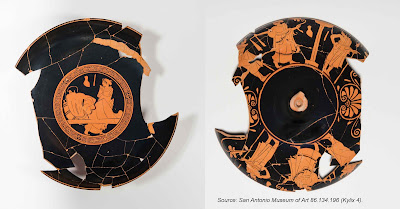
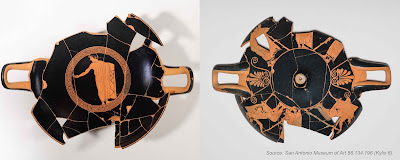
The San Antonio Museum of Art will be returning 192 fragments of Attic black-figured, red-figured and black-glossed cups to Italy. They are reported to have been found at Barbarano Romano to the south of Viterbo and were sold to Gilbert M. Denman, Jr. by Edoardo Almagià in 1985; Denman gave the fragments to the museum the following year (inv. 86.134.196). 

The Steinhardt legal papers cite two pieces of correspondence about pottery fragments from Barbarano Romano: the recipient is clearly in Texas. Almagià states the findspot and explained how the fragments were removed to Switzerland, and then moved to New York where they were cleaned and grouped with the help of a vasologist. Further fragments from the site were then noted, though they remained in Italy. 

It is unclear if the San Antonio fragments and the Texas letters are linked. But this does raise issues about other pot fragments that were handled by Almagià and those associated with him. 

| |
Bookmark and Share so Your Real Friends Know that You Know

Thursday, 30 December 2021

Steinhardt objects returning to Italy

Togate figure from Perugia
Source: Chasing Aphrodite


It has been announced that 51 antiquities will be returning from the Steinhardt collection to Italy. I estimate that they were purchased for $7.5 million. The objects include Etruscan bronzes, a fresco fragment from Herculaneum, and a mosaic removed from a Roman villa on Sicily. It is striking that so many of the items were identified from the seized photographic and documentary archives of Medici, Becchina, Symes, Hecht, and Almagià.

It is clear that only a fraction of the material in these archives has been returned to the countries where they were found. Museums, private collectors, and galleries need to start studying their lists of donors and former owners.

| |
Bookmark and Share so Your Real Friends Know that You Know

Wednesday, 29 December 2021

Crustumerium and returns to Italy


It appears that some of the objects that have been returned to Italy from Fordham University may have been removed from the cemeteries around Crustumerium in Latium. The city lies 15 km to the east of Veii in Etruria. Richard de Puma has discussed the production of White on Red pottery from Crustumerium, based on the research of Marina Micozzi. He draws specific parallels ("close similarities to some of the pieces excavated at Crustumerium", p. 99) with several pieces once in the Fordham University collection: for example, two lidded pyxides (inv. 70.038; cat. no. 43; 7.040; cat. no. 44). He then turns to the olla with four attached bowls: there are two examples that were once in Fordham, one decorated in the white on red style (inv. 2007.1.3–4 [2.002–003]; cat. nos. 45–46). De Puma notes that "details of fabric, style, and technique ... suggest that the place of manufacture may have been Crustumerium" (under no. 46). All four are reported to have been purchased from Harmer Rooke Numismatics or Harmer Rooke Numismatists. In addition, de Puma notes that the two pieces with the four attached bowls were reported by the vendor to have been found together "at the border of Etruscan, Faliscan and Latin territories"; this locality suggests Crustumerium.

The pyxides and one olla are placed in "northern Latium" by de Puma who wrote the catalogue entries for Fordham. 

The Fordham return is reported to be linked to material associated with Edoardo Almagià [Manhattan DA press release]

| |
Bookmark and Share so Your Real Friends Know that You Know

Tuesday, 28 December 2021

Further returns from the Getty

White on Red Lidded Pithos
Formerly Malibu inv. 96.AE.135.
The Manhattan DA Office mentioned the return of seven items from the J. Paul Getty Museum; they were seized on April 2, 2021, and the press release specifically states that they "were trafficked by ALMAGIÀ". [press release

Only one piece is listed in the Manhattan DA press release: "A Pithos with Ulysses, dating to 7th Century B.C.E. and valued at $200,000".

This is the lidded White on Red pithos decorated with the blinding of Polyphemos.  It was given to the Getty by Barbara and Lawrence Fleischman (inv. 96.AE.135; cat. no. 86). The pithos no longer appears on the online Getty catalogue. 

I am grateful to the Getty for providing details of the other pieces:

a. A White on Red Lidded Pithos. Gift of Barbara and Lawrence Fleischman. Inv. 96.AE.136; cat. no. 87.
b. A pair of Caeretan sub-geometric plate attributed to the circle of the Crane painter. Gift of Barbara and Lawrence Fleischman. Inv. 96.AE.137.1-2; cat. no. 88–89, A–B. 
c. A pair of Caeretan sub-geometric plates attributed to the Heron class. Gift of Barbara and Lawrence Fleischman. Inv. 96.AE.138.1-2; cat. no. 88–89, C–D. 
d. An Attic red-figured stemless cup, attributed to the Marlay painter. 'New York art market'. Inv. 86.AE.479; BAPD 41037.

The stemless cup had already been identified by Chasing Aphrodite.


Bookmark and Share so Your Real Friends Know that You Know

Monday, 27 December 2021

Etruscan White on Red Ware Returning to Italy


Bookmark and Share so Your Real Friends Know that You Know

Friday, 24 December 2021

San Antonio Museum of Art and returning antiquities

Olpe formerly in the San Antonio Museum of Art

Back in 2012 Chasing Aphrodite identified material in the San Antonio Museum of Art that was linked to Edoardo Almagià. 

It is now clear that a number of items were deaccessioned in February 2021 and have now formed part of a major return of objects to Italy. The museum has an oblique reference in the Manhattan DA Press Release

The two pieces that were identified by Chasing Aphrodite are indeed here.

a. An Attic red-figured olpe showing Dionysos and a satyr, attributed to the Florence painter by J.R. Guy (inv. 86.30; cat. no. 60; BAPD 19167). Gift of Gilbert M. Denman, Jr. The deaccessioning statement:  "sold by Edoardo Almagià, New York, to the San Antonio Museum of Art, 1986". 

b. An Attic red-figured plate showing the head of a man (inv. 87.1; cat. no. 87.1; BAPD 19168). Museum Purchase: Grace Fortner Rider Fund. The deaccessioning statement: "found at Barbarano Romano, Italy, according to Edoardo Almagià; with Edoardo Almagià, New York, by 1986; sold by Edoardo Almagià to the San Antonio Museum of Art, 1987". Ian McPhee and A.D. Trendall had earlier suggested that it had been found in Cerveteri (1990). Barbarano Romano is to the south of Viterbo.

The third part of the return consists of 192 fragments of cups, also reported to have been found at Barbarano Romano, and stated to have been sold to Gilbert M. Denman, Jr. by Almagià in 1985.

c. An Attic black-figured Little Master cup (inv. 86.134.196a; cat. no. 178; BAPD 20266). Gift of Gilbert M. Denman, Jr.
d-j. Seven fragmentary Attic red-figured cups (inv. 86.134.196).
k. Other assorted fragments of cups, some red-figured some black-glossed (inv. 86.134.196).


Bookmark and Share so Your Real Friends Know that You Know

Saturday, 18 December 2021

The Fordham Antiquities and the New York Galleries

The announcement that "Ninety-six pieces with an estimated value of $1.8 million [were] seized from the Fordham Museum of Greek, Etruscan, and Roman Art on May 28, 2021" raises new questions (Press Release, Manhattan DA: "Manhattan D.A.’s Office Returns 200 Antiquities to Italy", December 15, 2021). The statement reports, "All but two of the pieces seized from Fordham were trafficked by [Edoardo] ALMAGIÀ." One of these two pieces is probably the Apulian patera attributed to the Baltimore painter that surfaced through Sotheby's in London in December 1983.

It is clear that some of the Fordham objects have a public and published record that they had surfaced on the New York market through Almagià. What is more surprising is that four New York galleries appear to be associated with the returning material: at least 85 of the seized objects are reported to have passed through these routes. (Around 80 objects come from just two of the galleries.)

Separate legal papers present the way that Almagià's material is said to have moved from Italy to north America. Does this mean the bulk of the Fordham material that had allegedly been "trafficked by ALMAGIÀ" had been passed to specific New York galleries? (This would imply that the donor of the material to Fordham had purchased the items from these four New York galleries rather than directly from Almagià.) 

These four galleries are not ones that have featured in the sorry tale that so far has been told about the selling and collecting of cultural property from Italy. This raises the possibility—and I would stress the possibility—that further revelations are likely given that, as the Manhattan DA press release reminds us, Almagià's "Green Book" contained "entries for almost 1,700 looted antiquities that ALMAGIÀ purchased from tombaroli in Italy and then sold in the United States." 

Bookmark and Share so Your Real Friends Know that You Know

Another Bürki object returns to Italy

Source: MMA A psykter column-krater attributed to the Troilos painter was deaccessioned by New York's Metropolitan Museum of Art in June...