Showing posts with label Bürki. Show all posts

Thursday, 19 November 2026

Krater fragments in Princeton

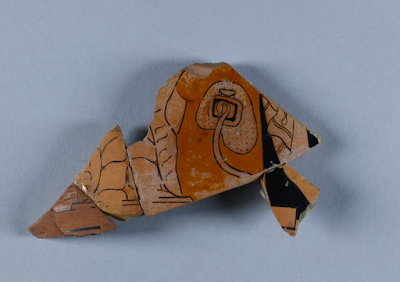
Greek, Attic, probably by the Kleophrades Painter, ca. 490–480 BCE, Two non-joining fragments from a calyx-krater (mixing bowl) depicting armor arranged on a burial tumulus. Red-figure ceramic; 9.2 x 4.6 x 0.8 cm (.1), 7.2 x 9.5 x 0.7 cm (.2). Gift in memory of Emily Townsend Vermeule, Honorary Degree Holder of the Class of 1989 (2002-164.1-.2)


The BMCR review of Princeton's CVA (2025)  [online] has drawn attention to the links between the fragments of a krater once in the Michael C. Carlos Museum at Emory University and fragments in Princeton. The CVA fails to note that the MCCM fragments, presented by Dietrich von Bothmer, were deaccessioned and seized by the Manhattan DA in December 2023 for return to Italy. The fragments, including the Vermeule fragments at Princeton, were discussed on LM back in 2023. The Vermeule fragments were known as early as 1972, whereas the Bothmer fragments (some acquired from 1972) came from a variety of sources including Bruce McNall, Harry Bürki, Nicholas Koutoulakis and Edoardo Almagià. The CVA notes:
Among them [the Bothmer pieces] are two sherds formerly on the New York art market that Padgett recognized in 1993 as being from the same vase as the Vermeule fragments ...
The CVA does not state the identity of the dealer though Bothmer did acquire fragments in 1993.

The reviewer made the wise comment, "one can only hope that they may be joined physically in the future". I presume that Princeton will be contacting the Italian authorities as a matter of urgency. 

| |
Bookmark and Share so Your Real Friends Know that You Know

Thursday, 16 July 2026

Another Bürki object returns to Italy

Source: MMA


A psykter column-krater attributed to the Troilos painter was deaccessioned by New York's Metropolitan Museum of Art in June 2026 (1986.11.12; BAPD 15922). The history of the piece was recorded by the MMA:
[By 1982, (perhaps late 1970s), with Sandro Cimicchi, Basel, Switzerland]; [until 1985, with Christoph Leon, Basel, Switzerland]; [1985-86, with Christie’s, London]; acquired in 1986, purchased from Christie’s, London (lot 141).
However, the Manhattan DA added that the krater was 'smuggled out of Italy by Fritz Bürki'. The Christie's sale was on July 16, 1986.

The references on the MMA website omit the publication in the volume of Essays in Honor of Dietrich von Bothmer (2002).

| |
Bookmark and Share so Your Real Friends Know that You Know

Wednesday, 15 July 2026

Two more Bothmer donations returned to Italy

Cup attributed to near Psiax. Source: MMA.


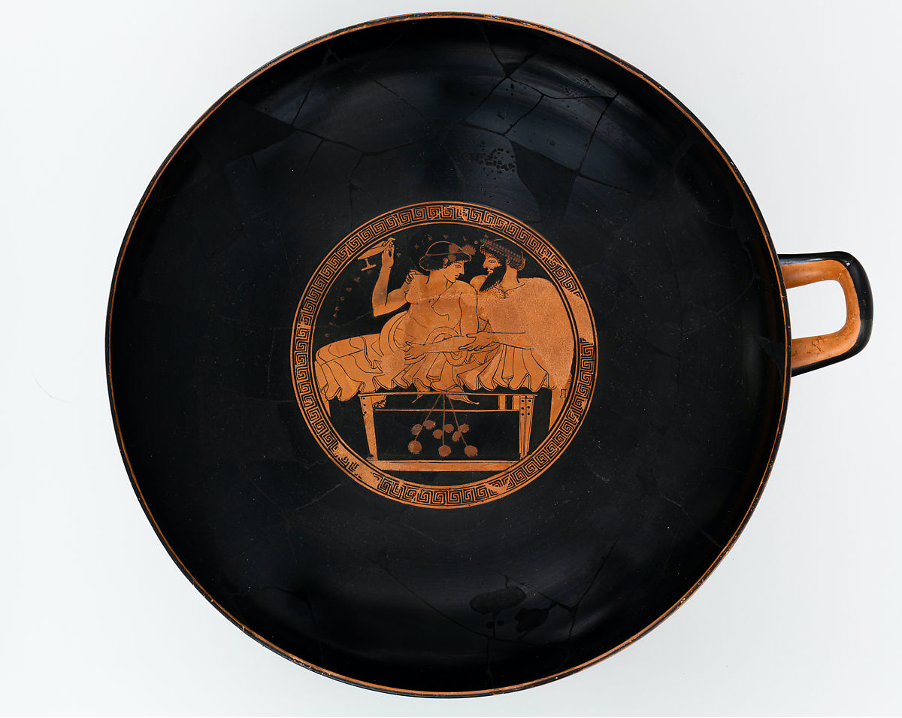
In February 2026 two fragmentary Attic cups that had been given to New York's Metropolitan Museum of Art by Dietrich von Bothmer were deaccessioned pending their return to Italy. Both were donated in 1984, and both had been acquired from Fritz Bürki. One was a bilingual cup attributed to near Psiax (1984.500.1; BAPD 44520) and the other cup was attributed to Epiktetos with a kalos inscription of Hip(p)archos (1984.500.2; BAPD 9055412).

We should note that the MMA has earlier returned a black-figured mastos attributed to Psiax (1975.11.6; BAPD 4525). Bürki was the source of other returns from the MMA including fragments from a Makron cup (1978.11.7a, d), and fragments of the Apulian dinos attributed to the Dinos painter (1984.11.7). He was also the source of some 11 per cent of the fragments in the sample selection of Bothmer fragment collection acquired by the MMA.


Bookmark and Share so Your Real Friends Know that You Know

Friday, 10 July 2026

The MMA returns 45 more antiquities to Italy

Source: MMA
The Manhattan DA has announced that 45 objects derived from New York's Metropolitan Museum have been returned to Italy. They include a marble fishplate and two marble dishes said to have been found together that had been handled by Robert Hecht (the fishplate) or Jonathan P. Rosen (the bowls) (inv. 1984.11.6; 1985.401.1–2). Another group of 40 Italic items had been donated by Mr & Mrs Jonathan P. Rosen (inv. 1991.171.2–41). Some of these pieces feature in the catalogue of the Etruscan collection. It should also be recalled that Rosen was the source for some of the pieces of amber that have already been returned to Italy.

Another piece was an Attic red-figured psykter column-krater attributed to the Troilos painter that is said to be have been removed from Italy by Fritz Bürki (inv. 1986.11.12; BAPD 15922).

Other classical items from the MMA are to be handed back to Greece and Türkiye including the terracottas from the Panionion.

| |
Bookmark and Share so Your Real Friends Know that You Know

Monday, 27 April 2026

Further returns to Italy from the MMA

Formerly New York MMA 1991.11.6.1–2.
Source: MMA
New York's Metropolitan Museum of Art has returned another batch of Greek and Roman antiquities as a result of investigations by the Manhattan DA into objects handled by Frieda Tchacos, Gianfranco Becchina, and Fritz Bürki [see Manhattan DA press release].

Only one piece is highlighted in the press release, a fragmentary Sicilian terracotta relief:
Two additional adjoining fragments of the votive relief were found in the archaeological excavations of the temple of Demeter Malophoros at Selinunte, Sicily, less than ten miles from Becchina’s hometown. Those fragments remain in the Palermo Museum.
This is linked to the Becchina investigation. The relief had formed part of the Norbert Schimmel collection. One other Schimmel piece is among the repatriated objects, a bronze handle attachment in the form of a mask. Other Schimmel items appeared in earlier returns.

The two Bürki linked pieces were objects presented by Dietrich von Bothmer, an Attic bilingual cup attributed to near Psiax, and a fragmentary cup attributed to Epiktetos.

The Tchacos pieces include a pair of spherical Greek gold earrings, a pair of Roman silver cups —one carries a weight inscription for the pair — and an inscribed lid of a Roman cinerarium (Sextus Flavius Pencarpus). There is also a forged Roman funerary inscription.

These latest returns have implications for other material. A batch of material from Selinunte is discussed in my Artwashing the Past (2025) [chapter 11]. The Tchacos investigation will lead to the numerous fragments acquired by other museums (as well as the nearly 300 fragments in the Bothmer collection: and these are just the ones identified in the sample).

I am grateful to Jason Felch for drawing my attention to one of the Schimmel pieces.

Bookmark and Share so Your Real Friends Know that You Know

Thursday, 7 December 2023

Gnathian Askos Returned from Virginia MFA

Gnathian Askos formerly in Virginia MFA 80.72

One of the announced returns from the VMFA is a Gnathian askos attributed to the Rose painter (inv. 80.72). This was identified from a photograph in the Medici Dossier by Christos Tsirogiannis ten years ago:
Tsirogiannis, C. 2013. "Nekyia. From Apulia to Virginia: An Apulian Gnathia askos at the Virginia Museum of Fine Arts." Journal of Art Crime 10: 81-86.
The museum purchased the askos from Fritz Bürki. One wonders what other pieces in the collection were derived from this source.

| |
Bookmark and Share so Your Real Friends Know that You Know

Thursday, 2 November 2023

LHIII Glass Necklace(s) at the Michael C. Carlos Museum

Source: Michael C. Carlos Museum


In 2004 the Michael C. Carlos Museum purchased a series of LHIII glass necklace fragments from Harry Bürki (inv. 2004.037.001, 002, 003, 004, 005, 006, 007, 008, 009, 010, 011, 012, 013, 019, 023). There were also some LHIII glass bead fragments (inv. 2004.037.014, 016, 017, 018, 020, 021, 022, 024, 025, 026, 027, 029, 030, 031, 032).

There is no mention of previous publication ('to our knowledge, this object has never been published') or previous owners. How did Bürki acquire them? Where were these fragments between 1970 and 2004? What was the museum's justification for acquiring them? What was the rigorous due diligence process?

Also in 2004, Phoenix Ancient Art gave the Carlos Museum a series of LHIII glass necklace fragments: rosette (inv. 2004.017.001, 002, 003, 004), double rosette (inv. 2004.017.009, 010, 011, 012), octopus (inv. 2004.017.005, 006, 007, 008). There was also a gold 'necklace element in the form of a papyrus spray' (inv. 2004.017.020).

There is no mention of previous publication or previous owners. How did Phoenix Ancient Art acquire them? Where were these fragments between 1970 and 2004? What was the museum's justification for acquiring them? What was the rigorous due diligence process?

Will the Carlos Museum be providing the background information to these acquisitions given the sensitivity over the so-called Aidonia Treasure? Is there a reason that some of these pieces do not appear to feature on the AAMD Object Register, or that for others there are pictures on the Object Register but not on the museum's website? 

| |
Bookmark and Share so Your Real Friends Know that You Know

Thursday, 21 September 2023

Bothmer, Almagià and the Michael C. Carlos Museum

Red-figured calyx-krater fragment
attributed to the Kleophrades painter.
Michael C. Carlos Museum inv. 2006.051.011B

I have noted that Dietrich von Bothmer acquired a fragment of a cup from Edoardo Almagià and then gave it to the J. Paul Getty Museum: the rest of the fragments were supplied by Galerie Nefer (D.W.J. Gill 2022. "Context Matters: Fragmented Athenian Cups." Journal of Art Crime 27: 77–84. ). 

A fragmentary calyx-krater attributed to the Kleophrades painter was presented to the Michael C. Carlos Museum by Bothmer in 2006. It is interpreted as showing the funeral mound of Hektor. Bothmer acquired the first fragment in July 1972, followed by further fragments in September 1978: the sources for these are unknown. However in 1978 another fragment was acquired from Bruce McNall of the Summa Galleries; this was followed by further fragments from Nikolas Koutoulakis in 1981, Edoardo Almagià in 1993, and Harry Bürki in 1994. 

This network of names would suggest that the origins of this krater deserve further investigation. Tsirogiannis and I will be exploring a parallel network, also including Bothmer, in a forthcoming article.

Incidentally, a fragmentary calyx-krater showing the funerary mound of Achilles (?), and compared by Bothmer to the Kleophrades painter, had resided in the private collection of Cornelius C. Vermeule (BAPD 3197). Both kraters seem to have surfaced around the same time.

| |
Bookmark and Share so Your Real Friends Know that You Know

Friday, 14 July 2023

Italy Seeks Return of Antiquities from the Louvre

Amphora attributed to the Berlin painter.
Source: The Louvre

The Italian authorities are seeking the return of seven antiquities from the Louvre (Roxana Azimi, "Italy calls on the Louvre to return seven of its archaeological objects", Le Monde July 13, 2023). The report draws attention to the Attic red-figured amphora that once formed part of the Hunt Collection (Wealth of the Ancient World no. 10). A further fragment from the amphora was supplied by Dietrich von Bothmer, and Robert Guy identified another piece that was presented to the Louvre in 1995 in honour of François Villard (Berlin Painter cat. no. 13; no. BN5; BAPD 8798). It should be noted that pots (and fragments) attributed to the Berlin painter have featured frequently in the returns to Italy. The identification of the Berlin painter amphora was made by Christos Tsirogiannis in 2006.

What are the other pieces likely to be? We know that the items were acquired between 1982 and 1998.

Possible candidates include:
a. Sicilian bell-krater attributed to the Lentini-Manfria group (CA 7249). Acq. Fritz Bürki (1986).
b. Capuan bell-krater attributed to the Ixion painter (CA 7124). Purchase (1985).
c. Attic black-figured psykter-krater attributed to the manner of the Antimenes painter (MNE 938) (BAPD 26150). Purchase (1988).

The Attic and the Capuan kraters (b–c) have been identified from the Becchina archive. The identifications were  made by Daniela Rizzo and Maurizio Pellegrini.
  • Rizzo, D., and M. Pellegrini. 2021. "The Italian Archaeological Heritage Abroad: Between Agreements, Debates and Indifference." In Stolen Heritage: Multidisciplinary Perspectives on Illicit Trafficking of Cultural Heritage in the EU and the MENA Region, edited by A. Traviglia, L. Milano, C. Tonghini, and R. Giovanelli, Antichistica, vol. 29: 99–114. Venezia: Edizioni Ca’ Foscari.

| |
Bookmark and Share so Your Real Friends Know that You Know

Thursday, 20 April 2023

Fragments from a cup attributed to Makron

Cup seized from
New York's Metropolitan Museum of Art

The New York Times has run a discussion of one of the Attic red-figured cups seized from New York's Metropolitan Museum of Art in 2022 (Graham Bowley and Tom Mashberg, "The Kylix Marvel: Why Experts Distrust the Story of an Ancient Cup’s Rebirth", April 19, 2023). The article looks at the way that this cup (and a companion piece also in the same museum) was put together from a series of fragments starting with pieces acquired from Fritz Bürki and the Summa Galleries, followed by pieces derived from Frieda Tchacos and Dietrich von Bothmer. 

The article includes identifications made by Christos Tsirogiannis from the Medici Dossier.

| |
Bookmark and Share so Your Real Friends Know that You Know

Wednesday, 22 March 2023

Further returns to Greece

Source: Manhattan DA

The Manhattan DA has announced the return of 29 antiquities, worth over $20 million, to Greece ("D.A. Bragg Returns 29 Antiquities to Greece", March 21, 2023 press release; see also here).

The items include a gold coin celebrating the assassination of Julius Caesar that surfaced on the Munich market in 2016.

The press release mentions the seizure of a bronze krater:
The Bronze Calyx Krater, which dates to 350 B.C.E., once held the bones of a deceased individual in a chamber tomb. It was looted and smuggled into Switzerland, where it was cleaned and restored by Fritz and Harry Bürki, the Zurich-based restorers and business partners of Robert Hecht. Hecht then arranged to smuggle the piece into New York, where it was sold to Leon Levy and Shelby White. It was seized by the Office in January of this year.
This seems to be a companion to the krater apparently looted from Pieria that was returned to Greece in 2008.

Unmentioned in the release, but placed next to the krater, was a bronze hydria that appears to be the one from the Shelby White collection (Bronzes no. 8). It is decorated beneath the vertical handle with a relief of Orpheus and a satyr. Chi and Gaunt draw attention to a companion piece in the Michael C. Carlos Museum (inv. 2002.012.001) that was acquired from Robert Hecht.

The release also mentions the return of a Late Neolithic marble group:
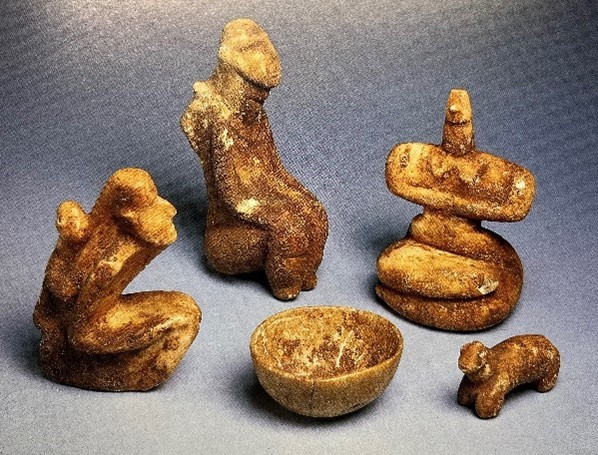
The Neolithic Family Group, which dates to 5000-3500 B.C.E and valued at $3 million. This group of objects compromises five human and animal figures carved from marble, and was looted from the island of Euboea by a Greek trafficker who smuggled the pieces into Switzerland. In 1982 dealer-trafficker Nicolas Koutoulakis sold the group to New York-based collectors Leon Levy and Shelby White. White loaned the group to the Metropolitan Museum of Art in 2000, where they remained on display until March of this year, when it was seized by the Office.
The group had been owned by Charles Gillet and Marion Schuster. They are "said to be from Euboea, or the east coast of Attica opposite, near Porto Raphti, perhaps from an islet attached to the mainland in prehistoric times" (Glories no. 8). It is interesting that the release emphasises the findspot on Euboea rather than Porto Raphti or more generally Attica preferred by Getz-Preziosi and Thimme. There are aspects of the group that make me wonder if they are ancient, a concern raised by Thimme back in 1977.

Next to the Late Neolithic group, but unmentioned in the release, was a double Cycladic figure: a small female figure standing on the head of a larger one. This appears to be the figure in the Shelby White collection (NAC no. 18; Glories no. 9; Katonah no. 15). Next to them was an Early Cycladic II bowl that also appears to be from the Shelby White collection (Glories no. 15).

Among the other items that appear to have been other items that formed part of the Shelby White collection:
  • Glories no. 76: A Late Geometric pair of horses 'said to have been found on Corfu, and for at least twenty years was in a collection in Austria. In October 1970, the group was lent to the Kunsthistorisches Museum in Vienna for restoration.'
  • Glories no. 80: an armlet, two lidded pyxides, and an oinochoe from a hoard of at least 40 pieces found in northern Greece.
  • Glories no. 141: a gold treasure consisting of a pair of coiled snake armbands, a pair of earrings with swans, a gold and carnelian necklace, a gold ring with carnelian intaglio, part of a gold wreath, and a gold diadem. 
The press release mentions that the Royal-Athena Galleries have co-operated with the investigation suggesting that some of the other items were from that source (perhaps including a fragment of wall-painting).

I note that Christos Tsirogiannis was involved with some of the identifications. 

We await for a full list of the return.

| |
Bookmark and Share so Your Real Friends Know that You Know

Monday, 19 September 2022

Robert Hecht and the Princeton painter

Neck-amphora fragments attributed to the Princeton painter
Formerly New York MMA inv. 1991.11.2.

In 1991 the Metropolitan Museum received a gift of a fragmentary black-figured neck-amphora showing Herakles, Athena and Hermes, from Dietrich von Bothmer (inv. 1991.11.2). It was attributed to the Princeton painter by von Bothmer (according to Mary B. Moore); BAPD suggests that the person who attributed the fragments was 'unknown'. Moore observes that the amphora was 'broken and mended with significant parts missing'. The restorer of the amphora is not indicated. The amphora was among a batch of antiquities seized from the museum in 2022 and returned to Italy.

Although the Beazley Archive suggests that the amphora had formed part of the Bothmer collection (BAPD 9023766), the MMA  online catalogue entry suggests that it was in fact purchased from Atlantis Antiquities in 1991. This implies that Bothmer had supplied the funds to purchase the fragments from the gallery that was part owned by Robert Hecht. 

Atlantis Antiquities has already been associated with a number of returns from North American collections that include:
  • An Attic black-figured lekythos attributed to the Diosphos painter from Boston, Museum of Fine Arts
  • An Attic black-figured amphora attributed to the painter of Berlin 1686 from The J. Paul Getty Museum
  • An Attic black-figured amphora attributed to the Antimenes painter from the Steinhardt collection
  • An Apulian amphora attributed to the Darius painter from Boston, Museum of Fine Arts
  • An Apulian loutrophoros attributed to the Metope group from The J. Paul Getty Museum
In some of these cases the restorations had been undertaken by Fritz Bürki. 

It is known that Hecht was the source for some of the pot fragments in Bothmer's collection. 

| |
Bookmark and Share so Your Real Friends Know that You Know

Wednesday, 14 September 2022

The Steinhardt Fresco from Herculaneum

Source: Manhattan DA


Among the antiquities seized from the collection of Michael Steinhardt was a fragment of Roman fresco showing the infant Hercules killing a snake (Exhibit 87). The Manhattan DA Statement suggested that the fresco had been looted in 1995 from a villa destroyed in the eruption of Vesuvius somewhere in the vicinity of Oliva dei Monaci. A letter sent to the Italian authorities, along with photographs of the finds, identified Pasquale Camera who had sold on the pieces to Raffaele Monticelli for $120,000. Monticelli then sold the fresco to to Robert Hecht for $240,000.

Steinhardt was reported to have been in correspondence with Jasper Gaunt on November 10, 1995 relating to the delivery of a "crate": Steinhardt received an invoice for the fresco from Harry Bürki on November 22, 1995 ($650,000). Bürki later (February 17, 1999) claimed that the fresco had been in his family's collection for some 25 years and that it had been acquired from a "Bulgarian medical doctor".

The interplay between Bürki and Hecht should be noted, as well as the creation of a false collecting history.

| |
Bookmark and Share so Your Real Friends Know that You Know

Tuesday, 13 September 2022

The Steinhardt Oinochoe Attributed to the Berlin painter

Oinochoe attributed to the Berlin painter
Source: Manhattan DA

The recent exhibition of Athenian pots attributed to the Berlin painter listed among the new attributions a single oinochoe from the Judy and Michael Steinhardt collection (BN44). It shows a youth feeding a Maltese dog.

The attribution had been made by J. Robert Guy though the date when this was made is not noted.

A polaroid of the oinochoe is reported to be in the Medici Dossier. The Manhattan DA's statement relating to the seizure of antiquities from the Steinhardt collection noted:
The Berlin Painter Oinochoe first surfaced on the international art market in 1996, when Steinhardt purportedly purchased the Berlin Painter Oinochoe from Harry Bürki with no prior provenance for $215,000. 
The statement notes that while the invoice stated that Bürki was the vendor, "Steinhardt’s records reflect that the real seller of the object was the American-born trafficker Robert Hecht."

This is one of several pots attributed to the Berlin painter that have been returned to Italy. And it should be a matter of concern to academics writing on Athenian pottery that such a high percentage of pots attributed to this painter have no secure archaeological contexts. 

It should be noted that the identification was made by Associate Professor Christos Tsirogiannis.

See D.W.J. Gill, 'Fragmented Athenian Pots and the Berlin Painter: Recent Breaks?' Academia Letters (2020): 1–5 [DOI].  

| |
Bookmark and Share so Your Real Friends Know that You Know

Monday, 21 March 2022

Roman Fresco Fragment: The Woman on a Balcony

Fresco Fragment: Woman on a Balcony,
10 B.C.–A.D. 14, Fresco

60 × 45.2 × 3 cm (23 5/8 × 17 13/16 × 1 3/16 in.),
96.AG.172

The J. Paul Getty Museum,
Villa Collection, Malibu, California,
Gift of Barbara and Lawrence Fleischman

The research of Christos Tsirogiannis has been highlighted in The Observer (Dalya Alberge, "Fresco fragment from Pompeii reopens row over 'looted' antiquities", March 20, 2021). The Roman fresco fragment had formed part of the Barbara and Lawrence Fleischman collection. The fragment had been acquired from Fritz Bürki in 1987, but it had also featured in the photographic archive of Robert Hecht. 

There are some 60 items in the Fleischman collection that were acquired from Bürki; only four are formerly listed as derived from Hecht. 

| |
Bookmark and Share so Your Real Friends Know that You Know

Thursday, 30 December 2021

Steinhardt material to return to Turkey


A total of 14 antiquities are due to be returned to Turkey from the Michael Steinhardt collection.

These include:
  • Antelope standard and three bird rattles [pp. 58–59] apparently found in eastern Turkey. Purchased by Steinhardt from Robin Symes on April 24, 1991 for $84,000.
  • A female figure with seven gold dress ornaments "found together" [p. 65]. Purchased from Robert Hecht on October 31, 2005 for $499,294.
  • An Anatolian terracotta female figure [pp. 73–74]. Surfaced at Sotheby's (London) in 1975; purchased by the British Rail Pension Fund; purchased by Robert Haber on February 1, 1990; purchased by Steinhardt on August 19, 1990 for $79,610.
  • A small limestone female figure of Kilia type [pp. 83–84]. Purchased from Harry Bürki on April 30, 2002 for $47,500.
  • A silver stag's head rhyton [pp. 68–69]. Reported to be from Milas, Turkey. Purchased by Steinhardt from the Merrin Gallery on November 22, 1991 for $2,600,000; placed on loan to New York's Metropolitan Museum of Art on March 11, 1993.
| |
Bookmark and Share so Your Real Friends Know that You Know

Wednesday, 29 December 2021

Steinhardt objects returning to Greece

Minoan larnax formerly in the Steinhardt collection
Source: Manhattan DA

The Hellenic Ministry of Culture and Sports has announced that 47 objects "surrendered" by Michael Steinhardt will be returning to Greece ("Trove of stolen antiquities coming home from US", ekathimerini.com December 29, 2021).

Highlighted items are:
Items that stand out include a Minoan larnax dated to to 1400-1200 BC and valued at US$1million, a $14 million torso of a Kouros statue dated to 560 BC, as well as a bronze griffin protome, Cycladic vessels, figurines and bronze swords.

The paperwork indicates these include:
  • a marble Cycladic spouted bowl [p. 28] acquired from Medici. First surfaced in 1980 allegedly in the collection of Marie LaForet. Sold by Robin Symes to the Beierwaltes in 1997; assigned to Phoenix Ancient Art in 2006; purchased by Steinhardt on November 9, 2006 for $500,000.
  • a 9th century BCE Geometric oinochoe [p. 34]. Smuggled by Georgios Zenebisis to Switzerland and sold to Becchina; sold by Hecht to Steinhardt on November 17, 2000 for $23,485.
  • Attic white ground lekythos attributed to the Triglyph painter [p. 56]. Identified from the Symes archive. Symes sold it to the Beierwalters for $360,000 (June 22, 1995); consigned to Phoenix Ancient Art (2006); Steinhardt purchased from Phoenix Ancient Art for $380,000 (December 14, 2006).
  • a Minoan larnax [pp. 77–78]. Stylistically placed at Rethymnon. Restored from fragments by Flavio Bertolin in Munich; Ralf Kotalla conducted a TL test in April 2016. Purchased by Steinhardt for $575,000 from FAM Services; 
  • Five objects from Naxos [pp. 78–81] acquired from Eugene Alexander between 2010 and 2014. 
    • They consist of a marble female folded arm figure (ECII), purchased December 15, 2010 for $100,000; 
    • two marble plates, acquired November 6, 2012 for $15,000, and April 9, 2014, for $10,000; 
    • a marble kandila, acquired November 6, 2012 for $75,000; 
    • and a marble cup, acquired February 20, 2013 for $20,000.  
  • Bronze griffin protome [p. 81] acquired from Eugene Alexander on November 6, 2012 for $350,000. Reported to be from the Samian Heraion.
  • Marble kouros [pp. 61–62] acquired from Robert Hecht, November 17, 2000 for $2,348,000. Restored by Fritz Bürki in Zurich.
  • Gold broach from Rhodes [pp. 63–64] acquired from Robert Hecht; purchased from Harry Bürki on September 29, 1999 for $728,000. Said to have been found with an alabastron carrying the cartouche of Nekko II.
  • Minoan hoard of 33 items containing spears, metal objects and stone vessels. [pp.64–65] acquired from Robert Hecht; purchased from Harry Bürki on September 29, 1999 for $92,000.
  • a glass oinochoe [p. 112], probably from Rhodes. Consigned by George Ortiz to Robert Haber April 2, 2002; Steinhardt acquired it on February 22, 2008 for $433,500; loaned to New York's Metropolitan Museum of Art on August 11, 2015.
  • bronze female figure from Crete [pp. 113–14] acquired from Noriyoshi Horiuchi. Acquired from Phoenix Ancient Art by Horiuchi on May 15, 1991; December 8, 1994 placed on loan to New York's Metropolitan Museum of Art; December 11, 2009, purchased by Steinhardt for $650,000.

These 47 objects were purchased for $6.2 million, though their current value is considerably more (clearly in excess of $15 million).

| |
Bookmark and Share so Your Real Friends Know that You Know

Wednesday, 8 December 2021

Returning Athenian pottery from the Steinhardt collection

Source: Manhattan District Attorney's Office

The documentation for the Michael Steinhardt  collection identifies several Attic pieces that will be returned to their country of origin, presumably Italy and Greece.
  • Attic black-figured Sphinx cup, 'Tleson, son of Nearchos' (pp. 19–20). Identified from the Medici dossier. Symes sold to Beierwaltes (January 8, 1996); Phoenix Ancient Art (2006); Steinhardt purchased from Phoenix Ancient Art for $310,000 (2007).
  • Attic red-figured oinochoe attributed to the Berlin painter (pp. 20–21). Identified from the Medici dossier. Steinhardt purchased from Harry Bürki for $215,000 (1996); Steinhardt's records show that the oinochoe had been sold by Robert Hecht.
  • Attic black-figured hydria showing Herakles and Kyknos attributed to the Leagros group (p. 21).  Identified from the Medici dossier. Displayed by Christos Bastis at New York's Metropolitan Museum of Art (1987); Bastis died (1999); Steinhardt purchased from Michael Ward for $127,000 (2000). The paperwork omits that the hydria surfaced at Sotheby's (London) July 11–12, 1983, lot 352, and was sold at Sotheby-Parke-Bernet, New York, December 9, 1999, lot 92. [BAPD 9050]
  • Attic black-figured hydria showing women at a fountain-house attributed to the Antimenes painter (pp. 22–23). Identified from the Medici dossier. Robin Symes advertised the hydria (1983); Atlantis Gallery, New York (1987); loan to the J. Paul Getty Museum L87.AE.4 (1987–96); Steinhardt purchased it at Sotheby's for $169,411 (December 17, 1996, lot 49). [BAPD 31596]
  • African head vase (pp. 23–24).  Identified from the Medici dossier.  Displayed in the Musée d'Art et d'Histoire, Geneva (1978–81); J. Paul Getty Museum (1984–96); Symes sold the piece to the Beierwaltes (1996); Beierwaltes consigned it to Phoenix Ancient Art (2006); Steinhardt purchased it from Phoenix Ancient Art for $163,312.50 (2009). 
  • Attic black-figured eye-cup (pp. 35–36). Identified from the Becchina archive. Mario Bruno, Lugano; sold to Becchina; TL tested by Ralf Kotalla, Germany(July 1992); Robert Hecht sold it to Steinhardt for $170,750 (June 15, 2000).
  • Attic black-figured amphora (p. 50). Identified from the Almagià archive. Purchased from a tombarolo for $6,500; sold for $13,000; accessioned by Steinhardt as coming from Almagià (1997). 
  • Attic black-figured plemochoe (pp. 54–55). Identified from the Symes archive. Photographed by Dieter Widmer (1985); held as loan by Sotheby's London for Budico SA, owned by Henri-Albert Jacques (1989); stolen from Sotheby's and recovered by the police; Budico SA sold it through Sotheby's to Steinhardt for $84,083 (December 11, 2002). Note: 'Ex. Private Coll. London, RS + CM' (?Symes and Michaelides).
  • Attic white ground lekythos attributed to the Triglyph painter (p. 56). Identified from the Symes archive. Symes sold it to the Beierwalters for $360,000 (June 22, 1995); consigned to Phoenix Ancient Art (2006); Steinhardt purchased from Phoenix Ancient Art for $380,000 (December 14, 2006).
| |
Bookmark and Share so Your Real Friends Know that You Know

Monday, 6 December 2021

Sources for the returned Michael Steinhardt antiquities


The legal paperwork lists those who handled the 180 antiquities that have been handed over by Michael Steinhardt. Robert Hecht is top of the list with 45 objects. Other names will be familiar to those who study the return of cultural property. 

Bookmark and Share so Your Real Friends Know that You Know

Michael Steinhardt and the return of antiquities valued at $70 million

Michael Steinhardt has agreed to hand over antiquities valued at $70 million (Karen Matthews, "Fund manager to turn over $70 million in stolen antiquities", ekathimerini.com December 6, 2021). Some 180 antiquities are due to be handed over (Dan Morgan, "Hedge-Fund Pioneer Michael Steinhardt Surrenders 180 Stolen Antiquities Valued at $70 Million, Manhattan DA Vance Says", nbcphiladelphia.com December 6, 2021). The antiquities are said to have been derived from 11 different countries, and passed through some 12 networks. Steinhardt has also agreed not to acquire any antiquities in the future; he will not be facing any criminal charges. 

Among the objects to be handed over is a Cretan larnax, a silver rhyton in the shape of a stag's head acquired from the Merrin Gallery, a fragmentary fresco acquired from Robert Hecht and Fritz Bürki.

Press Release from the New York District Attorney's Office: D.A. Vance: Michael Steinhardt Surrenders 180 Stolen Antiquities Valued at $70 Million, December 6, 2021.

Bookmark and Share so Your Real Friends Know that You Know

Krater fragments in Princeton

Greek, Attic, probably by the Kleophrades Painter, ca. 490–480 BCE, Two non-joining fragments from a calyx-krater (mixing bowl) depicting ar...