Showing posts with label Christie's. Show all posts

Thursday, 16 July 2026

Another Bürki object returns to Italy

Source: MMA


A psykter column-krater attributed to the Troilos painter was deaccessioned by New York's Metropolitan Museum of Art in June 2026 (1986.11.12; BAPD 15922). The history of the piece was recorded by the MMA:
[By 1982, (perhaps late 1970s), with Sandro Cimicchi, Basel, Switzerland]; [until 1985, with Christoph Leon, Basel, Switzerland]; [1985-86, with Christie’s, London]; acquired in 1986, purchased from Christie’s, London (lot 141).
However, the Manhattan DA added that the krater was 'smuggled out of Italy by Fritz Bürki'. The Christie's sale was on July 16, 1986.

The references on the MMA website omit the publication in the volume of Essays in Honor of Dietrich von Bothmer (2002).

| |
Bookmark and Share so Your Real Friends Know that You Know

Monday, 15 December 2025

Further returns to Italy from the San Antonio Museum of Art

Source: San Antonio Museum of Art
In addition to the objects deaccessioned by the San Antonio Museum of Art in September 2025, the museum  had done the same for another group in January 2022. These were mentioned (without significant detail) in a press release from the Manhattan DA in 2023. These items included material that surfaced through various sources:

Christie's (Geneva)
Attic red-figured lekythos. Inv. 86.134.75. Surfaced through Christie’s (Geneva) May 1979; Sotheby’s (London) May 1982. 

Christie's (London)
Attic white ground lekythos. Inv. 86.134.170. Surfaced through Christie’s (London) July 1983; July 1985. 

Frederick Schultz
Attic red-figured head kantharos. Inv. 91.24. Surfaced through Frederick Schultz, 1989. 

Galerie Günter Puhze
Attic black-figured lekythos. Inv. 91.80.1. Galerie Günter Puhze, 1989. 

Palladion Antike Kunst
Attic black-figured amphora. Inv. 86.134.31. Surfaced through Palladion Antike Kunst; Sotheby’s (London) December 1981. 
Attic red-figured oinochoe. Inv. 86.134.58. Surfaced through Palladion Antike Kunst; Robert Hecht. 

Robin Symes
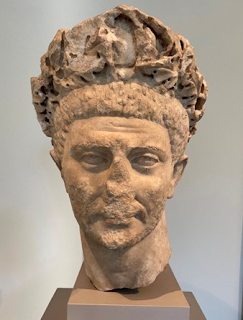
Portrait of Hadrian. Inv. 2005.1.81. Robin Symes; Royal-Athena Galleries; Sotheby’s (New York) June 1992. [Image identified in the Medici Dossier.]
"Dating to 200 C.E., the marble head of the Emperor Hadrian was first documented uncleaned and covered in marine encrustations in a polaroid photograph. The polaroid was recovered by Italian law-enforcement authorities during a raid of the office and warehouse of well-known antiquities trafficker Giacomo Medici in 1995. After being smuggled out of Italy by Medici and his co-conspirators, the piece was then laundered with false provenance by dealer-trafficker Robin Symes before being sold in New York County in 1992." (Manhattan DA)
Sotheby's (London)
Corinthian olpe. Inv. 93.17. Surfaced in Sotheby’s (London) July 1990; Charles Ede. 
Attic black-figured amphora. Inv. 86.134.173. Surfaced in Sotheby’s (London) July 1985. 
Attic red-figured lekythos. Inv. 86.134.79. Surfaced through Sotheby’s (London) May 1982. 

Alfredo Turchi
Head of Hermes. Inv. 86.134.145. Sold by Alfredo Turchi.

The head of Hermes was excavated in Rome in the 19th century. 

| |
Bookmark and Share so Your Real Friends Know that You Know

Friday, 12 December 2025

Head of Demosthenes returns to Türkiye

Head of Demosthenes
Source: New York MMA
Back in November I noted that New York's Metropolitan Museum of Art had returned a marble portrait of Demosthenes to Türkiye. The head was acquired in 2012 (inv. 2012.479.9). The stated collecting history (sometimes known as "provenance") is as follows:
Mussienko Family Collection, Maryland, 1973. Sold by Fortuna Fine Arts, New York, to Ariadne Gallery, New York, in 1987. Sold by the Ariadne Gallery to Morris Pinto, New York, before December, 1992. Consigned by Morris Pinto to Christie’s New York, December 15, 1992, lot 14, passed in. Consigned by Morris Pinto to the Acanthus Gallery, New York. Acquired by Renée E. and Robert A. Belfer from the Acanthus Gallery, New York, before 1998. Given by Renée E. and Robert A. Belfer to The Metropolitan Museum of Art in 2012.
The head was published in:
Zanker, P. 2016. Roman Portraits: Sculptures in Stone and Bronze in the Collection of The Metropolitan Museum of Art. New York: Metropolitan Museum of Art. Pp. 36-38, no. 9.
The portrait now features in a press release from the Manhattan DA:
This sculpture originated in Türkiye near the modern city of Izmir and first appeared on the art market in the possession of the New York-based Ariadne Galleries, before passing through the hands of several private collectors until it was donated to the Met in 2012. Ariadne Galleries allegedly falsely claimed that it had bought the Marble Head from Fortuna Fine Arts—claiming to have done so two years before Fortuna Fine Arts even existed. Ariadne and Fortuna, which is currently under indictment in federal court for fraud, also allegedly falsely claimed that the Marble Head had previously been in the collection of Boris Mussienko—a name Fortuna and other galleries allegedly frequently used to create false provenance. Law enforcement seized the Marble Head from the Met in 2025.
For clarification the head was seized in September 2025. For other material associated with "Mussienko" see here.

Again this is a reminder of the need to authenticate the collecting histories before making acquisitions.

| |
Bookmark and Share so Your Real Friends Know that You Know

Thursday, 23 March 2023

Return of antiquities to Türkiye

Source: Manhattan DA


Twelve antiquities have been handed over to Türkiye ("D.A. Bragg Returns 12 Antiquities to the Republic of Türkiye", March 22, 2023). Nine of the objects are derived from the Shelby White collection. The remaining three include a head from Perge:
The Perge Theater Head, dating back to 290 C.E., was looted from Perge, an archaeological site in Türkiye. The piece first surfaced on the international art market at Sotheby’s in 2000. It then resurfaced at Christie’s in 2012, when it was purchased by a private collected who loaned it to the Met. It remained at the museum until it was seized by the Office in January.
Formerly New York MMA L.2011.4
© David Gill
Another is a bronze statue apparently looted from Bubon:
A bronze statue of the Roman emperor Septimius Severus, dating back to 225 C.E. The statue was stolen in the late 1960s from Bubon, an archaeological site in Türkiye, by looters and was eventually smuggled into Switzerland by Robert Hecht. Coin dealer Charles Lipson eventually loaned the piece to the Museum of Fine Arts in Boston. It landed at the Metropolitan Museum of Art in 2011, which it remained on display until it was seized by the Office in February. With its partners in Türkiye, the ATU was able to find and interview one of the individuals who actually looted and smuggled this statue.
This statue will join the Lucius Verus returned to Türkiye from the White collection in 2022. This will have implications for other European and North American museums that currently possess bronzes from this particular site.

It is possible to recognise some of the items from pictures from the press conference. They include a marble 'stargazer' (Glories no. 4), a bronze waggon with oxen (Glories no. 19), and an East Greek trefoil oinochoe decorated with two grazing ibex (Glories  no. 100). A further White piece is:
The Sitting female figure from Çatalhöyük, which dates between 6000 and 5000 B.C.E. After it was smuggled out of Türkiye, it first appeared on the market in London at the Rabi Gallery, where it was purchased by Shelby White in 1985. It remained in his possession until it was seized by the Office in 2023.
This is the steatite sitting female figure (Glories no. 3).

Source: Türkiye, Consulate NY


| |
Bookmark and Share so Your Real Friends Know that You Know

Saturday, 4 February 2023

Further returns to Italy from San Antonio Museum of Art and Shelby White

Oinochoe fragment
attributed to the Harrow painter
returned from
the San Antonio Museum of Art.
Source: San Antonio Museum of Art

The Manhattan DA has reportedly returned 14 more antiquities to Italy: though the objects and images presented at the press announcement counted 16 ("D.A. Bragg Returns 14 Stolen Antiquities to Italy", Manhattan DA February 2, 2023). Two sources were acknowledged: Shelby White and the San Antonio Museum of Art. The third, the source of a silver coin, was left anonymous in the press release.

At least three of the objects appear in the Glories of the Past catalogue of the Shelby White and Leon Levy collection. The release gives further information about the Attic black-figured hydria attributed to the Priam painter.
The piece first surfaced in Italy after being looted by Giovanni Franco Becchina, a well-known antiquities trafficker. From Italy, the piece was then smuggled and laundered by Paris-based Robert Hecht. Hecht ultimately sold the piece with false provenance to Shelby White in New York County in 1989.
These add to the 14 pieces featured in the catalogue that have been returned to Greece, Italy and Turkey.

The nine pieces featured in the images at the press statement are derived from the San Antonio Museum of Art. The objects are derived from several sources: Sotheby's in London; Christie's in London and Geneva; Galerie Palladion Antike Kunst; Galerie Günter Puhze; Royal Athena Galleries; Robin Symes. For example, the oinochoe fragment attributed to the Harrow painter surfaced through Galerie Palladion Antike Kunst, and was sold to Gilbert M. Denman, Jr. by Robert Hecht.  The nine objects may be added to other pieces that were handed over in 2022. We are also expecting further details about three other objects derived from Frederick Schultz that have been handed over by the museum. 

Three other objects featuring in the press statement have yet to be linked in a formal way to a specific collection though Christos Tsirogiannis has identified two of them in the Becchina archive and one in the Schinousa archive. 

The final piece is a silver coin.
The Sicily Naxos Coin. Minted circa 430 B.C.E in the Greek colony of Naxos, on Sicily, this silver coin features the bearded Dionysus on one side and his squatting drinking partner, Silenus, on the reverse. The Sicily Naxos Coin first surfaced on the international art market in 2013, when a known trafficker offered the coin for sale with no provenance whatsoever. Prior to its appearance at a London-based auction house, a co-conspirator of the trafficker supplied false provenance for the coin. The Sicily Naxos Coin is currently valued at $500,000 and was among a group of coins seized at JFK airport as it was being smuggled into New York pursuant to an ongoing joint investigation between this Office, HSI, and Italy. At least one individual has been arrested in the course of this investigation with more to follow.
Three Shelby White pieces, nine objects from San Antonio, one silver coin, and three other pieces equal 16 objects (not 14).

Objects from the San Antonio Museum of Art and in the Shelby White and Leon Levy collection were the subject of an extended discussion by Chippindale and Gill in the American Journal of Archaeology back in 2000. 
Chippindale, C., and D. W. J. Gill. 2000. "Material consequences of contemporary classical collecting." AJA 104: 463-511. [DOI]
LM expects to add further detail to this summary in due course.

| |
Bookmark and Share so Your Real Friends Know that You Know

Tuesday, 20 December 2022

Funerary stele returned to Greece

Stele revealed at the Epigraphic Museum
Athens
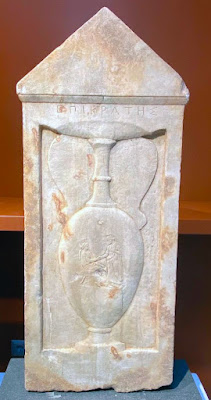
It is reported that today, December 20, 2022, that a funerary stele for one Epikrates has been returned to Greece. The stele is stated that it was due to have been offered through Christie's in London (December 2021) but was identified from three photographs in the Becchina archive and was withdrawn after intervention by the Art Squad of the Metropolitan Police. Incidentally, the stele was said to have been handled by Koutoulakis, a name that should have raised concerns. 

These three photographs were considered to be sufficient evidence for the return. (I am grateful to Christos Tsirogiannis for sharing the images with me.) Yet, when photographs of a Cycladic figure were identified with a piece residing in the Stern Collection there appears to have been a reluctance for the Greek authorities to seek the immediate return. Indeed there is currently an exhibition, 'Homecoming', at the Museum of Cycladic Art in Athens that contains 15 Cycladic pieces from the Stern Collection. I understand that questions relating to this inconsistency of policy were asked at the press conference today but were deflected by the Minister. 

| |
Bookmark and Share so Your Real Friends Know that You Know

Saturday, 23 July 2022

Myson krater returning to Italy

Back in 2014 I commented on an Attic column-krater attributed to Myson that had been identified by Christos Tsirogiannis from the Swingler collection of photographs (see here).  Tsirogiannis has subsequently published the krater and discussed its links with the Royal-Athena Galleries:
Source: Manhattan DA
Tsirogiannis, C. 2020. "The antiquities market we deserve: 'Royal-Athena Galleries' (1942-2020)." Acta ad archaeologiam et artium historiam pertinentia 32: 147–75. [Online]
Tsirogiannis has spotted that the same krater appears prominently in the Manhattan DA repatriation ceremony that took place this week. 

The krater itself surfaced in 1980 (Royal-Athena Galleries) and then had passed through the John Kluge collection (BAPD 9032028 [though without complete history]). The presence of its image in Swingler's photographic archive may suggest that it arrived in the US with consignments of pasta. Did Royal-Athena Galleries receive other consignments from this same source? 

Myson krater in Swingler archive
Image source: Christos Tsirogiannis
Is the krater one of the 60 pieces that are being returned from the stock of the now closed Royal-Athena Galleries? Or is it one of the 34 from other investigations? 

We look forward to the Manhattan DA listing the returned pieces.
| |
Bookmark and Share so Your Real Friends Know that You Know

Friday, 25 March 2022

A Roman Cavalry Helmet withdrawn from sale

Helmet from Hecht archive
Source: Christos Tsirogiannis

Christie's had been due to auction a Roman cavalry parade helmet on April 12, 2022 (lot 90). It currently forms part of a 'distinguished private collection'. The helmet has a recorded history. It surfaced in the collection of Axel Guttmann in 1996, and was sold in The Art of Warfare: The Axel Guttmann Collection, Part 1, at Christie's, London, 6 November 2002 (lot 89) for £58,750. It then passed into a UK based private collection before being sold at Christie's, London, 2 May 2013 (lot 115) for £205,875.

The Guttmann collection is not without issues. 

The helmet has now been withdrawn from sale at Christie's. It appears to be the one that features in a series of photographs in the Hecht archive. The identification was made by Christos Tsirogiannis. 

| |
Bookmark and Share so Your Real Friends Know that You Know

The Becchina Nolan amphora: update

Photograph from the Becchina archive
Source: Christos Tsirogiannis

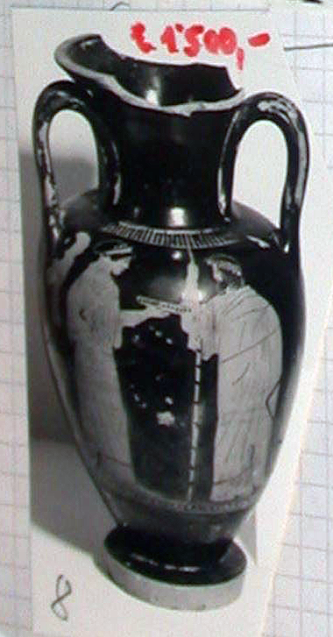
Further details on the history of the Nolan amphora that appears in the Becchina archive have come to light. Professor Peter Stewart has kindly checked the details in the Beazley archive. The amphora was photographed by Sir John Boardman at Sotheby's in London in July 1983. It was then offered at Sotheby's London on 12 July 1983 (lot 531). Christos Tsirogiannis points out that the price on the Becchina photograph suggests that it was sold for £1500 (estimate £800–1200). Does this suggest that Becchina consigned the amphora to Sotheby's? What else did he consign to that sale? The amphora then was sold at Sotheby's New York in June 1988.

It should be noted that an Attic black-figured hydria, identified from the Medici dossier, surfaced at the same 1983 London sale. This was seized from the Steinhardt collection.

The case is a reminder that auction houses need to conduct a more rigorous due diligence process prior to sales.

The Nolan amphora now seems to have been withdrawn from Christie's forthcoming sale. (Lot 76 no longer appears.) 

| |
Bookmark and Share so Your Real Friends Know that You Know

Monday, 21 March 2022

A Nolan amphora from the Becchina archive

Nolan amphora from the Becchina archive.
Image source: Christos Tsirogiannis.

In 1988 an Attic red-figured Nolan amphora, showing on one side a woman with a phiale with a bearded man holding a sceptre, surfaced at Sotheby's New York (June 15, 1988, lot 79). It features in the Beazley Archive Pottery Database without attribution or even full details of the sale, though it suggests it passed through London rather than New York (BAPD 50027): a label is attached to one of the handles, presumably giving details of the lot. The Nolan amphora is now due to be auctioned at Christie's on April 12, 2022 (lot 76) as the property of an anonymous Pennsylvania Private Collector. It is now attributed to 'near the Sabouroff painter' and the estimate is placed at $15,000-$20,000.

Christos Tsirogiannis has spotted that this same Nolan amphora appears to feature in the Becchina archive. Notice the damage to the rim (now restored without comment in the lot notes) and the retouching of the black gloss. 

Who originally consigned the amphora to Sotheby's? What part did Becchina play? What is the authenticated documentation for this amphora that allows its full history to be traced?

Will Christie's be contacting the Italian authorities to check the background to this piece?

| |
Bookmark and Share so Your Real Friends Know that You Know

Monday, 12 October 2020

An EPC Kotyle from the Medici Dossier

EPC Kotyle from the Medici Dossier.
Courtesy of Christos Tsirogiannis.
Christos Tsirogiannis, Associate Professor at the University of Aarhus, has linked a photograph from the Medici Dossier with the reverse of an Early Protocorinthian kotyle that is due to be offered for auction at Christies  (New York) on October 13, 2020 (lot 27). Although only one side is shown on the Christie's online catalogue, Tsirogiannis requested an image of the reverse from the auction-house and this has confirmed that they are one and the same. I understand that the District Attorney's office in New York was informed on Friday last week. 

The kotyle is provided with a history:
  • Private Collection, U.K. 
  • Art Market, U.K. 
  • with Peter Sharrer Ancient Art, New York. 
  • Acquired by the current owner from the above, 1997.
It is currently owned by an anonymous 'distinguished private collector'.

Peter Sharrer has been linked with at least one objects that has been returned to Italy: a Roman relief that was returned from Princeton in 2002. Sharrer was also the source for objects acquired by the Fleischmans as well as the Getty, the Michael C. Carlos Museum and Princeton. He is known to have acquired items from Robin Symes.

Why are the UK dealer and private collector anonymous? Are they are unknown? And where is the mention of the anonymous European collector in Christie's history?

Will other museums and collectors who purchased directly or indirectly from Sharrer conduct due diligence on their acquisitions?

Bookmark and Share so Your Real Friends Know that You Know

Saturday, 4 July 2020

Septimius Severus from Santa Maria Capua Vetere

It has been reported (by ARCA) that a portrait of the emperor Septimius Severus that had been stolen from the Antiquarium of Santa Maria Capua Vetere in November 1985 has been seized at Christie's New York (June 2020) after being offered at auction by them on 28 October 2019, Faces of the Past: Ancient Sculpture from the Collection of Dr. Anton Pestalozzi.

According to the stated history, the head first passed to Jean-Luc Chalmin, London. Chalmin also supplied antiquities to the Stanford Place collection and to the Fleischman collection (apparently the fourth most important supplier). The Severus then passed to Galerie Arete in Zurich in 1993. (The same gallery appears to have handled ex-Becchina material.) It was then sold to Dr Pestalozzi.

How did the portrait appear at auction when it had been reported as stolen? Was the history of the piece checked? What was the due diligence process?


Bookmark and Share so Your Real Friends Know that You Know

Monday, 15 June 2020

Christie's withdraws four lots


Pelike attributed to the Washing painter
Image from the Becchina archive
Courtesy of Christos Tsirogannis
Christie's has withdrawn for lots from its June 2020 auction after the objects had been identified by Professor Christos Tsirogiannis (Dalya Alberge, "Christie's withdraws 'looted' Greek and Roman treasures", The Guardian 14 June 2020). The four pieces are as follows:

  • lot 25 a bronze Roman eagle identified from the Becchina archive
  • lot 49 a Roman marble hare identified from the Becchina archive; acquired from "Tullio" in 1987.
  • lot 113 an Attic black-figured Band cup identified from the Becchina archive. Reported to be in a private collection, Basel, and consigned to Galerie Günter Puhze, Freiburg; J.L. Theodor collection, Brussels; Sotheby's (New York) 17 December 1998, lot 77.
  • lot 121 an Attic red-figured pelike attributed to the Washing painter identified from the Becchina archive. Surfaced: Sotheby's (London) 14–15 December 1981, lot 236. Then Dechter collection of Greek vases.
It would suggest that Christie's needs to tighten its due diligence process. Did the auction-house authenticate the histories of the lots before they were placed in the auction? Did it check with the Italian and Greek authorities before the sale?

I am grateful to Professor Tsiorgiannis for sharing this information with me.

Bookmark and Share so Your Real Friends Know that You Know

Wednesday, 18 March 2020

TEFAF Update

Following identifications made by Associate Professor Christos Tsirogiannis, two antiquities were seized at TEFAF, Masstricht last week (Theo Toebosch, "Twee oudheden in beslag genomen op kunstbeurs Tefaf", nrc.nl 17 March 2020). 

A Roman head of Apollo had formerly passed through the hands of Gianfranco Becchina and Palladion Antike Kunst in 1976. It is reported that it was displayed in the Merrin Gallery in New York from 1978–81, before passing into the hands of a Beverly Hills collector. It was auctioned in New York in 2008. This head had been displayed by the Chenel Gallery in Paris.

An Egyptian alabaster vase had passed through the hands of Robin Symes. This was displayed by the Merrin Gallery.

Bookmark and Share so Your Real Friends Know that You Know

Tuesday, 26 November 2019

Eros and Robin Symes

Christie's (London) are due to auction a Roman statue of Eros unstringing a bow on 4 December 2019 (lot 483). The piece, 'The property of a gentleman', is provided with the following history:
Roger Peyrefitte (1907-2000) collection, Paris, said to have been acquired from Nicolas Landau in the late 1960s. French private collection, purchased from the above in 1986.
Yet Professor Christos Tsirogiannis has identified images from the Schinoussa archive suggesting that the Eros had passed through the hands of Robin Symes at some point (Dalya Alberge, "Christie's urged to pull sale of Roman statue 'linked to illicit dealers'", The Guardian 24 November 2019).

When in the sequence did Symes handle the Eros? Why does this information not appear in the stated history? Is the stated history supported by authenticated documentation? Did Christie's check the piece with the relevant authorities in Greece or Italy?


Bookmark and Share so Your Real Friends Know that You Know

Tuesday, 9 July 2019

Tutankhamun, Christie's and rigorous due dligence

It was announced today that the Egyptian authorities would be taking legal action against Christie's over the sale of the head of Tutankhamun ("Egypt to sue Christie's to retrieve £4.7m Tutankhamun bust", BBC News 9 July 2019).

The BBC reports:
Egypt's former antiquities chief, Zahi Hawass, said the bust appeared to have been "stolen" in the 1970s from the Temple of Karnak. "The owners have given false information," he told AFP news agency. "They have not shown any legal papers to prove its ownership."
Christie's maintain the history of the piece as follows:
It stated that Germany's Prince Wilhelm von Thurn und Taxis reputedly had it in his collection by the 1960s, and that it was acquired by an Austrian dealer in 1973-4.
However the family of von Thurn und Taxis claim that the head was never in that collection [see here].

Christie's reject any hint of criticism:
"Christie's would not and do not sell any work where there isn't clear title of ownership and a thorough understanding of modern provenance."
All the auction house needs to do is to present the authenticated documentation showing the sequential history of the head as it passed from collection to gallery. This is all part of the rigorous due diligence process that auction houses are expected to conduct.


Bookmark and Share so Your Real Friends Know that You Know

Saturday, 8 June 2019

George Ortiz collection to be displayed in London

Christie's is due to display part of the former collection of the late George Ortiz in London in a non-selling show to mark the 25th anniversary of the exhibition at the Royal Academy. There is a statement on the Christie's website ("The Ortiz Collection — ‘proof that the past is in all of us’"). Max Bernheimer is quoted: ‘Ortiz was one of the pre-eminent collectors of his day’.

We recall the associations with Ortiz such as the Horiuchi sarcophagus, the Hestiaios stele fragment, the marble funerary lekythos, and the Castor and Pollux.

Bernheimer will, no doubt, wish to reflect on the Royal Academy exhibition by reading Christopher Chippindale and David W. J. Gill. 2000. "Material consequences of contemporary classical collecting." American Journal of Archaeology 104: 463-511 [JSTOR].

Bernheimer will probably want to re-read the two pieces by Peter Watson that appeared in The Times: , "Ancient art without a history" and "Fakes - the artifice behind the artefact", 14–15 August 1997. One of the issues raised related to lack of information about prior histories: "... in the George Ortiz Collection, shown at the Royal Academy in 1994, 23 per cent had no provenance at all, while 62 per cent were in the "said to be", "possibly" and "allegedly" categories. The point here is not that there were one or two objects in each of these collections that were open to question, but that the vast majority were."

There were also issues about how objects were presented. Watson reminded his readership of an alleged Cycladic "egg":
"There are many examples in auction catalogues of objects said to be found together. But who can prove it? We have only the salerooms' word to go on and, behind them, dealers and looters with a commercial interest in these things being found together. The sheer futility of all this is underlined by yet another phenomenon identified by Dr Gill and Dr Chippindale, which they term "wish fulfilment". They give two examples of this. The first is a marble "egg" in the Ortiz Collection that, allegedly, comes from the Cyclades. A date for this is given as 3200-2100 BC. But without any published knowledge of its provenance, or the context in which it was found, this object could actually be no more than an egg-shaped pebble picked up on any of the Greek islands. To call it an "egg", thereby implying intention on the part of the artist and a role for the object, perhaps in religious practices, is entirely unwarranted, archaeologically speaking."
I can remember having a memorable face to face exchange with Ortiz over this very "egg".

Christie's desire to remind us of the issues relating to George Ortiz only serve to refocus attention on the need for the antiquities market to develop a more rigorous due diligence process for all antiquities entering the market.

Bookmark and Share so Your Real Friends Know that You Know

Friday, 8 March 2019

"Do whatever you can to avoid admitting the unattractive truth"

Peter Watson has written a short piece in The Times (7 March 2019) about the return of antiquities to Italy by Christie's. He reminds readers about how the story was revealed in The Times back in 2014, and that the identifications had, in part, been due to the research of Dr Christos Tsirogiannis. Watson writes:
The man who spotted the looted objects in the 2014 sales was Christos Tsirogiannis, a Greek-born forensic archaeologist. Though Christie's was aware of this tainted history, it still took it five years to persuade the consignors of these objects that they were looted. So it's a little rich for Christie's to talk of the "voluntary" return of these artefacts. It was embarrassed into doing so. A spokeswoman for Christie's conceded last week that Dr Tsirogiannis was right about the objects he spotted. She added that illicit antiquities were a minute amount of a predominantly "honourable" market.
See my comments on the Apulian hydria, the glass oinochoe, the Etruscan terracotta antefix, the satyr relief and the Roman sarcophagus fragment.

Bookmark and Share so Your Real Friends Know that You Know

Stolen sculptural fragments returned to Italy

Relief removed from the gardens of the Villa Borghese. Source: MiBAC

Among the objects returned by Christie's to Italy last month were two fragmentary sculptures [press release]. One was a relief showing a satyr and maenad that had been removed from the gardens of the Villa Borghese in Rome in 1985. The second was a sarcophagus fragment that had been removed from the catacomb of San Callisto in Rome by 1982.

Sarcophagus fragment from the catacombs of San Callisto. Source: MiBAC.
The press release from Christie's stated:
The works, that had been acquired in the past in good faith, were more recently identified as not having the required, verifiable title, export or provenance details needed to proceed with a sale and as such were returned voluntarily.
How did these two pieces end up being consigned to Christie's? Where have they been residing over the intervening three decades? Who has been handling them? Who has been passing the sculptures on 'in good faith'?


Bookmark and Share so Your Real Friends Know that You Know

Wednesday, 6 March 2019

Etruscan terracotta antefix returned to Italy

Etruscan terracotta antefix. Source: Christie's (left), MiBAC (right)

An Etruscan terracotta antefix was among the items returned to Italy from Christie's [see ARCA]. The piece had been recognised from the Medici Dossier by Dr Christos Tsirogiannis when it was offered at auction by Christie's in London on 15 April 2015 (lot 103) [see Looting Matters]. It had then been withdrawn, along with three other lots [see ARCA].

The antefix had surfaced at Sotheby's in London on 9 December 1985 (lot 273). (In 2009 Looting Matters had highlighted issues about objects surfacing through Sotheby's in 1985.)

Why does the Christie's press release fail to mention the link with the Medici Dossier and the identification by Tsirogiannis?

Bookmark and Share so Your Real Friends Know that You Know

Finds from Afrati, Crete

Source of image: Michael C. Carlos Museum Creative Commons The repatriation of Norbert Schimmel's helmets and mitrai from New York's...