Showing posts with label Mario Bruno. Show all posts

Thursday, 26 October 2023

Hecht and a calyx-krater attributed to the Achilles painter

Michael C. Carlos Museum inv. 2002.43.56
Among the donations made by Dietrich von Bothmer to the Michael C. Carlos Museum is a series of fragments from a calyx-krater attributed to the Achilles painter (BAPD 9036441). The museum's audio recording appears to suggest that the fragments came from a single pot. 

What is more interesting is to see how Bothmer acquired the fragments:
  • Robert Hecht: 1984 / 9; 1988 / 2 
  • Jonathan Rosen: 1984 / 1 
  • Bruce McAlpine: 1989 / 4; 19**/1 
  • Mario Bruno: 1984 / 1
In other words the first pieces of this fragmented krater surfaced through three different routes in 1984: Robert Hecht, Jonathan Rosen, and Mario Bruno. Hecht supplied further fragments in 1988, and Bruce McAlpine in 1989. The sources for the remaining fragments appear to be undeclared.

Where and when was the krater found? When was it fragmented and the pieces dispersed? 

How did the Carlos justify the acquisition of these fragments given what was known (in 2002) about the sources? Why does the Carlos present the fragmented krater as a series of fragments rather than acknowledging in the text of the website that they come from a single piece? 

What do these fragments tell us about Bothmer as a collector given that some of his material has been returned to Italy? 

| |
Bookmark and Share so Your Real Friends Know that You Know

Saturday, 3 December 2022

Identifications at Sotheby's in London

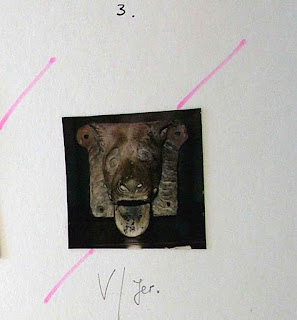
Image from the Becchina archive courtesy of Christos Tsirogiannis

Professor Christos Tsirogiannis has identified three objects from the Becchina, Medici and Symes archives that were due to be auctioned at Sotheby's in London on December 7, 2022. His identifications are covered in a report by Dalya Alberge, "Archaeologist urges Sotheby’s to cancel auction of ‘illicit’ artefacts", Daily Telegraph December 3, 2022.

Take for example the Roman bronze protome spout in the form of a dog or spout (lot 121). The history of the piece is provided:
  • Swiss private collection 
  • Royal-Athena Galleries, 
  • New York John W. Kluge, acquired from the above in 1989 (Christie's, New York, The Morven Collection of Ancient Art, December 10th, 2004, no. 590, illus.)
Notice on the image the annotation 'V[ia]/Jer[ome Eisenberg]' confirming the link with the Royal-Athena Galleries. The image is taken from the Becchina archive and records show that it was derived from Mario Bruno. Presumably one of these two sources is to be identified as the 'Swiss private collection'.

In the report in the Telegraph it is noted:
A Sotheby’s spokesman said that they “uphold the highest standards of due diligence”.
How did Sotheby's conduct a rigorous due diligence test on the anonymous Swiss private collection? Had they considered the possibility that Becchina or another such individual was the origin? 

Royal-Athena Galleries should also have raised an alert. Only in November three antiquities from this source were returned to Turkey: e.g. silver Apollo. Or in July this year an Attic krater from the Gallery was returned to Italy. This was among 60 antiquities from Royal-Athena Galleries. Again, had Sotheby's taken this into account as part of their rigorous due diligence process? 

In May 2017 a Paestan lekythos was provided with a nearly identical history to the bronze spout. Did this raise concern? Indeed it is clear that the Kluge collection has been linked to several antiquities that have been returned to Italy. This in itself should have alerted those preparing the catalogue entry for Sotheby's.

Will Sotheby's in London tighten up its processes? Is there a need to raise the standard of the due diligence approach to a more rigorous level?


| |
Bookmark and Share so Your Real Friends Know that You Know

Wednesday, 8 December 2021

Returning Athenian pottery from the Steinhardt collection

Source: Manhattan District Attorney's Office

The documentation for the Michael Steinhardt  collection identifies several Attic pieces that will be returned to their country of origin, presumably Italy and Greece.
  • Attic black-figured Sphinx cup, 'Tleson, son of Nearchos' (pp. 19–20). Identified from the Medici dossier. Symes sold to Beierwaltes (January 8, 1996); Phoenix Ancient Art (2006); Steinhardt purchased from Phoenix Ancient Art for $310,000 (2007).
  • Attic red-figured oinochoe attributed to the Berlin painter (pp. 20–21). Identified from the Medici dossier. Steinhardt purchased from Harry Bürki for $215,000 (1996); Steinhardt's records show that the oinochoe had been sold by Robert Hecht.
  • Attic black-figured hydria showing Herakles and Kyknos attributed to the Leagros group (p. 21).  Identified from the Medici dossier. Displayed by Christos Bastis at New York's Metropolitan Museum of Art (1987); Bastis died (1999); Steinhardt purchased from Michael Ward for $127,000 (2000). The paperwork omits that the hydria surfaced at Sotheby's (London) July 11–12, 1983, lot 352, and was sold at Sotheby-Parke-Bernet, New York, December 9, 1999, lot 92. [BAPD 9050]
  • Attic black-figured hydria showing women at a fountain-house attributed to the Antimenes painter (pp. 22–23). Identified from the Medici dossier. Robin Symes advertised the hydria (1983); Atlantis Gallery, New York (1987); loan to the J. Paul Getty Museum L87.AE.4 (1987–96); Steinhardt purchased it at Sotheby's for $169,411 (December 17, 1996, lot 49). [BAPD 31596]
  • African head vase (pp. 23–24).  Identified from the Medici dossier.  Displayed in the Musée d'Art et d'Histoire, Geneva (1978–81); J. Paul Getty Museum (1984–96); Symes sold the piece to the Beierwaltes (1996); Beierwaltes consigned it to Phoenix Ancient Art (2006); Steinhardt purchased it from Phoenix Ancient Art for $163,312.50 (2009). 
  • Attic black-figured eye-cup (pp. 35–36). Identified from the Becchina archive. Mario Bruno, Lugano; sold to Becchina; TL tested by Ralf Kotalla, Germany(July 1992); Robert Hecht sold it to Steinhardt for $170,750 (June 15, 2000).
  • Attic black-figured amphora (p. 50). Identified from the Almagià archive. Purchased from a tombarolo for $6,500; sold for $13,000; accessioned by Steinhardt as coming from Almagià (1997). 
  • Attic black-figured plemochoe (pp. 54–55). Identified from the Symes archive. Photographed by Dieter Widmer (1985); held as loan by Sotheby's London for Budico SA, owned by Henri-Albert Jacques (1989); stolen from Sotheby's and recovered by the police; Budico SA sold it through Sotheby's to Steinhardt for $84,083 (December 11, 2002). Note: 'Ex. Private Coll. London, RS + CM' (?Symes and Michaelides).
  • Attic white ground lekythos attributed to the Triglyph painter (p. 56). Identified from the Symes archive. Symes sold it to the Beierwalters for $360,000 (June 22, 1995); consigned to Phoenix Ancient Art (2006); Steinhardt purchased from Phoenix Ancient Art for $380,000 (December 14, 2006).
| |
Bookmark and Share so Your Real Friends Know that You Know

Wednesday, 4 February 2015

Mario Bruno, Becchina and the Bucci painter

The public handover of antiquities linked Gianfranco Becchina and seized in Basel raise major issues over objects identified from Becchina's dossier of images. Among them is an Attic black-figured column-krater attributed to the Bucci painter. The Becchina dossier suggests that they had been handled by the dealer Mario Bruno of Lugano.

Bruno appears in The Medici Conspiracy (p. 154): '[one of two] competitors in trafficking archaeological material from Italy, both busy trying to buy the best objects that came to light'.

I have noted this krater before when it passed through Christie's in 2013 (for $37,500) as part of the dispersal of the Kluge collection. The present owner of the Bucci painter's krater is unstated.

The Bruno-Becchina link also appears in the statue in the Virginia Museum of Fine Arts (noted by Dr Christos Tsirogiannis).


Bookmark and Share so Your Real Friends Know that You Know

Wednesday, 3 July 2013

Virginia Museum of Fine Arts: marble statue identified

Cambridge University researcher Christos Tsirogiannis has made a further identification ("A marble statue of a boy at the Virginia Museum of Fine Arts", Journal of Art Crime [Spring 2013] 55-60). The statue can be identified in a transaction between Mario Bruno and Gianfanco Becchina in August 1987.  It was then on offer through Galerie Nefer (owned by Frieda Nussberger-Tchacos) in 1989 and acquired by Virginia at that point. The curator in charge at this point was Dr Margaret Ellen Mayo (formerly linked to Summa Galleries in Beverly Hills).

Tsirogiannis' research demonstrates that Tchachos appears to have provided the statue with a created collecting history that linked it to Dr Arthur von Arx and Alfred Obrecht. The polaroid photographs also suggest that the statue was still in a broken and muddied state long after the time that Tchachos had been suggesting that the object was known.

Under the AAMD Guidelines this new evidence should compel the curatorial team in Virginia to contact the Italian authorities.

Bookmark and Share so Your Real Friends Know that You Know

Another Bürki object returns to Italy

Source: MMA A psykter column-krater attributed to the Troilos painter was deaccessioned by New York's Metropolitan Museum of Art in June...