Showing posts with label San Antonio Museum of Art. Show all posts

Monday, 15 December 2025

A head of Hermes from a genuinely old Italian collection

Source: San Antonio Museum of Art
Among the deaccessioned items from the San Antonio Museum of Art in January 2022 was a marble head of Hermes. The head was excavated on the Caelian Hill in Rome between 1887 and 1891: it was first published in 1894.

It is reported to have been sold to Gilbert Denman in 1971 by Alfredo Turchi (Rome) and subsequently given to the museum in 1986 (inv. 86.134.145). 

Carlos A. Picón published images of the head, "which entered the newly established Department of Antiquities at the San Antonio Museum of Art in 1986", in 1995. In a footnote he claimed that it was unpublished.

The head was identified by Jörg Deterling  in 2016 who recognised it from the original Italian publications.

Picón, C. A. 1995. "Polykleitan and related sculptures in American collections: recent acquisitions." In Polykleitos, the Doryphoros, and tradition, edited by W. G. Moon: 229–45. Madison: University of Wisconsin Press.


| |
Bookmark and Share so Your Real Friends Know that You Know

Further returns to Italy from the San Antonio Museum of Art

Source: San Antonio Museum of Art
In addition to the objects deaccessioned by the San Antonio Museum of Art in September 2025, the museum  had done the same for another group in January 2022. These were mentioned (without significant detail) in a press release from the Manhattan DA in 2023. These items included material that surfaced through various sources:

Christie's (Geneva)
Attic red-figured lekythos. Inv. 86.134.75. Surfaced through Christie’s (Geneva) May 1979; Sotheby’s (London) May 1982. 

Christie's (London)
Attic white ground lekythos. Inv. 86.134.170. Surfaced through Christie’s (London) July 1983; July 1985. 

Frederick Schultz
Attic red-figured head kantharos. Inv. 91.24. Surfaced through Frederick Schultz, 1989. 

Galerie Günter Puhze
Attic black-figured lekythos. Inv. 91.80.1. Galerie Günter Puhze, 1989. 

Palladion Antike Kunst
Attic black-figured amphora. Inv. 86.134.31. Surfaced through Palladion Antike Kunst; Sotheby’s (London) December 1981. 
Attic red-figured oinochoe. Inv. 86.134.58. Surfaced through Palladion Antike Kunst; Robert Hecht. 

Robin Symes
Portrait of Hadrian. Inv. 2005.1.81. Robin Symes; Royal-Athena Galleries; Sotheby’s (New York) June 1992. [Image identified in the Medici Dossier.]
"Dating to 200 C.E., the marble head of the Emperor Hadrian was first documented uncleaned and covered in marine encrustations in a polaroid photograph. The polaroid was recovered by Italian law-enforcement authorities during a raid of the office and warehouse of well-known antiquities trafficker Giacomo Medici in 1995. After being smuggled out of Italy by Medici and his co-conspirators, the piece was then laundered with false provenance by dealer-trafficker Robin Symes before being sold in New York County in 1992." (Manhattan DA)
Sotheby's (London)
Corinthian olpe. Inv. 93.17. Surfaced in Sotheby’s (London) July 1990; Charles Ede. 
Attic black-figured amphora. Inv. 86.134.173. Surfaced in Sotheby’s (London) July 1985. 
Attic red-figured lekythos. Inv. 86.134.79. Surfaced through Sotheby’s (London) May 1982. 

Alfredo Turchi
Head of Hermes. Inv. 86.134.145. Sold by Alfredo Turchi.

The head of Hermes was excavated in Rome in the 19th century. 

| |
Bookmark and Share so Your Real Friends Know that You Know

Saturday, 13 December 2025

Returns to Italy from the San Antonio Museum of Art

Source: San Antonio Museum of Art
A series of deaccessions has been made in September 2025 by the San Antonio Museum of Art. They consist of mostly South Italian pots and one Etruscan terracotta:

  • South Italian oinochoe (inv. 97.8). Sold by Peter Sharrer.
  • Gnathian hydria (inv. 86.119.3.a–b). Surfaced at Sotheby's (London) December 1982; sold by Atlantis Antiquities.
  • Two Apulian epichyses (inv. 88.11.1.a–b). Surfaced at Sotheby's (London) December 1987.
  • Paestan bell-krater (inv. 2005.1.72). Surfaced at Sotheby's (London) December 1986; Charles Ede Ltd.
  • Paestan fishplate (inv. 87.17). Galerie Hydra, Geneva; Sotheby's (London) December 1986; Charles Ede Ltd.
  • Etruscan terracotta figure of a woman (inv. 88.11.2). Surfaced at Sotheby's (London) December 1987.
Other items were deaccessioned in February 2021, and January 2022. 

The way that many of these pieces surfaced through Sotheby's (London) is significant. (For others from these same auctions see here.) Galerie Hydra is associated with material linked to Giacomo Medici (see here).
| |
Bookmark and Share so Your Real Friends Know that You Know

Saturday, 4 February 2023

Further returns to Italy from San Antonio Museum of Art and Shelby White

Oinochoe fragment
attributed to the Harrow painter
returned from
the San Antonio Museum of Art.
Source: San Antonio Museum of Art

The Manhattan DA has reportedly returned 14 more antiquities to Italy: though the objects and images presented at the press announcement counted 16 ("D.A. Bragg Returns 14 Stolen Antiquities to Italy", Manhattan DA February 2, 2023). Two sources were acknowledged: Shelby White and the San Antonio Museum of Art. The third, the source of a silver coin, was left anonymous in the press release.

At least three of the objects appear in the Glories of the Past catalogue of the Shelby White and Leon Levy collection. The release gives further information about the Attic black-figured hydria attributed to the Priam painter.
The piece first surfaced in Italy after being looted by Giovanni Franco Becchina, a well-known antiquities trafficker. From Italy, the piece was then smuggled and laundered by Paris-based Robert Hecht. Hecht ultimately sold the piece with false provenance to Shelby White in New York County in 1989.
These add to the 14 pieces featured in the catalogue that have been returned to Greece, Italy and Turkey.

The nine pieces featured in the images at the press statement are derived from the San Antonio Museum of Art. The objects are derived from several sources: Sotheby's in London; Christie's in London and Geneva; Galerie Palladion Antike Kunst; Galerie Günter Puhze; Royal Athena Galleries; Robin Symes. For example, the oinochoe fragment attributed to the Harrow painter surfaced through Galerie Palladion Antike Kunst, and was sold to Gilbert M. Denman, Jr. by Robert Hecht.  The nine objects may be added to other pieces that were handed over in 2022. We are also expecting further details about three other objects derived from Frederick Schultz that have been handed over by the museum. 

Three other objects featuring in the press statement have yet to be linked in a formal way to a specific collection though Christos Tsirogiannis has identified two of them in the Becchina archive and one in the Schinousa archive. 

The final piece is a silver coin.
The Sicily Naxos Coin. Minted circa 430 B.C.E in the Greek colony of Naxos, on Sicily, this silver coin features the bearded Dionysus on one side and his squatting drinking partner, Silenus, on the reverse. The Sicily Naxos Coin first surfaced on the international art market in 2013, when a known trafficker offered the coin for sale with no provenance whatsoever. Prior to its appearance at a London-based auction house, a co-conspirator of the trafficker supplied false provenance for the coin. The Sicily Naxos Coin is currently valued at $500,000 and was among a group of coins seized at JFK airport as it was being smuggled into New York pursuant to an ongoing joint investigation between this Office, HSI, and Italy. At least one individual has been arrested in the course of this investigation with more to follow.
Three Shelby White pieces, nine objects from San Antonio, one silver coin, and three other pieces equal 16 objects (not 14).

Objects from the San Antonio Museum of Art and in the Shelby White and Leon Levy collection were the subject of an extended discussion by Chippindale and Gill in the American Journal of Archaeology back in 2000. 
Chippindale, C., and D. W. J. Gill. 2000. "Material consequences of contemporary classical collecting." AJA 104: 463-511. [DOI]
LM expects to add further detail to this summary in due course.

| |
Bookmark and Share so Your Real Friends Know that You Know

Monday, 24 January 2022

The whole history of a Little Master cup

These fragments of an Athenian Little Master cup, decorated with 'nonsense' inscriptions are among the pieces being returned to Italy by the San Antonio Museum of Art.

It is a reminder of the way that museums restrict information. The published catalogue, by H. Alan Shapiro, Carlos A. Picón and Gerry D. Scott III merely note that it was a gift of Gilbert M. Denman, Jr in 1986. The Beazley Archive records nothing about its history (BAPD 20266). Yet now it seems that the fragments, including this Little Master cup, had been found at Barbarano Romano, and had been purchased by Edoardo Almagià in 1985. How was such information deemed to have been unknown to those preparing the catalogue? 

Were these fragments processed by Almagià with the help of an academic?

Are there other pieces remaining in San Antonio that also derive from Barbarano Romano or other sites in Italy?

Why were such large numbers of fragments acquired by San Antonio? Was there an expectation that other fragments from these figure-decorated pots would be acquired in future years? Was the museum following the pattern of other collections? 


| |
Bookmark and Share so Your Real Friends Know that You Know

Thursday, 6 January 2022

Broken pot fragments matter

Source: San Antonio Museum of Art

Among the material linked to Edoardo Almagià  and returning to Italy are 192 Attic cup fragments from the San Antonio Museum of Art. These are in addition to the calyx-krater fragments attributed to Euphronios that were returned from Princeton University Art Museum. 

These returns challenge the belittling of the issue by James Cuno who used the example of the 200 or so fragments acquired by Harvard as part of his attack on those who would wish to see a more rigorous approach to museum acquisitions. Harvard will no doubt be looking again at the histories of the fragments. Were any acquired from a New York based dealer? Have connections been made with fragments in other collections?

|
Bookmark and Share so Your Real Friends Know that You Know

Wednesday, 5 January 2022

Barbarano Romano: the Attic fragments

Source: San Antonio Museum of Art

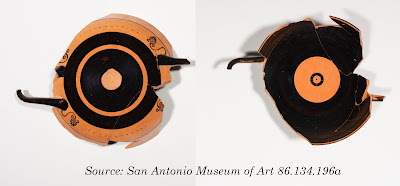
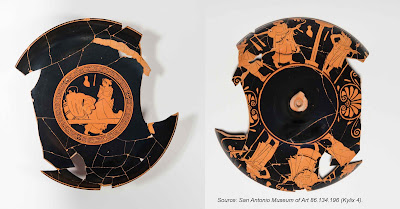
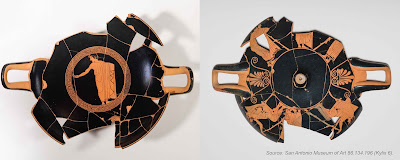
The San Antonio Museum of Art will be returning 192 fragments of Attic black-figured, red-figured and black-glossed cups to Italy. They are reported to have been found at Barbarano Romano to the south of Viterbo and were sold to Gilbert M. Denman, Jr. by Edoardo Almagià in 1985; Denman gave the fragments to the museum the following year (inv. 86.134.196). 

The Steinhardt legal papers cite two pieces of correspondence about pottery fragments from Barbarano Romano: the recipient is clearly in Texas. Almagià states the findspot and explained how the fragments were removed to Switzerland, and then moved to New York where they were cleaned and grouped with the help of a vasologist. Further fragments from the site were then noted, though they remained in Italy. 

It is unclear if the San Antonio fragments and the Texas letters are linked. But this does raise issues about other pot fragments that were handled by Almagià and those associated with him. 

| |
Bookmark and Share so Your Real Friends Know that You Know

Friday, 24 December 2021

San Antonio Museum of Art and returning antiquities

Olpe formerly in the San Antonio Museum of Art

Back in 2012 Chasing Aphrodite identified material in the San Antonio Museum of Art that was linked to Edoardo Almagià. 

It is now clear that a number of items were deaccessioned in February 2021 and have now formed part of a major return of objects to Italy. The museum has an oblique reference in the Manhattan DA Press Release. 

The two pieces that were identified by Chasing Aphrodite are indeed here.

a. An Attic red-figured olpe showing Dionysos and a satyr, attributed to the Florence painter by J.R. Guy (inv. 86.30; cat. no. 60; BAPD 19167). Gift of Gilbert M. Denman, Jr. The deaccessioning statement:  "sold by Edoardo Almagià, New York, to the San Antonio Museum of Art, 1986". 

b. An Attic red-figured plate showing the head of a man (inv. 87.1; cat. no. 87.1; BAPD 19168). Museum Purchase: Grace Fortner Rider Fund. The deaccessioning statement: "found at Barbarano Romano, Italy, according to Edoardo Almagià; with Edoardo Almagià, New York, by 1986; sold by Edoardo Almagià to the San Antonio Museum of Art, 1987". Ian McPhee and A.D. Trendall had earlier suggested that it had been found in Cerveteri (1990). Barbarano Romano is to the south of Viterbo.

The third part of the return consists of 192 fragments of cups, also reported to have been found at Barbarano Romano, and stated to have been sold to Gilbert M. Denman, Jr. by Almagià in 1985.

c. An Attic black-figured Little Master cup (inv. 86.134.196a; cat. no. 178; BAPD 20266). Gift of Gilbert M. Denman, Jr.
d-j. Seven fragmentary Attic red-figured cups (inv. 86.134.196).
k. Other assorted fragments of cups, some red-figured some black-glossed (inv. 86.134.196).


Bookmark and Share so Your Real Friends Know that You Know

Wednesday, 7 March 2012

Almagià: update

Chasing Aphrodite has discussed further objects links to Edoardo Almagià. This includes material in San Antonio and Indiana. There is also a discussion of material in Boston that I have discussed elsewhere.

There is also a note on the continued "stonewalling" by Princeton.

Bookmark and Share so Your Real Friends Know that You Know

Tuesday, 2 October 2007

Antiquities Surfacing in Freiburg

One of the sources for antiquities that appear to be newly-surfaced is Galerie Günter Puhze in Freiburg, Germany. I say "appear to be" because there is rarely a declared history before Freiburg.

Let me give four random examples from among those listed in my research notes (KdA = Kunst der Antike, issued by Galerie Günter Puhze):
a. An Attic red-figured amphora, attributed to the Triptolemos painter. KdA 10, no. 200. Subsequently Christie's, London, November 12th, 1996, no. 142; Sotheby's, New York, June 5th, 1999, no. 171 (US$21,850); Sotheby's, New York, 6 June 2006, lot 17 (US$45,000).

b. An Apulian situla, attributed to the group of Copenhagen 4223. KdA 6 (1985), no. 226. Subsequently: Sotheby's, London, July 13, 1987, lot 308; purchased by Dr & Mrs Jerome M. Eisenberg. Now Boston, MFA 1991.242, gift of Dr and Mrs Jerome M. Eisenberg.

c. An Attic red-figured lekythos, attributed to the Oiokles painter. KdA 8 (1989), no. 211. Subsequently: Dr Elie Borowski collection; Christie's, New York, June 12, 2000, lot 79. Now: Jerusalem, Bible Lands Museum 4642.

d. An Etruscan neck amphora. KdA 6 (1985). Subsequently: Gilbert M. Denman collection. Now: San Antonio Museum of Art 85.119.8.
There should be no reason to be suspicious of the history of the pieces. After all, the Gallery is a member of the International Association of Dealers in Ancient Art. In the Code of Ethics is this statement:
"The members of the IADAA undertake not to purchase or sell objects until they have established to the best of their ability that such objects were not stolen from excavations. architectural monuments, public institutions or private property."
The details of former owners are not provided so it appears that Galerie Günter Puhze stands at the start of the chain. But if these pieces were known before the 1970 UNESCO Convention it would be helpful - if only for the sake of transparency - for the dealer to provide this information. Were these pieces in some old German (or other) collection? Where have such complete pots been lurking for the last few centuries? Such histories would dispel any suspicions.

Wednesday, 1 August 2007

The generosity of Giacomo Medici

The hand of Giacomo Medici is sometimes hard to discern. The Medici Conspiracy (see the review article by Gill & Chippindale) has demonstrated the way that the route from the Etruscan grave to a display case in some North American museum has been obscured.

But a browse through the 'vase' catalogue of the San Antonio Museum of Art presents two fragmentary Greek pots as gifts of Giacomo Medici.

The first is a Rhodian oinochoe fragment in the Middle 'Wild Goat Style' (inv. 88.18.2; cat. no. 177) and the second is the fragment from an Athenian black-figured cup showing a charioteer (inv. 88.18.1; cat. no. 179).

It is important to stress that there is nothing suspect about their histories. Both came from the distinguished collection of the Comtesse de Behague. And both were auctioned at Sotheby's in Monaco on 5 December 1987 (lot 142, a and b).

I understand (from the present curator in San Antonio) that both pieces were handed over to Carlos Pícon, the then curator, in Monaco on 6 December 1987, i.e. the day after the sale.

In a recent interview for The New Yorker (April 9, 2007) it was noted that Pícon only knew Medici 'glancingly'.

Pícon speaks about the meeting:
'I saw Medici at the end of the auction. A friend of mine was with me and said, "You bought that fragment that Carlos wanted for San Antonio," and he said, "I will give it to him." I thought it was rather touching. He put it in my hands and said, "Give it to your museum." He had never been to Texas. He had never seen my museum.'
Medici's generosity is indeed touching.

Krater fragments in Princeton

Greek, Attic, probably by the Kleophrades Painter, ca. 490–480 BCE, Two non-joining fragments from a calyx-krater (mixing bowl) depicting ar...