Showing posts with label Cyrene. Show all posts

Wednesday, 14 September 2022

The Intellectual Consequences of Collecting a Panathenaic Amphora

Panathenaic Amphora
formerly in the Michael Steinhardt collection
Source: HSI New York / Manhattan DA
One of my long-standing concerns about looting and the subsequent collection of antiquities is that valuable archaeological information is lost. Findspots, contexts and associations are lost, with them the ability to assign appropriate dates. 

I would like to consider the Athenian Panathenaic amphora from the Steinhardt collection that has been returned to Egypt. The Manhattan DA's statement of fact about the Panathenaic amphora points the reader to the coastal site of Thonis-Heracleion.
The style and details on the Vase from the Pan-Athenian Games are characteristic of black-figure pots recovered from recent underwater excavations at Thonis-Heracleion, off the coast of Egypt.
As far as I know, there have been no Panathenaic amphorae (or fragments) found at Thunis-Heracleion. Indeed, I have only identified five Panathenaic amphora fragments (not complete pots) from Egypt: five from Naucratis (one of which is associated with the Hellenion) and one from Hadra (i.e. near the later foundation of Alexandria). If this amphora does indeed comes from Egypt it would be a most unusual find.

Furthermore, the Panathenaic amphora shows no sign that it comes from a submerged cemetery at Thonis-Heracleion. Or have looters discovered a cemetery site on land? 

However, there are numerous complete Panathenaic amphorae discovered in Cyrenaica in Libya. (See Faraj M. Elrashedy, Imports of post-Archaic Greek pottery into Cyrenaica from the end of the Archaic to the beginning of the Hellenistic period [BAR International Series, vol. 1022. Oxford: Archaeopress, 2002]). There are complete amphorae and fragments from Cyrene, Apollonia, Euesperides (Berenice / Benghazi), Tocra, Barca, Ptolemais and other sites. Could the Steinhardt amphora have been found in one of the cemeteries of, say, Cyrene, and then been smuggled to Egypt where it was associated with Thonis-Heracleion? 

The Manhattan DA may, of course, have access to other evidence that points to Thonis-Heracleion with a little more certainty. Or was this a hunch from someone researching the Steinhardt collection? 

The association of the Steinhardt amphora with Thonis-Heracleion seems, for now, unlikely and the mention of the alleged findspot should not be encouraged unless further information comes to light or is disclosed. Indeed, one wonders if the amphora should have been returned to Libya rather than Egypt. 

The case of the amphora is a reminder of the way that key information is irretrievably lost through the looting process.

| |
Bookmark and Share so Your Real Friends Know that You Know

Friday, 1 April 2022

Loan to the Metropolitan Museum of Art returned to Libya

Source: Manhattan DA


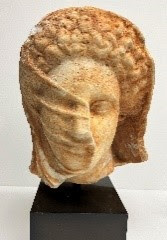
A marbled head of a veiled woman has been returned to Libya after being placed on long-term loan to New York's Metropolitan Museum of Art in 1998 ("D.A. Bragg Returns Two Antiquities Valued at Over $500,000 to the People of Libya", Manhattan DA March 30, 2022). It appears that the head had been looted from Cyrene. It is being returned with the head of a bearded man that surfaced through the market in Switzerland. 
| |
Bookmark and Share so Your Real Friends Know that You Know

Thursday, 13 January 2022

Steinhardt head from Cyrene returns to Libya

Source: Manhattan DA
The marble head of a woman has been returned to Libya after being "surrendered" by New York collector Michael Steinhardt ("D.A. Bragg: $1.2M Antiquity Seized From Michael Steinhardt Returned to the People of Libya", Manhattan DA press release, January 12, 2022). The head, dating to the mid fourth century BCE, has been valued at $1.2 million. The head is reported to have been looted from a tomb in the vicinity of Cyrene.

The head was purchased on November 10, 2000 from the Manhattan dealer Michael Ward for $1.2 million. The invoice is reported to have noted, "possibly from North Africa". 

Michael Ward also handled the "Aidonia Treasure" that was returned to Greece; a Campanian calyx-krater returned to Italy from the Dallas Museum of Art that had been acquired from Becchina; and items that have been associated with the discovery of the Korsechnica krater

Michael Ward had acquired an Attic black-figured hydria from the Bastis collection; this was sold to Steinhardt and will form part of the returns to Italy.
| |
Bookmark and Share so Your Real Friends Know that You Know

Wednesday, 1 April 2015

From Cyrene to London via Dubai

Statue from Cyrene
Source: Daily Telegraph
A UK court viewed a female statue apparently from Cyrene in Libya as part of an investigation into the movement of recently surfaced antiquities (Victoria Wood, "Court sits at British Museum for first time as judge studies looted Libyan sculpture", March 30, 2015 Daily Telegraph 2015). The statue, worth some £2 million, entered the UK via Dubai and was seized in a warehouse by a customs official. There were indications that the statue had been removed from the ground relatively recently.

The report informs us:
Jordanian, Riad Al Qassas, who does not reside in the UK, is accused of falsifying paperwork after telling customs that the sculpture came from Turkey, rather than Libya, and was worth £60,000, rather than between £1.5m to £2m. 
He denies one count of knowingly or recklessly delivering a false document to HMRC on November 1 last year.
It seems like another instance of paperwork being "falsified" in order to allow such objects to move freely. But there is more:
Andrew Bird, for HMRC, has told the court that documents suggest Al Qassas had only a marginal role in the export. He claimed Hassan Fazeli, a Dubai businessman who has claimed the sculpture has belonged to his family collection since 1977, was behind the crime. 
Mr Bird said the false documents were submitted by Hassan Fazeli Trading Company LLC, which is based in Dubai, and which was last year accused by New York prosecutors of illegally bringing five ancient Egypt artefacts into the USA.
The Telegraph is not quite accurate. The case in the USA was in 2013 (Lucile Scott, "Uncle Sam Seizes Ancient Egyptian Art", Courthouse News March 22 2013).
They were purchased from the Hassan Fazeli Trading Company in Dubai by Salem Alshdaifat, who "sells ancient coins and other antiques" online through a business called Holyland Numismatics, according to the complaint. U.S. Customs seized the package, sent by FedEx, as it entered the country through Newark International Airport in August 2010. 
The Customs officer became suspicious because the invoice identified the items as "Ancient Egyptian," but listed the country of manufacture as Turkey.
And there is specific discussion of the way that paperwork is prepared.
But the government claims that Fazeli, the exporter, admitted to a confidential source that he often "lists incorrect countries of origin to circumvent cultural patrimony and export laws. In particular, Fazeli acknowledged that he often supplied 'Turkey' as the country of origin because he had Turkish papers that he could use."
This is not the first link between Holyland Numismatics and Dubai (see LM).


Bookmark and Share so Your Real Friends Know that You Know

Monday, 25 February 2008

Relief from Cyrenaica Recovered in Paris

It has been reported ("Stolen Piece of Antiquity Retrieved", Mathaba, February 23, 2008) that a Roman relief showing Hermes (?, "Hurmuz"), stolen from an archaeological store in Libya, was recovered from an auction in Paris.
The director of the Board of Antiquities said the piece was found in Shahat during excavating work in 1973 and disappeared in 1999.

Search led to the piece being in the possession of Athens Hall Auction House owned by an American with branches in London and New York.

It was disclosed that the piece was acquired by the Hall in June from a antiquities trader in Zurich, Switzerland.
I wonder if the report is a little confused and has lost detail in translation. I know of no auction house called "Athens Hall". But I presume this is an antiquities dealer with branches in New York and London.

Shahat is otherwise known as Cyrene, so it is safe to presume that this theft is linked to material from the site (Mark Rose, "Stolen Sculptures from Cyrene, Libya", Archaeology, January 30, 2001).
Alerted of the theft by Emanuela Fabbricotti of the Italian Mission to Cyrene, White and Kane created a website, www.cyrenethefts.org, on which they posted information about the loss his January 22. Two heads--one of a male and the other possibly of Demeter--were relocated within as many days of the appearance of the website, thanks, says White, "to the energetic interventions of Jean-David Cahn, president of the International Association of Ancient Art Dealers, and Jerome M. Eisenberg, director of the Royal-Athena Galleries." The case highlights the potential of the web in publicizing the theft of antiquities and helping in the recovery of stolen artifacts.
The website is no longer functioning.

Donald White issued this statement back in 2001 [archived]:
In 1969 an international team of investigators began excavating the Extramural Sanctuary of Demeter and Persephone at Cyrene in the province of Cyrenaica of what is today eastern Libya. The project was begun under the sponsorship of the University of Michigan's Kelsey Museum and was taken over in 1973 by the University of Pennsylvania Museum of Archaeology and Anthropology. Fieldwork ceased in 1981 after nine seasons of activity directed by Penn's Dr. Donald White, largely because of the deteriorating relations between the governments of Libya and the United States. During the years between 1969 and 1981 a very substantial quantity of stone sculpture was unearthed from the sanctuary's ground. Professor Susan Kane at Oberlin is the principal investigator responsible for the publication of this material. It now our sad duty to report that a major theft of this material was carried out some time in late 1999 or early in 2000. A gang of persons as yet largely unidentified broke into the University of Pennsylvania's storerooms through a broken window and removed what appears to have been a total of 15 marble heads. These objects represent some of the most interesting and archaeologically valuable artifacts found by us in the course of the entire excavation. A list of the stolen pieces was provided to us by Professor Emanuela Fabbricotti of the Italian Mission to Cyrene in November 2000. While the current location of the stolen pieces is still a matter of speculation, it is likely that they were transported across the border into Egypt fairly soon after the initial theft. None of the principals responsible for the thefts have been apprehended by the Libyan authorities, and many details surrounding this event remain obscure owing to the on-going absence of direct communications between us and the Libyan Department of Antiquities headquartered in Tripoli. Fortunately we possess a complete documentation of all of the pieces reportedly lost. In the meantime we appeal to the public at large as well as to all of our scholarly colleagues to report to us any information they might have about the missing pieces.

Another Bürki object returns to Italy

Source: MMA A psykter column-krater attributed to the Troilos painter was deaccessioned by New York's Metropolitan Museum of Art in June...