Showing posts with label armour. Show all posts

Friday, 25 March 2022

A Roman Cavalry Helmet withdrawn from sale

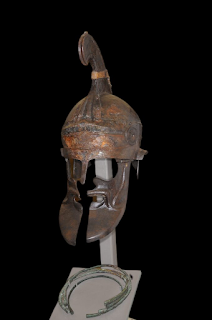
Helmet from Hecht archive
Source: Christos Tsirogiannis

Christie's had been due to auction a Roman cavalry parade helmet on April 12, 2022 (lot 90). It currently forms part of a 'distinguished private collection'. The helmet has a recorded history. It surfaced in the collection of Axel Guttmann in 1996, and was sold in The Art of Warfare: The Axel Guttmann Collection, Part 1, at Christie's, London, 6 November 2002 (lot 89) for £58,750. It then passed into a UK based private collection before being sold at Christie's, London, 2 May 2013 (lot 115) for £205,875.

The Guttmann collection is not without issues

The helmet has now been withdrawn from sale at Christie's. It appears to be the one that features in a series of photographs in the Hecht archive. The identification was made by Christos Tsirogiannis. 

| |
Bookmark and Share so Your Real Friends Know that You Know

Tuesday, 1 March 2022

Steinhardt helmet returns to Bulgaria

Helmet from the Steinhardt collection
Source: Manhattan DA

A fourth century BCE helmet once in the Michael Steinhardt collection has been returned to Bulgaria ("Ancient Helmet Likely Belonging to Philip of Macedon Returned to the People of Bulgaria", Manhattan DA, February 10, 2022). It is reported to have been discovered near Pletena in south-west Bulgaria. Steinhardt purchased the helmet from Axel Weber of Köln, Germany, on March 24, 1998 for $175,000. 

| |
Bookmark and Share so Your Real Friends Know that You Know

Friday, 20 February 2015

The so-called Crosby Garrett helmet

The 'Crosby Garrett' helmet on display in the British Museum
© David Gill
My article on the so-called Crosby Garrett helmet that appeared in the Journal of Art Crime is now available on academia.edu. This documents the varying accounts of the discovery, reporting, 'restoration', sale, and display.

Bookmark and Share so Your Real Friends Know that You Know

Monday, 23 July 2012

The restoration of the Crosby Garrett helmet

I have been watching part of the final episode of ITV's "Britain's Secret Treasures" (Sunday 22 July 2012). Number 9 was the so-called Crosby Garrett helmet (see PAS entry) [at c. 7 minutes on ITV player]. Michael Buerk makes the point that the helmet is "now lost to the nation".  


We have reviewed the reported story of its finding and its reporting to PAS elsewhere.


Bettany Hughes now tells us that there was a single finder (yet note that the Independent reported that it was found by a father an a son). She states that the finder reported the discovery to the British Museum (known to be Sally Worrell of PAS), and instructed Christie's to "reconstruct and sell" the helmet. I have read the report from the restorer and have noted the wider concern that this object should have been placed in the hands of a skilled archaeological conservator. Hughes claims that the restoration took some six months, but in fact it was closer to three.


Hughes makes the point that the disappearance of the helmet subsequent to the sale has left "a hole in history", but did not raise the more important issue that the removal of this helmet from its archaeological context (wherever that was) has destroyed knowledge.


Bookmark and Share so Your Real Friends Know that You Know

Thursday, 3 November 2011

Trustee of Boston MFA talks of the joy of collecting

North American private collector and trustee of the Boston's MFA, Peter Aldrich, has revised his earlier 2003 essay “An Antiquities Collector’s Thoughts on the Structure and Economics of the Antiquities Markets. The Unintended Consequences of Public Policy, Possible Reforms and the Ethics of Market Participation” (in Carol Mattusch, Alice A. Donohue, and Amy Brauer, eds., Common Ground: Archaeology, Art, Science, and Humanities -Proceedings of the XVI International Congress of Classical Archaeology, Boston (Oxford: Oxbow, 2006), 494-96) for Forbes (with Robert Lenzner, "There's Big Money And The Need For Reform In The Antiquities Trade", November 1, 2011). Lenzner tells us "Aldrich, a retired real estate investor from Boston, ... began collecting Greek and Roman artifacts in emulation of the late Leon Levy and his wife Shelby White". What Lenzner does not inform the readership of Forbes is that two of the antiquities returned from a North American collection to Italy had passed through the Peter and Widgie Aldrich collection (and discussed in an academic article published by Cambridge University Press in 2007). Among the antiquities presented by Aldrich to a major North American museum was a set of armour belonging to a South Italian cavalryman. (Another set of armour from a cavalryman's burial passed into the Shelby White and Leon Levy collection.)

Aldrich now writes "I found that the current market system stimulates, enables and creates looters, black marketeers, and unscrupulous middlemen, dealers and purchasers." He appears (astonishingly!) to be suggesting that some private collectors, like himself, were unscrupulous in the way that they developed their collections. Aldrich alludes to Robin Symes (though fails to mention Paris-, Swiss- and New York-based dealers who played their part): "There are examples galore of scandal in the antiquities trade, all of which makes reform advisable, indeed essential. For example, the reputation of the Getty Museum, an avid collector of antiquities, has been seriously stained by the scandal involving a London dealer who served time in jail."

Aldrich's association with recently-surfaced (and returned) antiquities makes it hard to take his seven point plan seriously.
I believe that this albeit plan could beneficially reform the structure and economics of the antiquities markets, lower the level of violence and corruption that afflicts poor and rich countries alike, and increase dramatically the employment and research opportunities of the archeological profession. It would also make it again an honor and a joy to collect.
Perhaps a more radical solution would be for collectors like Aldrich to insist on seeing properly authenticated documention before making their acquisitions. And in this spirit, I hope that he will publish the full collecting histories of the objects in his collection and include the pieces that he has donated to public museums.

Bookmark and Share so Your Real Friends Know that You Know

Monday, 13 December 2010

German Courts and an Apulian Helmet

Last week a German court rejected an Italian claim on a helmet that is alleged to have been removed from an archaeological context in Apulia (Sabine Deckwerth, "Prozess um einen Paradehelm Italien verlangt einen wertvollen antiken Kopfschutz zurück - und zog deshalb vor das Verwaltungsgericht", Berliner Zeitung December 10, 2010). The Italians claim it came from illicit activity in 1993 ("Der hegte einen Verdacht: Dass der Helm aus einer Raubgrabung in Apulien im Jahre 1993 stammt.") The helmet, dating from between 900 and 700 BCE, then passed to the Axel Guttman collection, and after his death in 2001 was offered on the London market (2002). It was spotted in a catalogue by an Italian academic, and in 2004 Italian authorities submitted a claim; the helmet was seized pending the court case.

The German judge has stated that the Italian authorities were unable to demonstrate that the piece had been looted or been able to show when the helmet entered Germany ("Man wisse nicht, ob der Helm tatsächlich aus einer Raubgrabung stammt und wann er von Italien nach Deutschland gelangte"). The court decided to apply a statue of limitation to the case which expired in 2008.

What was the fully documented collecting history for the Apulian helmet?


Sales of the Axel Guttmann collection include:


For earlier comments on the role of Germany in the antiquities market see here.


Bookmark and Share so Your Real Friends Know that You Know

Thursday, 18 November 2010

Lord Renfrew calls for transparency

The sale of the so-called Crosby Garrett helmet for £2.2 million ($3.6 million) has started to raise some uncomfortable questions. It is now clear if the helmet was found by "a young guy" (Georgiana Aitken of Christie's) or "an unnamed father and son" from Peterlee County Durham (The Independent). Dr Roger Bland of the Portable Antiquities Scheme (PAS) has talked about "the real gap" in The Treasure Act (1996). (Indeed the real issue is the term used for the act.)

A month ago Lord Renfrew of Kaimsthorn called a review of The Treasure Act in a letter to The Times (London).

On October 20, 2010 Lord Renfrew tabled a written question:
To Ask Her Majesty's Government whether they will review the definition of "treasure" so that major heritage discoveries, such as the Roman parade helmet found at Crosby Garrett and recently sold by public auction, should fall within the scope of the Treasure Act.[HL2515]

Baroness Rawlings (the President of the British Antique Dealers' Association [BADA]) presented a written reply:
The Department for Culture, Media and Sport plans to review the Treasure Act Code of Practice and this will include the definition of Treasure contained in the Treasure Act 1996. This review will take the form of a public consultation and so will provide the opportunity to consider whether it would be appropriate to extend the definition of treasure to include items such as the Roman parade helmet found at Crosby Garrett.

Lord Renfrew has now returned to the theme in the House of Lords by asking the question (November 11, 2010):
To ask Her Majesty’s Government whether they will review the definition of “treasure” in the Treasure Act 1996 in the light of the sale at auction of the Roman parade helmet recently found in Cumbria for £2 million.

Baroness Rawlings reminded Lord Renfrew of her written reply. In response Lord Renfrew noted:
It is strange that a national treasure can be sold at public auction by an anonymous vendor to an anonymous buyer.
But he then added a question that must cause concern for those dealing in antiquities within the United Kingdom:
will the Government consider reviewing the law on antiquities at sale by auction in favour of some transparency?
Transparency would mean auction houses and galleries providing full details of collecting histories and vendors.

Lord Redesdale returned to the issue of the Crosby Garrett helmet:
My Lords, are moves afoot to look at the practices of the auction houses, given that this helmet was found in many pieces and an enormous amount of archaeological information was lost when conservators put the pieces back together without consulting archaeologists? Is that a practice that auction houses should undertake, given that loss of information on a very rare artefact? Are the Government looking at sales of antiquities through internet sites such as eBay? That is becoming a real source of worry, as much of our heritage is disappearing abroad without any record whatever.
The restorer's report on the helmet is indeed enlightening and I am very grateful to Georgiana Aitken of Christie's for sending me a copy. There is indeed real concern that such an unusual object - could we use the term 'national treasure'? - was not put in the hands of an archaeological conservator.

But Lord Redesdale also raises the issue about eBay. He appears to be suggesting that archaeological material from the United Kingdom is slipping abroad. Are these just chance finds? Or are there those who make a deliberate search for archaeological material? And are all these items recorded by the Portable Antiquities Scheme? How much material goes unrecorded?

Baroness Rawlings responded by talking about 'provenance' (or more accuratley 'collecting histories'):
It is in the interests of both auctioneers and dealers to check that the provenance of items is acceptable to reduce any risk of prosecution for handling stolen goods or dealing in tainted or mended goods.
This brings us back to Lord Renfrew's point for the need of greater transparnechy in the market and the full disclousre of documented collecting histories when archaeological material is offered for sale on the market.

The sale of the Crosby Garrett helmet may well be seen as a turning-point in the debate over the market in archaeological material.


Bookmark and Share so Your Real Friends Know that You Know

Friday, 10 September 2010

The Crosby Garrett Helmet

In October Christie's (London) will be offering a Roman parade helmet reported to have been found at Crosby Garrett in Cumbria (7 October 2010, lot 176). The helmet is said to have been found in May 2010 by a metal-detectorist, and details appear on the website of the Portable Antiquities Scheme. The fragmentary ("found in 33 fragments, with 34 smaller fragments found in association") Roman helmet was discovered in May.

I suspect there would be export restrictions on the piece if the successful bidder wanted to take this unusual piece abroad.

Bookmark and Share so Your Real Friends Know that You Know

Thursday, 3 January 2008

Leiden and the Cuirass

While North American museums have been busy returning antiquities to Italy, European collections have been busy fighting off legal challenges. Is the difference that American institutions are wanting to be seen to be acting in an ethical way, whereas European museums only look at the strict legal implications?

Objects can be acquired "legally" even if they have been dug up at dead of night, their archaeological contexts destroyed and lost, and the pieces themselves transported across international frontiers contrary to legislation.

This is neatly illustrated by the actions of the National Museum of Antiquities (NMA) (Rijksmuseum van Oudheden) at Leiden in Holland. A partial set of "ancient bronze armour comprising a cuirass, a helmet, fragments of a belt and two leggings" surfaced on "the stand of a well-known Swiss antiquities dealer" at the 1997 TEFAF in Maastricht (Jos Van Beurden, "A disputed cuirass: Italy versus the Netherlands’ National Museum of Antiquities in Leiden", Culture Without Context 18, Spring 2006). This was subsequently purchased by the NMA in 1998.

In 1999 a "confidential source" provided the Italian Carabinieri with this information:
it seems that some years ago in the illicit trade a complete cuirass … surfaced. According to him, the cuirass was taken up by an important dealer in archaeological objects in Puglia … The important armour seems to have been purchased by a museum abroad.
The Italian government are reported to have requested the return of the armour in 2000 and started legal proceedings in 2002. The Dutch court rejected the request in 2004 (see NMA Annual Report for 2004, p. 10).

Van Beurden reported:
the NMA was not amused with the attitude of the Italians, who according to the head of the museum’s collection management, Steph Scholten, ‘did everything with a lot of fuss and display of power. They tried to criminalise the NMA’. At the same time Scholten could ‘well imagine the dilemmas and frustrations of the Italians. With hindsight maybe that purchase was naïve.’
At least Scholten accepted that the "purchase was naïve". So was the purchase ethical?

Scholten's statement sounds barely believable:
‘With the standards of 2005 one can say that information could have had more substance’ says Scholten, and now we also know more about the role of Switzerland in the illicit trade. In the National Museum of Antiquities one had been thinking for a long time that the illicit trade was something of shady back rooms and not something of prominent traders in prominent places. Now I understand that things happen even at the TEFAF which should not be allowed as far as provenance is concerned.
Could a National Museum of Antiquities really pretend that in the late 1990s that its staff were unaware of the way that newly-surfaced antiquities were passing through Switzerland? (Remember the euphemism of "once in a Swiss private collection".) Were the curatorial staff unaware of the 1970 UNESCO Convention? Were the professional archaeologists of the NMA unfamiliar with the 1973 AIA Declaration?

What is interesting is that this is not the only piece of South Italian armour which has surfaced in recent times. Other pieces include a set that surfaced on the German art market in the mid-1970s, and another in the Shelby White collection.

The Italian Government is reported to have made another request (in 2004) for the return of the armour from Leiden. Would it be ethical for the NMA to retain it given what is now known about the market in archaeological objects?

Wednesday, 5 September 2007

An Italian cavalryman in Manhattan

Greek colonial cavalrymen are clearly gathering on the eastern seaboard of North America - or at least sets of their armour can be found there.

The acquisition of a suit of Greek cavalry armour by the Museum of Fine Arts in Boston has been noted before. And there is another "set of armor from a burial" in the collection of Shelby White and the late Leon Levy. It consists of:

a. A "South Italian-Chalcidian" helmet
b. A long "muscle" cuirass (front and back)
c. A pair of greaves
d. A chamfron
e. A muzzle of a horse

The Apulian bronze armour appeared in the Glories of the Past exhibition (no. 95). The entry was written by David Cahn who suggested that the "set" should be placed in Apulia, "about 330 BC".

Cahn notes: "The date of the helmet is based on the many finds of armor in Apulia buried with Apulian red-figured vases, for which we have an established chronology".

Again, "Like the helmet, cuirasses of this type have come to light, usually with a wealth of ceramic material, in many monumental chamber tombs in Apulia".

As for the chamfron, Cahn notes its stylistic links with three others that appear to come from "a single workshop". He continues: "All four chamfrons were found with "south Italian-Chalcidian" helmets, long "muscle" cuirasses, and greaves; three of the four come from tombs that also contained Apulian red-figured vases".

No further information (e.g. archaeology, previous owners) is provided in the printed catalogue entry about the White/Levy set. But we can infer from Cahn's discussion and the catalogue entry caption that it came "from a burial" in Apulia.

And there is one more thing. Such sets of cavalry armour from Apulia tended to be found with Apulian pottery.

So does the dramatic increase of Apulian pottery surfacing on the market in the 1970s, 1980s and 1990s - so ably and forcefully demonstrated by Professor Ricardo Elia - coincide with the appearance of such sets of armour on the market?

If Cahn is right, and there is no reason to doubt his comments and observations, it would be interesting to know which Apulian pots (if any) were found in the "burial" alongside this "set of armor".

But perhaps such valuable archaeological evidence has been lost and will never be retrieved.

The collecting of such military equipment has material consequences for the funerary record of Southern Italy, and intellectual consequences for the study of both Greek colonial cavalry armour and Apulian pottery.

Tuesday, 4 September 2007

The trail of a South Italian cavalryman's armour

At some point in the late fourth century BCE a cavalryman from one of the Greek colonies was laid to rest in a tomb in the rolling foothills of southern Italy.

We do not know his name. We do not know his age. We do not know the name of his community. We do not even know what other objects were placed in the tomb.

And we shall never know, because nearly two and a half thousand years later a group of men dug up his grave and packed up his bronze armour.

We do not know the route the armour took. We do not know where it was conserved.

But the set consisting of a helmet, the front and back cuirass, and one greave surfaced on the Köln art market in 1975 where the group was purchased by Joost Kuizenga of Enschede, The Netherlands.

Eighteen years later, in March 1993, the pieces were sold and formed part of the Liebert collection in Krefeld, Germany. In 2001 they were "acquired by or consigned to" Axel Guttmann (1944-2001). For some unstated reason they were returned to Liebert after three months. (Guttmann died on 28 October 2001 but after the next stage in the armour's journey.)

Liebert then consigned the set to Sotheby's in New York where they appeared as a single lot ("A Greek Helmet, Cuirass, and Greave, circa late 4th Century B.C.") in a sale of antiquities on June 12, 2001, lot 68. Although they had resided in the hands of Guttmann for some three months - and there is no apparent evidence they were owned by him - the Sotheby's catalogue entry stresses the pedigree: "Axel Guttmann, Berlin". (This is also stressed in a review of the sale.)

There is no mention of Kuizenga or Liebert. But Guttmann was known as a collector of ancient armour. His name (and endorsement) was valuable.

The helmet, cuirass and greave were sold to an unnamed "private collector" for US$115,750. But he or she did not wish to keep the armour and the pieces were "repurchased not long thereafter" by Sotheby's.

So the pieces were re-auctioned as a single lot the following June (June 13, 2002, lot 67). They failed to sell.

In August 2003, Peter Aldrich purchased the armour from Sotheby's. And in December Widgie and Peter Aldrich presented the set to the Boston Museum of Fine Arts.

Who is Peter Aldrich?

First (in no particular order), he is a trustee of the Museum of Fine Arts in Boston.

Second, he is a collector of ancient Greek pottery.

And the list goes on.

He also does not have a good track-record of buying at Sotheby's. An Athenian bell-krater purchased from the auction-house in 1995 and presented to the MFA in 1999 was among those antiquities returned to Italy in 2006.

So where does this leave the set of armour?

The MFA's present acquisition and provenance policy states:

"In recognition of the November 1970 UNESCO Convention, the Museum will not acquire any archaeological material or work of ancient art known to have been "stolen from a museum, or a religious, or secular public monument or similar institution." In addition, the Museum will not acquire an object known to have been part of an official archaeological excavation and removed in contravention of the laws of the country of origin."


The paper trail - "the due-diligence research" - suggests that the armour does not appear to have been known prior to the 1970 UNESCO Convention. The Museum acknowledges that the armour "probably comes from the tomb of a South Italian cavalryman".

The museum must be praised for its approach to providing this information as part of its policy:

"In order to ensure transparency and aid potential claimants, all recent acquisitions will be posted with images on the Museum’s website. Inquiries regarding potential claims on objects in the collection must be immediately directed to the Deputy Director who will ensure thorough research and prompt response to each inquiry."


This leaves a few questions.

When was the tomb found?

Has the due-diligence process demonstrated that the tomb was opened prior to 1970?

What was the justification for its acquisition?

The armour

a. 2003.815.1. South Italian-Chalcidian helmet

b. 2003.815.2. South Italian cuirass, front

c. 2003.815.3. South Italian cuirass, back

d. 2003.815.4. South Italian greave

Note
This information is based on the catalogue entries provided on the MFA website (links above).

Another Bürki object returns to Italy

Source: MMA A psykter column-krater attributed to the Troilos painter was deaccessioned by New York's Metropolitan Museum of Art in June...