Showing posts with label Norbert Schimmel. Show all posts

Friday, 16 October 2026

The Afrati Armour in Harvard

Source: Harvard Art Museums
The repatriation of the Afrati armour from New York's Metropolitan Museum of Art has implications for other museums. Harvard received several pieces in 1991, some inscribed, that had formed part of the Norbert Schimmel collection (like the pieces in the Met and the cuirass in the Michael C. Carlos Museum). 

Given the interest in the Afrati material by Matthew Bogdanos can we assume that these other pieces of armour will be returning to Crete in the near future?

| |
Bookmark and Share so Your Real Friends Know that You Know

Monday, 12 October 2026

Finds from Afrati, Crete

Source of image: Michael C. Carlos Museum
Creative Commons
The repatriation of Norbert Schimmel's helmets and mitrai from New York's Metropolitan Museum of Art has implications for other museum collections. One is the Michael C. Carlos Museum at Emory University that purchased the breast- and back-plate of a bronze cuirass when it was sold at Christie's (London) in 2002 after it had formed part of the Axel Guttmann collection. It had been sold as part of the Schimmel collection at Sotheby's (New York) in 1992.

The cuirass was on loan to the Met from 1979 (inv. L.1979.49.7) as part of the exhibition Greek Art of the Aegean Islands (cat. no. 94). The catalogue stated - like the other pieces in the same exhibition - "said to be from Afrati on Crete".

The looting of Afrati in the 1960s was well documented and would have been known to the curatorial team at the MCCM. 

The Carlos has a public commitment to so-called "Provenance Research". The museum's position is stated as:
The Carlos is proactive in our approach to ownership resolution. Through the course of our research, if we find reason to believe that an object was looted from its original context or changed hands illegally or unethically, the Carlos takes immediate steps to rectify the situation and determine rightful ownership.
Can we assume that the Carlos will be contacting the Hellenic authorities to arrange for the cuirass to be returned to Greece so that it can be displayed with other material from Afrati in the Heraklion Museum?

| |
Bookmark and Share so Your Real Friends Know that You Know

Tuesday, 29 September 2026

Cretan bronzes to return to Greece

Helmet and two mitrai from Afrati, Crete
Source: New York, Metropolitan Museum of Art


Part of what Günter Kopcke called "freebooter's loot" from Afrati on Crete has been returned to Greece from New York's Metropolitan Museum of Art. The looting appears to have taken place c. 1964, well before the 1970 UNESCO Convention. The MMA pieces had formed part of the Norbert Schimmel collection. 

This has implications for two other North American university collections that hold Afrati material derived from the Schimmel collection. 

| |
Bookmark and Share so Your Real Friends Know that You Know

Thursday, 22 May 2025

The Met returns three antiquities to Iraq

Source: Manhattan DA


New York's Metropolitan Museum of Art has returned three antiquities to Iraq (Manhattan DA Press Release). The three pieces are:
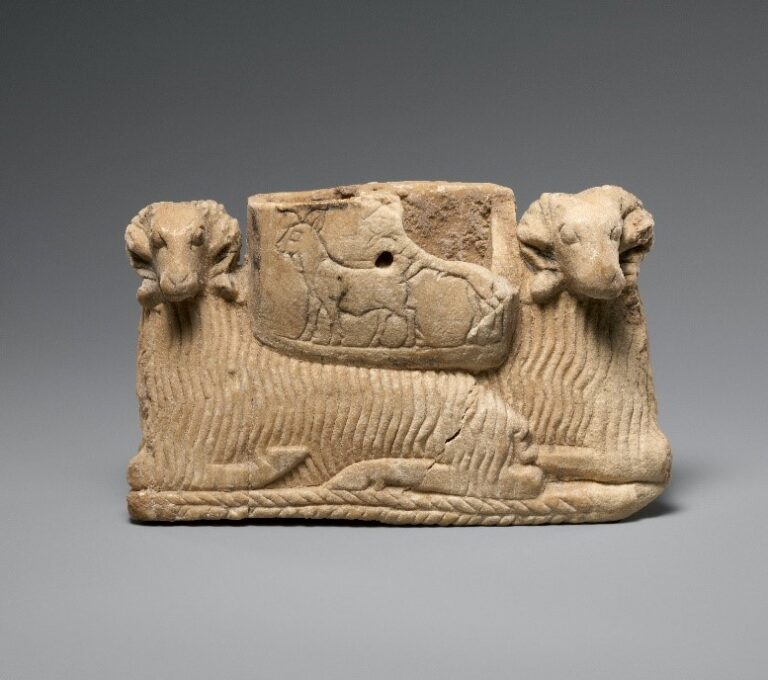
a. a Sumerian gypsum alabaster vessel supported by two rams, acquired from the Norbert Schimmel Trust in 1989. The history of the piece is provided:
By 1956, with N. Koutoulakis who bought it in Baghdad; from 1966, collection of Cecile de Rothschild; [by 1979, Robin Symes, London]; 1984, purchased by Norbert Schimmel from Robin Symes/ Xoilan Trader Inc., Geneva; from 1984, on loan to the Museum by Norbert Schimmel (L.1984.15.1); acquired by the Museum in 1989, gift of Norbert Schimmel Trust. 

b. a Mesopotamian terracotta female head, acquired from the Norbert Schimmel Trust in 1989. The  history of the piece is provided:
Before 1972, collection of Elie Borowski; by 1972, collection of Norbert Schimmel, New York; from 1983, on loan to the Museum by Norbert Schimmel (L.1983.119.12); acquired by the Museum in 1989, gift of Norbert Schimmel Trust. Deaccessioned for return to Iraq in May 2025.

c. a Mesopotamian terracotta male head, purchased from Robin Symes in 1972. It is reported to have been removed from the site of Isin. The history of the piece is provided:
By 1971, Robin Symes, London; acquired by the Museum in 1972, purchased from Robin Symes, London.

These returns renew the focus on antiquities handled by Robin Symes. The Met's "provenance" team could usefully look at the other Symes material currently on display in the museum. 

| |
Bookmark and Share so Your Real Friends Know that You Know

Tuesday, 20 March 2012

Norbert Schimmel as the model collector

News that Turkey has requested the return of part of the Norbert Schimmel collection is likely to have repercussions. I note Shelby White's comment: "Norbert Schimmel set a high standard for us as beginning collectors, not only for the quality of his collection but for his belief that it was to be shared with others" (Shelby White, "Building American museums: the role of the private collector." In Who owns the past? Cultural policy, cultural property, and the law, edited by K. Fitz Gibbon: 165-77. New Brunswick: Rutgers University Press / American Council for Cultural Policy, 2005: p. 171).

An eye of Amenhotep III from the Norbert Schimmel collection has now been returned to Egypt. Norbert Schimmel's name was linked to the Apulian dinos that was returned to Italy from New York's Metropolitan Museum of Art. Norbert Schimmel helped to fund the Met's purchase of the Morgantina hoard that has now been returned to Italy.

It looks as if there are precedents for the return of material from the Norbert Schimmel collection.

Bookmark and Share so Your Real Friends Know that You Know

Saturday, 25 October 2008

Eye of Amenhotep III Returned to Egypt

The eye of a statue of Amenhotep III from his mortuary temple near Luxor was returned from Switzerland on Thursday October 23, 2008. The piece had apparently formed part of the Norbert Schimmel Collection and then passed through various hands before being acquired by the Antikenmuseum in Basel [see earlier posting]. The identities of the Swiss collector and the German dealer have not been revealed. (They may, indeed, be one and the same.)

What is more interesting is the statement from the Egyptian State Information Service ("Amenhotep's eye back to Cairo from Switzerland", October 24, 2008):
The Swiss President had said his country gave back to Egypt one thousand pieces of antiquities.
What about these 1000 pieces? Were they returned from museums, private collectors or dealers?


Krater fragments in Princeton

Greek, Attic, probably by the Kleophrades Painter, ca. 490–480 BCE, Two non-joining fragments from a calyx-krater (mixing bowl) depicting ar...