Discussion of the archaeological ethics surrounding the collecting of antiquities and archaeological material.
Thursday, 5 February 2026
A Cycladic(ising) Journey
Friday, 14 November 2025
An Analysis of the Stern Collection of Cycladicising Art
Monday, 10 November 2025
Further returns to Greece from the Met
Fortuna then falsely claimed that the Gorgon came from William Froelich, a name frequently used by Fortuna and other galleries in its false provenance. Thereafter, the Gorgon was sold to a private collector who placed the antiquity on loan at the Met. The Antiquities Trafficking Unit seized the Gorgon from the Met in 2025.
This appears to be the figure that formed part of the exhibition, ‘Dangerous Beauty’, and was identified as coming from the collection of Andrés A. Mata. (The figure can be seen in press photograph of the October 2025 handover.)
Another gorgon applique that passed through Fortuna Fine Arts was acquired by the Carlos Museum at Emory University in 2017: it was a gift of Mata, Sybil and Ed Ralston, and Judy and Michael Steinhardt (2017.025.001). Mata also gave an inscribed bronze hydria rim to the museum in 2014 in honour of Jasper Gaunt (2014.023.001).
The mention of Froelich is important as it appears, in connection with Fortuna Fine Arts, in the history of a Tarentine limestone funerary relief acquired by the Met in 2013. Froelich and Fortuna came together in the history of a Canosan terracotta figure of Zeus that was withdrawn from a sale at Christie’s. The history also mentions Boris Mussienko. This name appears against a bronze Aphrodite on loan to the Met from a private collector and returned to Italy.
Fortuna then falsely claimed that the Statuette came from Boris Mussienko, a name frequently used by Fortuna and other galleries in its false provenance. Thereafter, the Statuette was sold to a private collector who placed the antiquity on loan at the Met. The Antiquities Trafficking Unit seized the Statuette from the Met in 2025.
The Met seizures may well have serious implications for other collections.
| |Wednesday, 5 November 2025
Returns to Greece from New York's Metropolitan Museum of Art
The Metropolitan Museum of Art announced today that it is returning 12 objects to the Hellenic Republic of Greece, including: four pieces of jewelry, two iron machaira (swords), two bronze belt clasps, two terracotta jugs, and two stone axe heads, and one group of silver spirals. The archaeological works range in date from 2700 BCE to 400 BCE. The works range in date from 2700 BCE to 400 BCE. Through the Museum’s cooperation with the Manhattan DA’s office, and as a result of its investigation into Fortuna Fine Arts, the Museum recently received new information that made it clear that the works should be repatriated, resulting in a constructive resolution.
- gold pendant, [1999.12]
- [Until 1999, with Fortuna Fine Arts, Inc., New York]; acquired in 1999, purchased from Fortuna Fine Arts, Inc. Deaccessioned for return to the Hellenic Republic in September 2025.
- two silver bracelets [1991.170.1] [1991.170.2]
- [Until 1991, with Selim Dere, New York]; acquired in 1991, gift of Selim Dere. Deaccessioned for return to the Hellenic Republic in September 2025.
- Gold and silver bracelet, [1993.314]
- [Until 1993, with Selim Dere, New York]; acquired in 1993, anonymous gift. Deaccessioned for return to the Hellenic Republic in September 2025.
- two iron machaira (swords), [2001.346] [2001.543]
- [Until 2001, with Fortuna Fine Arts, Inc.]; acquired in 2001, purchased from Fortuna Fine Arts, Inc. Deaccessioned for return to the Hellenic Republic in September 2025.
- [Until 2001, with Fortuna Fine Arts, Inc., New York]; 2001, purchsed by Andres A. Mata from Fortuna Fine Arts, Inc.; acquired in 2001, gift of Andres A. Mata, in honor of Carlos A. Picon, 2001. Deaccessioned for return to the Hellenic Republic in September 2025.
- two Macedonian bronze belt clasps, [2001.578] [2001.579]
- [Until 2001, with Fortuna Fine Arts, Inc.]; acquired in 2001, purchased from Fortuna Fine Arts, Inc. Deaccessioned for return to the Hellenic Republic in September 2025.
- 2001.579: Purchase, Mrs. Constance Goulandris Gift, in memory of Christos G. Bastis, 2001
- Cycladic or Cretan terracotta jug, [2004.342.2]
- [Until 2004, with Fortuna Fine Arts, Inc., New York]; June 2004, purchased by Andres A. Mata from Fortuna Fine Arts, Inc.; acquired in 2004, gift of Andres A. Mata. Deaccessioned for return to the Hellenic Republic in September 2025.
- Cycladic collared jar, [2004.342.1]
- [Until 2004, with Fortuna Fine Arts, Inc., New York]; June 2004, purchased by Andrés Mata from Fortuna Fine Arts, Inc., New York; acquired in August 2004, gift of A. Mata. Deaccessioned for return to the Hellenic Republic in September 2025.
- two stone axe heads, [2004.342.3]] [2004.342.4]
- [Until 2004, with Fortuna Fine Arts, Inc., New York]; June 2004, purchsed by Andres A. Mata from Fortuna Fine Arts, Inc.; acquired in August 2004, gift of Andres A. Mata. Deaccessioned for return to the Hellenic Republic in September 2025.
- one group of silver spirals. [1992.367.1–.6a, b]
- [Until 1992, with Selim Dere, New York]; acquired in 1992, anonymous gift. Deaccessioned for return to the Hellenic Republic in September 2025.
- a terracotta figure returned to Italy [2000.39]
- Private collection, England; [until 2000, with Fortuna Fine Arts, Inc.]; acquired in 2000, purchased from Fortuna Fine Arts, Inc. Deaccessioned for return to the Republic of Italy in September 2025.
- See Manhattan DA press release for mention of Fortuna Fine Arts
- a marble head of Demosthenes returned to Türkiye [2012.479.9]
- Mussienko Family Collection, Maryland, 1973. Sold by Fortuna Fine Arts, New York, to Ariadne Gallery, New York, in 1987. Sold by the Ariadne Gallery to Morris Pinto, New York, before December, 1992. Consigned by Morris Pinto to Christie’s New York, December 15, 1992, lot 14, passed in. Consigned by Morris Pinto to the Acanthus Gallery, New York. Acquired by Renée E. and Robert A. Belfer from the Acanthus Gallery, New York, before 1998. Given by Renée E. and Robert A. Belfer to The Metropolitan Museum of Art in 2012. Deaccessioned for return to the Republic of Türkiye in September 2025.
As part of a commitment to transparency, The Met has launched object webpages for all restituted works of art, specifying that the object has been returned and to what country.
Wednesday, 2 July 2025
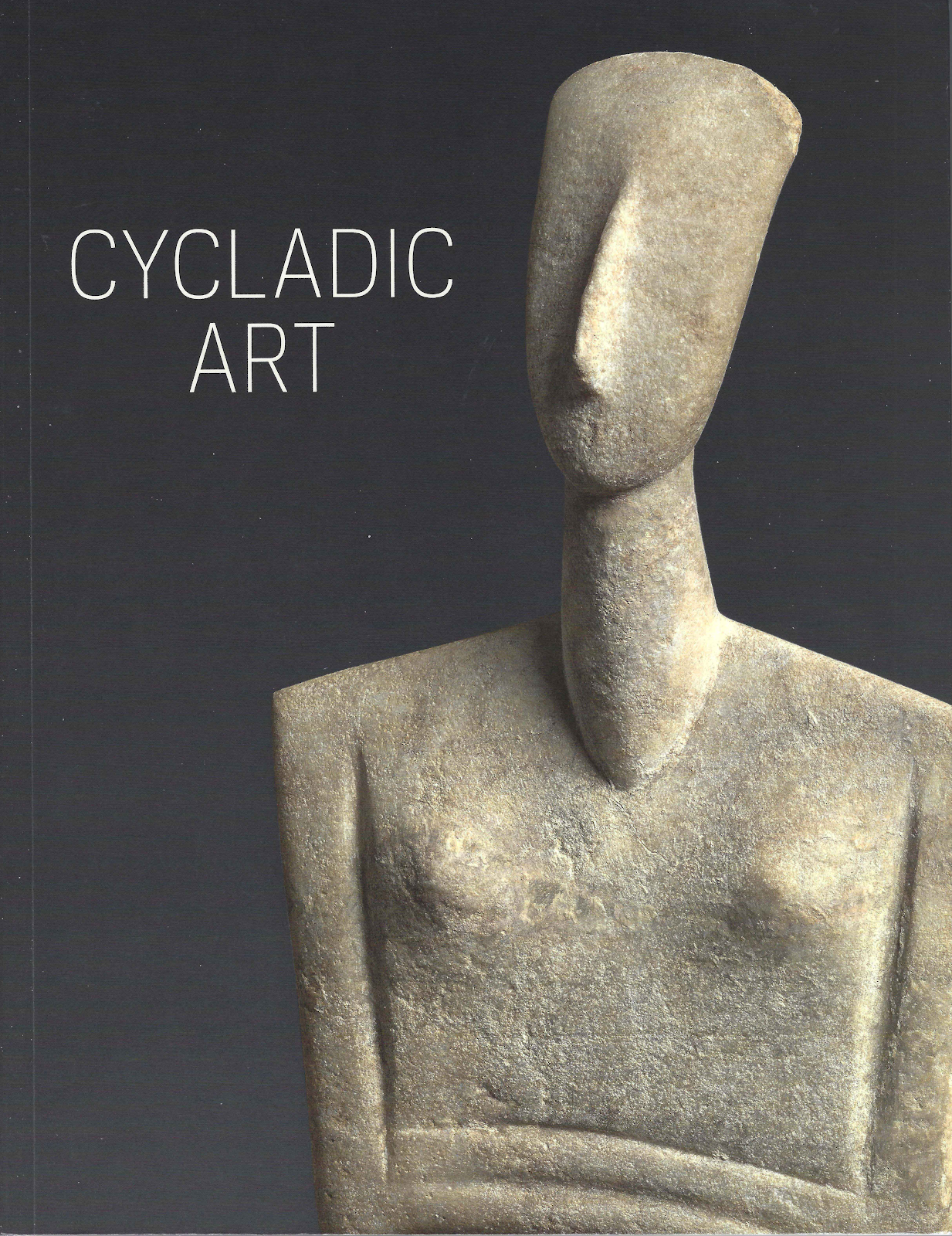
The Stern Collection of Cycladicising Figures
"The Stern collection of Cycladica holds lessons for the way that we approach ancient material culture. Viewers of this display will have their perceptions of the Early Bronze Age Cyclades shaped by the objects presented to them. Viewers—and that includes visitors to the exhibition—trust that the curators who create displays of ancient material culture are presenting authentic ancient material."
Tuesday, 25 February 2025
Metropolitan Museum of Art Returns Griffin to Greece
A bronze griffin head displayed at the museum just beyond the ticket counter was found in a riverbed at Olympia in Greece in 1914, only to disappear from the archaeological museum there years later. It resurfaced on the art market in 1948, when it was bought by a Met trustee who eventually donated it to the museum.
The Bronze Head of a Griffin was a gift in 1972 from Walter Baker and has never been the subject of a dispute.
Chance find by Th. Karachalios, supervisor of the Olympia Museum, in the bed of the Kladeos river at Olympia, near the gymnasium, in December 1914; in 1937/38 published as no longer to be found at the Olympia Museum; [by 1936, with Theodore Zoumpoulakis, Athens and Paris]; [Summer 1936, purchased by Joseph Brummer from Th. Zoumpoulakis]; [1936-1948, with Joseph Brummer, New York (P13197)]; January 15, 1948, purchased by Walter C. Baker from J. Brummer; 1948-1971, collection of Walter C. Baker, New York; acquired in 1972, bequest of Walter C. Baker.
The Met and the Greek Ministry agreed to the return of the Griffin after careful review of records and letters determining that it could not have legitimately left the Archaeological Museum of Olympia.
Saturday, 26 October 2024
Part of the Cycladic Corpus of Figures?
![]() |
| (2024) |
![]() |
| Source: Becchina archive Courtesy: Christos Tsirogiannis |
Wednesday, 18 September 2024
Attic Funerary Relief Returns to Greece
![]() |
| Sources: Hellas et Roma; Hellenic Ministry of Culture |
![]() |
| Source: Hellenic Ministry of Culture |
Friday, 26 January 2024
The Stern Collection in New York: Cycladic or Cycladicising?
![]() |
| Courtesy of Christos Tsirogiannis |
Monday, 22 January 2024
The Carlos Museum: Time to Reflect?
The return of three antiquities acquired in 2002 and 2003 raise a number of issues for the curatorial team at the Michael C. Carlos Museum at Emory University. The museum appears to overlook a number of 'facts' in the way that it has written about the return.
Returns to Greece from Michael C. Carlos Museum
Some things take time. Back in 2007 Nikolas Zirganos wrote a story about three antiquities in the Michael C. Carlos Museum [see here]. The identifications had been made by Christos Tsirogiannis.
a. Minoan larnax (inv. 2002.034.001). "The Carlos purchased the larnax from Robert Haber, New York in 2002. At the time of purchase, the museum believed the larnax to have been in the collection of Nicholas Koutoulakis (1910-1996) since the late 1960s."b. Statue from funerary naiskos (inv. 2003.005.001). "The Carlos purchased the figure in 2003 from Michael Ward, New York. No provenance information was given by the dealer. "c. Statue of a muse (formerly inv. 2002.031.001A/B). "Carlos purchased the sculpture in 2002 from New York-based dealer Robert Hecht (1919-2012), who stated he and partner George Zakos (1911-1983) had owned it since 1974."
Wednesday, 29 November 2023
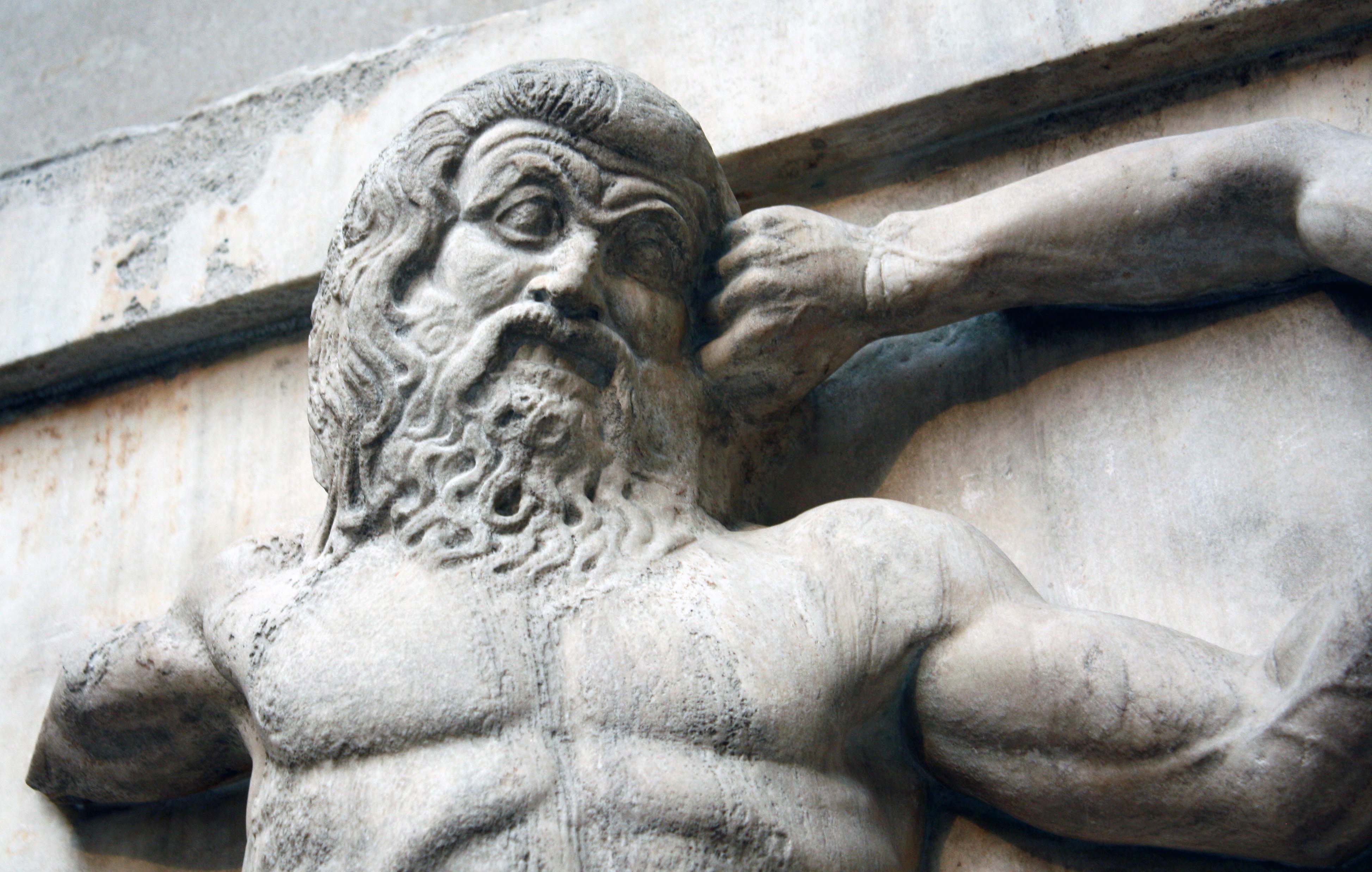
The Parthenon Sculptures and the political arena
![]() |
| Metope from the Parthenon © David Gill |
![]() |
| © David Gill |
Friday, 10 November 2023
The Michael C. Carlos Museum and the Becchina Archive
![]() |
| Image from the Becchina photographic archive courtesy of Christos Tsirogiannis; objects in the Michael C. Carlos Museum |
The Michael C. Carlos Museum has issued details of the five items that will be handed over to Italy (and three of them will remain on loan). Three of the pieces—the Laconian cup, the Attic Band Cup, and the Apulian fishplate—feature in images from the Becchina archive. The implications of the images are clear: "the fact that the Carlos could not determine where the [cup] was before it was with Palladion, there is a high probability the cup was looted".
Thursday, 2 November 2023
LHIII Glass Necklace(s) at the Michael C. Carlos Museum
![]() |
| Source: Michael C. Carlos Museum |
Monday, 16 October 2023
Becchina and the Michael C. Carlos Museum
Tuesday, 19 September 2023
Two bronze hydriai: one from a Munich collection
![]() |
| L: Formerly Shelby White collection R: Currently Michael C. Carlos Museum |
Wednesday, 22 March 2023
Bronze Hydria Returns to Greece
| Source: Homeland Security |
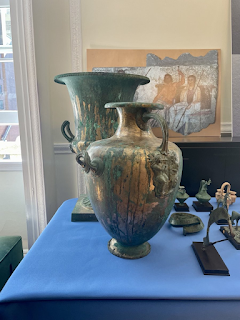
Further photographs of the latest return to Greece have been released. The bronze hydria from the Shelby White collection is of particular interest (Greek Bronze Vessels no. 8). Jasper Gaunt drew a parallel with a bronze hydria in the Michael C. Carlos Museum at Emory University (inv. 2002.012.001). The 'provenance' for this second hydria is given as:
Ex coll. Doris Seebacher, Munich, Germany. Purchased by MCCM from Robert Hecht (1919-2012) [Robert Hecht Gallery], New York, New York.
Further returns to Greece
| Source: Manhattan DA |
The Manhattan DA has announced the return of 29 antiquities, worth over $20 million, to Greece ("D.A. Bragg Returns 29 Antiquities to Greece", March 21, 2023 press release; see also here).
The Bronze Calyx Krater, which dates to 350 B.C.E., once held the bones of a deceased individual in a chamber tomb. It was looted and smuggled into Switzerland, where it was cleaned and restored by Fritz and Harry Bürki, the Zurich-based restorers and business partners of Robert Hecht. Hecht then arranged to smuggle the piece into New York, where it was sold to Leon Levy and Shelby White. It was seized by the Office in January of this year.
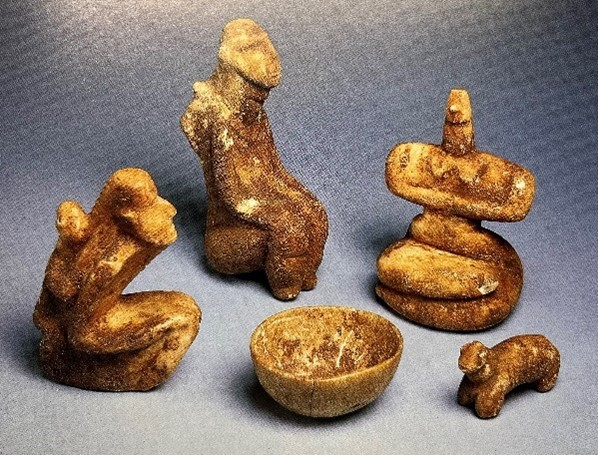
The Neolithic Family Group, which dates to 5000-3500 B.C.E and valued at $3 million. This group of objects compromises five human and animal figures carved from marble, and was looted from the island of Euboea by a Greek trafficker who smuggled the pieces into Switzerland. In 1982 dealer-trafficker Nicolas Koutoulakis sold the group to New York-based collectors Leon Levy and Shelby White. White loaned the group to the Metropolitan Museum of Art in 2000, where they remained on display until March of this year, when it was seized by the Office.
- Glories no. 76: A Late Geometric pair of horses 'said to have been found on Corfu, and for at least twenty years was in a collection in Austria. In October 1970, the group was lent to the Kunsthistorisches Museum in Vienna for restoration.'
- Glories no. 80: an armlet, two lidded pyxides, and an oinochoe from a hoard of at least 40 pieces found in northern Greece.
- Glories no. 141: a gold treasure consisting of a pair of coiled snake armbands, a pair of earrings with swans, a gold and carnelian necklace, a gold ring with carnelian intaglio, part of a gold wreath, and a gold diadem.
Monday, 13 March 2023
UK Government and the Parthenon: Update
| Parthenon metope in the British Museum © David Gill |
“The UK has cared for the Elgin Marbles for generations. Our galleries and museums are funded by taxpayers because they are a huge asset to this country,”
“We share their treasures with the world, and the world comes to the UK to see them. The collection of the British Museum is protected by law, and we have no plans to change it."
However, the museum is banned by law from disposing of objects in its collection and Sunak said “we have no plans to change it”. It is understood that Sunak does not believe that a long-term loan would be in the spirit of the British Museum Act.
Monday, 6 February 2023
From Geneva to Athens
![]() |
| L: source, Phoenix Ancient Art R: source, Hellenic Ministry of Culture |
The Hellenic Ministry of Culture has announced the return of 15 antiquities that had been seized from an unnamed antiquities gallery in Geneva [press release]. The Attic black-figured column-krater attributed to Lydos appears to be the one that features in the 2015 catalogue for Phoenix Ancient Art of Geneva and New York. Entry no. 4 shows the krater, reconstructed from 'large fragments', decorated with Herakles and the centaur Nessos. The entry suggests that it formed part of the Lambert collection in Neuchâtel prior to 1972 and then by descent through the family.
Another Bürki object returns to Italy
Source: MMA A psykter column-krater attributed to the Troilos painter was deaccessioned by New York's Metropolitan Museum of Art in June...
-
Source: Sotheby's A marble head of Alexander the Great has been seized in New York (reported in " Judge Orders Return of Ancien...
-
Source: ICE. There are times when you wonder if there is a lack of imagination when it comes to naming operations but 'Mummy's C...
-
Detail of the Sophilos dinos © David Gill The Sophilos dinos in the British Museum has been reconstructed from approximately 50 fragments. I...