Showing posts with label coins. Show all posts

Wednesday, 22 March 2023

Further returns to Greece

Source: Manhattan DA

The Manhattan DA has announced the return of 29 antiquities, worth over $20 million, to Greece ("D.A. Bragg Returns 29 Antiquities to Greece", March 21, 2023 press release; see also here).

The items include a gold coin celebrating the assassination of Julius Caesar that surfaced on the Munich market in 2016.

The press release mentions the seizure of a bronze krater:
The Bronze Calyx Krater, which dates to 350 B.C.E., once held the bones of a deceased individual in a chamber tomb. It was looted and smuggled into Switzerland, where it was cleaned and restored by Fritz and Harry Bürki, the Zurich-based restorers and business partners of Robert Hecht. Hecht then arranged to smuggle the piece into New York, where it was sold to Leon Levy and Shelby White. It was seized by the Office in January of this year.
This seems to be a companion to the krater apparently looted from Pieria that was returned to Greece in 2008.

Unmentioned in the release, but placed next to the krater, was a bronze hydria that appears to be the one from the Shelby White collection (Bronzes no. 8). It is decorated beneath the vertical handle with a relief of Orpheus and a satyr. Chi and Gaunt draw attention to a companion piece in the Michael C. Carlos Museum (inv. 2002.012.001) that was acquired from Robert Hecht.

The release also mentions the return of a Late Neolithic marble group:
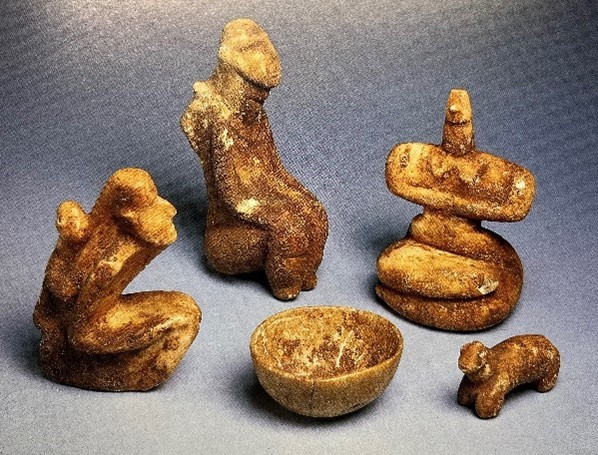
The Neolithic Family Group, which dates to 5000-3500 B.C.E and valued at $3 million. This group of objects compromises five human and animal figures carved from marble, and was looted from the island of Euboea by a Greek trafficker who smuggled the pieces into Switzerland. In 1982 dealer-trafficker Nicolas Koutoulakis sold the group to New York-based collectors Leon Levy and Shelby White. White loaned the group to the Metropolitan Museum of Art in 2000, where they remained on display until March of this year, when it was seized by the Office.
The group had been owned by Charles Gillet and Marion Schuster. They are "said to be from Euboea, or the east coast of Attica opposite, near Porto Raphti, perhaps from an islet attached to the mainland in prehistoric times" (Glories no. 8). It is interesting that the release emphasises the findspot on Euboea rather than Porto Raphti or more generally Attica preferred by Getz-Preziosi and Thimme. There are aspects of the group that make me wonder if they are ancient, a concern raised by Thimme back in 1977.

Next to the Late Neolithic group, but unmentioned in the release, was a double Cycladic figure: a small female figure standing on the head of a larger one. This appears to be the figure in the Shelby White collection (NAC no. 18; Glories no. 9; Katonah no. 15). Next to them was an Early Cycladic II bowl that also appears to be from the Shelby White collection (Glories no. 15).

Among the other items that appear to have been other items that formed part of the Shelby White collection:
  • Glories no. 76: A Late Geometric pair of horses 'said to have been found on Corfu, and for at least twenty years was in a collection in Austria. In October 1970, the group was lent to the Kunsthistorisches Museum in Vienna for restoration.'
  • Glories no. 80: an armlet, two lidded pyxides, and an oinochoe from a hoard of at least 40 pieces found in northern Greece.
  • Glories no. 141: a gold treasure consisting of a pair of coiled snake armbands, a pair of earrings with swans, a gold and carnelian necklace, a gold ring with carnelian intaglio, part of a gold wreath, and a gold diadem. 
The press release mentions that the Royal-Athena Galleries have co-operated with the investigation suggesting that some of the other items were from that source (perhaps including a fragment of wall-painting).

I note that Christos Tsirogiannis was involved with some of the identifications. 

We await for a full list of the return.

| |
Bookmark and Share so Your Real Friends Know that You Know

Saturday, 4 February 2023

Further returns to Italy from San Antonio Museum of Art and Shelby White

Oinochoe fragment
attributed to the Harrow painter
returned from
the San Antonio Museum of Art.
Source: San Antonio Museum of Art

The Manhattan DA has reportedly returned 14 more antiquities to Italy: though the objects and images presented at the press announcement counted 16 ("D.A. Bragg Returns 14 Stolen Antiquities to Italy", Manhattan DA February 2, 2023). Two sources were acknowledged: Shelby White and the San Antonio Museum of Art. The third, the source of a silver coin, was left anonymous in the press release.

At least three of the objects appear in the Glories of the Past catalogue of the Shelby White and Leon Levy collection. The release gives further information about the Attic black-figured hydria attributed to the Priam painter.
The piece first surfaced in Italy after being looted by Giovanni Franco Becchina, a well-known antiquities trafficker. From Italy, the piece was then smuggled and laundered by Paris-based Robert Hecht. Hecht ultimately sold the piece with false provenance to Shelby White in New York County in 1989.
These add to the 14 pieces featured in the catalogue that have been returned to Greece, Italy and Turkey.

The nine pieces featured in the images at the press statement are derived from the San Antonio Museum of Art. The objects are derived from several sources: Sotheby's in London; Christie's in London and Geneva; Galerie Palladion Antike Kunst; Galerie Günter Puhze; Royal Athena Galleries; Robin Symes. For example, the oinochoe fragment attributed to the Harrow painter surfaced through Galerie Palladion Antike Kunst, and was sold to Gilbert M. Denman, Jr. by Robert Hecht.  The nine objects may be added to other pieces that were handed over in 2022. We are also expecting further details about three other objects derived from Frederick Schultz that have been handed over by the museum. 

Three other objects featuring in the press statement have yet to be linked in a formal way to a specific collection though Christos Tsirogiannis has identified two of them in the Becchina archive and one in the Schinousa archive. 

The final piece is a silver coin.
The Sicily Naxos Coin. Minted circa 430 B.C.E in the Greek colony of Naxos, on Sicily, this silver coin features the bearded Dionysus on one side and his squatting drinking partner, Silenus, on the reverse. The Sicily Naxos Coin first surfaced on the international art market in 2013, when a known trafficker offered the coin for sale with no provenance whatsoever. Prior to its appearance at a London-based auction house, a co-conspirator of the trafficker supplied false provenance for the coin. The Sicily Naxos Coin is currently valued at $500,000 and was among a group of coins seized at JFK airport as it was being smuggled into New York pursuant to an ongoing joint investigation between this Office, HSI, and Italy. At least one individual has been arrested in the course of this investigation with more to follow.
Three Shelby White pieces, nine objects from San Antonio, one silver coin, and three other pieces equal 16 objects (not 14).

Objects from the San Antonio Museum of Art and in the Shelby White and Leon Levy collection were the subject of an extended discussion by Chippindale and Gill in the American Journal of Archaeology back in 2000. 
Chippindale, C., and D. W. J. Gill. 2000. "Material consequences of contemporary classical collecting." AJA 104: 463-511. [DOI]
LM expects to add further detail to this summary in due course.

| |
Bookmark and Share so Your Real Friends Know that You Know

Friday, 21 January 2022

Weiss coins return to Turkey


LM has covered the story of Arnold Peter Weiss on previous occasions. It was announced today that 14 coins from the collection of Weiss have been returned to Turkey ("D.A. Bragg: 28 Antiquities Repatriated to the People of Turkey", press release January 21, 2022). Alongside the return of antiquities from the Steinhardt collection it was announced: "Twelve of the coins, with a collective value of $58,000, from WEISS’ collection were repatriated to Turkey as part of today’s ceremony."

This is in addition to the coins returned to Greece.

Coin collectors should note the reminder:
As part of his plea agreement and sentence, WEISS agreed to forfeit 23 coins in his possession, pay a criminal fine, perform 70 hours of community service, and author an article for the American Numismatic Society Magazine detailing the dangers of collecting unprovenanced coins.

| |
Bookmark and Share so Your Real Friends Know that You Know

Tuesday, 21 April 2020

Coins in context


One of the conservators at the British Museum speaks about why it is important to treat coin hoards as part of an archaeological context.

Bookmark and Share so Your Real Friends Know that You Know

Monday, 23 January 2017

Operation Pandora

A selection of coins seized in Operation Pandora. Source: Europol.
The Deutsche Presse-Agentur GmbH has reported that Operation Pandora has recovered some 3500 cultural objects including some 400 coins. 75 people are said to have been arrested in 18 countries.

Some of the selling of material has taken place online.

Europol has issued a press release ("3561 artefacts seized in Operation Pandora", 23 January 2017). The main activity took place in November 2016.

Countries listed:

  • EU-countries: Austria, Belgium, Bulgaria, Croatia, Cyprus, Germany, Greece, Italy, Malta, the Netherlands, Poland, Portugal, Romania, Spain and the United Kingdom. 
  • Non-EU countries involved: Bosnia and Herzegovina, Serbia and Switzerland

What activity took place in the UK?

See also the report from the BBC ("'Operation Pandora' recovers thousands of artefacts", 23 January 2017).

Bookmark and Share so Your Real Friends Know that You Know

Tuesday, 3 January 2017

Metal-detecting and archaeology

Displays in Lincoln © David Gill
The recent archaeological survey work at the Anglo-Saxon vicus at Rendlesham in Suffolk has reminded me of the contribution of controlled metal-detecting on archaeological sites. But the account of the discovery of this significant site is partly due to the unauthorised activity of metal-detectorists on the site.

The archaeological community needs to be reminded that there is a difference between scientifically excavated material and finds that are scooped out of the ground and literally carried away in a supermarket carrier bag. Contrast the difference between the Lenborough Hoard (and see my discussion here) and the Beau Street Hoard. I was full of praise for the excavation of the Beau Street Hoard (e.g. "It is a good reminder of the amount of information that can be gleaned from a properly excavated, conserved and studied Roman coin hoard").

As we start 2017, would it be possible for there to be a sensible discussion of how the archaeological heritage of England and Wales can be protected from unauthorised disturbance?

Bookmark and Share so Your Real Friends Know that You Know

Friday, 7 October 2016

Arrests in Greece

News is emerging of 26 arrests linked to a network supplying antiquities (including coins) to outlets in Germany, Austria, Switzerland and the UK (Helen Stoilas, "Police in Greece arrest 26 in bust of alleged antiquities smuggling ring", The Art Newspaper 5 October 2016). It appears that more than 50 people were involved in the network.

It is reported:
The two alleged ringleaders of the gang were arrested on Sunday at the Greek-Bulgarian border, and had almost 1,000 coins and small artefacts hidden in the bumper of their car. Police said they have recovered a cache of more than 2,000 objects, mostly coins, but including gold jewellery, bronze figurines, ancient glassware and some larger stone and marble statues.
A number of metal detectors were recovered.

A spokesperson for the Greek police is mentioned, "Police said the works were sold using fake provenance documents attributing them to private collections in Europe, but that the auction houses involved (which have not been named) knew the coins were illicit property and often helped inflate the final prices paid for them."

This raises the question that there is a lack of rigour in the due diligence process adopted by some, as yet unnamed, dealers. However if any of those dealers have been linked in previous cases there needs to be a full investigation of internal procedures.

The case is a reminder of why coins need to form part of MOUs.


Bookmark and Share so Your Real Friends Know that You Know

Monday, 15 February 2016

Nathan Elkins on ACCG Coin Test Case

I have commented before on Nathan Elkins' article on "Ancient coins, find spots, and import restrictions: A critique of arguments made in the Ancient Coin Collectors Guild’s ‘‘test case’’" in the Journal of Field Archaeology (2015).

This is now available online via academia.edu.

Abstract
The Ancient Coin Collectors Guild (ACCG) has launched multiple legal challenges aimed at undermining import restrictions on ancient coins into the United States in bilateral agreements with foreign countries.One key component of the ACCG’s argument is that the State Department has inappropriately restricted certain types of coins according to where they were made rather than where they are found, as mandated by the 1983 Convention on Cultural Property Implementation Act. Although the ACCG has thus far been unsuccessful, it has not been pointed out that existing import restrictions on coins, in fact, have been written to include coins that tended to circulate locally and that are found primarily within the borders of the country with which the bilateral agreement is made. The ACCG’s argument is thus on shaky ground. As the ACCG continues to press ahead with new litigation, it is worth drawing attention to realities and probabilities of ancient coin circulation as they pertain to protected coins.

Bookmark and Share so Your Real Friends Know that You Know

Friday, 10 July 2015

The Lenborough Hoard

My article, 'Damaging the archaeological record: The Lenborough Hoard', has appeared in the Journal of Art Crime 13 (Spring 2015) 51-57. The article reviews how the coins were removed from their archaeological context and suggests ways to develop stronger guidelines to protect the archaeological heritage of England and Wales.

Bookmark and Share so Your Real Friends Know that You Know

Friday, 8 May 2015

The market in ancient coins and self-regulation

I have been reflecting on a series of questions to answer at a conference next week. One of them asks this, Is self-regulation the way forward?

One of the ways that this could be answered is by looking at the responses of auction-houses or galleries when 'toxic antiquities' are identified. The organisations can either open negotiations with the source countries or they can press ahead with the sale. But the second approach is not always successful because potential buyers can get 'spooked' and the objects get left unsold and perhaps unsellable.

But then there is the topic of freshly surfaced ancient coins. Does the market self-regulate? Or do national bodies have to set up procedures?

I have read with much interest the reaction to a scholarly article by a North American academic in a high profile archaeology journal that addresses aspects of this issue.

A Washington lobbyist who is paid for his services by the International Association of Professional Numismatists (IAPN) has reacted sharply to this piece of academic research, and has even complained that the author of the article shared an electronic offprint with colleagues ("provided advance copies of his article to his fellow archaeo-bloggers"). (There has also been an unsightly discussion of how those who deal in ancient coins seem to define collegiality.)

It gets worse: the lobbyist appears to misunderstand that copyright rules that restrict the author (or anyone else) from posting the article in a place where it can be downloaded for free.

And this same lobbyist has been outspoken about the movement of archaeological material removed from Syria to western markets.

And what has the IAPN said about one of its members linked to a recent incident?

It appears that IAPN spent $40,000 on lobbying for 2014, and $10,000 so far this year (to Messrs Bailey & Ehrenberg). (But I rely here on information that has been made available in the public domain to aid transparency.)

If the IAPN does not 'reign in' its paid lobbyist, it could suggest to the academic and policy-making communities that 'self-regulation' does not work in the area of ancient coins.

And, if I can use a soccer image, the lobbyist will have scored an 'own goal' and encouraged North American authorities to intervene more closely in the market in ancient coins.

| |
Bookmark and Share so Your Real Friends Know that You Know

Thursday, 7 May 2015

Ancient coins, find spots, and import restrictions

I note that the next number of the Journal of Field Archaeology, now published by Maney, will be including an important article on ancient coins. I am grateful to Nathan Elkins for sending me a digital offprint.

For those who would like to dismiss this research as appearing in an 'obscure journal' (and only a Washington lobbyist could write this!), can I direct readers of LM to the blibliometric data that places JFA in the first quartile of archaeological journals?

Nathan T. Elkins, Ancient coins, find spots, and import restrictions: A critique of arguments made in the Ancient Coin Collectors Guild’s "test case", Journal of Field Archaeology 40, 2 (2015) 237-43.

Abstract
The Ancient Coin Collectors Guild (ACCG) has launched multiple legal challenges aimed at undermining import restrictions on ancient coins into the United States in bilateral agreements with foreign countries. One key component of the ACCG’s argument is that the State Department has inappropriately restricted certain types of coins according to where they were made rather than where they are found, as mandated by the 1983 Convention on Cultural Property Implementation Act. Although the ACCG has thus far been unsuccessful, it has not been pointed out that existing import restrictions on coins, in fact, have been written to include coins that tended to circulate locally and that are found primarily within the borders of the country with which the bilateral agreement is made. The ACCG’s argument is thus on shaky ground. As the ACCG continues to press ahead with new litigation, it is worth drawing attention to realities and probabilities of ancient coin circulation as they pertain to protected coins.

| |
Bookmark and Share so Your Real Friends Know that You Know

Thursday, 23 April 2015

Operation Mummy's Curse

Source: ICE.
There are times when you wonder if there is a lack of imagination when it comes to naming operations but 'Mummy's Curse' is probably one of them.

Put that aside, ICE has announced that it is has returned "dozens" of Egyptian antiquities to Egypt as part of an "ongoing five-year investigation by ICE’s Homeland Security Investigations (HSI) targeting an international criminal network that illegally smuggled and imported more than 7,000 cultural items from around the world". The total value of the seizures so far is approximately $3 million.

This sarcophagus appears to be the one siezed in a garage in Brooklyn in 2009. It is reported (Kathleen Caulderwood, "US Returns $2.5M In Egyptian Antiquities As Experts Call For Tougher Punishment On Smugglers", International Business Times April 22, 2015):
The coffin had been emblazoned with the name Shesepamutayesher and the title “Lady of the House” sometime between 664 and 111 B.C. But when Special Agent Brenton Easter of the U.S. Department of Homeland Security (DHS) uncovered the artifact Sept. 8, 2009, after months of investigation, it had been slapped with a few false shipping labels.
So once again we are seeing that the "paper trail" of a significant object is being corrupted to allow the piece to enter the market.

Caulderwood reveals that the investigation is linked to Morris Khouli (and see my earlier discussion here).
Easter recovered the head and other objects from Khouli’s gallery, intercepted shipments in Newark, New Jersey, and eventually found the “Lady of the House” sarcophagus at Khouli’s home, in a crate all ready for shipment.
ICE issued a press release on these investigations back in 2011.

Caulderwood also makes the point that there is the potential for this investigation to be linked to material coming from Syria. And this is a point that I have made before with links to material allegedly from Palmyra.

The material is not just Egyptian in character. The press release states: "A related December 2010 shipment interception netted agents 638 ancient coins from different countries, 65 of which are being repatriated to Egypt today." Which countries? Who imported the coins? What did the paperwork say? And coins have already formed part of the discussion in the Khouli case.

This immediately raises the big question: who has acquired the 7000 plus objects mentioned in the release? Museums? Private collectors? Or are they still part of the stock in a range of dealers? And are some of these objects forming part of what some term "the licit market"?

And this stated case comes against a broad backdrop that appears to include an Egyptian coffin seized in Miami.

Bookmark and Share so Your Real Friends Know that You Know

Wednesday, 22 April 2015

The modern movement of ancient coins and protective legislation

I have been reading an important new piece of research by Professor Nathan T. Elkins of Baylor University ("Ancient coins, find spots, and import restrictions: a critique of arguments made in the Ancient Coin Collectors Guild's 'test case'," Journal of Field Archaeology 40, 2 [2015] 236-43). He considers the way that the ACCG "has launched multiple legal challenges aimed at undermining import restrictions on ancient coins into the United States in bilateral agreements with foreign countries".  He includes an important table that lists coin hoards from Cyprus that contain Cypriot coins. This data is provided to challenge the "spin" provided by those who lobby for the coin dealing bodies.

Elkins makes an important point in his conclusion: "Legal challenges have been launched by lobbying groups with a commercial interest that present a highly skewed picture of the actual situation that is not based on evidence".

This academic research is likely to undermine attempts to waive restrictions on the modern movement of ancient coins.

Bookmark and Share so Your Real Friends Know that You Know

Tuesday, 24 March 2015

Bland on the so-called Crosby Garrett helmet and the Lenborough Hoard

Roger Bland has placed his paper on 'The Portable Antiquities Scheme and Treasure Act: the Current Situation' given at the Museums Association March 2015 Dig It: Museums and Archaeology Conference online.

I notice that he discusses two topics discussed on LM. The first is the so-called Crosby Garrett helmet. Bland notes:
This was found by a metal detector user who reported it to one of our FLOs who was able to establish exactly where it was found.
I have discussed this helmet in print elsewhere (available online). Bland does not draw attention to the fact that the two FLOs [not one!] were not shown the reported find spot for some three months (i.e. on 30 August 2010).

Bland then talked about the subsequent excavation:
This at least proved that the object had come from Crosby Garrett – some people commenting on the web had doubted that – and that it had a context, as it came from a so - called `native’ settlement. The immediate context of the helmet remains difficult to pin down: it seems to have been buried below a rough stone floor, though whether that belonged to a building, a road, or possibly a cairn is unclear.
I have discussed this investigation and I found that the evidence was not compelling.

Lenborough Hoard
Source: finds.org.uk (under CC)
At the end of the talk Bland turned to the Lenborough Hoard as an example of a hoard falling under the Treasure Act:
Four days before Christmas the Finds Liaison Officer (FLO) for the Portable Antiquities Scheme in Bucks was invited to record the finds made by detectorists at a metal detecting rally at Lenborough, just south of Buckingham. Within half an hour of arriving and setting up her recording table, news came that something interesting had been found! As the light went at the end of the day a hoard of more than 5,000 silver coins, wrapped in a damaged lead parcel, had been excavated. The coins had been piled onto a thin rectangle of lead sheet with cut edges. The longer edges had then been lifted and folded over on themselves and the ends pinched together to make an elliptical parcel. Through the damage on the upper surface a tightly packed, jumble of coins could be seen. They did not appear to have been laid in any order and there was no trace of, or room for them to have been in leather pouches. This was a rescue job and Ros, as our sole FLO at event with about a hundred metal detector users, did a heroic job in the circumstances and ensured that all the coins were recovered.
This hoard has been discussed on LM before. In particular there is the issue of the historic nature of the location where the rally was held. And what about the less than orthodox removal of the coins, in contrast to the Beau Street Hoard that was removed in a scientific way that has allowed detailed study and interpretation?

Bland has only placed his notes on line and not his refined final views. But his online presentation appears to overlook some of the key issues relating to both these 'finds'.

Bookmark and Share so Your Real Friends Know that You Know

Friday, 13 February 2015

The Lenborough Hoard and loss of knowledge

The Lenborough Hoard
Source: www.finds.org.uk
I noticed that The Times (London has covered the Lenborough Hoard (Jack Malvern, "Metal-detector row led to £1m Anglo Saxon coin hoard", 11 February 2015). Much of the story recycles the British Museum press release but it includes a section on Paul Barford, an "archaeological blogger". The Times draws attention to the information that has been lost by the scooping of the coins into a carrier bag.

Bookmark and Share so Your Real Friends Know that You Know

Wednesday, 11 February 2015

The Lenborough Hoard and the future of PAS

Lenborough Hoard
Source: finds.org.uk (CC)
The Lenborough Hoard is now featured on the BBC ("Hoard of Anglo Saxon coins largest discovered under Treasure Act", 11 February 2015). It is essentially a recycled press release (see here), and even includes a mention of the alleged "excavation".

We should also note that Dr Roger Bland has suggested that the future of PAS is far from certain.
However, the head of the antiquities scheme that funds the finds, Roger Bland, said the future was looking uncertain because of budget reductions. 
"I'm not sure whether we're going to be able to renew the contracts for nine of the 32 posts that we've got in the scheme from the 1 April. 
"I'm quite concerned but I also feel that we've been in difficult places before and we've managed to keep going," he said.

Meanwhile Dr Daniel Pett of PAS has tweeted me a message.

This was no doubt in reaction to my post yesterday. My search arrived at a page so that when you clicked on the link you just saw code - and the image was one of Lego. I can only presume that the BM has set up their backup server so that the public (and search engines) can see it. Perhaps that is a loophole that should be closed.

Bookmark and Share so Your Real Friends Know that You Know

Tuesday, 10 February 2015

Lenborough Hoard: update

Lenborough Hoard
Source: finds.org.uk (under CC)

There appeared to be a curious blip on the PAS website earlier today that meant the normal record was unavailable. I have checked again this evening and it is now all there [here].

The circumstances provided on the website appears as "Weekend Wanderers Xmas Dig". (For further images see here.)

We also need to remember that under The Treasure Act (1996) 'the occupier of the land' can receive part of the reward.

Bookmark and Share so Your Real Friends Know that You Know

The amazing archaeological hoard

I see that the Lenborough Hoard features prominently in the press release for the launch of the Treasure Annual Report 2012 [press release, "Largest Anglo-Saxon coin hoard tops list of latest nationwide treasure finds". 10 February 2015].
... the largest Anglo Saxon coin hoard found since the Treasure Act began is announced. This amazing archaeological hoard of around 5,200 coins was discovered in the village of Lenborough, Buckinghamshire. This discovery highlights the ongoing importance of the Portable Antiquities Scheme and Treasure Act in ensuring that the most important finds are secured for the nation.
Neil MacGregor also comments on the hoard:
More Treasure finds are being reported than ever before and unique objects are documented and conserved for study and public display, such as the recent find of the largest Anglo-Saxon coin hoard recorded since the Treasure Act of 1996. These achievements are a testament to the network of Finds Liaison Officers, who play a key role in ensuring archaeological finds found by the public are properly reported and recorded.

Is the Lenborough Hoard the best example to use of how FLOs are deployed in the field? Could some of the issues that arose have been anticipated by the FLO? Are archaeologists just interested in recording objects and creating databases? What about the careful excavation of coin hoards that we have seen elsewhere?

The finder Paul Coleman is also quoted in the press release:
'When I saw the first few coins I was really excited because I knew I had found a hoard, however the excitement grew and grew as the size and importance of the find became apparent. Ros Tyrrell, the FLO who was in charge of the excavation, was spot on when she said "now I know a little of what Egyptologist Howard Carter must have felt, when he first looked into the tomb of Tutankhamen."'
What is meant by 'excavation' here? Did Carter scoop up the Tutankhamun finds into a handy F&M pannier? (No doubt an informed reader of LM will have studied the packing materials of the excavation.)

Coleman has indicated that he is willing to turn down the reward ("Jobless man set to miss out on £1 million hoard reward", Buckingham Today 10 February 2015).
Mr Vaizey said: “I’d especially like to thank the finders and landowners who have graciously waived their right to a reward so that local museums can acquire treasure. 
“It is an initiative that the government has been keen to support and it demonstrates that metal detectorists have a genuine interest in the past, and are not just interested in archaeology for personal gain.” 
The coins are being showcased at the British Museum this morning with curator, Gareth Williams, discussing his research into the hoard but the eventual resting place of the coins is yet to be decided.
It is pity that the apparent rushed removal of the coins will have meant that valuable contextual knowledge was lost.

Bookmark and Share so Your Real Friends Know that You Know

Unearthing the Lenborough Hoard


I have commented on the Lenborough Hoard before. Current Archaeology has a short account of the "discovery" in its March 2015 edition ("Unearthing the Lenborough Hoard", p.9) and the entry is partially posted on the PAS website (I suggest you visit to see the error message that I am sure will disappear shortly after this post goes up).

The CA report tells is, 'Attending metal-detecting events in order to ensure finds are properly recorded and their precise locations logged is all in a day's work for a Finds Liaison Officer'. So does that mean that the precise relationship of the coins one to another was retained? After all, the BM has published the model way to excavate and remove a coin hoard.

Earlier reports had suggested that the coins were found in a 'lead bucket' but Ros Tyrrell (FLO) is now quoted: 'The coins had been piled onto a thin rectangle of lead sheet, after which the longer edges were folded over on themselves, and the ends pinched together to make an elliptical parcel'. The parcel now appears as part of the description on the PAS database.

The report informs us that the coins 'do not seem to have been arranged in any particular order'. I presume that this is an observation made from the carefully controlled removal of the coins.

The PAS database states that Gareth Williams is preparing a report for the Coroner while the CA story states that 'a full archaeological report' is in preparation for the Coroner's inquest. What will it contain?

I am sure that there are lessons to be derived from the removal of the hoard.


Bookmark and Share so Your Real Friends Know that You Know

Tuesday, 6 January 2015

How to excavate and study a coin hoard

I was very struck by a presentation on the Beau Street Hoard at a conference last November. The publication notes:
The archaeologists decided to lift the hoard as a block with its surrounding soil so that it could be excavated under laboratory conditions.
A perusal of Eleanor Ghey's The Beau Street Hoard shows what can be gained from such a careful study.

What information has been lost through the rushed and apparently unscientific removal of the Lenborough Hoard from an unploughed field in Buckinghamshire?

Bookmark and Share so Your Real Friends Know that You Know

The Afrati Armour in Harvard

Source: Harvard Art Museums The repatriation of the Afrati armour from New York's Metropolitan Museum of Art has implications for other ...