Showing posts with label Turkey. Show all posts

Wednesday, 24 April 2024

Another Bubon bronze head likely to be repatriated


It appears that a bronze head acquired by the J. Paul Getty Museum from Nicolas Koutoulakis has been removed from display and appears to be returning to Türkiye (Adam Schrader, "The Getty Museum Returns an Ancient Bronze Head to Turkey", Artnet April 24, 2024). The head had featured in the Fire of Hephaistos exhibition (1996) no. 44: the find-spot was stated as "Reported to be from Ibecik (ancient Bubon in Lycia) in Turkey". Arielle Kozloff had earlier listed the statue among the Bubon pieces in The Bulletin of the Cleveland Museum of Art (1987).

This will put further pressure on the Cleveland Museum of Art in their attempt to disassociate a headless bronze statue from its suggested link with Bubon and its identification with the emperor Marcus Aurelius. Incidentally, the Cleveland statue was illustrated in the Fire of Hephaistos catalogue (cat. 54, fig. 2): "... possibly Marcus Aurelius ... Reported to be from Ibecik (ancient Bubon in Lycia)."

| |
Bookmark and Share so Your Real Friends Know that You Know

Tuesday, 31 October 2023

Boston Returns Two Bronzes Linked to Bubon


Elizabeth Marlowe has drawn attention (on X) to the return of two bronzes associated with Bubon in Türkiye from Boston's Museum of Fine Arts.

One is a right leg acquired in 1967 as a gift from Jerome M. Eisenberg and Alan Ravenal (inv. 68.732). The leg appeared in the Harvard exhibition, The Fire of Hephaistos (1996), no. 16: 'now associated with the group of sculptures from ancient Bubon'. Vermeule (1980) linked it with the Bubon series (no. N). Jale Inan (1994) linked the leg with the torso in a private collection (Inan: 'Dr Sackle') and identified as Commodus (Vermeule no. K; Fire of Hephaistos, no. 55). Inan also linked it with the left thigh that appeared on the New York market (Vermeule no. T). A composite image is provided in Inan's study (pl. xxix).

The second piece is a bronze head that was in the possession of Eisenberg in 1966 when it was shown to Vermeule. In 1967 it was sold to a private collector, and in 2003 was presented to Boston by an anonymous donor (inv. 2003.786). 

Display of imperial bronze statues at Bubon.
Reconstruction: David Gill based on Jale Inan.


| |
Bookmark and Share so Your Real Friends Know that You Know

Saturday, 2 September 2023

Bubon: More Returning Sculptures

Line drawing of part of the base in the Sebasteion at Bubon, Türkiye with portrait statues of Marcus Aurelius and Lucius Verus at the appropriate positions. Note: the figures are not to scale.


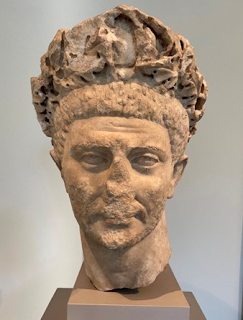
Christopher Chippindale and I drew attention to the imperial bronzes associated with the Sebasteion at Bubon in Turkey back in 2000: discussion of this group can be traced back to the 1970s. The looting of this space seems to have taken place in the early 1960s. It now seems that the (headless) portrait of Marcus Aurelius as a philosopher will be returned from the Cleveland Museum of Art and will be reunited with the portrait of Lucius Verus from the Shelby White and Leon Levy collection: the pair were originally displayed, appropriately, next to each other. They will join the Lipson statue of Septimius Severus that was seized from New York's Metropolitan Museum of Art. Other pieces include the head of Caracalla that had been displayed at Fordham University. 

Elizabeth Marlowe ("Bronze Roman statue, believed to have been looted from Turkey, seized from Cleveland Museum of Art", The Art Newspaper 31 August 2023) has pointed out that Cleveland has played down both the identification with Marcus Aurelius and the association with Bubon. The same phenomenon is being played out with the bronze statue in the Houston Museum of Fine Arts. The online entry now notes: 
It was associated throughout the 1970s and 1980s, by some scholars, with other bronzes that had been found near Bubon, Turkey. However, that opinion was ultimately disproved in 1993. The Houston sculpture was acquired in 1962; the excavations at Bubon commenced two years after, in 1964.
The start of the illicit activity at Bubon may well have preceded 1962 and the museum would be sensible to be cautious.

It appears that a portrait of a woman from the Worcester Art Museum (inv. 1966.67) has also been removed from display. It was reported to have been found 'in south-western Anatolia'. Andrew Oliver associated this find with Bubon. 

| |
Bookmark and Share so Your Real Friends Know that You Know

Friday, 16 June 2023

Bubon and North American Collections


Two Roman imperial statues associated with Bubon in Türkiye appear to be in a state of flux. The statue of Marcus Aurelius that was acquired by the Cleveland Museum of Art in 1986 (inv. 1986.5) and had earlier been in the Lipson collection is no longer on public view in spite of being central to the classical galleries. The head of Caracalla, formerly in the collection of Norbert Schimmel, and acquired by New York's Metropolitan Museum of Art in 1989 (inv. 1989.281.80) has disappeared from the museum's website, a fate normally indicating that it has been deaccessioned. 

Are these two about to join the statues of Lucius Verus formerly in the Shelby White collection, and the Septimius Severus formerly in the Lipson collection? If so, will Bubon associated statues from other North American and European museums be reunited in Türkiye?

Such returns indicate that material that surfaced prior to 1970 is now subject to investigation.

| |
Bookmark and Share so Your Real Friends Know that You Know

Thursday, 23 March 2023

Return of antiquities to Türkiye

Source: Manhattan DA


Twelve antiquities have been handed over to Türkiye ("D.A. Bragg Returns 12 Antiquities to the Republic of Türkiye", March 22, 2023). Nine of the objects are derived from the Shelby White collection. The remaining three include a head from Perge:
The Perge Theater Head, dating back to 290 C.E., was looted from Perge, an archaeological site in Türkiye. The piece first surfaced on the international art market at Sotheby’s in 2000. It then resurfaced at Christie’s in 2012, when it was purchased by a private collected who loaned it to the Met. It remained at the museum until it was seized by the Office in January.
Formerly New York MMA L.2011.4
© David Gill
Another is a bronze statue apparently looted from Bubon:
A bronze statue of the Roman emperor Septimius Severus, dating back to 225 C.E. The statue was stolen in the late 1960s from Bubon, an archaeological site in Türkiye, by looters and was eventually smuggled into Switzerland by Robert Hecht. Coin dealer Charles Lipson eventually loaned the piece to the Museum of Fine Arts in Boston. It landed at the Metropolitan Museum of Art in 2011, which it remained on display until it was seized by the Office in February. With its partners in Türkiye, the ATU was able to find and interview one of the individuals who actually looted and smuggled this statue.
This statue will join the Lucius Verus returned to Türkiye from the White collection in 2022. This will have implications for other European and North American museums that currently possess bronzes from this particular site.

It is possible to recognise some of the items from pictures from the press conference. They include a marble 'stargazer' (Glories no. 4), a bronze waggon with oxen (Glories no. 19), and an East Greek trefoil oinochoe decorated with two grazing ibex (Glories  no. 100). A further White piece is:
The Sitting female figure from Çatalhöyük, which dates between 6000 and 5000 B.C.E. After it was smuggled out of Türkiye, it first appeared on the market in London at the Rabi Gallery, where it was purchased by Shelby White in 1985. It remained in his possession until it was seized by the Office in 2023.
This is the steatite sitting female figure (Glories no. 3).

Source: Türkiye, Consulate NY


| |
Bookmark and Share so Your Real Friends Know that You Know

Friday, 2 December 2022

The Bubon statue in the Cleveland Museum of Art

Imperial bronze in Cleveland Museum of Art
Source: Open Access

In 1986 the Cleveland Museum of Art acquired a bronze statue (Inv. 1986.5). It had previously resided in the collection of Mr & Mrs Charles Lipson of Boston (Mass.). The Lipsons were also the owners of the bronze statue of Lucius Verus that has been returned to Turkey from the Shelby White collection. Both statues are reported to have the same findspot: 'reported to be from Ibecik (ancient Bubon in Lycia), Turkey' (Fire of Hephaistos no. 50; fig. 2 under no. 54). 

Will the Cleveland Museum of Art be contacting Turkish authorities to arrange the return of this statue? 

A discussion of the issues for this statue can be found on Chasing Aphrodite.


| |
Bookmark and Share so Your Real Friends Know that You Know

$24 million worth of antiquities reported to have been seized from NYC collector

Source: BusinessTurkeyToday.com

I understand that back in April this year 18 antiquities valued at $24.393 million were seized from a New York private collection. The most valuable was a bronze statue of Lucius Verus valued at $15 million, followed by an Attic red-figured calyx-krater and a bronze bust, each valued at $3 million. Some of these items had been displayed in an exhibition, Glories of the Past, at New York's Metropolitan Museum of Art. Two of the seized items have been returned to Turkey, and others to Italy: it is unclear if and when one or more of the items will be returned to Greece.

The Art Newspaper revealed today that the objects formed part of the Shelby White collection (Claire Voon, "Looted antiquities returned to Turkey and Italy were seized from New York home of Met trustee Shelby White", December 2,  2022).

Source: Manhattan DA.


I grateful to Jason Felch for assistance with this post, and to Christos Tsirogiannis who made many of the identifications. 

| |
Bookmark and Share so Your Real Friends Know that You Know

Thursday, 1 December 2022

Returning Glories of the Past

Source: Manhattan DA.
The return of the marble sarcophagus fragments and the bronze statue of Lucius Verus from Bubon highlight how far the Leon Levy and Shelby White collection has been the source of returns to Greece, Italy and Turkey.

Many of these identifications were made by Christos Tsirogiannis.

Returned items that appeared in Glories of the Past include:
87: Bronze statue of naked youth. [Italy]
97: Fragment of an Attic funerary stele. [Greece]
102: Chalcidian neck-amphora, attributed to the painter of the Cambridge Hydria Cavalcade. [Italy]
104: Attic black-figured neck-amphora of Panathenaic shape, attributed to the painter of Louvre F6. [Italy]
107: Attic black-figured neck-amphora, attributed to the painter of the Medea group. [Italy]
112: Attic black-figured psykter. [Italy]
113: Attic black-figured skyphos. [Italy]
117: Attic red-figured calyx-krater, A: Zeus and Ganymede, B: Herakles and Iolaos, attributed to the Eucharides painter. [Italy]
129: Apulian guttus with ram's head spout. [Italy]
131: Apulian fishplate attributed to the Cuttlefish painter. [Italy]
142: Fragment of Roman fresco. [Italy]
143: Fragment of Roman fresco. [Italy]
169: Four fragments of Roman sarcophagus. [Turkey]
174: Bronze statue of Lucius Verus from Bubon. [Turkey]

Concerns about the Shelby White and Leon Levy collection were discussed in:
Chippindale, C., and D. W. J. Gill. 2000. "Material consequences of contemporary classical collecting." AJA 104: 463-511. [DOI]

There appear to be other returned items that do not feature in Glories.

| |
Bookmark and Share so Your Real Friends Know that You Know

Monday, 28 November 2022

Bronze Attis Returns to Turkey

L: Bronze returned to Turkey. R: Bronze in Royal-Athena Galleries


Among the objects returned to Turkey was a small bronze identified as Attis. This appears to be the bronze acquired from Galerie Nefer in July 1984 and then sold through Royal-Athena Galleries (Art of the Ancient World 4 [1985] no. 144) to the J.H. collection, Dearborn, Michigan. It was then placed on loan with Ohio State University; Picker Art Gallery, Colgate University; and Fitchburg Art Museum. It was then back on sale at the Royal-Athena Galleries (Art of the Ancient World 29 [2018] no. 18).

Note that the 2018 catalogue entry mentions the oriental 'costume and cap' but rather than identifying it as Attis suggests Orpheus.

What other material did the Royal-Athena Galleries acquire from Galerie Nefer? 

I presume that the Manhattan DA will at some point issue a list of material that has been returned to Italy and Turkey from the stock of the Royal-Athena Galleries. Should those museums and collectors that acquired material from this source now be checking the histories of the objects? 

| |
Bookmark and Share so Your Real Friends Know that You Know

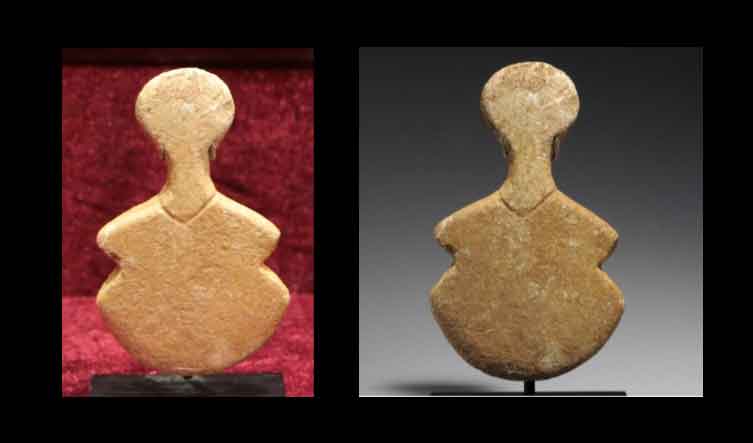
Kusura Type Figure Returned to Turkey

L: Figure Returned to Turkey. R: Figure from Royal-Athena Galleries

Among the recent items returned to Turkey was a Kusura type marble figure. Although there was no statement about the origin of the figure it seems to be the one offered by the Royal-Athena Galleries in New York in 2006 (Art of the Ancient World 17, no. 218) and 2017 (Art of the Ancient World 28, no. 166). It is said to have resided in an anonymous French private collection. 

It will be recalled that 60 items from the Royal-Athena Galleries were returned to Italy in July 2022. Was this Kusura type figure seized at the same time or has it been residing elsewhere? The Manhattan DA does not yet seem to have issued an informative press release about these latest returns to Turkey. 

| |
Bookmark and Share so Your Real Friends Know that You Know

Wednesday, 16 November 2022

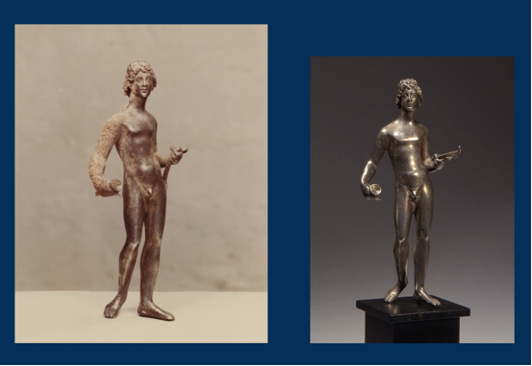
A Silver Apollo Returns to Turkey

Left: Symes-Michaelides archive; Right: Royal-Athena Galleries


In November 2022 the US authorities returned a silver statuette of Apollo to Turkey. This was recognised as the figure that had been identified by Christos Tsirogiannis in 2007 as appearing in the Symes-Michaelides archive. It receives a full discussion in his PhD thesis, Unravelling the Hidden Market of Illicit Antiquities: The Robin Symes - Christos Michaelides Network and its International Implications (Cambridge University, PhD Dissertation, 2012). 

The history can be traced through the various sale catalogues in which it appeared.

The figure seems to have surfaced in an exhibition organised by Marie-Louise Vollenweider, Musées de Genève in January 1987 (no. 274), and then featured in the exhibition for Numismatic Fine Arts, Treasures from an Ancient Jewelbox: Gold and Silver of the Ancient World (1992): the catalogue was prepared by Robert Hecht. 

The figure next appeared in the exhibition organised in memory of Michaelides by Robin Symes, Royal Portraits and Hellenistic Kingdoms (New York 1999) no. 24, and then passed into a New York private collection. It was offered at Sotheby’s (New York) on December 7, 2001, lot 76 but was unsold; it entered an Australian private collection in 2002, and was offered at Sotheby’s (New York) June 5, 2008, lot 22 but again was reportedly unsold. It was purchased by Jerome Eisenberg and appeared in Royal-Athena Galleries, Art of the Ancient World 20 (2009) no. 134; Art of the Ancient World 28 (2017) no. 27. It is not clear when the Apollo was seized.

The evidence used to associate the Apollo with a findspot in Turkey has not been disclosed as part of the return, but it has been associated with rulers from Pontus and Cappadocia.

Note. The label in the Antalya Museum states that the figure is bronze but this is incorrect. I am grateful to Christos Tsirogiannis who was able to confirm the material.

| |
Bookmark and Share so Your Real Friends Know that You Know

Düver Frieze Fragment Returns to Turkey

Düver frieze fragment: Antalya Museum (l) and New York market (r)


Among the returns to Turkey is a fragment of the terracotta architectural frieze derived from Düver in Turkey. It was offered on the New York market in October 2021 and had formed part of a New York collection. This is a significant return because Düver was looted in the 1960s before the 1970 UNESCO Convention.

The composition of the frieze was reconstructed after a series of fragments were purchased from auction at Sotheby's (24 February 1964) by a civic museum in England; examples purchased from this sale in a Stockholm collection notes that they were derived from an anonymous Swiss private collection. Further fragments were auctioned at Sotheby's in July 1964 and many of these are reported to have moved to north America. I have already noted one such fragment in the Virginia Museum of Fine Arts (inv. 78.62.5) that was purchased from the Summa Galleries in Beverly Hills. A further fragment in an English university collection was acquired from Robert Hecht.

It is likely that Turkish authorities will be seeking the return of these dispersed fragments so that they can be reunited and displayed to the public.

| |
Bookmark and Share so Your Real Friends Know that You Know

Tuesday, 15 November 2022

Shelby White sarcophagus fragments return to Antalya


Bookmark and Share so Your Real Friends Know that You Know

Lucius Verus from Bubon Returns to Antalya

Source: BusinessTurkeyToday.com

Back in 2008 I discussed on LM that the bronze statue of Lucius Verus was one of a series of statues that had originated in the sebasteion at Bubon in Turkey (and an earlier discussion in the American Journal of Archaeology in 2000). It now appears that this statue from the collection of Shelby White (Glories no. 174) has been returned to the Antalya Museum (see story here and here). This return comes soon after the return of further Shelby White material to Italy (discussed here).

This return has serious implications for other museums (e.g. the J. Paul Getty Museum, the Cleveland Museum of Art, Fordham University, and the Ny Carlsberg in Copenhagen) that have bronze statues, or parts of bronze statues, that are derived from, linked to, or associated with Bubon (see previous posts here). 

The return includes other material such as part of the terracotta architectural frieze from the temple at Düver that had surfaced on the North American antiquities market. This will cause concerns for a number of museums, including several in the UK, that acquired parts of the series.

Further details are available in a release from the American Embassy in Ankara. 

| |
Bookmark and Share so Your Real Friends Know that You Know

Friday, 21 January 2022

Weiss coins return to Turkey


LM has covered the story of Arnold Peter Weiss on previous occasions. It was announced today that 14 coins from the collection of Weiss have been returned to Turkey ("D.A. Bragg: 28 Antiquities Repatriated to the People of Turkey", press release January 21, 2022). Alongside the return of antiquities from the Steinhardt collection it was announced: "Twelve of the coins, with a collective value of $58,000, from WEISS’ collection were repatriated to Turkey as part of today’s ceremony."

This is in addition to the coins returned to Greece.

Coin collectors should note the reminder:
As part of his plea agreement and sentence, WEISS agreed to forfeit 23 coins in his possession, pay a criminal fine, perform 70 hours of community service, and author an article for the American Numismatic Society Magazine detailing the dangers of collecting unprovenanced coins.

| |
Bookmark and Share so Your Real Friends Know that You Know

Steinhardt antiquities return to Turkey

Silver rhyton
Source: Manhattan DA

The Manhattan DA has announced that 14 antiquities from the Michael Steinhardt collection have been returned to Turkey ("D.A. Bragg: 28 Antiquities Repatriated to the People of Turkey", press release January 21, 2022).

Among them is an important silver stag's head rhyton that is reported to have been found at Milas, Turkey. Steinhardt purchased the piece from the Merrin Gallery on November 22, 1991 for $2,600,000, and subsequently placed it on loan to New York's Metropolitan Museum of Art on March 11, 1993.

This is not the only ex Merrin piece to have been placed on loan to the Metropolitan Museum of Art. 
| |
Bookmark and Share so Your Real Friends Know that You Know

Thursday, 30 December 2021

Steinhardt material to return to Turkey


A total of 14 antiquities are due to be returned to Turkey from the Michael Steinhardt collection.

These include:
  • Antelope standard and three bird rattles [pp. 58–59] apparently found in eastern Turkey. Purchased by Steinhardt from Robin Symes on April 24, 1991 for $84,000.
  • A female figure with seven gold dress ornaments "found together" [p. 65]. Purchased from Robert Hecht on October 31, 2005 for $499,294.
  • An Anatolian terracotta female figure [pp. 73–74]. Surfaced at Sotheby's (London) in 1975; purchased by the British Rail Pension Fund; purchased by Robert Haber on February 1, 1990; purchased by Steinhardt on August 19, 1990 for $79,610.
  • A small limestone female figure of Kilia type [pp. 83–84]. Purchased from Harry Bürki on April 30, 2002 for $47,500.
  • A silver stag's head rhyton [pp. 68–69]. Reported to be from Milas, Turkey. Purchased by Steinhardt from the Merrin Gallery on November 22, 1991 for $2,600,000; placed on loan to New York's Metropolitan Museum of Art on March 11, 1993.
| |
Bookmark and Share so Your Real Friends Know that You Know

Monday, 6 December 2021

Michael Steinhardt and the return of antiquities valued at $70 million

Michael Steinhardt has agreed to hand over antiquities valued at $70 million (Karen Matthews, "Fund manager to turn over $70 million in stolen antiquities", ekathimerini.com December 6, 2021). Some 180 antiquities are due to be handed over (Dan Morgan, "Hedge-Fund Pioneer Michael Steinhardt Surrenders 180 Stolen Antiquities Valued at $70 Million, Manhattan DA Vance Says", nbcphiladelphia.com December 6, 2021). The antiquities are said to have been derived from 11 different countries, and passed through some 12 networks. Steinhardt has also agreed not to acquire any antiquities in the future; he will not be facing any criminal charges. 

Among the objects to be handed over is a Cretan larnax, a silver rhyton in the shape of a stag's head acquired from the Merrin Gallery, a fragmentary fresco acquired from Robert Hecht and Fritz Bürki.

Press Release from the New York District Attorney's Office: D.A. Vance: Michael Steinhardt Surrenders 180 Stolen Antiquities Valued at $70 Million, December 6, 2021.

Bookmark and Share so Your Real Friends Know that You Know

Monday, 28 September 2020

Stela from Saittai (Lydia)


A Roman period stele from the sanctuary of Apollo at Saittai in Lydia, modern Turkey, has been recovered in Italy ("1,800-year-old artifact delivered to Turkey from Italy", Anadolu Agency 23 September 2020). It was seized in 1997 from an undisclosed antiquities dealer. The stela, inscribed in Greek, has now been returned to Turkey for display in Anakara. 

Bookmark and Share so Your Real Friends Know that You Know

Saturday, 10 February 2018

History of objects in Virginia exhibition


Colleagues have suggested that I had a look at the exhibition catalogue of The Horse in Ancient Greek Art that will be opening at the Virginia Museum of Fine Arts (VMFA) in a week's time. Among the interesting sources for the objects are:

  • Edoardo Almagià: no. 43, Apulian volute-krater attributed to the Virginia Exhibition painter, Fordham University Collection 8.001 [Fordham cat. no. 32]
  • Fritz Bürki: no. 19, Apulian lekythos attributed to the Underworld painter, Virginia MFA 81.55; no. 20, Apulian lekythos attributed to the Underworld painter, Virginia MFA 80.162; no. 26, Corinthian skyphos showing a boar hunt, Virginia MFA 80.27; no. 41, Apulian calyx-krater attributed to the Dublin Situlae group, Virginia MFA 81.81; no. 53.1, Apulian Xenon oinochoe, Virginia MFA 81.82; no. 53.2, Apulian Xenon oinochoe, Virginia MFA 81.83
  • Sotheby's, London (12–13 December 1983): no. 42, Apulian patera attributed to the Baltimore painter, Fordham University Collection 11.003 [Fordham cat. no. 25].
  • Summa Galleries Inc. Beverley Hills: no. 12, a Phrygian terracotta revetment, Virginia MFA 78.62.5. (This looks as if it could be part of the Düver frieze.)
  • Robin Symes: no. 55, Villanovan or early Etruscan bronze horse bit, Sidney and Lois Eskenazi Museum of Art, Indiana University 84.28
The series of acquisitions from Fritz Bürki is particularly significant as Dr Christos Tsirogiannis has written on a Gnathian askos acquired by Virginia MFA in 1980. Not only was this acquired from Bürki but it had previously been handled by Giacomo Medici. Has VMFA conducted a rigorous due diligence search on the series of objects that it acquired from Bürki? Has VMFA contacted the Italian authorities about the controversial askos?

Has Fordham University contacted the Italian authorities about the Almagià volute-krater? And what about the Apulian patera that surfaced at Sotheby's, London in 1983?

We should be grateful to Peter Schertz and Nicole Stribling, the editors of the VMFA catalogue, for printing the histories of the objects.


Bookmark and Share so Your Real Friends Know that You Know

Another Bürki object returns to Italy

Source: MMA A psykter column-krater attributed to the Troilos painter was deaccessioned by New York's Metropolitan Museum of Art in June...