Showing posts with label Athens. Show all posts

Thursday, 22 December 2022

Inadequate attributions and Cycladic figures

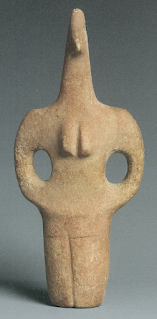
New York MMA
inv. L.2022.38.47
In 1993 Christopher Chippindale and I suggested that some of the attributions to Cycladic 'masters' (as they were then called) were inadequate as not a single piece was derived from a secure archaeological context. Subsequently, the Stafford master was removed from the attributions as key works were considered by Getz-Preziosi / Getz-Gentle to be modern works. In 2002 I returned to the theme of inadequate sculptors in a review of Getz-Gentle's Personal Styles in Early Cycladic Sculpture (2001) noting the introduction of two new entrants to the category (and both represented in the Leonard Stein collection of Cycladic figures): the Karlsruhe/Woodner sculptor and the Rodgers sculptor.

There are three figures attributed to the Rodgers sculptor. Two are reported to have surfaced from the same dealer, 'three years apart', and both were 'encrusted with similar hard deposits' (quotes from Getz-Gentle). One of the figures was in an anonymous North American private collection (NAC no. 52; acq. 1975) and the other in the Stern collection (and previously in the Rodgers collection; acq. 1972). The Stern figure had been reported as being derived 'from English coll., after World War II' though Getz-Gentle qualified this with the dismissive, 'information I distrust'. The third figure is in the Museum of Cycladic Art (inv. 282: Doumas no. 223). Although Getz-Gentle notes 'find-place unknown', Doumas suggested the 'possible' findspot of Koufonisia. This figure was described by Colin Renfrew as achieving 'a rhythmic effect in the curving outlines of the head, shoulders, upper arms, thighs, and calves' (Cycladic Spirit p. 86, pl. 57). No further information is provided by Aegean Waves (no. 24).

The Stern figure appears in the Homecoming exhibition at the Museum of Cycladic Art (no. 13) where it is attributed (inaccurately), along with the Athens figure, to the Rodgers master

| |
Bookmark and Share so Your Real Friends Know that You Know

Wednesday, 21 December 2022

Christos Doumas on Cycladic Forgeries

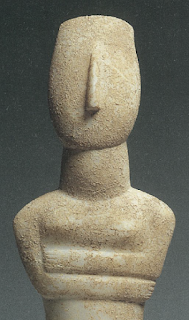
New York MMA
inv. L.2022.38.49
An interview with archaeologist Christos Doumas was published earlier this week. The focus was on the 15 items from the Leonard Stern collection that went on display in the Homecoming exhibition at the Museum of Cycladic Art. Doumas raised questions about the authenticity of some of the figures. When pressed by the journalist he thought that at least 4 or 5 of the figures (out of 10!) were likely to be fakes. (Only one is identified: the Late Neolithic figure [no. 1], though it should be remembered that Getz-Gentle does illustrate this in Personal Styles, pl. 2. The Homecoming catalogue notes, 'It belongs to a type that has not yet been identified among Aegean marble figurines of the Neolithic period'.) Doumas based his view on fakes on the type of marble that was used. He raised the issue why there had not been a panel formed to help authenticate the figures in the Stern collection. 

This raises questions about other figures in the Stern collection especially in the light of recent revelations about the forging of Cycladic figures. 

How will the curators at the Museum of Cycladic Art and New York's Metropolitan Museum of Art respond to Doumas' concerns? There is likely to be unease that accepting all the Stern figures as authentic has the potential of corrupting the corpus of knowledge for Cycladic figurines. 

| |
Bookmark and Share so Your Real Friends Know that You Know

Saturday, 13 March 2021

Parthenon marbles: British Prime Minister makes his position clear

Parthenon frieze in the British Museum © David Gill
The architectural sculptures from the Parthenon, part of the World Heritage Site of the Athenian Acropolis, have been part of an exchange instigated by the British Prime Minister. 

In an interview on Friday 12 March 2021, Boris Johnson stated ("Greek culture minister challenges British PM’s claims on Parthenon sculptures", ekatherimini.com 12 March 2021):
“the UK government has a firm longstanding position on the sculptures which is that they were legally acquired by Lord Elgin under the appropriate laws of the time and have been legally owned by the British Museum’s Trustees since their acquisition.”
The central issue is about whether these stunning sculptures should be displayed in Bloomsbury, or be placed within line of site of the building on which they were once an integral part of the sculptural scheme. The intention of the original sculptors was to integrate them within the decorative programme of a single building.


Bookmark and Share so Your Real Friends Know that You Know

Saturday, 20 February 2021

Theft in Greece: surfacing in Athens, New York and Basel


Greek archaeologist Angelos Zardakas had identified a head looted from the Liopesi collection in 1967 (Marianna Kakaounaki, "The mystery of two looted heads", ekathermini.com, 18 February 2021).  It was identified in the Paul and Alexandra Canellopoulos Museum in Athens.

A companion piece, stolen from the same collection (also in 1967), had been identified in the 1990s from the Shelby White and Leon Levy collection; it has subsequently been returned to Greece and placed in storage in the National Archaeological Museum. 

A third piece from the same raid, "the top part of the funerary stele of Euthesion of Pallene that is currently on show at the Archaeological Museum of Basel in Switzerland", has yet to be returned to Greece even though it was identified back in 1971.

Who handled these pieces of sculpture? Which networks were used? When does Basel intend to return the stele?

| |
Bookmark and Share so Your Real Friends Know that You Know

Monday, 23 October 2017

Becchina and the Funerary Markers from Greece

Marble loutrophoros from the Becchina archive.
Source: Dr Christos Tsirogiannis
Cambridge-based academic, Dr Christos Tsirogiannis, has identified two Attic funerary markers that have surfaced on the Swiss market (Howard Swains, "Looted antiquities allegedly on sale at London Frieze Masters art fair", The Guardian October 22, 2017). The items feature in the Becchina archive.

The marble lekythos and loutrophoros were displayed by Swiss-based dealer Jean-David Cahn at the Frieze Masters art fair in Regent's Park in London.

It appears that the items are being offered on behalf of the Swiss canton of Basel-Stadt. They had apparently formed part of the stock seized from Becchina's warehouse in Switzerland. (For more on this see here.)

Strangely the Swiss authorities are claiming that the Italian authorities have given permission for the material to be sold. But these two items are objects that were created in Attica for display in Attic cemeteries. They are from Greek, not Italian, soil.

The key question is this: did the Swiss authorities as well as Cahn contact the Greek authorities to check that the sale was acceptable? If the answer to this is no, then there has been a major breakdown in the due diligence process. Any responsible dealer would have known that they need to contact the Greek authorities for objects that would have been found in Greek funerary contexts.

This makes the statement from James Ratcliffe, counsel for the Art Loss Register sound ridiculous: “If [the Italians] are not reclaiming it, it’s then in this grey area where legally it’s seemingly OK ... As far as [the Swiss] were concerned, they were selling with good title. Now if that’s not the case, and information has emerged that’s contrary to that, then quite clearly that’s something we would say changes our view.” But if the two funerary objects came from Greece rather than Italy, then Ratcliffe's statement reflects his apparent lack of understanding of the reality of the situation.

Cahn is not unfamiliar with handling material from Greece. Items include the statue of Apollo that had been looted from Gortyn on Crete, and another Attic marble lekythos.

Incidentally, the Becchina archive also includes images of a Minoan larnax from Crete now in the Michael C. Carlos Museum. This case is currently unresolved.

These two ex-Becchina items are now toxic. The Basel authorities and Cahn would be best advised to arrange for them to be returned to Greece before the Greek authorities make a formal request and with it all the associated publicity.


Bookmark and Share so Your Real Friends Know that You Know

Monday, 30 March 2015

"Enabling the whole world to see, study and enjoy the sculptures of the Parthenon"

The Duveen Gallery © David Gill
Sir Richard Lambert has responded to the request by the Greek Government to mediate on the Parthenon sculptures [26 March 2015, letter]. The key message from the Trustees is this: "After full and careful consideration, we have decided respectfully to decline this request".

The position of the Encyclopedic Museum is presented: "Museums holding Greek works, whether in Greece, the UK or elsewhere in the world, are naturally united in a shared endeavour to show the importance of the legacy of ancient Greece. The British Museum is committed to playing its full part in sharing the value of that legacy for all humanity".

Visitor figures are pulled out: More than 6 million visitors a year visit the British Museum, and thereby the Parthenon Sculptures, free of charge. 

Lambert concludes his letter: "In conclusion, therefore, we would invite our colleagues in Greek museums to continue to work with us and to explore new ways of enabling the whole world to see, study and enjoy the sculptures of the Parthenon". He could have added "... in London, not Athens".

Yet the statement misses the key point. The architectural and visual context for these wonderful fifth century sculptures is in Athens, under Greek light.

I recorded my thoughts on this topic back in 2009.

Bookmark and Share so Your Real Friends Know that You Know

Thursday, 5 June 2014

Karlsruhe to return Cycladic material to Greece

The Badisches Landesmuseum in Karlsruhe will be returning two Cycladic objects, a figure and a bowl, to Greece, The ceremony is apparently due to take place in the National Archaeological Museum in Athens tomorrow, Friday June 6, 2014.

The claim was first made in October 2011.

If this return is confirmed, it will hint that the Badisches Landesmuseum has now accepted that it was buying recently surfaced material.

News story here (Επαναπατρισμός αρχαιοτήτων από τη Γερμανία).

Bookmark and Share so Your Real Friends Know that You Know

Another Bürki object returns to Italy

Source: MMA A psykter column-krater attributed to the Troilos painter was deaccessioned by New York's Metropolitan Museum of Art in June...