Showing posts with label Harvard. Show all posts

Thursday, 6 January 2022

Broken pot fragments matter

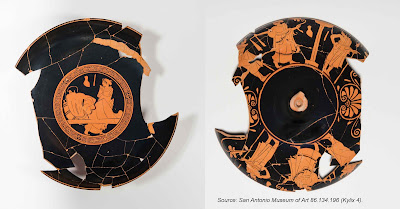
Source: San Antonio Museum of Art

Among the material linked to Edoardo Almagià  and returning to Italy are 192 Attic cup fragments from the San Antonio Museum of Art. These are in addition to the calyx-krater fragments attributed to Euphronios that were returned from Princeton University Art Museum. 

These returns challenge the belittling of the issue by James Cuno who used the example of the 200 or so fragments acquired by Harvard as part of his attack on those who would wish to see a more rigorous approach to museum acquisitions. Harvard will no doubt be looking again at the histories of the fragments. Were any acquired from a New York based dealer? Have connections been made with fragments in other collections?

|
Bookmark and Share so Your Real Friends Know that You Know

Wednesday, 30 December 2020

Fragments attributed to the Berlin painter


What questions should we be considering when we study the fragments of Athenian red-figured pottery that are dispersed between different collections and museums? This short study takes the example of some five pieces attributed to the Berlin painter (BN3, BN9, BN12, BN29, BN38); two have been returned to Italy. When were these fragments moved to different collections? Who was involved? In the case of two of the pieces, the initial fragments were presented to the museum only to be followed by purchases from a different source. Such a pattern of acquisition is not confined to the Berlin painter.

This paper questions the position taken by James Cuno that scholars should not seek the clarify the "provenance" (I prefer "history") of such fragments. 

The fragments are a reminder of the information that has been lost by the unscientific removal of Athenian pottery from funerary and other archaeological contexts.

Gill, D. W. J. 2020. "Fragmented Athenian Pots and the Berlin Painter: Recent Breaks?" Academia Letters, Letter 40: 1–5. [DOI]


Bookmark and Share so Your Real Friends Know that You Know

Thursday, 24 April 2014

The collecting history of PDodg

I am grateful to Paul Barford for drawing my attention to further discussion of the collecting history of PDodg. otherwise known as "The Gospel of Jesus' Wife". Last September I noted the reports that the papyrus had surfaced in "... the early 1980s indicating that Professor Gerhard Fecht from the faculty of Egyptology at the Free University in Berlin believed it to be evidence for a possible marriage of Jesus".

Owen Jarus has done a little more background work ("'Gospel of Jesus's Wife': Doubts Raised About Ancient Text", Live Science, April 22, 2014). This draws attention to the collecting history: "it was purchased, along with five other Coptic papyrus fragments, from a man named Hans-Ulrich Laukamp in November 1999 and that Laukamp had obtained it in 1963 from Potsdam in then-East Germany". It is now suggested that Laukamp did not collect antiquities, and that as a resident of (partitioned) West Berlin in 1963 he would not have been in a position to visit Potsdam.

The papyrus has been prepared for publication in HTR by Professor Karen King, the Hollis Professor of Divinity at Harvard. (Incidentally, the title of her chair reflects the benefaction of the republican Thomas Hollis whose collection passed into the hands of the Reverend John Disney, and was donated to the University of Cambridge by his son Dr John Disney as the Museum Disneianum.) King provides the details of the collecting history though it is not clear that the supporting documentation has been authenticated.


Bookmark and Share so Your Real Friends Know that You Know

Friday, 30 August 2013

Pot Fragments Matter

Group of part of the approximately 
10,000 terracotta vase fragments
from the Bothmer collection.

Source: www.metmuseum.org
One of the themes that has emerged from the return of antiquities to Italy has been the role of fragmented pots. Sometimes pots have been reconstructed from sherds apparently brought together from numerous collections or dealers. Such pots would include the krater attributed to the Berlin painter that was returned from the J. Paul Getty Museum. And the acquisition of sherds has not been without controversy. And we could reflect on the fragments added to the Berlin painter's amphora once in New York's Metropolitan Museum of Art. Harvard's purchase (via a New York dealer) of the Robert Guy collection was not without  comment and has been used by James Cuno to support his views on antiquities. And we could consider the major collection formed by Dietrich von Bothmer: a small selection has been returned to Italy (apparently as they are associated with material already owned) and more recently fragments will be handed over to Italian authorities after an identification made by Dr Christos Tsirogiannis. Or there are fragments like the one attributed to the Euaion painter in Princeton.

These small fragments of time deserve more attention.

Bookmark and Share so Your Real Friends Know that You Know

Friday, 8 March 2013

Bothmer Fragments Linked to Rome

Detail of Attic red-figured cup.
Fragments in the Villa Giulia and
the Bothmer collection, New York
In January 2012 it was announced that 40 fragments from the 10,000 or so bequeathed to New York's Metropolitan Museum of Art would be returning to Italy. So far only a very limited number of images have appeared, but last week Cambridge University researcher Christos Tsirogiannis told me that he had made an identification for some cup fragments.

Tsirogiannis spotted that the missing pentagonal shape from an Attic red-figured cup now resided in the Villa Giulia in Rome. The tondo scene shows a central volute-krater, with a satyr holding a kantharos, and a maenad to the right.

The fragment had been attributed to the 'Euaion painter', a decorator of pots well known to Bothmer. Several fragments are listed (by the Beazley Archive) in his collection (though not apparently this cup), and he donated other fragments to the Metropolitan Museum of Art and the J. Paul Getty Museum. For example, one cup in the Met was reconstituted after Bothmer donated a series of fragments from 1973 to 1989. The source of these fragments is undeclared. The fragments in the Getty were donated from 1981 to 1986.

Bothmer had also made connections with fragments in Paris and Dresden. So why did he overlook the Rome connection? Or had he made the connection, but had not wished to declare it?

And given his interest in the 'Euaion painter' is he likely to have overlooked the connection?

There are wider issues. When did the Villa Giulia fragment become separated from the rest of the cup? Clearly the Rome fragment was known in the early 20th century. But have the other fragments been residing unrecorded in some other collection? Or were they left in an Etruscan tomb in Tuscany? When did they enter the Bothmer collection? What was their source?

There are also 'Euaion painter' fragments from the former Robert Guy collection in Harvard. Do any fit with the fragments in the Bothmer collection?

And what are all the collecting histories of all these 'Euaion painter' fragments?

What associations will be provided as the Met starts to publish more of the Bothmer collection? And what is their plan to release images and details of this bequest?

It was the original intention of the 'artist' that the fragments be seen as part of a single cup. Will the Met be contacting the staff of the Villa Giulia to arrange the restoration of the cup?

I am grateful to Tsirogiannis for giving me permission to share this identification on Looting Matters.

Bookmark and Share so Your Real Friends Know that You Know

Monday, 14 January 2013

Icklingham bronzes: call for their return

BBC Radio Suffolk had a focus on Icklingham today [iPlayer: final 10 minutes]. I was invited to say a few words about the Icklingham bronzes and their surfacing in New York. I reminded the listeners about how they were removed from the ground and what information had been lost. Interestingly one of the bronzes was displayed in a temporary exhibition at Harvard.

Shelby White, the present proprietor of the bronzes, has indicated that she intends to leave the bronzes to the British Museum. But our hope is that she will return them to be displayed in the Ipswich Museum or another collection in Suffolk.

Bookmark and Share so Your Real Friends Know that You Know

Monday, 24 September 2012

The "dodgy" papyrus and Harvard Theological Review

It now appears that the New York Times was premature in announcing that PDodg. would be published in the January 2013 number of Harvard Theological Review. It has now been stated that "A Harvard University journal says it hasn’t fully verified research that purportedly shows some early Christians believed Jesus had a wife, even though Harvard’s divinity school touted the research during a publicity blitz this week" ("Harvard journal: Research into papyrus with text about Jesus’ ‘wife’ not yet verified", Washington Post September 22, 2012).

The report goes on:
the review’s co-editor Kevin Madigan said he and his co-editor had only “provisionally” committed to a January publication, pending the results of the ongoing studies. In an email, Madigan said the added studies include “scientific dating and further reports from Coptic papyrologists and grammarians.”
HTR could have avoided this apparent turnaround by having a more rigorous publication policy along the lines of the Archaeological Institute of America for the American Journal of Archaeology.

AP quotes Ric Elia who makes the striking point: “If it’s real, it was looted and smuggled, most likely ... If it’s not real, then it shouldn’t even be out there in the discussion.”

This now raises issues about why Professor King publicised PDodg. through the NYT. Was she unaware of the issues relating to recently surfaced material? Why had she not completed scientific studies on the papyrus?

Bookmark and Share so Your Real Friends Know that You Know

Thursday, 20 September 2012

The "dodgy" papyrus: the Fecht connection

I am wondering about the authenticity of the supporting evidence for PDodg. It seems that the Harvard Gazette tells us "The collector provided King with a letter from the early 1980s indicating that Professor Gerhard Fecht from the faculty of Egyptology at the Free University in Berlin believed it to be evidence for a possible marriage of Jesus." (B. D. Colen, "Suggestion of a married Jesus", September 18, 2012). Harvard Divinity School has issued this comment: "The earliest documentation about the fragment is a letter from the early 1980s indicating that Professor Gerhard Fecht from the faculty of Egyptology at the Free University in Berlin believed it to be evidence for a possible marriage of Jesus."

However, the New York Times reported: "It came with a handwritten note in German that names a professor of Egyptology in Berlin, now deceased, and cited him calling the fragment “the sole example” of a text in which Jesus claims a wife."

In contrast, the Smithsonian magazine noted:
Among the papers the collector had sent King was a typed letter to Laukamp from July 1982 from Peter Munro. Munro was a prominent Egyptologist at the Free University Berlin and a longtime director of the Kestner Museum, in Hannover, for which he had acquired a spectacular, 3,000-year-old bust of Akhenaten. Laukamp had apparently consulted Munro about his papyri, and Munro wrote back that a colleague at the Free University, Gerhard Fecht, an expert on Egyptian languages and texts, had identified one of the Coptic papyri as a second-to fourth-century A.D. fragment of the Gospel of John.
Munro, like Fecht, is no longer alive. Laukamp was a dealer in Berlin.

The Smithsonian also notes a second piece of correspondence:
The collector also left King an unsigned and undated handwritten note that appears to belong to the same 1982 correspondence—this one concerning a different gospel. “Professor Fecht believes that the small fragment, approximately 8 cm in size, is the sole example of a text in which Jesus uses direct speech with reference to having a wife. Fecht is of the opinion that this could be evidence for a possible marriage.”
Has anybody authenticated these two more modern letters? A typed letter could be forged. Whose handwriting appears in the second note? When was it written? Is it contemporary with the (purported) 1982 typewritten letter? Or could it be an afterthought added to the dossier when sold to the present proprietor?

Bookmark and Share so Your Real Friends Know that You Know

The "dodgy" papyrus fragment: top question

Professor Karen King has been defending the so-called "dodgy" papyrus (PDodg.) in an interview for the Huffington Post (Daniel Burke and David Gibson, "'Jesus Wife': 5 Big Questions About The Discovery", September 20, 2012). Number 1 is "Where did the papyrus come from?"

Looting Matters has been asking much the same thing. So King replies:
We don't know. King says that "nothing is known about the circumstances of its discovery," an admission that has raised red flags for other scholars.
... The papyrus now belongs to an anonymous collector who asked King to analyze it. King says three scholars have determined that the fragment is not a forgery, but that further tests will be conducted on the ink. The scholar also says that she will press the fragment's anonymous owner to come forward.
One gets the feeling that King has been surprised by the media interest and the negative impact of the story. The present proprietor is probably wishing that there had not been such a high profile spread in the New York Times.

Bookmark and Share so Your Real Friends Know that You Know

The "dodgy" papyrus fragment: video


Harvard Divinity School has now issued a short video about the "dodgy" papyrus fragment that may or may not be authentic.

Bookmark and Share so Your Real Friends Know that You Know

Wednesday, 19 September 2012

The "dodgy" papyrus fragment: further comments

Nicole Winfield, writing from Rome, has written an important response to the news about the newly surfaced papyrus fragment ("Doubts over Harvard claim of 'Jesus' Wife' papyrus", September 19, 2012 [available on Bloomberg Business Week). Winfield has interviewed participants at the conference who have questioned the authenticity of the fragment:
Stephen Emmel, a professor of Coptology at the University of Muenster ... questioned whether the document was authentic. 
"There's something about this fragment in its appearance and also in the grammar of the Coptic that strikes me as being not completely convincing somehow," he said in an interview on the sidelines of the conference. 
Another participant at the congress, Alin Suciu, a papyrologist at the University of Hamburg, was more blunt. "I would say it's a forgery. The script doesn't look authentic" when compared to other samples of Coptic papyrus script dated to the 4th century, he said.
Despite concerns about how the fragment surfaced on the market, there is the predictable comment:
AnneMarie Luijendijk, the Princeton University expert whom King consulted to authenticate the papyrus, said the fragment fit all the rules and criteria established by the International Association of Papyrologists. She noted that papyrus fragments frequently don't have a provenance, simply because so many were removed from Egypt before such issues were of concern. She acknowledged the dilemma about buying such antiquities but said refraining from publishing articles about them is another matter. 
"You wouldn't let an important new text go to waste," she said.
Perhaps the International Association of Papyrologists needs to revisit its criteria and recommendations for the "commerce in papyri" (available here). (I note the phrase "observe scrupulously".)

Winfield also draws attention to concerns about publishing recently surfaced antiquities.

I am also quoted: "This looks to me as if any sensible, responsible academic would keep their distance from it."

Perhaps King, Bagnall, and Luikendijk have been too quick in associating themselves with the fragment.

Winfield's interview is now informing other reports that have appeared elsewhere (e.g. Daily Mail, Fox News).

Bookmark and Share so Your Real Friends Know that You Know

The Papyrus Fragment about Jesus’s Relations: Cambridge comment

I note that Tyndale House in Cambridge has issued a helpful comment by Simon Gathercole on the newly-surfaced papyrus fragment ("Did Jesus have a wife?"). Gathercole makes the point, contra the New York Times, that this fragment is not a gospel and should be known as the fragment about Jesus' relations "since there’s no evidence that it was called a gospel and the text mentions at least two family members".

Christian Askeland has commented on his blog, "Evangelical Textual Criticism", from the International Association of Coptic Studies in Rome where the fragment was presented. Askeland suggests that the fragment "looks like a fake".

Bookmark and Share so Your Real Friends Know that You Know

The Gospel of Jesus' Wife from an old German collection

Harvard Divinity School has provided information about a fragment of papyri in an anonymous private collection ("The Gospel of Jesus's Wife: A New Coptic Gospel Papyrus"). The Harvard website helpfully informs us "Nothing is known about the circumstances of its discovery, but it had to have come from Egypt".

Readers of LM will not be asking certain questions. Why is nothing known about its discovery? When was the fragment found? Where was the fragment found? What else was found with it? When did it leave Egypt (if Egypt was where it was found)?

What about the collecting history? Again, the Harvard website tells us more:
Nothing is known about the circumstances of its original discovery or early ownership, but there are some clues about its modern history. The earliest documentation about the fragment is a letter from the early 1980s indicating that Professor Gerhard Fecht from the faculty of Egyptology at the Free University in Berlin believed it to be evidence for a possible marriage of Jesus. It now belongs to an anonymous private collector who contacted Karen L. King at Harvard Divinity School for help in identifying its contents.
Will the Fecht letter be made public? Has the handwritten letter been authenticated? (Fecht died in December 2006.)

Who is the present anonymous collector?

The New York Times (Laurie Goodstein, "A Faded Piece of Papyrus Refers to Jesus’ Wife", September 18, 2012) has a bit of publicity for the fragment. It tells us
The collector acquired it in a batch of papyri in 1997 from the previous owner, a German. It came with a handwritten note in German that names a professor of Egyptology in Berlin, now deceased, and cited him calling the fragment “the sole example” of a text in which Jesus claims a wife.
Who was the previous German owner? Was the person a dealer or collector? What is the documentation for the sale?

Professor Karen L. King has been invited to prepare the fragment for publication in Harvard Theological Review. Some journals would not allow the publication given the fragment's obscure collecting history. The publication will no doubt help to add to the fragment's value prior to its acquisition by a proposed new owner.

Professor Roger Bagnall, director of the Institute of the Ancient World (ISAW) in New York, makes an important observation about the fragment:
The piece is torn into a rough rectangle, so that the document is missing its adjoining text on the left, right, top and bottom — most likely the work of a dealer who divided up a larger piece to maximize his profit, Dr. Bagnall said.
In other words Bagnall thinks that a much larger papyrus fragment was cut up to provide this piece that can be flouted as a great discovery (and no doubt a wonderful acquisition from some undiscerning institution).

There are a number of legitimate academic concerns about this newly surfaced fragment, and it is hoped that King will be addressing these prior to any proposed publication.

Bookmark and Share so Your Real Friends Know that You Know

Thursday, 12 May 2011

James Cuno at Harvard

Jason Felch, co-author of Chasing Aphrodite, has written a piece on James Cuno's appointment as CEO to the Getty Trust ("James Cuno says he accepts the Getty's antiquities acquisition policy", LA Times May 11, 2011). Felch looks back to Cuno's time at Harvard:
In one case, Cuno approved the purchase of more than 180 Greek vase fragments with unclear ownership histories. Cuno has said he inquired into their origins. With no clear evidence that they came from illicit excavations, Cuno said Tuesday, "we were satisfied these were appropriately acquired."

In an interview, David Mitten, the retired Harvard curator and professor who recommended the purchase, has a slightly different account. He said he and Cuno knew that two antiquities dealers known to traffic in looted antiquities — Robert Hecht and Frieda Tchacos — were the source of some of the fragments.
Felch contacted Cuno who is quoted: "At the time I didn't know the extent of his reputation". (I presume this meant Hecht.)

More at stake is the fact about what we now know about Hecht and Tchacos, and what was known to Cuno when he wrote Who Owns Antiquity? (2008). Cuno made his position on the acquiisition of the fragments quite clear (see here).

Felch also raises the issues about Shelby White's acquisition of the Icklingham bronzes that are apparently derived from a Roman site in Suffolk, England.
In 1996, Cuno oversaw an exhibit of bronze statues that included objects with murky ownership histories on loan from private collectors Leon Levy and Shelby White and Lawrence and Barbara Fleischman.

Irene Winter, the chair of Harvard's fine arts department, filed a complaint with the university's then-president, Neil Rudenstine, requesting that the loans be barred under the school's loans and acquisitions policy. Dozens of objects from the two private collections have since been returned to Italy or Greece.

Rudenstine today is a Getty Trustee and a member of the committee that selected Cuno. In an interview, he said he was satisfied that Cuno had conducted the proper due diligence.

Will Cuno be toning down his position as he takes up his new role?


Bookmark and Share so Your Real Friends Know that You Know

Monday, 15 March 2010

Antiquities and museums: Looking to the future


I noticed this panel at the 98th College Art Association (CAA) in Chicago:
Looking to the Future: Antiquities and the Art Museum
Saturday, February 13
Chair: Jenifer Neils, Case Western Reserve University and Johns Hopkins University
  • Is the Market in Antiquities Evolving toward Greater Care? Changing Museum Standards and Their Legal Background: Patty Gerstenblith, DePaul Unviersity
  • "Due Diligence": Rationalizing Acquisition in the "Universal Museum": Irene Winter, Harvard University
  • The Shape of Things to Come: Developing Collections of Antiquities and Archaeological Materials in the Twenty-First Century: Timothy Rub, Philadelphia Museum of Art
  • The Future for Antiquities at the J. Paul Getty Museum: Karol Wight, J. Paul Getty Museum
  • Acropolis in Motion: Reflections on the New Acropolis Museum in Athens and Its Predecessors: Christina Papadimitriou, Princeton University
Tom Mullaney has commented on Rub's presentation.
He distanced himself from Cuno’s defense of the universal museum as the best repository (a minority view among museum directors) but also tiptoed away from archeologists’ claim that antiquities have little value independent of their archeological context, meaning resting in the ground at their original location.
It would have been interesting for Rub to have commented in more detail about how the Cleveland Museum of Art managed to acquire the antiquities that were returned to Italy while on his watch (see my earlier comments). Equally significant would have been Winter on Harvard's acquisition of the pot fragments.


Bookmark and Share so Your Real Friends Know that You Know

Friday, 22 August 2008

Orphans and the Berlin painter

Among the antiquities returned from the Metropolitan Museum of Art, New York to Italy was an Attic red-figured amphora attributed to the Berlin painter (inv. 1985.11.5) (see earlier posting). The amphora, showing a man playing a kithara, surfaced at Sotheby's (London) 13-14 December 1982, lot 220. (Two further pots attributed to the Berlin painter have been returned to Italy. A calyx-krater was returned from the J. Paul Getty Museum: inv. 77.AE.5, with other fragments given or purchased in 1982, 1984 and 1987. A hydria was returned from the Museum of Fine Arts, Boston: inv. 1978.45).

I had overlooked one significant detail about the New York pot. The amphora was published by Dietrich von Bothmer, "Greek and Roman Art", Recent Acquisitions (Metropolitan Museum of Art), (1985 - 1986), p. 9 [JSTOR]. It was purchased by the Rogers Fund, the Classical Purchase Fund, and The Vincent Astor Foundation Gift. The published photographs show that the amphora had at some point been broken and then reconstructed.

Images of the amphora were seized from the premises of Giacomo Medici in the Geneva Freeport. Peter Watson and Cecilia Todeschini (The Medici Conspiracy, p. 107) commented:
Then there were the photographs of a red-figure Attic amphora by the Berlin Painter. Among the photographs seized was one showing this in the early stages of restoration, with the fragments crudely assembled but with many gaps. A second photograph shows the amphora after complete restoration, "in near perfect conservative condition thanks to expert restoration which completely eliminated the traces of breakage."
Who was the conservator?

Bothmer notes:
When the vase was acquired it lacked only a handful of small fragments. Shortly after it was placed on exhibition, Dr. J. Robert Guy recognized that nineteen of the fragments had been in his collection for some time. He has graciously donated these fragments (1985.315) to the Museum in "Commemoration of the Centenary of Sir John Beazley's Birth."

The Beazley Archive database does not appear to include the information about the additional fragments. When did Guy acquire the pieces? What was their source?

Such questions are also relevant to the issue of the acquisition of pot fragments (formerly owned by J. Robert Guy) by the Harvard University Art Museums in 1995.

Wednesday, 18 June 2008

Fragments of Antiquity at Harvard

I have earlier commented on the 1995 purchase of more than 200 Apulian, Attic, Chalcidian, Corinthian, Etruscan, Laconian pot-fragments. (There are 182 catalogue entries in the Harvard University Art Museums Bulletin representing the exhibition at the Fogg Art Museum, 15 March - 28 December 1997.) This acquisition is discussed briefly in James Cuno's Who Owns Antiquity?
Every fragment was described and reproduced. Their provenance, such as we knew it, was indicated. And the objects became the subject of study in seminars and other classes. [p. 22]
Cuno wrote the "Director's Foreword" for the Harvard catalogue. He noted the origin of the fragments:
These had been collected by J. Robert Guy, currently Humfry Payne Senior Research Fellow in Classical Archaeology and Art at Oxford.
They were apparently purchased indirectly. Cuno wrote:
When I first saw the fragments we would soon acquire in 1995 ... Lying flat in drawer after drawer in a dealer's shop ...
The acquisition was made with the help of:
  • Jonathan H. Kagan
  • Mr & Mrs Evangelos Karvounis
  • Ian M. Watson McLaughlin
  • Nicholas S. Zoullas
As far as I can see this is the sum total of the "history" - or Cuno's less precise "provenance" - of the pieces. The catalogue (prepared by Aaron J. Paul) does not appear to provide any further information.

Cuno now adds:
We discussed the matter with the dealer and collector and got more provenance, but only some; all that could be found. [p. 22]
Who was the dealer? What was the additional information? What were the sources for the pieces? Is it certain that the fragments were known prior to the 1970 UNESCO Convention?

Catalogue
Attic Black-figure: nos. 1-11
Unattributed Attic Black-figure (Cups): nos. 12-20
Unattributed Attic Black-figure (Vessels): no. 21
Chalcidian Black-figure: no. 22
Corinthian Black-figure: no. 23
Laconian Black-figure: nos. 24-25
Etruscan Black-figure: nos. 26-27
Attic Red-figure: nos. 28-118
Unattributed Attic Red-figure (Cups): nos. 119-171
Attic White-ground: no. 172
Unattributed Attic Red-figure (Vessels): nos. 173-181
Apulian Red-figure: no. 182

Reference
Paul, A. J. 1997. "Fragments of antiquity: drawing upon Greek vases." Harvard University Art Museums Bulletin 5: 1-87. [WorldCat]

Thursday, 29 May 2008

James Cuno on the Icklingham Bronzes

One of the issues that I hoped would be addressed by James Cuno was the decision to display one of the Icklingham bronzes in a loan exhibition, The Fire of Hephaistos (1996) no. 31, at Harvard University Art Museums. The piece, on loan from Shelby White and Leon Levy, was "Found in Suffolk, in southeastern England; purchased in 1988".

And here is the issue, on the very first page of Chapter 1, "Political Issues", of Who Owns Antiquity? (I received my review copy today.) Cuno notes the Fire of Hephaistos exhibition included bronzes from some private collections. One of Cuno's Harvard colleagues "objected to our borrowing a work from a particular private collection and claimed that it had been purchased in contravention of international law". Cuno explains in a rather vague way (without giving too much detail for the casual reader):
The work in question had been part of a controversy involving the British Museum and when I sought that museum director's advice, he assured me that so far as the British government and British Museum were concerned, the controversy was resolved and he had no objection to our exhibiting—and publishing—the Roman bronze, which we did.
What he does not mention is that the "controversy" was far from resolved for the Suffolk farmer, John Browning, from whose land the bronzes were reported to have been taken.

And why does Cuno fail to mention that the bronze in question had been removed from Icklingham or that it was acquired by Leon Levy and Shelby White?

Is it because Cuno wishes to portray the couple as "philanthropists and collectors of antiquities"? [p. 200 n. 7] Or is there some other reason? His book went to press before he could take account of the fact that Shelby White had returned some of her "Glories" to Italy, a public admission that the couple were acquiring recently surfaced antiquities.

Nor is there any mention by Cuno that Fire of Hephaistos was one of the exhibitions discussed by David Gill and Christopher Chippindale ("Material consequences of contemporary classical collecting." American Journal of Archaeology 104 [2000] 463-511 [JSTOR]). Is he really unaware of the literature?

So many questions raised from the opening paragraphs of chapter 1. What other issues will be raised?

Tuesday, 8 January 2008

"Cultural property is a modern political construct"

James Cuno, president and director of the Art Institute of Chicago, made the claim, "Cultural property is a modern political construct", at a debate in March 2006 (see "Is It All Loot? Tackling The Antiquities Problem", New York Times, March 29, 2006).

The reason? He was wanting to dismiss the claims by Italy on various antiquities.

Cuno continued:
Italy is making claims on objects that are, in the case of the Euphronios krater, 2,500 years old. The state itself is only 170 years old.
The discussion is dated; it is nearly two years old. Since the statements by Cuno, Philippe de Montebello, and Kwame Anthony Appiah, there have been returns from Boston, the Getty, the Princeton University Art Museums, and the University of Virginia Art Museum in Charlottesville. Indeed a selection of antiquities formerly owned by these great institutions are now on exhibition in Rome.

But why did Cuno care so much about antiquities claimed by Italy?

Perhaps he remembered the acquisition of fragments of Greek figure-decorated pottery when he was director of Harvard's art museums. Back in 1998 Culture Without Context reported:
Harvard Museums have recently put on display a 1995 purchase of 182 fifth-century BC Greek vase fragments. The director of Harvard's art museums, James Cuno, argued that the pieces had probably been removed from Italy before 1971, the date at which the Harvard acquisitions code took effect, and which forbids the purchase of material of questionable provenance. The fragments were bought on the advice of museum curator David Mitten from a New York dealer who had in turn purchased them from Robert Guy, of the University of Oxford, who could only have obtained them after 1971. Guy's name has in the past been linked to those of dealers Robin Symes and Herbert Cahn. Mitten has also purchased several unprovenanced antiquities from Robert Hecht ... Innocent until proven guilty claims Cuno. Guilty by association counter his critics.
I went back through my archive of material and found Walter V. Robinson and John Yemma, "Harvard museum acquisitions shock scholars", Boston Globe, January 16, 1998. There the report made the point:
Harvard's museums have been acquiring undocumented objects from an international dealer so notorious for dealing in looted artifacts that he was barred from Italy for almost a decade. The museums' director said he sees no reason to sever ties to the dealer.
Talking about the 182 fragments Cuno was quoted:
The decision I took was, I thought, a very ethical one and I would stand by it and do it again, ... If we hadn't acquired them, they might be in some private collection lord knows where. No one would know about them; no one would learn from them. Then what service would I have done?
Indeed,
Cuno acknowledged that despite Guy's expertise, he provided Harvard with no documentation regarding the origin of the fragments. Nor could he say where they came from - a dead giveaway, archeologists say, that the items are unclean. Cuno said Guy had obtained them from friends, including dealers, over several decades - a suggestion they might have been in Guy's possession before Harvard's policy took effect in 1971.
The Globe also reported on a 1996 Harvard exhibition, The Fire of Hephaistos:
That Harvard might have compromised its ethical standards has provoked debate within its fine arts faculty. A 1996 Sackler exhibition prompted a formal objection on ethical grounds by Irene J. Winter, then chair of the fine arts department. The exhibition comprised bronzes on loan from collectors - including Harvard benefactors Leon Levy and Shelby White - whose purchases of undocumented antiquities have prompted as much debate as the prices they pay.

In her 1996 letter to Cuno, Winter raised questions about the dubious origin of several of the pieces, including one bronze owned by Levy and White, which, she noted, had been "purchased in clear contravention of international convention, for which its purchasers have shown consistent disregard over the years." Levy and White have insisted that their acquisitions have been proper.
I presume that one of the pieces was the bronze "Portrait Head of a Youth" (cat. no. 31) reported as "Found in Suffolk, in southeastern England; purchased in 1988" (see "Private collectors are a potential threat to our cultural heritage").

And what was Cuno's view about the acquisitions?
It's out of the ground ... It's out of the country of origin. It's on the market. We're a public institution. Our job is to encourage research and preservation. If you don't acquire it, where would it go? Back to the netherworld of private holdings in conditions inimical to its preservation.
The Globe was quite prophetic and the report included this gem of a quotation from Harvard's David G. Mitten:
I don't think there is any reason to question Hecht's credentials ... We have bought from Bob Hecht and will continue to do so. He's very square with us. We have every reason to believe him.
Is cultural property safe when such views are expressed?

Another Bürki object returns to Italy

Source: MMA A psykter column-krater attributed to the Troilos painter was deaccessioned by New York's Metropolitan Museum of Art in June...