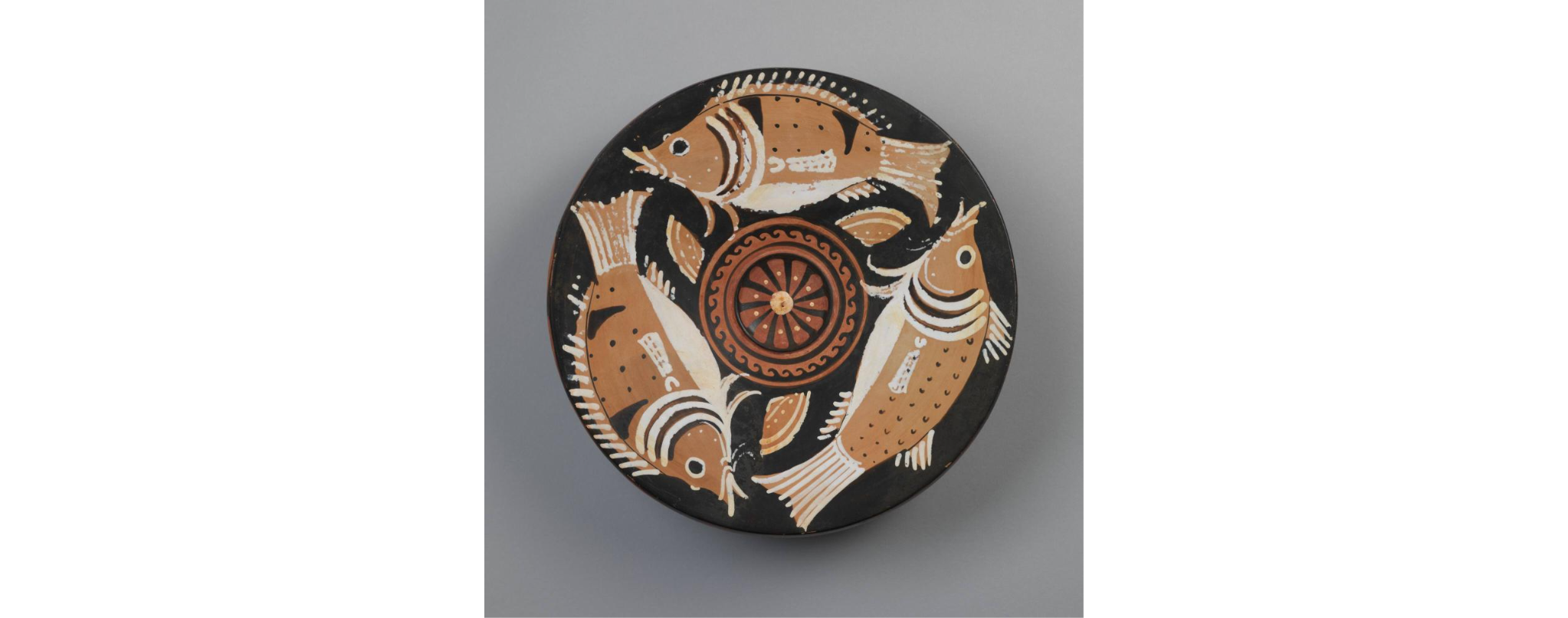
Showing posts with label Italy. Show all posts

Monday, 5 October 2026

A volute-krater with a "tremendous provenance"

A volute-krater attributed to the Syriskos painter by J.R. Guy (see BAPD 44988) is said by Michael Padgett to have been found with a psykter-column-krater attributed to the Troilos painter recently repatriated to Italy from New York's Metropolitan Museum of Art (BAPD 15922). Fragments of both kraters were held, so Padgett informs us, by Rolf Blatter. (Blatter donated the Troilos painter fragments to the Met.)

Is it time for the present owner of the volute-krater to return it to Italy so that it can be displayed alongside its companion piece?

| |
Bookmark and Share so Your Real Friends Know that You Know

Thursday, 16 July 2026

Another Bürki object returns to Italy

Source: MMA


A psykter column-krater attributed to the Troilos painter was deaccessioned by New York's Metropolitan Museum of Art in June 2026 (1986.11.12; BAPD 15922). The history of the piece was recorded by the MMA:
[By 1982, (perhaps late 1970s), with Sandro Cimicchi, Basel, Switzerland]; [until 1985, with Christoph Leon, Basel, Switzerland]; [1985-86, with Christie’s, London]; acquired in 1986, purchased from Christie’s, London (lot 141).
However, the Manhattan DA added that the krater was 'smuggled out of Italy by Fritz Bürki'. The Christie's sale was on July 16, 1986.

The references on the MMA website omit the publication in the volume of Essays in Honor of Dietrich von Bothmer (2002).

| |
Bookmark and Share so Your Real Friends Know that You Know

Wednesday, 15 July 2026

Two more Bothmer donations returned to Italy

Cup attributed to near Psiax. Source: MMA.


In February 2026 two fragmentary Attic cups that had been given to New York's Metropolitan Museum of Art by Dietrich von Bothmer were deaccessioned pending their return to Italy. Both were donated in 1984, and both had been acquired from Fritz Bürki. One was a bilingual cup attributed to near Psiax (1984.500.1; BAPD 44520) and the other cup was attributed to Epiktetos with a kalos inscription of Hip(p)archos (1984.500.2; BAPD 9055412).

We should note that the MMA has earlier returned a black-figured mastos attributed to Psiax (1975.11.6; BAPD 4525). Bürki was the source of other returns from the MMA including fragments from a Makron cup (1978.11.7a, d), and fragments of the Apulian dinos attributed to the Dinos painter (1984.11.7). He was also the source of some 11 per cent of the fragments in the sample selection of Bothmer fragment collection acquired by the MMA.


Bookmark and Share so Your Real Friends Know that You Know

Friday, 10 July 2026

The MMA returns 45 more antiquities to Italy

Source: MMA
The Manhattan DA has announced that 45 objects derived from New York's Metropolitan Museum have been returned to Italy. They include a marble fishplate and two marble dishes said to have been found together that had been handled by Robert Hecht (the fishplate) or Jonathan P. Rosen (the bowls) (inv. 1984.11.6; 1985.401.1–2). Another group of 40 Italic items had been donated by Mr & Mrs Jonathan P. Rosen (inv. 1991.171.2–41). Some of these pieces feature in the catalogue of the Etruscan collection. It should also be recalled that Rosen was the source for some of the pieces of amber that have already been returned to Italy.

Another piece was an Attic red-figured psykter column-krater attributed to the Troilos painter that is said to be have been removed from Italy by Fritz Bürki (inv. 1986.11.12; BAPD 15922).

Other classical items from the MMA are to be handed back to Greece and Türkiye including the terracottas from the Panionion.

| |
Bookmark and Share so Your Real Friends Know that You Know

Monday, 6 July 2026

The Carlos: Don't Mention the Donor

Source: MCCM.
Loan from the Republic of Italy

The Michael C. Carlos Museum at Emory University has issued a "story" about their acquisition of looted Laconian pottery fragments from Italy ("Thieves, soda cans and an ancient vessel"). There is no mention of the donor in this new report: "the five sherds were photographed in the collection of the individual who donated them to the Carlos". It is more than significant that the donor was the late Dietrich von Bothmer who has been linked to a number of sherds that have had to be returned to Italy. Why does the "story" fail to name one of the most prolific modern collectors of pottery fragments? 

Henry Kim, the director of the Carlos, reminds us of the importance of transparency: "It’s a notion based in fear ... which the Carlos staff counteracts through vociferous transparency about their own efforts." Perhaps he needs to reflect a little more on the meaning of obscured transparency.

See Gill, D. W. J., and C. Tsirogiannis. 2024. "Fragmented pots and Dietrich von Bothmer." MAAR 69: 535–94 [online].  

| |
Bookmark and Share so Your Real Friends Know that You Know

Friday, 17 April 2026

A Roman Portrait to be Returned to Italy from New Zealand

A Roman marble portrait dating to the Antonine period will be returned to Italy [press release]. The female head was acquired by the Classics Museum at Victoria University of Wellington, New Zealand in 2003. It is reported that the portrait was purchased "from a London dealer who is a regular supplier of antiquities to the University’s Classics museum". The dealer has not been named but the Classics Museum will need to undertake a due diligence search on the other objects derived from this source.

Postscript. It now appears that the head was purchased from Charles Ede Ltd. The portrait was said to come from a 19th century collection. 
  • Deuling, J. K. (2004), ‘Classics Museum Victoria University of Wellington: in the museum’, Scholia: Studies in Classical Antiquity 13 (1): 169–74. [Online]


| |
Bookmark and Share so Your Real Friends Know that You Know

Monday, 15 December 2025

A head of Hermes from a genuinely old Italian collection

Source: San Antonio Museum of Art
Among the deaccessioned items from the San Antonio Museum of Art in January 2022 was a marble head of Hermes. The head was excavated on the Caelian Hill in Rome between 1887 and 1891: it was first published in 1894.

It is reported to have been sold to Gilbert Denman in 1971 by Alfredo Turchi (Rome) and subsequently given to the museum in 1986 (inv. 86.134.145). 

Carlos A. Picón published images of the head, "which entered the newly established Department of Antiquities at the San Antonio Museum of Art in 1986", in 1995. In a footnote he claimed that it was unpublished.

The head was identified by Jörg Deterling  in 2016 who recognised it from the original Italian publications.

Picón, C. A. 1995. "Polykleitan and related sculptures in American collections: recent acquisitions." In Polykleitos, the Doryphoros, and tradition, edited by W. G. Moon: 229–45. Madison: University of Wisconsin Press.


| |
Bookmark and Share so Your Real Friends Know that You Know

Saturday, 13 December 2025

Returns to Italy from the San Antonio Museum of Art

Source: San Antonio Museum of Art
A series of deaccessions has been made in September 2025 by the San Antonio Museum of Art. They consist of mostly South Italian pots and one Etruscan terracotta:

  • South Italian oinochoe (inv. 97.8). Sold by Peter Sharrer.
  • Gnathian hydria (inv. 86.119.3.a–b). Surfaced at Sotheby's (London) December 1982; sold by Atlantis Antiquities.
  • Two Apulian epichyses (inv. 88.11.1.a–b). Surfaced at Sotheby's (London) December 1987.
  • Paestan bell-krater (inv. 2005.1.72). Surfaced at Sotheby's (London) December 1986; Charles Ede Ltd.
  • Paestan fishplate (inv. 87.17). Galerie Hydra, Geneva; Sotheby's (London) December 1986; Charles Ede Ltd.
  • Etruscan terracotta figure of a woman (inv. 88.11.2). Surfaced at Sotheby's (London) December 1987.
Other items were deaccessioned in February 2021, and January 2022. 

The way that many of these pieces surfaced through Sotheby's (London) is significant. (For others from these same auctions see here.) Galerie Hydra is associated with material linked to Giacomo Medici (see here).
| |
Bookmark and Share so Your Real Friends Know that You Know

Thursday, 27 November 2025

Two lots withdrawn from Bonham's sale

Becchina Archive
Source: Christos Tsirogiannis.

Dr Christos Tsirogiannis has identified two lots that were due to be auctioned at next week's sale of antiquities at Bonham's (4 December 2025). Both feature in the Becchina archive. They have now been withdrawn (along with lot 126).


Lot 15 is a South Italian terracotta figure. It was said to have been in a private collection in France in 1979 before entering the Nina Borowski collection in the 1990s. It is reported to be part of unnamed private collection in Switzerland. The entry in the Palladion Antike Kunst records suggest that it was part of an unnamed Swiss private collection.

Lot 123 is an Attic red-figured pelike showing an Eros on horseback currently in the Lloyd and Jeanne Raport collection. Tsirogiannis informs me that the pelike was consigned by Becchina to Sotheby's in London on 17 May 1983 (lot 264).

Did the staff at Bonham's attempt to authenticate the information relating to the collecting histories (so-called "provenance") prior to the sale? 


| |
Bookmark and Share so Your Real Friends Know that You Know

Thursday, 13 November 2025

Hecht fragment returns to Italy

Source: MMA
In January 2024 New York's Metropolitan Museum of Art deaccessioned the foot of an Attic black-figured band cup related to the Lysippides painter (inv. 2017.18; BAPD 340463). The fragment surfaced with Hesperia Arts in Philadelphia in 1957 and was discussed by Sir John Beazley in 1961. It then passed into the hands of Münzen und Medaillen in Basel (1963) and was then sold to the Toledo Museum of Art (inv. 63.25). It featured in the first fascicule of the CVA (1976). The fragment was deacessioned and sold through Christie's, New York (October 25, 2016, lot 15).

A press release (February 18, 2025) from the Manhattan DA informs us:
The Kylix was found and illegally excavated from the Etruscan archaeological site of Vulci in the 1960s before it was smuggled out of Italy by the New York and Paris-based dealer Robert Hecht.
In fact, the cup must have been removed in the 1950s (or earlier). But what is the basis of this new evidence?

More importantly, what does it means for museums that acquired items that passed through Hesperia Arts in the 1950s and 1960s? Eight items appear in the Beazley Archive Pottery Database, including a clutch formerly in the collection of J.V. Noble. There are even more pieces listed under "Philadelphia market": a quick check on some of the pieces quickly established a named link with Robert Hecht or Hesperia Arts. And I noted another black-figured amphora that certainly passed through Hesperia Arts but that information was not recorded on BAPD. 

Is Italy now pursuing items that surfaced well before the 1970 UNESCO Convention? Will this result in a further set of returns?

| |
Bookmark and Share so Your Real Friends Know that You Know

Wednesday, 5 November 2025

Returns to Greece from New York's Metropolitan Museum of Art

Source: MMA


The Metropolitan Museum of Art has announced that it returned 12 antiquities to the Hellenic Republic of Greece in October. 
The Metropolitan Museum of Art announced today that it is returning 12 objects to the Hellenic Republic of Greece, including: four pieces of jewelry, two iron machaira (swords), two bronze belt clasps, two terracotta jugs, and two stone axe heads, and one group of silver spirals. The archaeological works range in date from 2700 BCE to 400 BCE. The works range in date from 2700 BCE to 400 BCE. Through the Museum’s cooperation with the Manhattan DA’s office, and as a result of its investigation into Fortuna Fine Arts, the Museum recently received new information that made it clear that the works should be repatriated, resulting in a constructive resolution.
The return is presumably part of this oblique press release from the Manhattan DA that acknowledges help from Fortune Fine Arts. Some of the items can be recognised here.

Although the press release does not give further details (and the press release list is not entirely accurate), these items can be identified as:
  • gold pendant, [1999.12] 
    • [Until 1999, with Fortuna Fine Arts, Inc., New York]; acquired in 1999, purchased from Fortuna Fine Arts, Inc. Deaccessioned for return to the Hellenic Republic in September 2025.
  • two silver bracelets [1991.170.1] [1991.170.2]
    • [Until 1991, with Selim Dere, New York]; acquired in 1991, gift of Selim Dere. Deaccessioned for return to the Hellenic Republic in September 2025.
  • Gold and silver bracelet, [1993.314]
    • [Until 1993, with Selim Dere, New York]; acquired in 1993, anonymous gift. Deaccessioned for return to the Hellenic Republic in September 2025.
  • two iron machaira (swords), [2001.346] [2001.543]
    • [Until 2001, with Fortuna Fine Arts, Inc.]; acquired in 2001, purchased from Fortuna Fine Arts, Inc. Deaccessioned for return to the Hellenic Republic in September 2025.
    • [Until 2001, with Fortuna Fine Arts, Inc., New York]; 2001, purchsed by Andres A. Mata from Fortuna Fine Arts, Inc.; acquired in 2001, gift of Andres A. Mata, in honor of Carlos A. Picon, 2001. Deaccessioned for return to the Hellenic Republic in September 2025.
  • two Macedonian bronze belt clasps, [2001.578] [2001.579]
    • [Until 2001, with Fortuna Fine Arts, Inc.]; acquired in 2001, purchased from Fortuna Fine Arts, Inc. Deaccessioned for return to the Hellenic Republic in September 2025.
      • 2001.579: Purchase, Mrs. Constance Goulandris Gift, in memory of Christos G. Bastis, 2001
  • Cycladic or Cretan terracotta jug,  [2004.342.2]
    • [Until 2004, with Fortuna Fine Arts, Inc., New York]; June 2004, purchased by Andres A. Mata from Fortuna Fine Arts, Inc.; acquired in 2004, gift of Andres A. Mata. Deaccessioned for return to the Hellenic Republic in September 2025.
  • Cycladic collared jar, [2004.342.1]
    • [Until 2004, with Fortuna Fine Arts, Inc., New York]; June 2004, purchased by Andrés Mata from Fortuna Fine Arts, Inc., New York; acquired in August 2004, gift of A. Mata. Deaccessioned for return to the Hellenic Republic in September 2025.
  • two stone axe heads, [2004.342.3]] [2004.342.4]
    • [Until 2004, with Fortuna Fine Arts, Inc., New York]; June 2004, purchsed by Andres A. Mata from Fortuna Fine Arts, Inc.; acquired in August 2004, gift of Andres A. Mata. Deaccessioned for return to the Hellenic Republic in September 2025.
  • one group of silver spirals. [1992.367.1–.6a, b]
    • [Until 1992, with Selim Dere, New York]; acquired in 1992, anonymous gift. Deaccessioned for return to the Hellenic Republic in September 2025.
Other pieces of interest (not apparently discussed in the press release) include:
  • a terracotta figure returned to Italy [2000.39]
    • Private collection, England; [until 2000, with Fortuna Fine Arts, Inc.]; acquired in 2000, purchased from Fortuna Fine Arts, Inc. Deaccessioned for return to the Republic of Italy in September 2025.
  • a marble head of Demosthenes returned to Türkiye [2012.479.9]
    • Mussienko Family Collection, Maryland, 1973. Sold by Fortuna Fine Arts, New York, to Ariadne Gallery, New York, in 1987. Sold by the Ariadne Gallery to Morris Pinto, New York, before December, 1992. Consigned by Morris Pinto to Christie’s New York, December 15, 1992, lot 14, passed in. Consigned by Morris Pinto to the Acanthus Gallery, New York. Acquired by Renée E. and Robert A. Belfer from the Acanthus Gallery, New York, before 1998. Given by Renée E. and Robert A. Belfer to The Metropolitan Museum of Art in 2012. Deaccessioned for return to the Republic of Türkiye in September 2025.
The press release remarks:
As part of a commitment to transparency, The Met has launched object webpages for all restituted works of art, specifying that the object has been returned and to what country.
It would be helpful, in the spirit of transparency, if the so-called provenance team provided more precise information about their returns. A concerted effort to tidy up the "repatriated objects" page would be a start.

| |
Bookmark and Share so Your Real Friends Know that You Know

Thursday, 7 August 2025

More returns from the Metropolitan Museum of Art

Tarentine funerary relief
Source: Metropolitan Museum of Art
The Manhattan DA has provided limited details about the recent return of antiquities to Italy [August 6, 2025; press release]. A cluster of items seems to be derived from Tarentum, and includes three fragments of a funerary relief that were sold to New York's Metropolitan Museum of Art in 1996 by Robin Symes. All had a reported history that suggested that they had been in an anonymous English private collection from the 1950s. Two of the returning items–a limestone column capital and a capital fragment from a naiskos—were gifts by the Aboutaam family in 1995. This group of material should alert other museums that hold Tarentine material supplied by Symes.

Among the 31 antiquities being returned to Italy is a fragmentary Attic black-figured column-krater attributed to Lydos. The fragments were derived from Robin Symes and additional fragments from the Rosens and Dietrich von Bothmer.

The Met has yet to issue a press release about its return.

| |
Bookmark and Share so Your Real Friends Know that You Know

Wednesday, 5 March 2025

Worcester Art Museum Returns Hecht-linked Pots to Italy

Photo: Worcester Art Museum

The Worcester Art Museum has returned two Attic pots to Italy; they are now back on loan to the museum ("Worcester Art Museum Secures Landmark Cultural Cooperation Agreement with Italian Ministry of Culture Following Voluntary Return of Antiquities", January 30, 2025). What is striking about the two pieces is that they were both acquired in the mid-1950s, well before the 1970 UNESCO Convention.

The two pieces are:
a. An Attic black-figured amphora attributed to the Rycroft painter, showing Hermes, Leto, Apollo and Artemis; Dionysos and Maenads. Inv. 1956.83 (BAPD 301829). [Website]
b. An Attic black-figured cup decorated with a gigantomachy. Inv. 1956.91 [Website]

Both the amphora and the cup were acquired from Elie Borowski, though both could be traced back to Robert Hecht.

This will raise concerns for museums that had acquired pieces from both Borowski and Hecht well before the 1970 benchmark date. 


| |

 
Bookmark and Share so Your Real Friends Know that You Know

Friday, 24 January 2025

Francavilla Marittima and the links to Switzerland

Fragment of plate
formerly in the Michael C. Carlos Museum
In 1979 the J. Paul Getty Museum acquired ‘a large collection of fragments of Corinthian pottery (79.AE.110) and Italian imitations of Corinthian wares (79.AE.111)’. A similar batch of material was purchased by the Archäeologische Institut der Universität Bern. As a result of research by Vera Uhlman several joins between the two collections (‘primarily from alabastra and pyxides’) were established, and a ‘set of fragments of Corinthian vases and local Italic imitations of Corinthian pottery’ were exchanged (83.AE.276). In addition, a number of plastic vases had been acquired in 1978 from ‘a private collection in Switzerland’ (78.AE.271) that were ‘part of the contents of an ancient favissa said to have been discovered in Lucania’. The combined number of fragments was in the region of 3,500. 

The fragmentary pieces appear to have come from a sanctuary at Francavilla Marittima inland from the Greek colony of Sybaris. Subsequently this cache of material was returned to Italy in 2011. 

Two more fragments linked directly to Francavilla Marittima have been returned to Italy from the Michael C. Carlos Museum at Emory University (2005.026.001). The fragment of a Wild Goat style plate joined two other fragments: one found at the Timpone della Motta sanctuary, and another in the collection of the Ny Carlsberg Glyptotek in Copenhagen. The Carlos Museum fragment had formed part of the collection of Peter Sharrer and had been acquired at a sale of fragments at Sotheby’s (New York) in June 2005: the fragment is reported to have been in a private New York collection since 1976. 

Fragments formerly
in the Bothmer collection
and given to the
Michael C. Carlos Museum;
now on loan to the museum
The second set of Carlos Museum fragments consisted of a Laconian cup (2006.042.001A and B; now on loan to the museum) that had been acquired from Dietrich von Bothmer. Bothmer had acquired his fragments from Hans Jucker, professor of classical archaeology at the University of Bern, Switzerland. The Bothmer fragments joined fragments found at the Timpone della Motta sanctuary. 

It is perhaps significant that a fragment of a Laconian cup attributed to the Boreads painter formed part of Bothmer’s collection (New York MMA 2011.604.9.10): it ‘joins fragments at the Archaeological Collection, University of Zurich (Inv. 5942), formerly in the Ines and Hans Jucker-Scherrer Collection (by 1960s)’. 

Given that Bothmer clearly obtained material from Francavilla Marittima for his collection, which other pieces may also come from that source and perhaps join fragments derived from excavations there? 

James Cuno has noted that it was Sharrer who sold a collection of pottery fragments to Harvard University Art Museums. Are there any potential fragments from Francavilla Marittima residing in that location?

| |
Bookmark and Share so Your Real Friends Know that You Know

Wednesday, 15 January 2025

Bothmer and Francavilla Marittima

Source:
Michael C. Carlos Museum
The Michael C. Carlos Museum has handed over ownership of two Laconian cup fragments that had been donated by Dietrich von Bothmer in 2006 [press release]. The fragments were acquired from Ines Jucker in 1985. The pieces fit excavated fragments from Francavilla Marittima.

Fragments of a Wild Goat plate (acquired in 2005) have already been repatriated from the Carlos. Several thousand fragments from the same site have been returned from the J. Paul Getty Museum and the Institute of Archaeology in Bern. 

In November 2024 the Carlos announced that it had returned fragments from two Attic red-figured kraters to Italy in December 2023 [press release]. What other Bothmer fragments should be returned to Italy? 


Mittica, G. 2018. Francavilla Marittima: Un patrimonio ricontestualizzato. Vibo Valentia: Adhoc Edizioni.
Gill, D. W. J. 2024. "The Michael C. Carlos Museum Returns Antiquities." Journal of Art Crime 31: 3–9.
Gill, D. W. J., and C. Tsirogiannis. 2024. "Fragmented pots and Dietrich von Bothmer." Memoirs of the American Academy in Rome 69: 535–94. [Open Access]


| |
Bookmark and Share so Your Real Friends Know that You Know

Friday, 8 December 2023

Silver Pyxis Lid Returned from VMFA


Silver pyxis lid formerly VMFA inv.  82.181.

Among the returning antiquities from the Virginia Museum of Fine Arts is a silver pyxis lid. My colleague Christos Tsirogiannis has confirmed that an image is in the Becchina archive with the annotation indicating a link with Robert Hecht. Another colleague has confirmed that the the lid was a gift of Jonathan Rosen, an associate of Hecht in Atlantis Antiquities.

VMFA has yet to release a list of the returns that contains the inventory numbers as well as the previous histories (so-called 'provenance'). The museum also appears to have scrubbed the digital record of these accessions unlike some other institutions that have recorded their deaccessions. 

| |
Bookmark and Share so Your Real Friends Know that You Know

Thursday, 7 December 2023

Gnathian Askos Returned from Virginia MFA

Gnathian Askos formerly in Virginia MFA 80.72

One of the announced returns from the VMFA is a Gnathian askos attributed to the Rose painter (inv. 80.72). This was identified from a photograph in the Medici Dossier by Christos Tsirogiannis ten years ago:
Tsirogiannis, C. 2013. "Nekyia. From Apulia to Virginia: An Apulian Gnathia askos at the Virginia Museum of Fine Arts." Journal of Art Crime 10: 81-86.
The museum purchased the askos from Fritz Bürki. One wonders what other pieces in the collection were derived from this source.

| |
Bookmark and Share so Your Real Friends Know that You Know

Virginia MFA Returns Antiquities

Apulian lekythos. Formerly Virginia MFA 80.162

It has been announced that the Virginia Museum of Fine Arts in Richmond will be returning 44 antiquities to their countries of origin, namely Egypt, Italy and Türkiye (see press release). The press release gives limited information and omits inventory numbers. One of the pieces is a bronze Etruscan warrior that was stolen from the Museo Civico Archeologico in Bologna in 1963 (apparently inv. 2014.217).

Other pieces that can be identified included an Attic marble funerary stele apparently handled by Gianfranco Becchina (inv. 79.148), and a pair of Apulian lekythoi attributed to the Underworld painter that were acquired from Fritz Bürki (inv. 80.162, 81.55; the one acquired in 1980 was a gift of the Council of the Virginia Museum of Fine Arts on the Occasion of its 25th Anniversary) [see earlier post]. A group of funerary terracottas from South Italy, and acquired in 1985, forms a large batch within the return.

Another piece is the marble statue of a boy (inv. 89.24) that was identified ten years ago by Christos Tsirogiannis:
Tsirogiannis, C. 2013. "A marble statue of a boy at the Virginia Museum of Fine Arts." Journal of Art Crime 9: 55-60.
The statue was purchased from Galerie Nefer (Freida Tchacos) though it can be traced back to Becchina. 

We look forward the VMFA releasing more details about  the returns. 

| |
Bookmark and Share so Your Real Friends Know that You Know

Friday, 10 November 2023

The Wild Goat Plate Fragment and Francavilla Marittima

Source: Michael C. Carlos Museum


The Michael C. Carlos Museum at Emory University has returned a Wild Goat fragment to the Italian government. The statement notes:
In June 2021, Italy’s Ministry of Culture presented the Carlos with photographic evidence that the Carlos fragment joins with two other fragments from the same plate. One fragment, currently housed in the Museo Nazionale Archeologico della Sibaritide, was unearthed during official excavations at the Timpone della Motta Sanctuary in Francavilla Marittima. The second fragment was returned to Italy from a European museum following evidence it had come from illegal excavations at Timpone della Motta.
This is no doubt associated with the 3500 fragments acquired by the J. Paul Getty Museum in 1979 and 1983: the 1983 batch included joining fragments from the Institute of Archaeology in Bern. Other museums, including the Ny Carlsberg in Copenhagen, are said to have fragments from this same cache. 

The main cache of material was returned to Italy in 2001, four years before the Carlos Museum acquired its fragment. 

| |
Bookmark and Share so Your Real Friends Know that You Know

Tuesday, 31 October 2023

The Michael C. Carlos Museum and an Apulian Fishplate

Source: Michael C. Carlos Museum

The Michael C. Carlos Museum at Emory University has noted that it will be returning an Apulian fishplate attributed to the group of Karlsruhe 66/140 (inv. 1986.015). The website provides the so-called 'provenance':
Probably with Gianfranco Becchina, Zurich, Switzerland. Ex coll. William Knight Zewadski, United States, purchased from Sotheby's London, 17 May 1983, lot 261. Deaccessioned by MCCM for repatriation to the Italian Republic, August 29, 2023.
What does 'probably with' mean? What is the basis for returning the fishplate? Who consigned the piece to Sotheby's in London in 1983? 

What other ex-Becchina pieces in the Carlos Museum need explaining?

I am grateful to Dr Cynthia Patterson for drawing my attention to this piece of information.

| |
Bookmark and Share so Your Real Friends Know that You Know

Finds from Afrati, Crete

Source of image: Michael C. Carlos Museum Creative Commons The repatriation of Norbert Schimmel's helmets and mitrai from New York's...