| Source: MMA |
Discussion of the archaeological ethics surrounding the collecting of antiquities and archaeological material.
Friday, 10 July 2026
The MMA returns 45 more antiquities to Italy
Monday, 6 July 2026
MMA returns terracottas to Türkiye
| Source: MMA |
LM has drawn attention to the three terracottas apparently from the Panionion in Türkiye that the Metropolitan Museum of Art acquired as a gift from Robert Hecht in 1992. Prior to this they had been handled by George Zakos. All three terracottas were returned to Türkiye in June 2026.
Friday, 12 December 2025
Another statue associated with Bubon returns to Türkiye
The D.A.’s Office has been investigating looted Bubon antiquities trafficked into and through New York County since 2022. The ongoing investigation into Bubon has led to the seizure of 16 antiquities from Bubon, 15 of which have already been repatriated, collectively valued at almost $80 million.
In this ceremony we will be returning an over-life-sized bronze statue of a “Nude Emperor” that was looted from Bubon, trafficked through Manhattan, and purchased by collector Aaron Mendelsohn. Pursuant to a deferred prosecution agreement, Mendelsohn has agreed to surrender the statue of the Nude Emperor so that the D.A.’s Office can repatriate it to the people of Türkiye. Mendelsohn’s federal lawsuit challenging the Office’s investigation of the statue was also dismissed.
“The looting into ancient sites like Bubon were extensive, and I am pleased that our investigation has yielded such significant results. I thank the work of our prosecutors and analysts for their dedication to uncovering these trafficking networks that target ancient sites rich with cultural heritage,” said District Attorney Bragg.
“It takes real courage to challenge what is unjust. Today, the dedicated Antiquities Trafficking Unit of the DA’s Office is repatriating artifacts stolen from the Turkish people decades ago. The strong partnership we have built and sustained with determination has carried our national efforts onto the international stage. These restitutions not only reunite the heroes of these cases, but also send a clear message to the world: do not buy cultural property removed illegally from its country of origin. This is how a single return becomes a powerful tool against illicit excavations—and why this work matters more than ever,” said Gökhan Yazgı, Deputy Minister, Ministry of Culture and Tourism of the Republic of Türkiye.
In the 1960s, individuals from a village near Bubon began plundering a Sebasteion, an ancient shrine with monumental bronze statues of Roman emperors and selling those looted antiquities to smugglers based in the coastal Turkish city of Izmir. Working with Switzerland-based trafficker George Zakos and New York-and-Paris-based trafficker Robert Hecht, they unlawfully removed the looted antiquities from Türkiye, transporting them to Switzerland or the United Kingdom, and then onward to the United States or other European destinations. Once the statues were in the United States, New York-based dealers such as Jerome Eisenberg’s Royal-Athena Galleries and the Merrin Gallery funneled the stolen Bubon bronzes into museum exhibitions and academic publications thereby laundering the pieces with newly crafted provenance. As the Bubon pieces graced the halls of the Metropolitan Museum of Art (Met), the Cleveland Museum of Art, the Getty Museum, Boston’s Museum of Fine Arts, the Santa Barbara Museum of Art, the Worcester Museum of Art, and the Fordham Museum of Art, the reputational value of the institutions that displayed the Bubon pieces increased and the financial value of the statues grew.
Thursday, 13 November 2025
Hecht fragment returns to Italy
| Source: MMA |
The Kylix was found and illegally excavated from the Etruscan archaeological site of Vulci in the 1960s before it was smuggled out of Italy by the New York and Paris-based dealer Robert Hecht.
Monday, 10 November 2025
Further returns to Greece from the Met
Fortuna then falsely claimed that the Gorgon came from William Froelich, a name frequently used by Fortuna and other galleries in its false provenance. Thereafter, the Gorgon was sold to a private collector who placed the antiquity on loan at the Met. The Antiquities Trafficking Unit seized the Gorgon from the Met in 2025.
This appears to be the figure that formed part of the exhibition, ‘Dangerous Beauty’, and was identified as coming from the collection of Andrés A. Mata. (The figure can be seen in press photograph of the October 2025 handover.)
Another gorgon applique that passed through Fortuna Fine Arts was acquired by the Carlos Museum at Emory University in 2017: it was a gift of Mata, Sybil and Ed Ralston, and Judy and Michael Steinhardt (2017.025.001). Mata also gave an inscribed bronze hydria rim to the museum in 2014 in honour of Jasper Gaunt (2014.023.001).
The mention of Froelich is important as it appears, in connection with Fortuna Fine Arts, in the history of a Tarentine limestone funerary relief acquired by the Met in 2013. Froelich and Fortuna came together in the history of a Canosan terracotta figure of Zeus that was withdrawn from a sale at Christie’s. The history also mentions Boris Mussienko. This name appears against a bronze Aphrodite on loan to the Met from a private collector and returned to Italy.
Fortuna then falsely claimed that the Statuette came from Boris Mussienko, a name frequently used by Fortuna and other galleries in its false provenance. Thereafter, the Statuette was sold to a private collector who placed the antiquity on loan at the Met. The Antiquities Trafficking Unit seized the Statuette from the Met in 2025.
The Met seizures may well have serious implications for other collections.
| |Thursday, 6 November 2025
Lions from the archaic Panionion
| Source: MMA |
In 1992 three terracotta antefixes decorated with the heads of lions were acquired by New York's Metropolitan Museum of Art (1992.36.1, 2, 3). Their histories were supplied:
[With George Zakos (1911-1983), Basel, Switzerland]; after 1983, with Janet Zakos (d. 2003); 1980s, purchased from Janet Zakos by Robert E. Hecht, Jr.; [until 1992, with Robert E. Hecht, Jr.]; acquired in 1992, gift of Robert E. Hecht, Jr.
Three identical antefixes which are evidently made from the same mold were donated to the Metropolitan Museum of Art at New York in 1992, but evidently came from this site.
Wednesday, 5 March 2025
Worcester Art Museum Returns Hecht-linked Pots to Italy
| Photo: Worcester Art Museum |
The Worcester Art Museum has returned two Attic pots to Italy; they are now back on loan to the museum ("Worcester Art Museum Secures Landmark Cultural Cooperation Agreement with Italian Ministry of Culture Following Voluntary Return of Antiquities", January 30, 2025). What is striking about the two pieces is that they were both acquired in the mid-1950s, well before the 1970 UNESCO Convention.
Friday, 14 February 2025
Cleveland Museum of Art returns statue linked to Bubon
| Source: Cleveland Museum of Art |
The Cleveland Museum of Art has agreed that the bronze figure acquired in 1986 will be returned to Türkiye. Scientific tests on soil samples appear to confirm that the figure was in fact found at Bubon and thus formed part of a series of imperial statues. For many years the headless statue was presented as a representation of the emperor Marcus Aurelius.
In the 1960s, individuals from a village near Bubon began plundering a Sebasteion, an ancient shrine with monumental bronze statues of Roman emperors and selling those looted antiquities to smugglers based in the coastal Turkish city of Izmir. Working with Switzerland-based trafficker George Zakos and New York-and-Paris-based trafficker Robert Hecht, they unlawfully removed the looted antiquities from Türkiye, transporting them to Switzerland or the United Kingdom, and then onward to the United States or other European destinations. Once the statues were in the United States, New York-based dealers such as Jerome Eisenberg’s Royal-Athena Galleries and the Merrin Gallery funneled the stolen Bubon bronzes into museum exhibitions and academic publications thereby laundering the pieces with newly crafted provenance. As the Bubon pieces graced the pages of exhibition catalogues and academic publications, the reputational value of the institutions who displayed the Bubon pieces increased and the financial value of the statues grew.
Wednesday, 27 November 2024
Further Returns to Türkiye
Thursday, 3 October 2024
Another Bubon Head Returns to Türkiye
Bearded Head of a Man, dating to the 3rd century C.E., was looted from Bubon in 1966 and smuggled out by Turkish traffickers for Robert Hecht. The Bearded Head of a Man was ultimately sold by New York-based dealer Matthias Komor to a private collector, who donated the piece to the Santa Barbara Museum of Art, where it was seized by the ATU.
Monday, 22 January 2024
Returns to Greece from Michael C. Carlos Museum
Some things take time. Back in 2007 Nikolas Zirganos wrote a story about three antiquities in the Michael C. Carlos Museum [see here]. The identifications had been made by Christos Tsirogiannis.
a. Minoan larnax (inv. 2002.034.001). "The Carlos purchased the larnax from Robert Haber, New York in 2002. At the time of purchase, the museum believed the larnax to have been in the collection of Nicholas Koutoulakis (1910-1996) since the late 1960s."b. Statue from funerary naiskos (inv. 2003.005.001). "The Carlos purchased the figure in 2003 from Michael Ward, New York. No provenance information was given by the dealer. "c. Statue of a muse (formerly inv. 2002.031.001A/B). "Carlos purchased the sculpture in 2002 from New York-based dealer Robert Hecht (1919-2012), who stated he and partner George Zakos (1911-1983) had owned it since 1974."
Friday, 8 December 2023
Silver Pyxis Lid Returned from VMFA
Among the returning antiquities from the Virginia Museum of Fine Arts is a silver pyxis lid. My colleague Christos Tsirogiannis has confirmed that an image is in the Becchina archive with the annotation indicating a link with Robert Hecht. Another colleague has confirmed that the the lid was a gift of Jonathan Rosen, an associate of Hecht in Atlantis Antiquities.
Tuesday, 5 December 2023
Bubon Bronzes Returning to Türkiye
![]() |
| Reconstruction of part of the Sebasteion at Bubon. Source: David Gill |
Thursday, 26 October 2023
Hecht and a calyx-krater attributed to the Achilles painter
| Michael C. Carlos Museum inv. 2002.43.56 |
- Robert Hecht: 1984 / 9; 1988 / 2
- Jonathan Rosen: 1984 / 1
- Bruce McAlpine: 1989 / 4; 19**/1
- Mario Bruno: 1984 / 1
Tuesday, 19 September 2023
Two bronze hydriai: one from a Munich collection
![]() |
| L: Formerly Shelby White collection R: Currently Michael C. Carlos Museum |
Wednesday, 22 March 2023
Bronze Hydria Returns to Greece
| Source: Homeland Security |
Further photographs of the latest return to Greece have been released. The bronze hydria from the Shelby White collection is of particular interest (Greek Bronze Vessels no. 8). Jasper Gaunt drew a parallel with a bronze hydria in the Michael C. Carlos Museum at Emory University (inv. 2002.012.001). The 'provenance' for this second hydria is given as:
Ex coll. Doris Seebacher, Munich, Germany. Purchased by MCCM from Robert Hecht (1919-2012) [Robert Hecht Gallery], New York, New York.
Further returns to Greece
| Source: Manhattan DA |
The Manhattan DA has announced the return of 29 antiquities, worth over $20 million, to Greece ("D.A. Bragg Returns 29 Antiquities to Greece", March 21, 2023 press release; see also here).
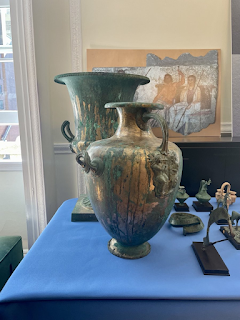
The Bronze Calyx Krater, which dates to 350 B.C.E., once held the bones of a deceased individual in a chamber tomb. It was looted and smuggled into Switzerland, where it was cleaned and restored by Fritz and Harry Bürki, the Zurich-based restorers and business partners of Robert Hecht. Hecht then arranged to smuggle the piece into New York, where it was sold to Leon Levy and Shelby White. It was seized by the Office in January of this year.
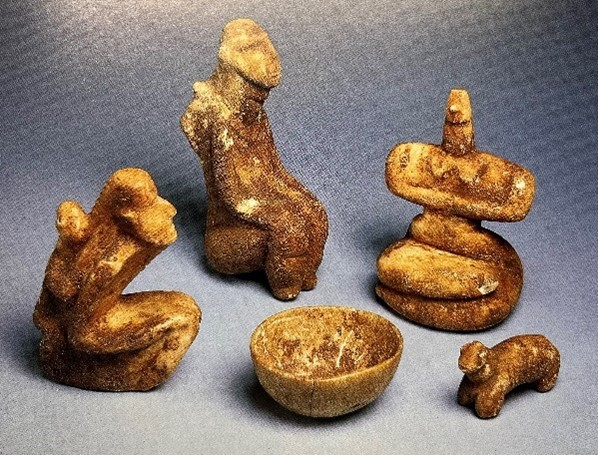
The Neolithic Family Group, which dates to 5000-3500 B.C.E and valued at $3 million. This group of objects compromises five human and animal figures carved from marble, and was looted from the island of Euboea by a Greek trafficker who smuggled the pieces into Switzerland. In 1982 dealer-trafficker Nicolas Koutoulakis sold the group to New York-based collectors Leon Levy and Shelby White. White loaned the group to the Metropolitan Museum of Art in 2000, where they remained on display until March of this year, when it was seized by the Office.
- Glories no. 76: A Late Geometric pair of horses 'said to have been found on Corfu, and for at least twenty years was in a collection in Austria. In October 1970, the group was lent to the Kunsthistorisches Museum in Vienna for restoration.'
- Glories no. 80: an armlet, two lidded pyxides, and an oinochoe from a hoard of at least 40 pieces found in northern Greece.
- Glories no. 141: a gold treasure consisting of a pair of coiled snake armbands, a pair of earrings with swans, a gold and carnelian necklace, a gold ring with carnelian intaglio, part of a gold wreath, and a gold diadem.
Saturday, 4 February 2023
Further returns to Italy from San Antonio Museum of Art and Shelby White
| Oinochoe fragment attributed to the Harrow painter returned from the San Antonio Museum of Art. Source: San Antonio Museum of Art |
The Manhattan DA has reportedly returned 14 more antiquities to Italy: though the objects and images presented at the press announcement counted 16 ("D.A. Bragg Returns 14 Stolen Antiquities to Italy", Manhattan DA February 2, 2023). Two sources were acknowledged: Shelby White and the San Antonio Museum of Art. The third, the source of a silver coin, was left anonymous in the press release.
The piece first surfaced in Italy after being looted by Giovanni Franco Becchina, a well-known antiquities trafficker. From Italy, the piece was then smuggled and laundered by Paris-based Robert Hecht. Hecht ultimately sold the piece with false provenance to Shelby White in New York County in 1989.
The Sicily Naxos Coin. Minted circa 430 B.C.E in the Greek colony of Naxos, on Sicily, this silver coin features the bearded Dionysus on one side and his squatting drinking partner, Silenus, on the reverse. The Sicily Naxos Coin first surfaced on the international art market in 2013, when a known trafficker offered the coin for sale with no provenance whatsoever. Prior to its appearance at a London-based auction house, a co-conspirator of the trafficker supplied false provenance for the coin. The Sicily Naxos Coin is currently valued at $500,000 and was among a group of coins seized at JFK airport as it was being smuggled into New York pursuant to an ongoing joint investigation between this Office, HSI, and Italy. At least one individual has been arrested in the course of this investigation with more to follow.
Chippindale, C., and D. W. J. Gill. 2000. "Material consequences of contemporary classical collecting." AJA 104: 463-511. [DOI]
Wednesday, 16 November 2022
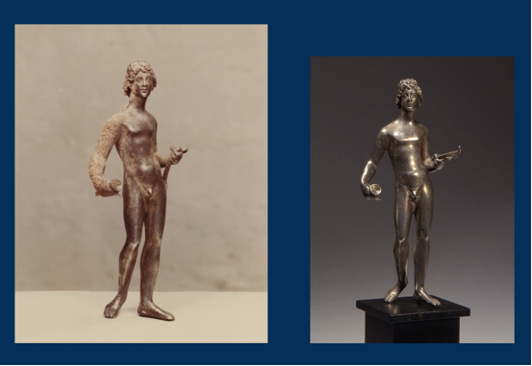
A Silver Apollo Returns to Turkey
Düver Frieze Fragment Returns to Turkey
![]() |
| Düver frieze fragment: Antalya Museum (l) and New York market (r) |
Another Bürki object returns to Italy
Source: MMA A psykter column-krater attributed to the Troilos painter was deaccessioned by New York's Metropolitan Museum of Art in June...
-
Source: Sotheby's A marble head of Alexander the Great has been seized in New York (reported in " Judge Orders Return of Ancien...
-
Source: ICE. There are times when you wonder if there is a lack of imagination when it comes to naming operations but 'Mummy's C...
-
Detail of the Sophilos dinos © David Gill The Sophilos dinos in the British Museum has been reconstructed from approximately 50 fragments. I...