Showing posts with label Dietrich von Bothmer. Show all posts

Wednesday, 15 July 2026

Two more Bothmer donations returned to Italy

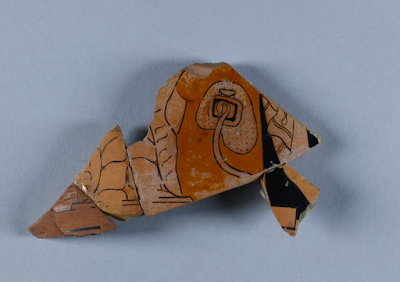
Cup attributed to near Psiax. Source: MMA.


In February 2026 two fragmentary Attic cups that had been given to New York's Metropolitan Museum of Art by Dietrich von Bothmer were deaccessioned pending their return to Italy. Both were donated in 1984, and both had been acquired from Fritz Bürki. One was a bilingual cup attributed to near Psiax (1984.500.1; BAPD 44520) and the other cup was attributed to Epiktetos with a kalos inscription of Hip(p)archos (1984.500.2; BAPD 9055412).

We should note that the MMA has earlier returned a black-figured mastos attributed to Psiax (1975.11.6; BAPD 4525). Bürki was the source of other returns from the MMA including fragments from a Makron cup (1978.11.7a, d), and fragments of the Apulian dinos attributed to the Dinos painter (1984.11.7). He was also the source of some 11 per cent of the fragments in the sample selection of Bothmer fragment collection acquired by the MMA.


Bookmark and Share so Your Real Friends Know that You Know

Monday, 6 July 2026

The Carlos: Don't Mention the Donor

Source: MCCM.
Loan from the Republic of Italy

The Michael C. Carlos Museum at Emory University has issued a "story" about their acquisition of looted Laconian pottery fragments from Italy ("Thieves, soda cans and an ancient vessel"). There is no mention of the donor in this new report: "the five sherds were photographed in the collection of the individual who donated them to the Carlos". It is more than significant that the donor was the late Dietrich von Bothmer who has been linked to a number of sherds that have had to be returned to Italy. Why does the "story" fail to name one of the most prolific modern collectors of pottery fragments? 

Henry Kim, the director of the Carlos, reminds us of the importance of transparency: "It’s a notion based in fear ... which the Carlos staff counteracts through vociferous transparency about their own efforts." Perhaps he needs to reflect a little more on the meaning of obscured transparency.

See Gill, D. W. J., and C. Tsirogiannis. 2024. "Fragmented pots and Dietrich von Bothmer." MAAR 69: 535–94 [online].  

| |
Bookmark and Share so Your Real Friends Know that You Know

Monday, 27 April 2026

Further returns to Italy from the MMA

Formerly New York MMA 1991.11.6.1–2.
Source: MMA
New York's Metropolitan Museum of Art has returned another batch of Greek and Roman antiquities as a result of investigations by the Manhattan DA into objects handled by Frieda Tchacos, Gianfranco Becchina, and Fritz Bürki [see Manhattan DA press release].

Only one piece is highlighted in the press release, a fragmentary Sicilian terracotta relief:
Two additional adjoining fragments of the votive relief were found in the archaeological excavations of the temple of Demeter Malophoros at Selinunte, Sicily, less than ten miles from Becchina’s hometown. Those fragments remain in the Palermo Museum.
This is linked to the Becchina investigation. The relief had formed part of the Norbert Schimmel collection. One other Schimmel piece is among the repatriated objects, a bronze handle attachment in the form of a mask. Other Schimmel items appeared in earlier returns.

The two Bürki linked pieces were objects presented by Dietrich von Bothmer, an Attic bilingual cup attributed to near Psiax, and a fragmentary cup attributed to Epiktetos.

The Tchacos pieces include a pair of spherical Greek gold earrings, a pair of Roman silver cups —one carries a weight inscription for the pair — and an inscribed lid of a Roman cinerarium (Sextus Flavius Pencarpus). There is also a forged Roman funerary inscription.

These latest returns have implications for other material. A batch of material from Selinunte is discussed in my Artwashing the Past (2025) [chapter 11]. The Tchacos investigation will lead to the numerous fragments acquired by other museums (as well as the nearly 300 fragments in the Bothmer collection: and these are just the ones identified in the sample).

I am grateful to Jason Felch for drawing my attention to one of the Schimmel pieces.

Bookmark and Share so Your Real Friends Know that You Know

Friday, 24 January 2025

Francavilla Marittima and the links to Switzerland

Fragment of plate
formerly in the Michael C. Carlos Museum
In 1979 the J. Paul Getty Museum acquired ‘a large collection of fragments of Corinthian pottery (79.AE.110) and Italian imitations of Corinthian wares (79.AE.111)’. A similar batch of material was purchased by the Archäeologische Institut der Universität Bern. As a result of research by Vera Uhlman several joins between the two collections (‘primarily from alabastra and pyxides’) were established, and a ‘set of fragments of Corinthian vases and local Italic imitations of Corinthian pottery’ were exchanged (83.AE.276). In addition, a number of plastic vases had been acquired in 1978 from ‘a private collection in Switzerland’ (78.AE.271) that were ‘part of the contents of an ancient favissa said to have been discovered in Lucania’. The combined number of fragments was in the region of 3,500. 

The fragmentary pieces appear to have come from a sanctuary at Francavilla Marittima inland from the Greek colony of Sybaris. Subsequently this cache of material was returned to Italy in 2011. 

Two more fragments linked directly to Francavilla Marittima have been returned to Italy from the Michael C. Carlos Museum at Emory University (2005.026.001). The fragment of a Wild Goat style plate joined two other fragments: one found at the Timpone della Motta sanctuary, and another in the collection of the Ny Carlsberg Glyptotek in Copenhagen. The Carlos Museum fragment had formed part of the collection of Peter Sharrer and had been acquired at a sale of fragments at Sotheby’s (New York) in June 2005: the fragment is reported to have been in a private New York collection since 1976. 

Fragments formerly
in the Bothmer collection
and given to the
Michael C. Carlos Museum;
now on loan to the museum
The second set of Carlos Museum fragments consisted of a Laconian cup (2006.042.001A and B; now on loan to the museum) that had been acquired from Dietrich von Bothmer. Bothmer had acquired his fragments from Hans Jucker, professor of classical archaeology at the University of Bern, Switzerland. The Bothmer fragments joined fragments found at the Timpone della Motta sanctuary. 

It is perhaps significant that a fragment of a Laconian cup attributed to the Boreads painter formed part of Bothmer’s collection (New York MMA 2011.604.9.10): it ‘joins fragments at the Archaeological Collection, University of Zurich (Inv. 5942), formerly in the Ines and Hans Jucker-Scherrer Collection (by 1960s)’. 

Given that Bothmer clearly obtained material from Francavilla Marittima for his collection, which other pieces may also come from that source and perhaps join fragments derived from excavations there? 

James Cuno has noted that it was Sharrer who sold a collection of pottery fragments to Harvard University Art Museums. Are there any potential fragments from Francavilla Marittima residing in that location?

| |
Bookmark and Share so Your Real Friends Know that You Know

Wednesday, 15 January 2025

Bothmer and Francavilla Marittima

Source:
Michael C. Carlos Museum
The Michael C. Carlos Museum has handed over ownership of two Laconian cup fragments that had been donated by Dietrich von Bothmer in 2006 [press release]. The fragments were acquired from Ines Jucker in 1985. The pieces fit excavated fragments from Francavilla Marittima.

Fragments of a Wild Goat plate (acquired in 2005) have already been repatriated from the Carlos. Several thousand fragments from the same site have been returned from the J. Paul Getty Museum and the Institute of Archaeology in Bern. 

In November 2024 the Carlos announced that it had returned fragments from two Attic red-figured kraters to Italy in December 2023 [press release]. What other Bothmer fragments should be returned to Italy? 


Mittica, G. 2018. Francavilla Marittima: Un patrimonio ricontestualizzato. Vibo Valentia: Adhoc Edizioni.
Gill, D. W. J. 2024. "The Michael C. Carlos Museum Returns Antiquities." Journal of Art Crime 31: 3–9.
Gill, D. W. J., and C. Tsirogiannis. 2024. "Fragmented pots and Dietrich von Bothmer." Memoirs of the American Academy in Rome 69: 535–94. [Open Access]


| |
Bookmark and Share so Your Real Friends Know that You Know

Thursday, 26 October 2023

Hecht and a calyx-krater attributed to the Achilles painter

Michael C. Carlos Museum inv. 2002.43.56
Among the donations made by Dietrich von Bothmer to the Michael C. Carlos Museum is a series of fragments from a calyx-krater attributed to the Achilles painter (BAPD 9036441). The museum's audio recording appears to suggest that the fragments came from a single pot. 

What is more interesting is to see how Bothmer acquired the fragments:
  • Robert Hecht: 1984 / 9; 1988 / 2 
  • Jonathan Rosen: 1984 / 1 
  • Bruce McAlpine: 1989 / 4; 19**/1 
  • Mario Bruno: 1984 / 1
In other words the first pieces of this fragmented krater surfaced through three different routes in 1984: Robert Hecht, Jonathan Rosen, and Mario Bruno. Hecht supplied further fragments in 1988, and Bruce McAlpine in 1989. The sources for the remaining fragments appear to be undeclared.

Where and when was the krater found? When was it fragmented and the pieces dispersed? 

How did the Carlos justify the acquisition of these fragments given what was known (in 2002) about the sources? Why does the Carlos present the fragmented krater as a series of fragments rather than acknowledging in the text of the website that they come from a single piece? 

What do these fragments tell us about Bothmer as a collector given that some of his material has been returned to Italy? 

| |
Bookmark and Share so Your Real Friends Know that You Know

Thursday, 21 September 2023

Bothmer, Almagià and the Michael C. Carlos Museum

Red-figured calyx-krater fragment
attributed to the Kleophrades painter.
Michael C. Carlos Museum inv. 2006.051.011B

I have noted that Dietrich von Bothmer acquired a fragment of a cup from Edoardo Almagià and then gave it to the J. Paul Getty Museum: the rest of the fragments were supplied by Galerie Nefer (D.W.J. Gill 2022. "Context Matters: Fragmented Athenian Cups." Journal of Art Crime 27: 77–84. ). 

A fragmentary calyx-krater attributed to the Kleophrades painter was presented to the Michael C. Carlos Museum by Bothmer in 2006. It is interpreted as showing the funeral mound of Hektor. Bothmer acquired the first fragment in July 1972, followed by further fragments in September 1978: the sources for these are unknown. However in 1978 another fragment was acquired from Bruce McNall of the Summa Galleries; this was followed by further fragments from Nikolas Koutoulakis in 1981, Edoardo Almagià in 1993, and Harry Bürki in 1994. 

This network of names would suggest that the origins of this krater deserve further investigation. Tsirogiannis and I will be exploring a parallel network, also including Bothmer, in a forthcoming article.

Incidentally, a fragmentary calyx-krater showing the funerary mound of Achilles (?), and compared by Bothmer to the Kleophrades painter, had resided in the private collection of Cornelius C. Vermeule (BAPD 3197). Both kraters seem to have surfaced around the same time.

| |
Bookmark and Share so Your Real Friends Know that You Know

Friday, 14 July 2023

Italy Seeks Return of Antiquities from the Louvre

Amphora attributed to the Berlin painter.
Source: The Louvre

The Italian authorities are seeking the return of seven antiquities from the Louvre (Roxana Azimi, "Italy calls on the Louvre to return seven of its archaeological objects", Le Monde July 13, 2023). The report draws attention to the Attic red-figured amphora that once formed part of the Hunt Collection (Wealth of the Ancient World no. 10). A further fragment from the amphora was supplied by Dietrich von Bothmer, and Robert Guy identified another piece that was presented to the Louvre in 1995 in honour of François Villard (Berlin Painter cat. no. 13; no. BN5; BAPD 8798). It should be noted that pots (and fragments) attributed to the Berlin painter have featured frequently in the returns to Italy. The identification of the Berlin painter amphora was made by Christos Tsirogiannis in 2006.

What are the other pieces likely to be? We know that the items were acquired between 1982 and 1998.

Possible candidates include:
a. Sicilian bell-krater attributed to the Lentini-Manfria group (CA 7249). Acq. Fritz Bürki (1986).
b. Capuan bell-krater attributed to the Ixion painter (CA 7124). Purchase (1985).
c. Attic black-figured psykter-krater attributed to the manner of the Antimenes painter (MNE 938) (BAPD 26150). Purchase (1988).

The Attic and the Capuan kraters (b–c) have been identified from the Becchina archive. The identifications were  made by Daniela Rizzo and Maurizio Pellegrini.
  • Rizzo, D., and M. Pellegrini. 2021. "The Italian Archaeological Heritage Abroad: Between Agreements, Debates and Indifference." In Stolen Heritage: Multidisciplinary Perspectives on Illicit Trafficking of Cultural Heritage in the EU and the MENA Region, edited by A. Traviglia, L. Milano, C. Tonghini, and R. Giovanelli, Antichistica, vol. 29: 99–114. Venezia: Edizioni Ca’ Foscari.

| |
Bookmark and Share so Your Real Friends Know that You Know

Wednesday, 3 May 2023

Sourcing Makron


New York's Metropolitan Museum of Art (MMA) appears to be reluctant to release the full details of the source for three cups attributed to Makron that were acquired in 1979 alongside the two cups that were discussed in The New York Times. 

The three cups are:
a. 1979.136, gift of Dietrich von Bothmer. BAPD 275244. Joins other fragments in the Vatican; reported to have been transferred to the Vatican.
b. 1979.11.11, purchase (Mr & Mrs Martin Fried Gift). BAPD 6919.
c. 1979.11.4, purchase (Norbert Schimmel Gift Fund); 1979.11.16 [4 frr.]; 1980.11.5, purchase (The Dover Fund Inc. Gift). BAPD 6918. [The third acquisition is not noted on BAPD.] The MMA website attributes one of these acquisitions to the Euaion painter even though the other pieces are attributed to Makron.

No images are provided on the website for any of these three pieces.


Each object page invites users to provide feedback or to ask questions. The MMA clearly did not appreciate my requests using the online form as there has been no response to a polite request for information.

I hope that this post will prompt the MMA to update the five records to provide the relevant information as well as some images. Or were the fragments sourced from the same galleries and dealers as the other two Makron cups?

| |
Bookmark and Share so Your Real Friends Know that You Know

Thursday, 20 April 2023

Fragments from a cup attributed to Makron

Cup seized from
New York's Metropolitan Museum of Art

The New York Times has run a discussion of one of the Attic red-figured cups seized from New York's Metropolitan Museum of Art in 2022 (Graham Bowley and Tom Mashberg, "The Kylix Marvel: Why Experts Distrust the Story of an Ancient Cup’s Rebirth", April 19, 2023). The article looks at the way that this cup (and a companion piece also in the same museum) was put together from a series of fragments starting with pieces acquired from Fritz Bürki and the Summa Galleries, followed by pieces derived from Frieda Tchacos and Dietrich von Bothmer. 

The article includes identifications made by Christos Tsirogiannis from the Medici Dossier.

| |
Bookmark and Share so Your Real Friends Know that You Know

Wednesday, 12 April 2023

Princeton Fragments from an Attic Cup

Princeton y1988.16 and y1989-19a–r
Source: Daily Princetonian
In 1988 Princeton University Art Museum purchased through the Classical Purchase Fund a fragment of an Attic red-figured cup attributed to the Villa Giulia painter (inv. y1988.16). The following year Dietrich von Bothmer presented a series of fragments from the same cup (inv. y1989-19a–r). The note in the Record acknowledged the join.

What was the source for the fragment purchased in 1988? And what was the sources (or sources) for Bothmer's fragments?

The cup is one of the pieces under investigation by the Manhattan DA.

| |
Bookmark and Share so Your Real Friends Know that You Know

Saturday, 8 April 2023

Amphora fragment seized from Princeton

Amphora fragment attributed to Psiax
Source: Daily Princetonian


An Attic belly amphora fragment attributed to Psiax (by Dietrich von Bothmer) was among the 11 objects seized from Princeton University Art Museum by the Manhattan DA (inv. 1997-469: BAPD 902285). The fragment was acquired by 1997 as an anonymous gift by exchange, though we also know that it was derived from a "Centre Island private collection". 

Among the other objects seized were six pieces on loan from Edoardo Almagià. Further details have yet to be released.

We know of another calyx-krater attributed to Psiax that had also formed part of a "Centre Island private collection". 

| |
Bookmark and Share so Your Real Friends Know that You Know

Monday, 19 September 2022

Robert Hecht and the Princeton painter

Neck-amphora fragments attributed to the Princeton painter
Formerly New York MMA inv. 1991.11.2.

In 1991 the Metropolitan Museum received a gift of a fragmentary black-figured neck-amphora showing Herakles, Athena and Hermes, from Dietrich von Bothmer (inv. 1991.11.2). It was attributed to the Princeton painter by von Bothmer (according to Mary B. Moore); BAPD suggests that the person who attributed the fragments was 'unknown'. Moore observes that the amphora was 'broken and mended with significant parts missing'. The restorer of the amphora is not indicated. The amphora was among a batch of antiquities seized from the museum in 2022 and returned to Italy.

Although the Beazley Archive suggests that the amphora had formed part of the Bothmer collection (BAPD 9023766), the MMA  online catalogue entry suggests that it was in fact purchased from Atlantis Antiquities in 1991. This implies that Bothmer had supplied the funds to purchase the fragments from the gallery that was part owned by Robert Hecht. 

Atlantis Antiquities has already been associated with a number of returns from North American collections that include:
  • An Attic black-figured lekythos attributed to the Diosphos painter from Boston, Museum of Fine Arts
  • An Attic black-figured amphora attributed to the painter of Berlin 1686 from The J. Paul Getty Museum
  • An Attic black-figured amphora attributed to the Antimenes painter from the Steinhardt collection
  • An Apulian amphora attributed to the Darius painter from Boston, Museum of Fine Arts
  • An Apulian loutrophoros attributed to the Metope group from The J. Paul Getty Museum
In some of these cases the restorations had been undertaken by Fritz Bürki. 

It is known that Hecht was the source for some of the pot fragments in Bothmer's collection. 

| |
Bookmark and Share so Your Real Friends Know that You Know

Monday, 12 September 2022

Attic Pot Fragments Returning from the Metropolitan Museum of Art

Fragment of amphora attributed to the Amasis painter. Formerly MMA inv. 1985.53.

Three of the fragments that were returned to Italy from the Metropolitan Museum of Art had been illustrated in the exhibition catalogue of the Amasis painter (New York, Metropolitan Museum of Art September-October 1985; The Toledo Museum of Art, November  1985-January 1986; Los Angeles County Museum of Art, February-April 1986).

Two were attributed by Dietrich von Bothmer to the Amasis painter:
No. 2 bis: Inv. 1985.53; BAPD 14680; Search List U. Fragment of a panel amphora. Traces of a horse's mane. Attribution by Dietrich von Bothmer. 

Fragment of amphora attributed to the Amasis painter. Formerly MMA inv. 1985.11.2.


No. 17: Inv. 1985.11.2; BAPD 14683; Search List K. Fragment of a panel amphora. End of 'signature'. Attribution by Dietrich von Bothmer. 


Fragment attributed to Lydos. Formerly MMA inv. 1985.11.1.


One fragment was attributed to Lydos. It had been purchased from Galerie Antike Kunst Palladion in 1985:
(fig. 25) Fragment of a plate showing gods. Inv. 1985.11.1; BAPD 14695; Search List J. Attribution by Dietrich von Bothmer. 

All three fragments are reported on the MMA's website to have been with Galerie Antike Kunst Palladion until 1985 (the year of the Amasis painter exhibition). Fragment 1985.53 was purchased by Dietrich von Bothmer and given to the museum as an anonymous gift. 

How were these fragments 'discovered' in the very year of the exhibition? 

And what are the histories of the Amasis painter fragments purchased in the same and preceding year? How were they acquired? For some reason this information is not provided on the MMA website.

No. 18. Inv. 1984.313.2; BAPD 14656. Fragment of an amphora. Anonymous gift.  Attributed to the Amasis painter by Dietrich von Bothmer.

No. 18 bis. Inv. 1985.57.a-h; BAPD 14735. Fragments of a panel amphora; both sides. Anonymous Gift. Attributed to the Amasis painter by J.R. Guy in February 1984 'before the fragments came to New York'. 

No. 56. Inv. 1984.313.1; BAPD 14636. Fragment of a Band Cup. Anonymous gift. Attributed to the Amasis painter by Dietrich von Bothmer. 

What about the fragment of a Band Cup that was given to the museum in 1986 by Dietrich von Bothmer? What was its history?

Inv. 1986.99.6;  BAPD 9035071.

The recent return of the three pieces from the Metropolitan Museum of Art has started to raise questions about other pieces in the collection. 

| |
Bookmark and Share so Your Real Friends Know that You Know

Saturday, 3 September 2022

Search Warrant for the Met

Castor and Pollux previously on loan to New York's Metropolitan Museum of Art
© David Gill


Some of the pieces on the search warrant have been discussed by LM in the past:

Bookmark and Share so Your Real Friends Know that You Know

Tuesday, 11 January 2022

A Bothmer fragment sourced from Almagià


When 40 of Bothmer pot fragments were returned to Italy from New York's Metropolitan Museum of Art there was the statement from the museum's spokesperson, Elise Topalian, reported by Chasing Aphrodite:
Von Bothmer was a client of Almagia for many years, Topalian said. The fragments von Bothmer obtained from the dealer were returned to Italy “to serve as evidence in the investigation and possible trial of Edoardo Almagia.”
In the statement of fact relating to Michael Steinhardt's collection an example of Almagià's sales from the summer of 1994 is provided. This suggests that Almagià provided "Frammenti Attici" that had been purchased from Mauro Morani $22,000.

One of the pieces purchased by Bothmer from Almagià in 1987 was a fragment, measuring 1.9 cm, of an Attic red-figured cup attributed to the Triptolemos painter (Malibu inv. 87.AE.154). 103 fragments of the same cup were purchased in 1990 from Galerie Nefer (Malibu inv. 90.AE.35). 

Where did Almagià acquire his fragment? Where did the Galerie Nefer acquire its fragments? 

Were other Bothmer fragments in the Getty acquired from Almagià?
| |
Bookmark and Share so Your Real Friends Know that You Know

Wednesday, 30 December 2020

Fragments attributed to the Berlin painter


What questions should we be considering when we study the fragments of Athenian red-figured pottery that are dispersed between different collections and museums? This short study takes the example of some five pieces attributed to the Berlin painter (BN3, BN9, BN12, BN29, BN38); two have been returned to Italy. When were these fragments moved to different collections? Who was involved? In the case of two of the pieces, the initial fragments were presented to the museum only to be followed by purchases from a different source. Such a pattern of acquisition is not confined to the Berlin painter.

This paper questions the position taken by James Cuno that scholars should not seek the clarify the "provenance" (I prefer "history") of such fragments. 

The fragments are a reminder of the information that has been lost by the unscientific removal of Athenian pottery from funerary and other archaeological contexts.

Gill, D. W. J. 2020. "Fragmented Athenian Pots and the Berlin Painter: Recent Breaks?" Academia Letters, Letter 40: 1–5. [DOI]


Bookmark and Share so Your Real Friends Know that You Know

Friday, 23 January 2015

'Fragments in time': reflecting on the Bothmer collection

Christos Tsirogiannis and I have published "“A Fracture in Time”: A Cup Attributed to the Euaion Painter from the Bothmer Collection" that is now available in the latest number of the International Journal of Cultural Property 21, 4 (2014) [DOI]. IJCP is published by Cambridge University Press.

The paper considers the issue of "orphaned" figure-decorated pottery fragments.

Abstract
In February 2013 Christos Tsirogiannis linked a fragmentary Athenian red-figured cup from the collection formed by Dietrich von Bothmer, former chairman of Greek and Roman Art at New York’s Metropolitan Museum of Art, to a tondo in the Villa Giulia, Rome. The Rome fragment was attributed to the Euaion painter. Bothmer had acquired several fragments attributed to this same painter, and some had been donated to the Metropolitan Museum of Art as well as to the J. Paul Getty Museum. Other fragments from this hand were acquired by the San Antonio Museum of Art and the Princeton University Art Museum. In January 2012 it was announced that some fragments from the Bothmer collection would be returned to Italy, because they fitted vases that had already been repatriated from North American collections. The Euaion painter fragments are considered against the phenomenon of collecting and donating fractured pots.

Bookmark and Share so Your Real Friends Know that You Know

Saturday, 7 June 2014

The Fano Athlete: Decision On Hold

The Fano Athlete
It appears that the legal process to decide on Italian claims to the Fano Athlete has been put on hold (LA Times). Yet one of the issues to emerge (via Jason Felch) back in January 2010 was the due diligence process undertaken (or not) by the J. Paul Getty Museum.

It would be interesting for the Getty to release the documents to show how the curatorial team at the museum responded to concerns voiced by Dietrich von Bothmer and Thomas Hoving.

For some of the earlier issues relating to the statue see here.

Bookmark and Share so Your Real Friends Know that You Know

Tuesday, 10 September 2013

Collecting histories for Bothmer fragments

It has been drawn to my attention that Dietrich von Bothmer did note the sources for at least some of the pot fragments that he acquired. It would be helpful if the curatorial staff of New York's Metropolitan Museum of Art started to post this information on the MMA website. Collecting histories matter!

Bookmark and Share so Your Real Friends Know that You Know

Krater fragments in Princeton

Greek, Attic, probably by the Kleophrades Painter, ca. 490–480 BCE, Two non-joining fragments from a calyx-krater (mixing bowl) depicting ar...