Showing posts with label forgeries. Show all posts

Wednesday, 11 February 2026

Towards a Corpus of Cycladic Figures

One of the ideas said to have come out of the Cycladic workshop at New York's Metropolitan Museum of Art is the creation of an online corpus of Cycladic figures.  The organisers of the workshop may not have been aware of these studies:
  • Tsirogiannis, C., D. W. J. Gill, and C. Chippindale. 2022. "The Forger’s Tale: An insider’s account of corrupting the corpus of Cycladic figures." International Journal of Cultural Property 29: 369–85. [CUP]
  • —. 2025. "A Corrupt Cycladic Corpus of Marble Figures." Journal of Eastern Mediterranean Archaeology & Heritage Studies 13: 203–33.[DOI]
We discuss the Future of the Cycladic Corpus with the following sub-divisions: An Archaeologists' Corpus; A Connoisseurs' Corpus; An Unresolved Corpus; and An Outcast Corpus. The Leonard Stern collection even has its own section: 'Learning from a recently formed private collection'. My BMCR review of the Stern collection also has a section on 'A Potentially Corrupted Corpus'.

We hope that those who have an interest in the importance of the archaeological context for these figures will be allowed to steer the project and (perhaps even more importantly) will assess whether or not it is a project worth pursuing.

| |
Bookmark and Share so Your Real Friends Know that You Know

Thursday, 5 February 2026

A Cycladic(ising) Journey

In September 2025 New York's Metropolitan Museum of Art returned a number of items, including Cycladic, to Greece. The EC collared jar (inv. 2004.342.1) was significant enough to include in S. Hemingway, "Art of the Aegean Bronze Age." The Metropolitan Museum of Art Bulletin 69 (2012), 21, fig. 34, and it is a reminder that as recently as 2004 the museum had been receiving suspect Cycladic material.

The controversial long-term loan of the Stern collection of Cycladicising material will be celebrated today by a symposium, "Journey to the Cyclades: Exploring the Early Cycladic Culture of Greece". Hemingway is due to be speaking about cultural patrimony. One hopes that the Director, Max Hollein, will talk about the reason why the Met has had to return so many hundreds of Etruscan, Greek and Roman antiquities to the countries where they were found. 

It is disappointing to see that issues relating to context and authenticity are not addressed as explicit topics by specific speakers. Will the issue of the figure that appears in the Becchina photographic archive be rehearsed? And will the Greek position on figure fragments derived from the Keros Haul [not a "Hoard"] be made clear?

For further discussion of the Stern collection see:
—. 2025. "Leonard Stern Collection of Cycladic Antiquities". Museum of Looted Art. 
—. and C. Tsirogiannis. 2025. "The Stern Collection of Cycladic Figures and the Metropolitan Museum of Art." MeditArch 38: 1–24.

| |
Bookmark and Share so Your Real Friends Know that You Know

Saturday, 10 January 2026

Authenticity and Cycladic figures


I understand that in February there will be a closed conference to explore the Stern collection of Cycladicising objects currently on loan to New York's Metropolitan Museum of Art. One of the key issues that needs to be explored relates to the authenticity of the figures. Are some of them modern creations? Are some recreated from genuine figures? Are some the work of well-known forgers of Cycladic figures? Will it be possible to identify the works of forgers in other collections, perhaps including the Met?

Will delegates of the conference restate the importance of archaeological context in determining authenticity? Or will there be an exploration of "the land of parallel" where similar figures may not have secure contexts?

What will be the lasting academic contribution of this conference to the Early Cycladic period?

For further reading:
Tsirogiannis, C., D. W. J. Gill, and C. Chippindale. 2022. "The Forger’s Tale: An insider’s account of corrupting the corpus of Cycladic figures." International Journal of Cultural Property 29: 369–85. [Online]
Tsirogiannis, C., D. W. J. Gill, and C. Chippindale. 2025. "A Corrupt Cycladic Corpus of Marble Figures." Journal of Eastern Mediterranean Archaeology & Heritage Studies 13: 203–33. [Online]

| |
Bookmark and Share so Your Real Friends Know that You Know

Friday, 14 November 2025

An Analysis of the Stern Collection of Cycladicising Art

The loan exhibition of the Leonard N. Stern collection of Cycladicising art at New York's Metropolitan Museum of Art has been drawing much attention. Our detailed analysis has just been published by Mediterranean Archaeology.

Gill, D. W. J., and C. Tsirogiannis. 2025. "The Stern Collection of Cycladic Figures and the Metropolitan Museum of Art." MeditArch 38: 1–24.

The structure of the article is as follows:
I. Introduction 
II. The Formation of the Stern Collection 
III. Cycladic Figures in Public Exhibitions and Key Publications 
IV. From Cycladic Master to Cycladic Sculptor 
V. The Sources of Cycladic Figures Known Before 1970 
VI. Potentially Looted Material 
VII. Potential Forgeries 
VIII. The Rest of the Cycladic Collection 
IX. Repatriation or Loans: The Political Dimension 
X. Conclusion

Two other studies of the Stern collection have appeared:

Gill, D. W. J. 2025. "Leonard Stern Collection of Cycladic Antiquities". Museum of Looted Art.

There is a shorter discussion of the Stern collection in this study of Cycladic figures:

Tsirogiannis, C., D. W. J. Gill, and C. Chippindale. 2025. "A Corrupt Cycladic Corpus of Marble Figures." Journal of Eastern Mediterranean Archaeology & Heritage Studies 13: 203–33. [DOI]


| |
Bookmark and Share so Your Real Friends Know that You Know

Wednesday, 21 December 2022

Christos Doumas on Cycladic Forgeries

New York MMA
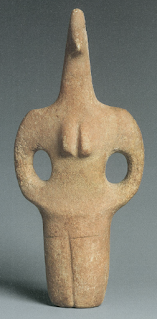
inv. L.2022.38.49
An interview with archaeologist Christos Doumas was published earlier this week. The focus was on the 15 items from the Leonard Stern collection that went on display in the Homecoming exhibition at the Museum of Cycladic Art. Doumas raised questions about the authenticity of some of the figures. When pressed by the journalist he thought that at least 4 or 5 of the figures (out of 10!) were likely to be fakes. (Only one is identified: the Late Neolithic figure [no. 1], though it should be remembered that Getz-Gentle does illustrate this in Personal Styles, pl. 2. The Homecoming catalogue notes, 'It belongs to a type that has not yet been identified among Aegean marble figurines of the Neolithic period'.) Doumas based his view on fakes on the type of marble that was used. He raised the issue why there had not been a panel formed to help authenticate the figures in the Stern collection. 

This raises questions about other figures in the Stern collection especially in the light of recent revelations about the forging of Cycladic figures. 

How will the curators at the Museum of Cycladic Art and New York's Metropolitan Museum of Art respond to Doumas' concerns? There is likely to be unease that accepting all the Stern figures as authentic has the potential of corrupting the corpus of knowledge for Cycladic figurines. 

| |
Bookmark and Share so Your Real Friends Know that You Know

Saturday, 10 December 2022

The Forger's Tale


Our latest study on forgeries and the corpus of Cycladic figures is now available from the International Journal of Cultural Property.

Tsirogiannis, C., D. W. J. Gill, and C. Chippindale. 2022. "The Forger’s tale: An insider’s account of corrupting the corpus of Cycladic figures." International Journal of Cultural Property: 1-17 [Web].

Abstract

Many of the known Cycladic figures – the late prehistoric human-shaped sculptures from the Aegean archipelago – came from twentieth-century illicit excavations, especially in the 1960s and 1970s. It is also known that figures were being faked at the time and perhaps also earlier: a few fakes have been identified, whilst other figures are under suspicion. Interviews with a man who faked Cycladic figures in the 1980s and 1990s give us a first insider’s autobiographical account of the forging business. This article offers, step-by-step, the method that two forgers developed to create fake figures, to treat them so that they appeared ancient, and to sell them on. The forger has identified a few of these forgeries from photographs of figures; his story is consistent with other information and seems to ring true. By verifying various elements in the forger’s testimony – from names of well-known figures in the modern antiquities market to small details and dates – we have been able to evaluate the validity of the narrative; to use it in order to uncover the true paths that fake objects followed into various collections; and to highlight valuable provenance information that no one involved in trading these objects was ever willing to provide.

| |
Bookmark and Share so Your Real Friends Know that You Know

Saturday, 23 September 2017

Aydin Dikmen and the forging of antiquities

Suzan Mazur has published a timely piece on Aydin Dikmen ("Anatolian Stargazer Fakes?—The Aydin Dikmen Connection", Huffington Post September 22, 2017). She raises the spectre that some of the more complete Anatolian "Stargazer" figures could be modern creations. 

Mazur notes the presence of such figures in the hands of Aydin Dikmen who was separately reported as having made the "best fakes" (though not specifically of Anatolian figures). Dikmen's basement in Konya was also reported to have been equipped to make objects from marble.

There are clear intellectual consequences if the insecure "Stargazers" are allowed to join the corpus of Anatolian figures that have been recovered from scientific excavations.

Owners of "Stargazers" that surfaced on the market since 1960 need to check their full histories.

It needs to be stressed that some of these "Stargazers" could indeed be ancient, but the absence of contextual information will make it difficult for their date to be authenticated.

Bookmark and Share so Your Real Friends Know that You Know

Tuesday, 17 January 2017

Intellectual Consequences of Forgeries

I attended the Second AHRC Workshop | Art, Crime and Criminals: Painting Fresh Pictures of Art Theft, Fraud and Plunder at RUSI in London yesterday. I was very struck that some of the issues that I have explored with Christopher Chippindale in our work on Cycladic sculptures were emerging for other works of art and from so many different cultures. Undetected forgeries corrupt the corpus of knowledge and undermine the genuine pieces.

Some of the lessons derived from the conference should be that academics need to be more cautious about providing attributions and opinions as these can be used to authenticate the forgeries. Secondly, the due diligence needs to be far more rigorous.

I will be revisiting Cycladic figures in February as part of a presentation in Cambridge and I expect modern creations will feature in the discussion.

Bookmark and Share so Your Real Friends Know that You Know

Tuesday, 12 May 2015

Forgeries and the market

One of the questions posed for later this week is 'how are forgeries placed on the market?'

I look back to my study of the 'Fitzwilliam Goddess', acquired by the Fitzwilliam Museum in 1926 [JSTOR]. The endorsement for the piece was by Sir Arthur Evans. The dealer, Charles Seltman, was known to the museum. The story of the alleged find-spot (the harbour for Knossos) was plausible. The curator was keen to develop the prehistoric collection.

We could consider other pieces such as the Getty kouros. Is it genuine? Or is it a modern creation? Look at the way that parallels were supplied. And there was the creation of a collecting history (with the wrong postal code).

Or there are Cycladic figures attributed by an expert in the field to named sculptors that have turned out to be modern creations. They share one thing in common: they did not come from a secure archaeological context.

And then there is the Amarna princess. Who authenticated it? It was believable because it had the right elements.

So how can we avoid forgeries? Perhaps by acquiring objects that have authenticated collecting histories and that come from known contexts.

Bookmark and Share so Your Real Friends Know that You Know

Tuesday, 5 August 2014

Coins returning to Greece from Rhode Island collector

Coins that had passed through the hands of a North American private collector have been returned to Greece ("U.S. returning ancient Greek coins after Manhattan DA prosecutes prominent collector", New York Daily News August 4, 2014). It is reported:
The coins were part of a case against noted Rhode Island hand surgeon and coin aficionado Dr. Arnold-Peter Weiss, whose January 2012 arrest during a coin auction at the Waldorf-Astoria hotel roiled the numismatic world.  
An orthopedics professor at Brown University's Alpert Medical School and author of a hand-surgery textbook, Weiss also had been on a coin collector and investor for 35 years and had served as on the board of the American Numismatic Society.  
He later pleaded guilty to attempted criminal possession of stolen property.
LM reported on the initial story back in January 2012 (as it broke during the AIA Annual Conference). The "haul" included three modern creations that may have been identified as a result of "Operation Ghelas". Issues relating to Weiss' plea were also reported in July 2012. It is also important to remember that Weiss is reported, by the ANS, to be "one of the founding Partners of the second incarnation of the firm Nomos AG, of Zürich, Switzerland". Weiss' role in the Swiss based company still features on their website. Does this case have any implications for Nomos AG?

There are some key issues that need to be addressed. How far have sophisticated numismatic forgeries penetrated the market? Do collectors, such as Dr Weiss, feel comfortable handling material that they have (apparently) been informed was fresh out of the ground? Is the numismatic market as toxic as that for antiquities? Will the ANS be making a statement about the case? What are the full documented collecting histories for the coins that Weiss has presented to the ANS?

Further details on the Weiss case can be found here.


Bookmark and Share so Your Real Friends Know that You Know

Thursday, 7 November 2013

Art Forgery and Provenance

I attended the ARCA (Association for Research into Crimes against Art) Art Crime Symposium at the V&A in London today. There were two sessions:

  • a. Art Recovery and Reward: Det Sgt Claire Hutcheon (Metropolitan Police), Charlie Hill, Richard Ellis, Jonathan Jones.
  • b. Art Forgery and Provenance: Vernon Rapley, Christopher Marsden, Christos Tsirogiannis, Noah Charney.

I tweeted some of the themes here.

I was very struck by Jonathan Jones' point that art can be displayed in its original context (e.g. a church) rather than the sanitised environment of a museum. (It reminded me of the Houghton Hall exhibition --- and interestingly Peter Watson alluded to the exhibition during the discussion.)

During the discussion, Richard Ellis reminded us that due diligence meant that we needed to ensure that we left no stone unturned as we researched past collecting histories.

Vernon Rapley kept coming back to the Amarna Princess as well as other pieces from the same forger. He reminded us of little clues that would send curators down carefully laid false trails. Christopher Marsden (Senior Archivist at the V&A) reminded us of the forging of documentation to support "provenance".

Christos Tsirogiannis (U Cambridge) discussed a range of forged paperwork and collecting histories drawing on examples from the Medici Dossier, as well as the Sarpedon krater that had been acquired by New York's Metropolitan Museum of Art. He explored the background to the Getty kouros.

Bookmark and Share so Your Real Friends Know that You Know

Tuesday, 15 October 2013

The Iranian silver griffin

Suzan Mazur has added some further information about the silver griffin returned to Iran ("ICE "Incompetence" In Iranian Griffin Debacle", scoop.nz October 15, 2013). She also quotes from an email by Peter Northover relating to the analysis of the griffin. [Northover also analysed the Cleveland Apollo.]

Oscar Muscarella responds and suggests that Northover's report "hangs in the air" and has "no scientific value".

Bookmark and Share so Your Real Friends Know that You Know

Wednesday, 9 October 2013

Cultural Diplomacy: have US - Iran relations been compromised?

Suzan Mazur has published an important piece on the silver griffin returned to Iran ("A Fake? America's souvenir to the Iranian people", scoop October 9, 2013). She reports that Oscar White Muscarella, who has published one of the major studies of forged Near Eastern antiquities [see review in AJA: JSTOR], has identified the griffin as "a modern forgery". Muscarella identified the griffin as "a modern Iranian artifact" in a contribution to a series of studies in honour of Massoud Azarnoush (and published in 2012).

Mazur reminds us that the griffin was purchased from the Aboutaams in 2002 for $950,000. It apparently surfaced in Geneva in 1999. The purchaser asked for confirmation of the authentification.

The story has an interesting parallel with the Cleveland Apollo: readers of Mazur's article with recognise that the dealer and the scientific studies overlap to some degree. Does this undermine their authority?

What will the Iranian Government make of this offering?

I am grateful to Suzan Mazur for drawing my attention to her article.

Bookmark and Share so Your Real Friends Know that You Know

Thursday, 20 September 2012

The "dodgy" papyrus: the Fecht connection

I am wondering about the authenticity of the supporting evidence for PDodg. It seems that the Harvard Gazette tells us "The collector provided King with a letter from the early 1980s indicating that Professor Gerhard Fecht from the faculty of Egyptology at the Free University in Berlin believed it to be evidence for a possible marriage of Jesus." (B. D. Colen, "Suggestion of a married Jesus", September 18, 2012). Harvard Divinity School has issued this comment: "The earliest documentation about the fragment is a letter from the early 1980s indicating that Professor Gerhard Fecht from the faculty of Egyptology at the Free University in Berlin believed it to be evidence for a possible marriage of Jesus."

However, the New York Times reported: "It came with a handwritten note in German that names a professor of Egyptology in Berlin, now deceased, and cited him calling the fragment “the sole example” of a text in which Jesus claims a wife."

In contrast, the Smithsonian magazine noted:
Among the papers the collector had sent King was a typed letter to Laukamp from July 1982 from Peter Munro. Munro was a prominent Egyptologist at the Free University Berlin and a longtime director of the Kestner Museum, in Hannover, for which he had acquired a spectacular, 3,000-year-old bust of Akhenaten. Laukamp had apparently consulted Munro about his papyri, and Munro wrote back that a colleague at the Free University, Gerhard Fecht, an expert on Egyptian languages and texts, had identified one of the Coptic papyri as a second-to fourth-century A.D. fragment of the Gospel of John.
Munro, like Fecht, is no longer alive. Laukamp was a dealer in Berlin.

The Smithsonian also notes a second piece of correspondence:
The collector also left King an unsigned and undated handwritten note that appears to belong to the same 1982 correspondence—this one concerning a different gospel. “Professor Fecht believes that the small fragment, approximately 8 cm in size, is the sole example of a text in which Jesus uses direct speech with reference to having a wife. Fecht is of the opinion that this could be evidence for a possible marriage.”
Has anybody authenticated these two more modern letters? A typed letter could be forged. Whose handwriting appears in the second note? When was it written? Is it contemporary with the (purported) 1982 typewritten letter? Or could it be an afterthought added to the dossier when sold to the present proprietor?

Bookmark and Share so Your Real Friends Know that You Know

Wednesday, 19 September 2012

The "dodgy" papyrus fragment: further comments

Nicole Winfield, writing from Rome, has written an important response to the news about the newly surfaced papyrus fragment ("Doubts over Harvard claim of 'Jesus' Wife' papyrus", September 19, 2012 [available on Bloomberg Business Week). Winfield has interviewed participants at the conference who have questioned the authenticity of the fragment:
Stephen Emmel, a professor of Coptology at the University of Muenster ... questioned whether the document was authentic. 
"There's something about this fragment in its appearance and also in the grammar of the Coptic that strikes me as being not completely convincing somehow," he said in an interview on the sidelines of the conference. 
Another participant at the congress, Alin Suciu, a papyrologist at the University of Hamburg, was more blunt. "I would say it's a forgery. The script doesn't look authentic" when compared to other samples of Coptic papyrus script dated to the 4th century, he said.
Despite concerns about how the fragment surfaced on the market, there is the predictable comment:
AnneMarie Luijendijk, the Princeton University expert whom King consulted to authenticate the papyrus, said the fragment fit all the rules and criteria established by the International Association of Papyrologists. She noted that papyrus fragments frequently don't have a provenance, simply because so many were removed from Egypt before such issues were of concern. She acknowledged the dilemma about buying such antiquities but said refraining from publishing articles about them is another matter. 
"You wouldn't let an important new text go to waste," she said.
Perhaps the International Association of Papyrologists needs to revisit its criteria and recommendations for the "commerce in papyri" (available here). (I note the phrase "observe scrupulously".)

Winfield also draws attention to concerns about publishing recently surfaced antiquities.

I am also quoted: "This looks to me as if any sensible, responsible academic would keep their distance from it."

Perhaps King, Bagnall, and Luikendijk have been too quick in associating themselves with the fragment.

Winfield's interview is now informing other reports that have appeared elsewhere (e.g. Daily Mail, Fox News).

Bookmark and Share so Your Real Friends Know that You Know

Friday, 6 July 2012

Source of the Weiss coins

Where did coin-dealer Arnold Peter C. Weiss obtain his (not so ancient?) coins? I note that Janon Fisher in the New York Daily News points us in a new direction ("Prominent hand surgeon pleads guilty to selling phony ancient coins to undercover agent", July 3, 2012):
Herbert Kreindler, a Long Island coin dealer who Weiss says sold him the bad pennies, was not charged in the crime.
A company with this name is a member of the International Association of Professional Numismatists (IAPN). Weiss is also a founding partner of an IAPN member numismatic company.

Will the IAPN be investigating how these "toxic" coins entered and circulated in the market?

I also note that the Washington lobbyist who acts for the IAPN has been remarkably silent.

It has been suggested to me by an academic numismatist that there is a possible link with Operation Ghelas that uncovered evidence for fake coins. If this is the case then there are likely to me major implications for some of the large European numismatic traders.

Bookmark and Share so Your Real Friends Know that You Know

Thursday, 5 July 2012

Fake Coins: a lesson

The case of the Weiss coins is reminiscent of the "Fitzwilliam Goddess" [JSTOR].

  • The important object with the large price tag
  • The semi-professional dealer who handled the sculpture / coins
  • The authentification prior to the sale
  • The reported find-spot that added authenticity

Perhaps this article should be on Weiss' reading list as he prepares his longer article for the benefit of coin collectors.

Bookmark and Share so Your Real Friends Know that You Know

Wednesday, 4 July 2012

Coin dealer pleads guilty

In January this year coin dealer Arnold Peter C. Weiss, a founding partner of "the second incarnation of the firm Nomos A.G., of Zürich", was arrested and charged. It has now been reported that Weiss has pleaded guilty ("Prominent hand surgeon pleads guilty to selling phony ancient coins to undercover agent", New York Daily News July 3, 2012).
The renowned doctor pleaded guilty Tuesday in Manhattan Criminal Court to criminal possession of the three Fifth Century B.C. Sicilian coins. 
Weiss said he thought the coins were real, but admitted he knew he violated Italy’s Code of Cultural and Landscape Heritage, which makes it a crime to remove from the country anything that has been unearthed after 1909. 
“I know that there are foreign statutes that prohibit the removal of antiquities, including coins from countries,” Weiss said in court.

Apart from 70 hours of community service, the court has imposed a creative task on Weiss.

Under a plea agreement with Manhattan prosecutors, Ivy League surgeon Arnold-Peter Weiss, 52, has to write an article detailing the widespread corruption among collectors selling and trading rare coins without the proper paperwork. 
Weiss, a professor of Orthopaedics at Brown University and a trustee of the American Numismatic Society, must also chronicle how the anything-goes atmosphere threatens historical records and he must suggest ways of policing the hobby. 
“Thanks to today’s disposition, the article to be written by the defendant for a coin trade magazine will raise needed awareness about unprovenanced coins, and will promote responsible collecting among numismatists,” said Joan Vollero, a spokeswoman for Manhattan District Attorney Cy Vance Jr.

This should be an interesting read. The twist in the case is that the coins turned out to be modern creations.

Weiss had earlier opposed any restrictions on the movement of coins from Italy.


Bookmark and Share so Your Real Friends Know that You Know

Friday, 17 February 2012

Douris, Borowski and a new appointment

The J. Paul Getty Museum is to have a new director, Dr Timothy Potts, presently director of the Fitzwilliam Museum in Cambridge ("Dr. Timothy Potts Named Director of the J. Paul Getty Museum", press release). James Cuno, president and CEO of the Getty Trust, is quoted:
I have known Dr. Potts for almost fifteen years and have worked closely with him on policy positions taken by the Association of Art Museum Directors. I know him to be a person of integrity, intelligence, advanced learning, and refined connoisseurship.
The press release draws attention to Potts' acquisition of an Athenian cup attributed to Douris for the Kimbell (inv. AP 2000.02). The cup appeared in the Royal Ontario Museum exhibition, Glimpses of Excellence: a Selection of Greek Vases and Bronzes from the Elie Borowski Collection. A Special Exhibition---18 December 1984 to 30 June 1985 (no. 12). The cup was sold at Christie's Rockefeller Plaza New York (Ancient Greek Vases Formerly in the Private Collection of Dr. Elie Borowski on Monday 12 June 2000, lot 81 for $1.766 million. The Kimbell claims that after the Toronto exhibition the cup was "sold to a Japanese oil company, probably late 1980s". It is also claimed that Borowski had acquired the cup by 1977 (although the basis of this statement is not provided).

Borowski's name appears in the infamous "organigram" that features so centrally in the Medici Conspiracy.

I raised the earlier collecting history of the cup in my Fall 2009 review of James Cuno (ed.), Whose Culture? (2009) in the Journal of Art Crime. I also noted the Kimbell's ("temporary") acquisition of a "Sumerian" statue for a reported $2.7 million in 2000.

It would be interesting to learn more about Potts' position on recently surfaced antiquities. Lee Rosenbaum has a helpful transcript of Potts' response at the 2006 symposium on "Museums and the collecting of antiquities" (that forms the basis of Cuno's uneven Whose Culture?). Ralph Frammolino and Jason Felch have an assessment of Potts' appointment and comment specifically on the Douris cup.


Bookmark and Share so Your Real Friends Know that You Know

Thursday, 4 February 2010

The intellectual consequences of forgeries


London's Victoria and Albert Museum has been hosting a short-lived exhibition of Fakes and Forgeries. The show has been mounted with the collaboration of the Art and Antiques Squad of the Metropolitan Police. One of the pieces on display was the Amarna princess --- created by Shaun Greenhalgh --- that was sold to the Bolton Museum with the support of the National Arts Collection Fund. The statue was even supplied with a false collecting history, namely that it had once resided in the Silverton Park collection. Greenhalgh was also responsible for the creation of the Roman Risley Park lanx.

The creation of forgeries and their admission to the corpus of knowledge can have serious intellectual consequences. This is the case for some Cycladic marble figures that were attributed to the hand of a supposed third millennium BC sculptor ('The Stafford Master') only to find that they were modern creations. Doubts about the antiquity of the 'artisan' had been raised when it was realised that the statues attributed to 'him' had not come from any known archaeological contexts.

The Bolton Museum case finds a parallel in the acquisition of the 'Getty kouros'. This sculpture, like the 'Amarna princess' was 'falsely historied' placing its initial acquisition around 1930.

The Kimbell Art Museum in Fort Worth, Texas also appeared to acquire what appeared to be a possible modern creation in 2000. It was reported that the 'Sumerian' statue had been purchased from a New York antiquities dealer --- Phoenix Solo --- for $2.7 million (Gabriella Coslovich, "Former state art gallery chief buys into another controversy", The Age (Melbourne) August 21, 2001; see also Russell Berman, "Antiquities Dealers Suddenly Emerge Into Sunlight", The New York Sun April 14, 2006). The statue was apparently returned to the dealer for a refund ("Museum wants refund for $2.7 million statue", AP August 17, 2001; see also Adam McGill, "The Kimbell and its critics", D - Dallas / Fort Worth February 1, 2002).

Forgeries have corrupted collections for centuries. So how can museums and collectors avoid them? One strategy is to insist that the object has a documented collecting history that can be verified. Such a 'provenance' (see earlier discussion of the term) needs to be the subject of a rigorous due diligence search. And such a search will, at the same time, protect the museum or private collector from acquiring a genuine ancient piece that had been looted in recent years.

Scholarship cannot ignore forgeries.

Bookmark and Share so Your Real Friends Know that You Know

The Afrati Armour in Harvard

Source: Harvard Art Museums The repatriation of the Afrati armour from New York's Metropolitan Museum of Art has implications for other ...