Showing posts with label treasure. Show all posts

Thursday, 20 May 2021

The so-called Marcus Aurelius and the so-called Ryedale hoard

The bronze bust of a figure identified as the emperor Marcus Aurelius formed part of a 'hoard' discovered in a field in Ryedale, Yorkshire (Jonathan Chadwick, "Incredible Marcus Aurelius bust is among a treasure trove of 2,000-year-old Roman bronze artefacts dug up by metal detectorists in Yorkshire and tipped to sell for £100,000 at auction", Mail Online 21 April 2021). The find is described:
"The items were discovered last year by metal detectorists James Spark and Mark Didlick in a field in Ryedale, North Yorkshire."
In other words, during 2020, the pandemic year, these finds were made. Specifically the find was made in May 2020 (George Buksmann, "Incredible 'nationally important' Roman bronze artefacts discovered in Ryedale expected to sell for £90,000", Scarborough Evening News 29 April 2021). This has been identified as 24-25 May; the location was near Ampleforth [see here].

Url: https://finds.org.uk/database/artefacts/record/id/1013510 PAS record number: YORYM-870B0E
Object type: Assemblage
Broadperiod: Roman
County of discovery: North Yorkshire
Stable url: https://finds.org.uk/database/artefacts/record/id/1013510

Adam Staples from Hansons speculates:
"They were interred in the ground together so they should stay together. We think they were buried as a ritual deposit, as part of a Roman religious process and an offering to the gods."
Do we know that this 'hoard' was interred together? What is the archaeological context? What is the evidence that this was a 'ritual deposit'?

The hoard is due to be sold at auction by Hansons today.

| |
Bookmark and Share so Your Real Friends Know that You Know

Tuesday, 21 April 2020

Coins in context


One of the conservators at the British Museum speaks about why it is important to treat coin hoards as part of an archaeological context.

Bookmark and Share so Your Real Friends Know that You Know

Monday, 18 March 2019

Cadbury's, Treasure and Damage to the Archaeological Record

LM has consistently commented on the damage to the archaeological record sustained by unscientific digging. In the UK, and specifically in England and Wales, LM has discussed the damage sustained by (some) metal-detecting. I was asked by the editors of the Papers of the Institute of Archaeology to write a forum piece on the issue. Subsequent published research has considered the cases of the so-called Crosby Garrett helmet, and the Lenborough Hoard. I have been present at a meeting of the Cultural Property APPG and heard members from a major national museum refuting comments about the looting of archaeological sites in East Anglia. Contemporary concerns about looting have been raised in a review article for Antiquity. 

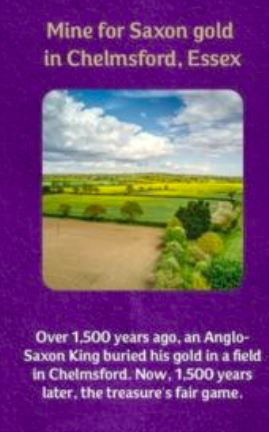
In this permissive culture there is little surprise that Cadbury's thought that it was acceptable to encourage individuals to go and dig up an archaeological site in order to find 'treasure'. The reaction from the archaeological community was resounding. People who would normally fail to hear the academic arguments were free to comment on social media.

The BBC ran a story, "Cadbury treasure hunt ad labelled 'stupid' by archaeologists" (17 March 2019), and now the Guardian has noted that the Cadbury's campaign has been suspended ("Cadbury pulls ad campaign that ‘advocates looting’", 18 March 2019). Minister Michael Ellis MP has even commented.

Historic England issued a statement to the Guardian:
Unfortunately Cadbury’s PR campaign encouraging digging for treasure potentially puts people at odds with the law. There are strict rules that protect England’s archaeological heritage, including laws governing metal detection.
Is it time for the DCMS to strengthen the protection of England's archaeological record?


Bookmark and Share so Your Real Friends Know that You Know

Thursday, 23 November 2017

Treasure Finds and metal-detecting

© David Gill
Ian Richardson has commented on his favourite Treasure Finds (Laurence Cawley, "Treasure finds in England top 1,000 for first time", BBC News 23 November 2017). This coincides with the number of Treasure Finds passing the 1,000 mark for the third year in a row. (See statistical summary here.)

Norfolk and Suffolk top the list with 211 finds. Julie Shoemark, the finds liaison officer for Norfolk, commented that "the rising number of reported treasure finds corresponded to a growth in the numbers of metal detecting clubs."

There is no comment from Richardson on the scale of the lost or damaged archaeological contexts represented by the 1,120 Treasure Finds.


Bookmark and Share so Your Real Friends Know that You Know

Wednesday, 30 November 2016

Anglo-Saxon jewellery declared treasure

A piece of Anglo-Saxon jewellery discovered by a metal-detectorist in a Norfolk field near Diss has been declared Treasure ("Anglo-Saxon find in Norfolk declared treasure", BBC News November 29, 2016; see also "Anglo-Saxon pendant: Norfolk student makes 'royal' find", BBC News February 27, 2015). A subsequent excavation showed that this came from a female burial.

Bookmark and Share so Your Real Friends Know that You Know

Tuesday, 19 May 2015

Studying Silver Plate from Gaul

My review article of Kenneth Lapatin (ed.), The Berthouville Silver Treasure and Roman Luxury (Los Angeles: The J. Paul Getty Museum, 2014) has just been published by BMCR [link here]. Lapatin's helpful study reminds us of what can be gained from the methodical study of a distinct group of archaeological material within a wider context of a sanctuary in Gaul. The volume also contains a discussion of Late Roman missoria, some from Italy.

Bookmark and Share so Your Real Friends Know that You Know

Another Bürki object returns to Italy

Source: MMA A psykter column-krater attributed to the Troilos painter was deaccessioned by New York's Metropolitan Museum of Art in June...