Showing posts with label Medici Dossier. Show all posts

Monday, 15 December 2025

Further returns to Italy from the San Antonio Museum of Art

Source: San Antonio Museum of Art
In addition to the objects deaccessioned by the San Antonio Museum of Art in September 2025, the museum  had done the same for another group in January 2022. These were mentioned (without significant detail) in a press release from the Manhattan DA in 2023. These items included material that surfaced through various sources:

Christie's (Geneva)
Attic red-figured lekythos. Inv. 86.134.75. Surfaced through Christie’s (Geneva) May 1979; Sotheby’s (London) May 1982. 

Christie's (London)
Attic white ground lekythos. Inv. 86.134.170. Surfaced through Christie’s (London) July 1983; July 1985. 

Frederick Schultz
Attic red-figured head kantharos. Inv. 91.24. Surfaced through Frederick Schultz, 1989. 

Galerie Günter Puhze
Attic black-figured lekythos. Inv. 91.80.1. Galerie Günter Puhze, 1989. 

Palladion Antike Kunst
Attic black-figured amphora. Inv. 86.134.31. Surfaced through Palladion Antike Kunst; Sotheby’s (London) December 1981. 
Attic red-figured oinochoe. Inv. 86.134.58. Surfaced through Palladion Antike Kunst; Robert Hecht. 

Robin Symes
Portrait of Hadrian. Inv. 2005.1.81. Robin Symes; Royal-Athena Galleries; Sotheby’s (New York) June 1992. [Image identified in the Medici Dossier.]
"Dating to 200 C.E., the marble head of the Emperor Hadrian was first documented uncleaned and covered in marine encrustations in a polaroid photograph. The polaroid was recovered by Italian law-enforcement authorities during a raid of the office and warehouse of well-known antiquities trafficker Giacomo Medici in 1995. After being smuggled out of Italy by Medici and his co-conspirators, the piece was then laundered with false provenance by dealer-trafficker Robin Symes before being sold in New York County in 1992." (Manhattan DA)
Sotheby's (London)
Corinthian olpe. Inv. 93.17. Surfaced in Sotheby’s (London) July 1990; Charles Ede. 
Attic black-figured amphora. Inv. 86.134.173. Surfaced in Sotheby’s (London) July 1985. 
Attic red-figured lekythos. Inv. 86.134.79. Surfaced through Sotheby’s (London) May 1982. 

Alfredo Turchi
Head of Hermes. Inv. 86.134.145. Sold by Alfredo Turchi.

The head of Hermes was excavated in Rome in the 19th century. 

| |
Bookmark and Share so Your Real Friends Know that You Know

Thursday, 7 December 2023

Gnathian Askos Returned from Virginia MFA

Gnathian Askos formerly in Virginia MFA 80.72

One of the announced returns from the VMFA is a Gnathian askos attributed to the Rose painter (inv. 80.72). This was identified from a photograph in the Medici Dossier by Christos Tsirogiannis ten years ago:
Tsirogiannis, C. 2013. "Nekyia. From Apulia to Virginia: An Apulian Gnathia askos at the Virginia Museum of Fine Arts." Journal of Art Crime 10: 81-86.
The museum purchased the askos from Fritz Bürki. One wonders what other pieces in the collection were derived from this source.

| |
Bookmark and Share so Your Real Friends Know that You Know

Thursday, 20 April 2023

Fragments from a cup attributed to Makron

Cup seized from
New York's Metropolitan Museum of Art

The New York Times has run a discussion of one of the Attic red-figured cups seized from New York's Metropolitan Museum of Art in 2022 (Graham Bowley and Tom Mashberg, "The Kylix Marvel: Why Experts Distrust the Story of an Ancient Cup’s Rebirth", April 19, 2023). The article looks at the way that this cup (and a companion piece also in the same museum) was put together from a series of fragments starting with pieces acquired from Fritz Bürki and the Summa Galleries, followed by pieces derived from Frieda Tchacos and Dietrich von Bothmer. 

The article includes identifications made by Christos Tsirogiannis from the Medici Dossier.

| |
Bookmark and Share so Your Real Friends Know that You Know

Friday, 7 October 2022

From Geneva to the Steinhardt Collection


Source: Manhattan DA

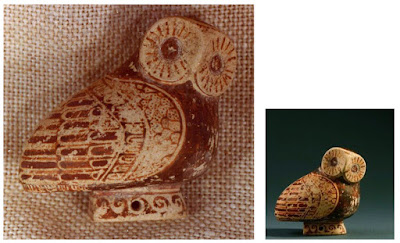
Five objects (Attic head aryballos; Protocorinthian duck and owl; Corinthian bull's head; Ionian ram's head; Apulian head vase) in the seizure of antiquities from the collection of Michael Steinhardt have something in common: they were placed on loan with Geneva's Musée d'Art et d'Histoire (1978–81). And all of them were subsequently placed on loan with the J. Paul Getty Museum (1984–96). And all of them were sold by Robin Symes to the Beierwaltes in 1996. All but the Apulian head vase appear in images from the Medici Dossier: the head vase itself appears in the Becchina archive (with an Attic skyphos now returned from the Shelby White collection).

Such loans to these two museums were used as a response to seizures  in 2018 from another dealer. It is almost as if the loans created an acceptable collecting history. This raid seems to relate to another group of material. 

The Geneva museum has associations with other loans such as the Ka-Nefer-Nefer mummy mask (though the museum does not have a record of the loan). And the Getty accepted loans of fragments from some of these same individuals, as well as complete pots such as the Steinhardt hydria.

It should be noted that the same Geneva museum appears to be linked to the Apulian grave group acquired by Berlin. 

What part did Geneva play in handling recently surfaced antiquities and providing them with a history? What other objects passed this way? The papers relating to the Steinhardt seizure expand on this aspect.

And how many of these objects were then placed on loan with the J. Paul Getty Museum? 

Note: Identifications from the Medici Dossier and the Becchina Archive were made by Christos Tsirogiannis.

| |
Bookmark and Share so Your Real Friends Know that You Know

Wednesday, 21 September 2022

Oscilla from the Steinhardt Collection

Source: Manhattan DA
Among the objects returned to Italy from the collection formed by Michael Steinhardt were four Roman oscilla. The Manhattan DA Statement of Facts expands:
A set of four marble oscillum (collectively “the Marble Oscilla”), or Roman disks suspended on chains between columns in gardens, appear in dirt-encrusted fragments in multiple Polaroid photographs recovered from the Medici Archive. ... Depicting satyrs and female followers of Dionysus, the Marble Oscilla were crafted in Italy between 100 B.C.E. and 100 C.E. The Marble Oscilla first surfaced on the international art market in 1992, when Steinhardt purchased the antiquities from Robin Symes with no prior provenance for $175,000. In 1998, Steinhardt sent the Marble Oscilla to a Brooklyn-based restorer for“cleaning and repair.” 
The suggestion is that these oscilla probably came from the garden of a residence. Was this a residence buried during the eruption of Vesuvius?

Two further oscilla are known from Polaroids: these are now displayed in the Miho Museum, Japan. Concerns about their origins were first raised in 2007. Daniella Rizzo and Maurizio Pellegrini have recently indicated that the oscilla feature, like the Steinhardt ones, in the Medici Dossier. They also suggested that they come from 'the Vesuvian area'. Carlos Picón separately has indicated that the parallels for such items come from the area around Vesuvius.

One wonders if the Steinhardt and the Miho oscilla come from the same complex but we will have to await the definitive publication of the Steinhardt examples. 

Will the return of the Steinhardt oscilla place renewed pressure on the Miho Museum to return their pieces so that the series, perhaps originally displayed in the same garden space, can be reunited in Italy?

The identifications of the Steinhardt oscilla were made by Associate Professor Christos Tsirogiannis. 

Source: Miho Museum


| |
Bookmark and Share so Your Real Friends Know that You Know

Tuesday, 20 September 2022

The Steinhardt hydria attributed to the Antimenes painter

Source of images: Manhattan DA.

Among the items seized from the Michael Steinhardt collection and returned to Italy was an Attic black-figured hydria attributed to the Antimenes painter. The hydria had been identified from an image in the Medici Dossier.

The Manhattan DA reports that the hydria had first surfaced with Robin Symes in 1983 (when it was advertised in Apollo). The statement then adds:
By 1987, Symes had transferred the object to the New York-based Atlantis Gallery, part-owned by Robert Hecht, who then loaned it to the Getty Museum. From 1987-1996, the object was on view at the Getty Museum prior to its sale to Steinhardt through Sotheby’s New York on December 17, 1996. 
Steinhardt is report to have purchased the hydria from Sotheby's for $169,411.

The Beazley Archive (BAPD 31596) provides the loan number for the Getty (L87.AE.4) as well as the details for the Sotheby's New York sale (17 December 1996, lot 49). It also suggests that the hydria passed through the Royal-Athena Galleries though this information may not be correct.

Christopher Chippindale and I had rehearsed the history of this specific hydria in our review article of The Medici Conspiracy (2007) [see here]. We clarify that the hydria was placed on loan at the Getty in January 1987, and returned in February 1996. This raises a question about the nature and purpose of loans that were placed at the Getty.

It should be recalled that one of the Attic black-figured neck-amphorae seized from Fordham University was attributed to the circle of the Antimenes painter (BAPD 24304).

It should be noted that the identification of the Steinhardt hydria was made by Associate Professor Christos Tsirogiannis. 

| |
Bookmark and Share so Your Real Friends Know that You Know

Tuesday, 13 September 2022

The Steinhardt Oinochoe Attributed to the Berlin painter

Oinochoe attributed to the Berlin painter
Source: Manhattan DA

The recent exhibition of Athenian pots attributed to the Berlin painter listed among the new attributions a single oinochoe from the Judy and Michael Steinhardt collection (BN44). It shows a youth feeding a Maltese dog.

The attribution had been made by J. Robert Guy though the date when this was made is not noted.

A polaroid of the oinochoe is reported to be in the Medici Dossier. The Manhattan DA's statement relating to the seizure of antiquities from the Steinhardt collection noted:
The Berlin Painter Oinochoe first surfaced on the international art market in 1996, when Steinhardt purportedly purchased the Berlin Painter Oinochoe from Harry Bürki with no prior provenance for $215,000. 
The statement notes that while the invoice stated that Bürki was the vendor, "Steinhardt’s records reflect that the real seller of the object was the American-born trafficker Robert Hecht."

This is one of several pots attributed to the Berlin painter that have been returned to Italy. And it should be a matter of concern to academics writing on Athenian pottery that such a high percentage of pots attributed to this painter have no secure archaeological contexts. 

It should be noted that the identification was made by Associate Professor Christos Tsirogiannis.

See D.W.J. Gill, 'Fragmented Athenian Pots and the Berlin Painter: Recent Breaks?' Academia Letters (2020): 1–5 [DOI].  

| |
Bookmark and Share so Your Real Friends Know that You Know

Thursday, 8 September 2022

Further Shelby White Antiquities Return to Italy

Source: Manhattan DA (September 6, 2022) / Lynda Albertson (on Twitter)

I was looking through the images of the handover of the antiquities to Italy yesterday. The press statement did not clarify the collections linked with all the objects:
Manhattan District Attorney Alvin L. Bragg, Jr., today announced the return of 58 antiquities valued at nearly $19 million to the people of Italy. The pieces were trafficked by Giacomo Medici, Giovanni Franco Becchina, Pasquale Camera and Edoardo Almagiá.

My main interest was in "21 of the pieces ... seized from the Metropolitan Museum of Art" (see here).

I then thought that two of the pieces looked familiar. On the right side of the table is an Attic black-figured psykter with a procession of riders. A quick search in the Beazley Archive pointed me to the psykter in the Shelby White and Leon Levy collection (Glories no. 112; BAPD 43272). The psykter was known from images in the Medici Dossier and had been discussed on LM back in 2008.

Balancing the psykter on the back left corner is an Attic black-figured skyphos showing Odysseus in the Cave of Polyphemos. This too is in the White-Levy collection and was attributed to the Theseus painter by Dietrich von Bothmer (Glories no. 113; BAPD 43271).

Does this mean that the Italian authorities are revisiting the Shelby White / Leon Levy collection? Will there be further revelations? Are there other items from this collection included in the return?

Does this open the way for the British Government to request the immediate return of the Icklingham Bronzes?

It should be noted that the identification of the Shelby White skyphos and psykter were made by Associate Professor Christos Tsirogiannis. 

| |
Bookmark and Share so Your Real Friends Know that You Know

Monday, 28 February 2022

Apulian grave group in Berlin subject to Italian court order

Apulian grave group currently in Berlin
© David Gill

The apparent grave group consisting of Apulian pottery now in Berlin is the subject of a court order from the Tribunale di Roma ("Scoppia la "guerra" dell'arte Italia-Germania. Il tribunale di Roma confisca 21 vasi al museo di Berlino", ItTempo.it February 25, 2022). The group has been the subject of discussion by LM back in 2007. Three of the volute-kraters are attributed to the Darius painter. This painter was the subject of an exhibition in Geneva: 
Aellen, Christian, Alexandre Cambitoglou, and Jacques Chamay. 1986. Le Peintre de Darius et son Milieu: Vases grecs d'Italie méridionale. Hellas et Roma, vol. 4. Geneva: Association Hellas et Roma.
The Berlin pots were acquired in 1983 (and accessioned in 1984), and they appear in the Medici Dossier. 

The acquisition record links the group to Jacques Chamay of Geneva's Museum of Art and History. 
«l’organo giudicante evidenziava una complicità con Medici degli indagati Jacques Chamay, all’epoca direttore del museo archeologico di Ginevra, e Fiorella Cottier Angeli, restauratrice, nella vendita al museo archeologico di Berlino dei 21 vasi».
It has been suggested that the grave group had once resided in a 19th century collection but there does not appear to be any authenticated documentation to support this claim. 

Will Berlin finally return this group to Italy?

| |
Bookmark and Share so Your Real Friends Know that You Know

Thursday, 30 December 2021

Steinhardt objects returning to Italy

Togate figure from Perugia
Source: Chasing Aphrodite


It has been announced that 51 antiquities will be returning from the Steinhardt collection to Italy. I estimate that they were purchased for $7.5 million. The objects include Etruscan bronzes, a fresco fragment from Herculaneum, and a mosaic removed from a Roman villa on Sicily. It is striking that so many of the items were identified from the seized photographic and documentary archives of Medici, Becchina, Symes, Hecht, and Almagià.

It is clear that only a fraction of the material in these archives has been returned to the countries where they were found. Museums, private collectors, and galleries need to start studying their lists of donors and former owners.

| |
Bookmark and Share so Your Real Friends Know that You Know

Thursday, 9 December 2021

The surrendered Steinhardt collection and the Medici dossier

Left: Medici Dossier, courtesy of Christos Tsirogiannis
Right: New York State District Attorney Office 
Research by Associate Professor Christos Tsirogiannis has made innumerable identifications of objects from the Medici Dossier. The paperwork for the Steinhardt collection makes it clear how many items had passed before the Polaroid camera of that source.

The items include:
  • Etruscan togate figure, from Perugia (pp. 16–17).
  • Two bronze figures of Pegasus (pp. 17–18).
  • Villanovan helmet (pp. 18–19).
  • Two Etruscan terracotta panels, from Cerveteri (pp. 19).
  • Attic sphinx cup, Tleson (pp. 19–20).
  • Oinochoe attributed to the Berlin painter (pp. 20–21)
  • Attic Leagros hydria (pp. 21–22).
  • Attic Antimenes hydria (pp. 22–23).
  • Attic head vase (pp. 23–24).
  • Protocorinthian duck (p. 24).
  • Protocorinthian owl (pp. 24–25).
  • Ionian ram's head (p. 25).
  • Corinthian bull's head (pp. 25–26).
  • Corinthian lion vessel (p. 26).
  • Faliscan askos (p. 27).
  • Four marble oscilla (p. 27)
  • Cycladic spouted bowl (p. 28).
It is a reminder that the 'Medici Conspiracy' continues to make an impact on cultural property issues.
| |
Bookmark and Share so Your Real Friends Know that You Know

Wednesday, 8 December 2021

Returning Athenian pottery from the Steinhardt collection

Source: Manhattan District Attorney's Office

The documentation for the Michael Steinhardt  collection identifies several Attic pieces that will be returned to their country of origin, presumably Italy and Greece.
  • Attic black-figured Sphinx cup, 'Tleson, son of Nearchos' (pp. 19–20). Identified from the Medici dossier. Symes sold to Beierwaltes (January 8, 1996); Phoenix Ancient Art (2006); Steinhardt purchased from Phoenix Ancient Art for $310,000 (2007).
  • Attic red-figured oinochoe attributed to the Berlin painter (pp. 20–21). Identified from the Medici dossier. Steinhardt purchased from Harry Bürki for $215,000 (1996); Steinhardt's records show that the oinochoe had been sold by Robert Hecht.
  • Attic black-figured hydria showing Herakles and Kyknos attributed to the Leagros group (p. 21).  Identified from the Medici dossier. Displayed by Christos Bastis at New York's Metropolitan Museum of Art (1987); Bastis died (1999); Steinhardt purchased from Michael Ward for $127,000 (2000). The paperwork omits that the hydria surfaced at Sotheby's (London) July 11–12, 1983, lot 352, and was sold at Sotheby-Parke-Bernet, New York, December 9, 1999, lot 92. [BAPD 9050]
  • Attic black-figured hydria showing women at a fountain-house attributed to the Antimenes painter (pp. 22–23). Identified from the Medici dossier. Robin Symes advertised the hydria (1983); Atlantis Gallery, New York (1987); loan to the J. Paul Getty Museum L87.AE.4 (1987–96); Steinhardt purchased it at Sotheby's for $169,411 (December 17, 1996, lot 49). [BAPD 31596]
  • African head vase (pp. 23–24).  Identified from the Medici dossier.  Displayed in the Musée d'Art et d'Histoire, Geneva (1978–81); J. Paul Getty Museum (1984–96); Symes sold the piece to the Beierwaltes (1996); Beierwaltes consigned it to Phoenix Ancient Art (2006); Steinhardt purchased it from Phoenix Ancient Art for $163,312.50 (2009). 
  • Attic black-figured eye-cup (pp. 35–36). Identified from the Becchina archive. Mario Bruno, Lugano; sold to Becchina; TL tested by Ralf Kotalla, Germany(July 1992); Robert Hecht sold it to Steinhardt for $170,750 (June 15, 2000).
  • Attic black-figured amphora (p. 50). Identified from the Almagià archive. Purchased from a tombarolo for $6,500; sold for $13,000; accessioned by Steinhardt as coming from Almagià (1997). 
  • Attic black-figured plemochoe (pp. 54–55). Identified from the Symes archive. Photographed by Dieter Widmer (1985); held as loan by Sotheby's London for Budico SA, owned by Henri-Albert Jacques (1989); stolen from Sotheby's and recovered by the police; Budico SA sold it through Sotheby's to Steinhardt for $84,083 (December 11, 2002). Note: 'Ex. Private Coll. London, RS + CM' (?Symes and Michaelides).
  • Attic white ground lekythos attributed to the Triglyph painter (p. 56). Identified from the Symes archive. Symes sold it to the Beierwalters for $360,000 (June 22, 1995); consigned to Phoenix Ancient Art (2006); Steinhardt purchased from Phoenix Ancient Art for $380,000 (December 14, 2006).
| |
Bookmark and Share so Your Real Friends Know that You Know

Saturday, 12 June 2021

A Couchant Horned Goat from the Medici Dossier


The goat has surfaced (as was re-spotted by Tsirogiannis) as "Masterful Greek Hellenistic Ceramic Goat Vessel" in the Artemis Gallery in Louisville CO, as lot 0054. The history is given as "East Coast, USA collection; ex-Royal-Athena Galleries, New York, USA, acquired in the 2000s". The lot was "passed" on June 10, 2021. 

The Artemis catalogue does not mention any link with Italy, but the RAG catalogue of 2010 helpfully noted 'South Italy, 4th century BC'.  Will the Italian authorities be seeking its return?

This was one of 16 pieces identified on the New York market back in 2010, yet it has remained available for sale. 


Bookmark and Share so Your Real Friends Know that You Know

Saturday, 23 January 2021

The Medici Dossier and the Allard Pierson Museum


Image of Siana cup fragments
from Medici Dossier. Source: nrc.nl
Christos Tsirogiannis, Associate Professor at the University of Aarhus, has identified a Siana cup currently in the Allard Pierson Museum in Amsterdam with images from the Medici Dossier (BAPD 16323). The cup, attributed to the Ainipylos painter, shows Aineas conversing. It surfaced at Sotheby's in London in an auction on 18 July 1985, lot 513. The sales in 1985 have yield other examples of toxic antiquities. 

The cup was placed on loan in the museum (inv. B 11.999). What is more interesting is that an additional fragment was supplied by Herbert Cahn (inv. 13.247; formerly HC 1468). The Medici polaroids show the cup in fragments as well as in a restored form. How did Cahn acquire his fragment?

The Allard Pierson Museum will no doubt be arranging the return of this cup to Italy.

Theo Toebosch, "Illegale vaas in collectie van Allard Pierson museum", nrc.nl 22 January 2021.

Bookmark and Share so Your Real Friends Know that You Know

Monday, 12 October 2020

An EPC Kotyle from the Medici Dossier

EPC Kotyle from the Medici Dossier.
Courtesy of Christos Tsirogiannis.
Christos Tsirogiannis, Associate Professor at the University of Aarhus, has linked a photograph from the Medici Dossier with the reverse of an Early Protocorinthian kotyle that is due to be offered for auction at Christies  (New York) on October 13, 2020 (lot 27). Although only one side is shown on the Christie's online catalogue, Tsirogiannis requested an image of the reverse from the auction-house and this has confirmed that they are one and the same. I understand that the District Attorney's office in New York was informed on Friday last week. 

The kotyle is provided with a history:
  • Private Collection, U.K. 
  • Art Market, U.K. 
  • with Peter Sharrer Ancient Art, New York. 
  • Acquired by the current owner from the above, 1997.
It is currently owned by an anonymous 'distinguished private collector'.

Peter Sharrer has been linked with at least one objects that has been returned to Italy: a Roman relief that was returned from Princeton in 2002. Sharrer was also the source for objects acquired by the Fleischmans as well as the Getty, the Michael C. Carlos Museum and Princeton. He is known to have acquired items from Robin Symes.

Why are the UK dealer and private collector anonymous? Are they are unknown? And where is the mention of the anonymous European collector in Christie's history?

Will other museums and collectors who purchased directly or indirectly from Sharrer conduct due diligence on their acquisitions?

Bookmark and Share so Your Real Friends Know that You Know

Monday, 5 August 2019

Steinhardt and the Berlin painter oinochoe

Among the pots in the exhibition, The Berlin painter and his world, was an oinochoe (shape 1) from the Judy and Michael Steinhardt collection in New York (BN44; not in BPAD). The description is given:
Youth in himation leaning on stick to right, dropping red tidbit to a Maltese dog standing on its hind legs.
The oinochoe was attributed to the Berlin painter by Robert Guy.

Dr Christos Tsirogiannis reminds me that this is indeed the oinochoe seized in January 2018 [see LM]. Tsirogiannis has now published on the Steinhardt seizure:

  • Tsirogiannis, C. 2019. "Nekiya: a reflection of the antiquities market: selected cases from the antiquities identified in 2018 and 2019." Journal of Art Crime 21: 63–75.

It appears as no. 3 in the list of objects, and Tsirogiannis notes that it was purchased in 1996 for $215,000. Tsirogiannis identified the oinochoe in two images from the seized Medici dossier.

This now raises a number of questions:

  • who sold the oinochoe to Steinhardt?
  • who acquired the oinochoe from Medici?
  • when did Robert Guy make the attribution?
It should be remembered that this oinochoe is not the only pot attributed to the Berlin painter that passed through the hands of Medici.


Bookmark and Share so Your Real Friends Know that You Know

Monday, 20 May 2019

Toledo Museum of Art and an Attic skyphos

Source: Toledo Museum of Art
In 2017 Dr Christos Tsirogannis wrote a study of the Attic red-figured skyphos attributed to the Kleophon painter (by Dietrich von Bothmer) and acquired in 1982. Tsirogiannis had spotted that the skyphos featured in the Medici Dossier, and elicited from the museum that it had been acquired from Nichols Koutoulakis. 

It has now been announced by the Italian authorities that the skyphos will be returned to Italy [press release, 16 May 2019].
Il ministero per i Beni e le attività culturali della Repubblica italiana e il Toledo Museum of Art (TMA) hanno annunciato oggi di aver raggiunto un accordo per il trasferimento alla Repubblica italiana di uno skyphos attico risalente al V secolo a-C (Vaso Potorio), che raffigura il ritorno di Efesto sull'Olimpo. Lo skyphos è stato acquistato da TMA nel 1982, ma recentemente, il Museo ha ritenuto di dover acquisire ulteriori informazioni dal Mibac circa la sua provenienza. In collaborazione con il Ministero e alla luce de informazioni fomite da questo, il TMA ha ritenuto appropriato di trasferire lo skyphos all'Italia. Il Mibac ha accettato di concedere in prestito lo skyphos al Museo per 4 anni e, al termine del periodo di prestito, di effettuarne di ulteriori su base rotativa.
The skyphos will be placed on loan to Toledo for 4 years. It is significant that the role of Tsirogiannis has not been acknowledged.

Toledo has placed a statement on its website. It includes this paragraph:
The Toledo Museum of Art purchased the skyphos in 1982 for $90,000 with funds gifted from Edward Drummond Libbey. The provenance of the object was called into question in 2017 by Christos Tsirogiannis, a forensic archaeologist, after which the Museum began an internal investigation and contacted the Italian authorities.
The entry for the skyphos in the Toledo Corpus Vasorum Antiquorum does not provide information about the piece's previous history.

Toledo has already returned an Etruscan kalpis, also acquired in 1982. What else was acquired in this period from the same sources? Museums need to be revisiting any material that passed through the hands of Koutoulakis.

Bookmark and Share so Your Real Friends Know that You Know

Wednesday, 6 March 2019

Etruscan terracotta antefix returned to Italy

Etruscan terracotta antefix. Source: Christie's (left), MiBAC (right)

An Etruscan terracotta antefix was among the items returned to Italy from Christie's [see ARCA]. The piece had been recognised from the Medici Dossier by Dr Christos Tsirogiannis when it was offered at auction by Christie's in London on 15 April 2015 (lot 103) [see Looting Matters]. It had then been withdrawn, along with three other lots [see ARCA].

The antefix had surfaced at Sotheby's in London on 9 December 1985 (lot 273). (In 2009 Looting Matters had highlighted issues about objects surfacing through Sotheby's in 1985.)

Why does the Christie's press release fail to mention the link with the Medici Dossier and the identification by Tsirogiannis?

Bookmark and Share so Your Real Friends Know that You Know

Tuesday, 5 March 2019

Glass oinochoe returned to Italy

Glass oinochoe. sources: Christie's (left), MiBAC (right)

A glass oinochoe is among the objects returned to Italy from Christie's. This appears to be the one offered in the sale of antiquities on 2 April 2014 (lot 173). That particular oinochoe had surfaced at Sotheby's in London on 11 July 1988 (lot 173). The identification of the oinochoe with an image in the Medici Dossier [see ARCA] was made by Dr Christos Tsirogiannis [see earlier comments]. The piece was then withdrawn from the sale [see earlier comments].

Why has the official press release [Christie's] failed to mention either the Medici Dossier, or the research of Dr Christos Tsirogiannis?

Bookmark and Share so Your Real Friends Know that You Know

Krater fragments in Princeton

Greek, Attic, probably by the Kleophrades Painter, ca. 490–480 BCE, Two non-joining fragments from a calyx-krater (mixing bowl) depicting ar...