Showing posts with label Barbarano Romano. Show all posts

Monday, 24 January 2022

The whole history of a Little Master cup

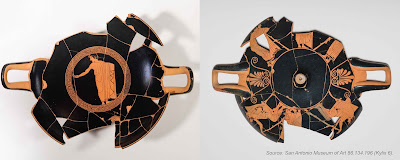
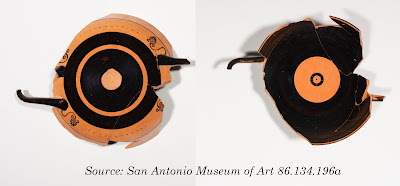
These fragments of an Athenian Little Master cup, decorated with 'nonsense' inscriptions are among the pieces being returned to Italy by the San Antonio Museum of Art.

It is a reminder of the way that museums restrict information. The published catalogue, by H. Alan Shapiro, Carlos A. Picón and Gerry D. Scott III merely note that it was a gift of Gilbert M. Denman, Jr in 1986. The Beazley Archive records nothing about its history (BAPD 20266). Yet now it seems that the fragments, including this Little Master cup, had been found at Barbarano Romano, and had been purchased by Edoardo Almagià in 1985. How was such information deemed to have been unknown to those preparing the catalogue? 

Were these fragments processed by Almagià with the help of an academic?

Are there other pieces remaining in San Antonio that also derive from Barbarano Romano or other sites in Italy?

Why were such large numbers of fragments acquired by San Antonio? Was there an expectation that other fragments from these figure-decorated pots would be acquired in future years? Was the museum following the pattern of other collections? 


| |
Bookmark and Share so Your Real Friends Know that You Know

Wednesday, 5 January 2022

Barbarano Romano: the Attic fragments

Source: San Antonio Museum of Art

The San Antonio Museum of Art will be returning 192 fragments of Attic black-figured, red-figured and black-glossed cups to Italy. They are reported to have been found at Barbarano Romano to the south of Viterbo and were sold to Gilbert M. Denman, Jr. by Edoardo Almagià in 1985; Denman gave the fragments to the museum the following year (inv. 86.134.196). 

The Steinhardt legal papers cite two pieces of correspondence about pottery fragments from Barbarano Romano: the recipient is clearly in Texas. Almagià states the findspot and explained how the fragments were removed to Switzerland, and then moved to New York where they were cleaned and grouped with the help of a vasologist. Further fragments from the site were then noted, though they remained in Italy. 

It is unclear if the San Antonio fragments and the Texas letters are linked. But this does raise issues about other pot fragments that were handled by Almagià and those associated with him. 

| |
Bookmark and Share so Your Real Friends Know that You Know

Krater fragments in Princeton

Greek, Attic, probably by the Kleophrades Painter, ca. 490–480 BCE, Two non-joining fragments from a calyx-krater (mixing bowl) depicting ar...