Showing posts with label Elie Borowski. Show all posts

Thursday, 22 May 2025

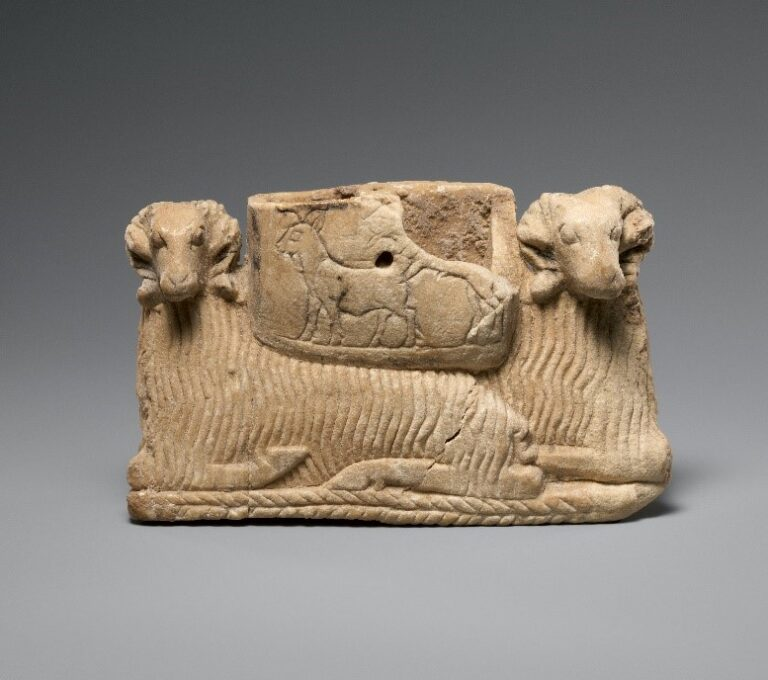
The Met returns three antiquities to Iraq

Source: Manhattan DA


New York's Metropolitan Museum of Art has returned three antiquities to Iraq (Manhattan DA Press Release). The three pieces are:
a. a Sumerian gypsum alabaster vessel supported by two rams, acquired from the Norbert Schimmel Trust in 1989. The history of the piece is provided:
By 1956, with N. Koutoulakis who bought it in Baghdad; from 1966, collection of Cecile de Rothschild; [by 1979, Robin Symes, London]; 1984, purchased by Norbert Schimmel from Robin Symes/ Xoilan Trader Inc., Geneva; from 1984, on loan to the Museum by Norbert Schimmel (L.1984.15.1); acquired by the Museum in 1989, gift of Norbert Schimmel Trust. 

b. a Mesopotamian terracotta female head, acquired from the Norbert Schimmel Trust in 1989. The  history of the piece is provided:
Before 1972, collection of Elie Borowski; by 1972, collection of Norbert Schimmel, New York; from 1983, on loan to the Museum by Norbert Schimmel (L.1983.119.12); acquired by the Museum in 1989, gift of Norbert Schimmel Trust. Deaccessioned for return to Iraq in May 2025.

c. a Mesopotamian terracotta male head, purchased from Robin Symes in 1972. It is reported to have been removed from the site of Isin. The history of the piece is provided:
By 1971, Robin Symes, London; acquired by the Museum in 1972, purchased from Robin Symes, London.

These returns renew the focus on antiquities handled by Robin Symes. The Met's "provenance" team could usefully look at the other Symes material currently on display in the museum. 

| |
Bookmark and Share so Your Real Friends Know that You Know

Wednesday, 5 March 2025

Worcester Art Museum Returns Hecht-linked Pots to Italy

Photo: Worcester Art Museum

The Worcester Art Museum has returned two Attic pots to Italy; they are now back on loan to the museum ("Worcester Art Museum Secures Landmark Cultural Cooperation Agreement with Italian Ministry of Culture Following Voluntary Return of Antiquities", January 30, 2025). What is striking about the two pieces is that they were both acquired in the mid-1950s, well before the 1970 UNESCO Convention.

The two pieces are:
a. An Attic black-figured amphora attributed to the Rycroft painter, showing Hermes, Leto, Apollo and Artemis; Dionysos and Maenads. Inv. 1956.83 (BAPD 301829). [Website]
b. An Attic black-figured cup decorated with a gigantomachy. Inv. 1956.91 [Website]

Both the amphora and the cup were acquired from Elie Borowski, though both could be traced back to Robert Hecht.

This will raise concerns for museums that had acquired pieces from both Borowski and Hecht well before the 1970 benchmark date. 


| |

 
Bookmark and Share so Your Real Friends Know that You Know

Wednesday, 30 November 2016

New Surfacings and Re-surfacings in Germany

Source: Schinoussa archive
Cambridge based archaeologist Dr Christos Tsirogannis has made a number of new identifications for items that are due to be auctioned by Gorny & Mosch in Munich on 14 December 2016.

Below is a text based on Tsirogiannis' notes and reproduced with his permission.

1. An Etruscan bronze figure of a youth (lot 19)
Mid 5th century B.C.
Collecting history: 'Ex Sammlung R.G., Deutschland. Bei Royal Athena Galleries, New York, Catalogue XXI, 2010, 43. Ex Sotheby´s Catalogue of Antiquities 13. Juli 1981, 341'.
Tsirogiannis had previously identified the same figure from the Symes archive when it was on offer in the Royal Athena Galleries on October 2010. It was one of several pieces identified from the Medici and the Becchina archives. In January 2011 these identifications were presented in brief through 'Looting Matters' and by the Italian journalist Fabio Isman in Il Giornale dell'Arte (see here). It is unclear why this piece has resurfaced given the earlier discussion.

2. An Apulian red-figure situla attributed to the Lycurgus painter. (Lot 87)  
360 - 350 B.C.
collecting history: 'Provenienz: Aus der James Stirt Collection, Vevey in der Schweiz, erworben 1997 bei Heidi Vollmöller, Zürich'.
This situla is shown covered with soil and salt encrustations from an image in the Becchina archive.
A handwritten note indicates that the images were sent from Raffaele Montichelli to Becchina on 18 March 1988. this predates the collecting history presented by Gorny & Mosch.

3. An Apulian red-figure bell-krater attributed to the Dechter painter (Lot 88)
350 - 340 B.C.
Collecting history: 'Ex Galerie Palladion, Basel; ex Privatsammlung von Frau Borowzova, Binnigen in der Schweiz, erworben 1976 von Elie Borowski, Basel'.
The Gallerie Palladion [Antike Kunst] was associated with Becchina. An image from the Becchina archive shows the krater covered with soil and salt encrustations. The date printed on the image reads 'APR 4 '89' (4 April 1989), making almost impossible the attested involvement of Elie Borowski 13 years earlier in the collecting history of the krater.

4. A Gnathian squat alabastron with the bust of a winged woman with sakkos, attributed to the White Sakkos Painter (Lot 127)  
Apulia, 320 - 310 B.C.
Collecting history: 'Ex Christie´s London, 15.04.2015, ex 113; aus der Privatsammlung von Hans Humbel, Schweiz, erworben bei der Galerie Arete, Zürich in den frühen 1990er Jahren'.
This alabastron is also depicted in the Becchina archive in an image dating 24 September 1988, sent to Becchina again by Raffaele Montichelli. Again the date on the image is pre-dates the collecting history given by Gorny & Mosch.
However, the most significant element of this case is that it is the first example of an object reappearing after it was withdrawn following one of Tsiirgiannis' identifications.This alabastron was one of the two vases comprising lot 113, in Christie's 15/4/2015 antiquities auction in London. At that point the alabastron was among four identifications Tsirogiannis made and all four antiquities were withdrawn before the auction. All four cases and the image of the alabastron were published on the ARCA blog. It seems that the owner of the alabastron is trying to sell the vase in the antiquities market of a different country, thinking that Tsirogiannis would not notice the piece.

Tsirogiannis reports that Interpol as well as German and Italian authorities have been informed.
Bookmark and Share so Your Real Friends Know that You Know

Saturday, 22 November 2014

The Steinhardt Sardinian Figure and the Medici Dossier

Sardinian figure from the Medici Dossier.
Source: Christos Tsirogiannis / ARCA
Glasgow-based researcher Dr Christos Tsirogiannis has suggested that a Sardinian figure due to be auctioned at Christie's (December 11, 2014, lot 85) is linked to the Medici Dossier of polaroid photographs. The estimate is $800,000-$1,200,000.

The upper part of the head has been damaged in the Polaroid photograph, although no comments about restoration are made in the lot notes.

The figure is the stated as coming from the Michael and Judy Steinhardt Collection. Its earlier collecting history is stated as:
  • Harmon Fine Arts, New York. 
  • The Merrin Gallery, New York, 1990 (Masterpieces of Cycladic Art from Private Collections, Museums and the Merrin Gallery, no. 27). 
  • Acquired by the current owner, 1997.
The due diligence search will no doubt have alerted the staff at Christie's and the agency they used to possible concerns. So, for example, was Harmon linked to some of the fragmentary Cycladic figures derived from the 'Keros Haul'?

The Merrin Gallery is linked to Roman bronze known as 'The Merrin Zeus' that was returned to Italy. Only last year there were issues about the sale of the Symes Pan at Christie's. And the marble statues of the Dioskouroi on loan to New York's Metropolitan Museum of Art were handled by the same gallery. We also recall that pots in the Borowski collection were derived from Merrin. (For a review of the Merrin Cycladic exhibition in the New York Times see here with a mention of the Sardinian figure.)

Then there is Steinhardt as a collector of such things as a gold phiale that has been returned to Sicily. What about the alleged link with the tomb painting from Paestum seized at a North American airport? Steinhardt has been associated with Cycladic figures. Steinhardt is also linked to Christie's where he is listed as a member of the Advisory Board.

Yet is there more information about the Sardinian figure? Suzan Mazur discussed the exhibition at the Merrin Gallery back in 2006 ('Merrin Gallery In Italy's Antiquities Dragnet?'). She noted:
[Leonard] Stern owned 10 Cycladic marbles and loaned all of them to Merrin for the show: Six Spedos pieces; a Dokathismata female (2400-2300 BC); the Anatolian "Stargazer" (3000-2500 BC) worth $1 millon and previously belonging to Nelson Rockefeller; a Sardinian female figure from the Ozieri culture (2000 BC); and a Cycladic female (2800-2700 BC) said to be from the same source as the Met's Cycladic "Harp Player". The Harp Player is a fake -- according to Met Ancient Near East expert Oscar White Muscarella. 
The collection was housed at the time in Stern's Fifth Avenue townhouse aka Harmon Fine Arts Gallery, which did "sizeable transactions" in antiquities Stern told me in a phone call. Stern's secretary, warned me the address was not for publication and she said Stern used a second gallery when he needed additional space.
So is the appearance of 'Harmon Fine Art' in the Christie's catalogue an alternative to stating 'Leonard Stern'? Was the figure only exhibited with Merrin? (For Stern as a collector see 'Dynasty in Distress', Bloomberg.)

So if Mazur is right, and Leonard N. Stern was the former owner, where did Stern acquire the figure?

And who purchased the figure from Medici?

Christie's would be wise to re-investigate the collecting history of the figure as a matter of urgency. Have they contacted the Italian authorities?


Bookmark and Share so Your Real Friends Know that You Know

Friday, 25 July 2014

Forfeiture and Becchina: another link to Canada

Ric St Hilaire has written about a new forfeiture of two items that seem to be identified from the Becchina archive. The two items are an Attic red-figured skyphos and an Apulian bell-krater, valued at $55,000. They are reported to have been consigned to Christie's in New York. It is reported that they were seized in 2011 from from Walter M. Banko Enterprises, Ltd. of Montreal.

It appears that the paperwork for the objects may have been fabricated as the skyphos passed through the hands of Becchina in 1982 even though there had been a link with Borowski. The krater appears to have been in Becchina's possession in 1992 even though the paperwork suggested an alternative collecting history.

St Hilaire notes the quoted collecting history for the krater that was later moved from France to Canada:
Documents recovered from the search of Becchina’s gallery and warehouse reveal the occurrence of the following events: in February of 1992, Becchina purchased the Krater, in fragments, from Raffaele Monticelli. On or about October 24, 1992, Becchina delivered the Krater to Ettore Bruno who was to restore the Krater. On or about July 15, 1993, Ettore Bruno sent a photograph of the restored Krater to Becchina. On or about August 10, 1993, Robert Guy answered Becchina regarding the Krater’s attribution and the scientific study of the Krater. Ettore Bruno returned the Krater to Becchina in March of 1994. Becchina paid 8,490 Swiss francs for the restoration of the Krater. On May 1, 1994, Bechina noted that the Krater was then located in his warehouse at Porto Franco di Basilea (Switzerland).
I have raised the issue of Walter Banko before in the case of the janiform head also identified from the Becchina archive. This head had passed through Christie's in 2009.

Will Christie's have to explain the rigour of their due diligence process?

Bookmark and Share so Your Real Friends Know that You Know

Monday, 9 December 2013

The Symes Pan

Last week Dr Christos Tsirogiannis identified the Medici Pan that is due to be auctioned in New York later this week. Tsirogiannis has now identified a terracotta Pan from the Schinousa archive that is due to be auctioned at Christie's Rockefeller Plaza (December 13, 2013, lot 114, estimate $8000 - $12000).

Christie's have offered the following collecting history:

  • with Edward H. Merrin Gallery, New York, 1968. 
  • Private Collection, New York, 1968-2011.

So when was the Pan in the possession of Robin Symes? What is the identity of the private collection? Is the collecting history presented by Christie's robust? What authenticated documentation was supplied to Christie's?

The Edward H. Merrin Gallery has been linked to the bronze Zeus returned to Italy, material in the collection of Dr Elie Borowski, as well as the marble Castor and Pollux on loan to New York's Metropolitan Museum of Art.


Bookmark and Share so Your Real Friends Know that You Know

Wednesday, 22 May 2013

Euboean amphora from the Borowski collection

One of the pieces to note in Christie's forthcoming sale in June is a Euboean black-figured amphora showing a seated woman and a sphinx (lot 540). The amphora first surfaced in an anonymous sale at Sotheby's (London) December 3, 1991, lot 383. It then entered the collection of Dr Elie Borowski and was sold for $10,575 at Christie's (Rockefeller Plaza) on June 12, 2000 (lot 27; "Ancient Greek Vases formerly in the private collection of Dr. Elie Borowski"). It was then sold twice by Royal-Athena Galleries, New York, 2001 (Art of the Ancient World, vol. XII, no. 172) and 2010 (1000 Years of Ancient Greek Vases, no. 31).

Cambridge University researcher Christos Tsirogiannis has spotted the amphora in the Medici Dossier. This suggests that Medici, or one of his agents, consigned the pot to Sotheby's in London. (See other pieces that passed through Sotheby's in London and since returned to Italy.) The amphora seems to have been photographed prior to surface cleaning.

Will one of the staff at Christie's be contacting the Italian authorities to clarify the full collecting history of this piece?


Bookmark and Share so Your Real Friends Know that You Know

Friday, 21 October 2011

Karlsruhe and Greece: update

I have commented earlier today on the claim on two pieces in the Badisches Landesmuseum in Karlsruhe. We should note that Lord Renfrew is due to lecture in Karlsruhe on 23 February 2012 as part of the activities surrounding the exhibition. He has spoken out about the looting of archaeological sites in the Cyclades.

There is a suggestion that the Cycladic figure and bowl were derived from Dr Elie Borowski. Will the museum confirm or deny that Borowski was the source? I note that the museum acquired several pieces, including at least two Cycladic figures, in  1975.

Bookmark and Share so Your Real Friends Know that You Know

Tuesday, 6 September 2011

Ex Borowski material on sale in London

I note that the October sale at Bonhams is now back on line. It includes a piece of jewellery formerly in the Elie Borowski collection (lot 245).

There is a particularly fine Roman bronze of Lar (lot 107). This has an interesting collecting history. It surfaced in a Swiss private collection in the 1980s before passing through "Hesperia Art Ltd, New York, early 1990s". Is this the same as Hesperia Arts of New York that sold a selection of antiquities in November 1990?

Bookmark and Share so Your Real Friends Know that You Know

Monday, 6 June 2011

Breaking Story on Gianfranco Becchina

The June 2011 number of the Art Newspaper is now available. It contains a significant piece ("The masterpiece sold for $1,500 and a suckling pig") by Italian investigative journalist Fabio Isman. The article discusses the detail in the Becchina archive especially the documentary evidence. It will make uncomfortable reading not least for one UK museum. One of the collectors discussed in detail by Isman is George Ortiz whose collection was displayed at London's Royal Academy.

North American museums also get some attention, not least the Toledo Museum of Art. The Louvre receives its section entitled "uncaring about provenance". Other New York galleries feature in the discussion as well as the role of Eli Borowski.

The Becchina Archive is known to have been used to identify material in a number of North American collections. Isman's report is likely to initiate another round of claims.

Bookmark and Share so Your Real Friends Know that You Know

Thursday, 2 September 2010

Bonhams: October Catalogue Available

Readers of Looting Matters will be interested to know that the online catalogue for the sale of antiquities on 6 October 2010 is now available.

There are several interesting lots including one ex-Borowski Corinthian pyxis (lot 70) [estimate $3100-4700] that sold at Christie's 12 June 2000 (lot 20) for $1410.

There is also an Attic black-figured Nikosthenic amphora (lot 93), with the inscription Pamphaios mepoies(e)n that appeared in the Phoenix Ancient Art catalogue, "The Painter's Eye, The Art of Greek Ceramics. Greek Vases from a Swiss Private Collection and other European Collections" (Geneva-New York, 2006, 8-11, no.2) [details].

Several pieces are accompanied by an "Art Loss Register certificate" (e.g. lots 8587899092,  94).


Bookmark and Share so Your Real Friends Know that You Know

Tuesday, 31 August 2010

A Minoan larnax in New York

In 2002 the Michael J. Carlos Museum acquired a Minoan larnax. Its full collecting history has not been disclosed. Then in 2006 or 2007 Houston's Museum of Fine Arts (MFAH) received a larnax as a gift from Shelby White. Its full collecting history has yet to be revealed.

However these two larnakes were preceded by the anonymous gift of a LMIIIB example "in memory of Nicolas and Mireille Koutoulakis" to New York's Metropolitan Museum of Art (inv. 1996.521a,b). Koutoulakis, it will be remembered, appeared in the infamous "organigram" that featured in the "Medici Conspiracy".

So what is the full collecting history of the New York larnax? Who was the anonymous donor? When was the larnax removed from its (supposed) funerary context on Crete?

A further larnax to note here is the ex-Borowski example in Bible Lands Museums in Jerusalem (inv. 4738; Glories of Ancient Greece no. 20) [noted]. It is close (as the catalogue makes clear) to an east Cretan example in the Ayios Nikolaos Museum (inv. 282; Im Labyrinth des Minos no. 260). What is the full collecting of the Borowski larnax?


Further reading
Bernheimer, G. M. 2001. Glories of ancient Greece: vases and jewelry from the Borowski collection. Jerusalem: Bible Lands Museum.
Watrous, L. V. 1991. "The Origin and Iconography of the Late Minoan Painted Larnax." Hesperia 60: 285-307. [JSTOR]


Bookmark and Share so Your Real Friends Know that You Know

Thursday, 14 January 2010

The Fano athlete: new revelations

In January 2009 there were still comments in the Italian press suggesting a desire for the return of the bronze 'Fano athlete' from the J. Paul Getty Museum. Italy renewed its claims in January 2008 just as the Sarpedon krater was returning to Rome, and it was being announced that Shelby White would be handing over part of her collection. Maurizio Fiorelli, the Italian state prosecutor, still had the athlete on his agenda when he was interviewed for the Sunday Telegraph in August 2008. Michael Brand, director of the Getty, had made his position on the Fano athlete clear stating that he was uninterested in objects that had left their country of origin prior to 1970.

I have reviewed the 'collecting history' before. The statue appears to have been found in the sea by fishermen from Fano; it seems likely this happened in August 1964. It then apparently passed through Gubbio before being handled by Elie Borowski in Switzerland, and sold to the Artemis Consortium.

In March 2008 I wrote:
My hunch is that Rutelli will not be revisiting any of the above collections (with the possible exception of the J. Paul Getty Museum for the Fano athlete) unless there are new and spectacular revelations. He has negotiated and agreements have been reached.
It now appears that there are indeed new revelations. In today's LA Times, Jason Felch has revealed some new documents ("A twist in Getty Museum's Italian court saga", LA Times January 14, 2010). Dietrich von Bothmer and Thomas Hoving, both of New York's Metropolitan Museum of Art, commented on the possibility of acquiring the statue jointly with the Getty.

Thomas Hoving, the Director of the MMA, wrote to J. Paul Getty on June 26, 1973. 
It is clearly understood by us that no commitment is to be made by me on your behalf for the Greek Bronze until certain legal questions are clarified.
These included the confirmation of title and "the circumstances regarding its [i.e. the athlete] leaving Italy".

Felch continues:
Hoving promised that the Met's attorneys would talk with Italian officials to clarify the circumstances under which the statue had left Italy and whether the Italians were still pursuing a legal claim, records show.

In an internal MMA memo (June 19, 1973) Dietrich von Bothmer, curator of Greek and Roman art, noted:
I recommend that legal opinions be solicited as to the possibility that a foreign government may at a later time, especially after publication of the statue, claim it as "artistic patrimony".
Bothmer had earlier briefed Hoving in a memo of January 31, 1973, and pointed out that the dismissal of the case in Italy "does not permit the legal conclusion that the statue was . . . legally exported from Italy."


Hoving's correspondence of July 3, 1973 also make it clear that J. Paul Getty did not want to acquire the statue unless the legal points were clarified.

Felch notes:
When Getty died in June 1976, his legal concerns died with him. The following year, the Getty Museum bought the statue for just under $4 million -- more than Getty himself had been willing to pay. Rather than check with Italian authorities as Getty had required, museum officials simply confirmed that the legal opinion provided by the dealer's lawyers in 1972 was still valid, records show.
One thing that the series of returns to Italy and Greece has taught us is that it is important for museums to carry out due diligence before making acquisitions. And the new documentation seems to suggest that the Getty chose not to ask key questions before the Fano athlete was purchased (in spite of J. Paul Getty's personal concerns).


Felch continues:

And it may be hard, given its founder's legal concerns, for the Getty to persuade an Italian judge that the museum conducted the proper due diligence before buying the statue.

"Instead of clearing it with Italian authorities," said Patty Gerstenblith, a professor of law at DePaul University in Chicago, "they went to the one party that was sure to give them the answer they wanted."
It now looks as if Italy's claim for the statue has been strengthened.


Bookmark and Share so Your Real Friends Know that You Know

Thursday, 6 March 2008

A Porphyry Tyche from the Borowski Collection

Christie's has announced one of the highlights for its June 2008 auction ("Rare Roman Statue is Extraordinary Highlight of Christie's Antiquities Spring Sale"). The "Ancient Art" department will be offering "an exquisite Roman statue of the goddess Tyche".

The piece first surfaced in 1967 and has been on loan to the Liebieghaus, Frankfurt, (1980-1986), and later at the Royal Ontario Museum, Toronto (1986-1991).

G. Max Bernheimer, International Department Head for Antiquities, raves about it:
This is the most spectacular and beautiful sculpture that I have ever had the pleasure to work with ... The fact that it’s still in impeccable condition, makes it all the more exceptional.
So why comment? After all, the piece surfaced before 1970.

The reason is that the "statue was formerly in the private collection of Dr. Elie Borowski, collector and connoisseur of ancient art".

What the text fails to mention is that Borowski was also a dealer. His name is associated with the Fano Athlete (now in the J. Paul Getty Museum), and it also appears in the famous organigram that features in The Medici Conspiracy.

Bernheimer can hardly be unaware of this. The description on his website notes:
He is the author of several volumes documenting the collection of Dr. Elie Borowski including, "Ancient Gems from the Borowski Collection (2007)"; "Glories of Ancient Greece (2001)" an exhibition catalogue for ancient Greek vases and jewelry from the collection; "Reflections on Ancient Glass from the Borowski Collection (2002);" and a contributor to the exhibition catalogue "Dragons, Monsters and Fabulous Beasts (2004)" at the Bible Lands Museum in Jerusalem.
He has also been known to praise the Borowski collection:
This was a sale for true connoisseurs ... A variety of international buyers, including a number of prestigious museums, bid enthusiastically for pieces that once formed one of the most outstanding private collections in existence. This encyclopedic assemblage of world-class masterpieces was unparalleled in terms of quality and provenance.
No doubt there is a little bit of hype and rivalry going on. Sotheby's stole the limelight with the sale of the Guennol Lioness last December for just over US$57 million; earlier in the year they sold the bronze Artemis and a Stag for US$28.6 million. It rather places the £7.9 million raised by Christie's (London) for the Jenkins Venus in the shade.

How much will the Borowski Tyche fetch? Will another record be broken? Who knows ... "Estimate on Request".

Tuesday, 20 November 2007

The Fano athlete

I have earlier commented on the Fano athlete (at present in the J. Paul Getty Museum, inv. 77.AB.30, "Victorious Youth") as an example of cultural property which (literally) "surfaced" prior to the 1970 UNESCO Convention.

Jason Felch has now reported on the decision by an Italian judge ("Italian group's bid for Getty statue rejected",
LA Times, November 20, 2007). Felch reports:
An Italian judge Monday rejected the request of a local cultural group to seize an ancient bronze from the J. Paul Getty Museum, further increasing the chances that the prized statue will stay in Los Angeles.

Carol Mattusch has provided the information in a J. Paul Getty Museum publication:
The statue of the Victorious Youth was evidently found during the early 1960s at some distance from shore by fishermen from Fano, a resort town on the Adriatic Sea about halfway between Rimini and Ancona .... The statue's history over the next ten years is uncertain, for even though the Italian police apparently knew about the bronze by 1965, they were unable to locate it. Men were tried for but acquitted of harboring the statue, and it was exported, although when and to what country remains a mystery.

She noted that the statue was acquired by a Munich-based dealer Heinz Herzer (with the Artemis Group) in 1971 and the bronze was then conserved.

Bryan Rostron, who published an earlier account of the Youth's "alleged history" in 1979, published an update earlier this year ("Chasing Getty's 'Youth'", The Spectator, March 31, 2007). Rostron places the find in August 1964. He then presents a version of events:
Italian law stipulates that new found antiquities become the property of the state. A crew member called his cousin, a carpet dealer, who in turn contacted a local furniture restorer. ... The statue had been bought by Giacomo Barbetti, a modest antiquarian from the mediaeval Umbrian town of Gubbio. He paid the equivalent of $3,899. It was loaded on to a fruit van at night and driven the 50 miles from Fano to Gubbio.

After further incidents, including being concealed under the stairs in the home of a local priest, it was seen by the Basel-based dealer Elie Borowski. After a tip off to the police in April 1965 the statue left Italy. It was then purchased by the Artemis consortium for US$700,000, and eventually sold to the Getty.

Rostron notes that the assertion that the Victorious Youth was found "in international waters" as "possible, but not proved". He also records the intervention of Elie Borowski in the 1966 trial against the Barbettis.

It is thus interesting to note that Felch reports:
The statue was not excavated from an archaeological site but found by chance in international waters. Experts say it was not even crafted in Italy but was made by Greek artists and lost in the Adriatic after being looted by Roman soldiers.

There is a possibility that the statue had been looted in antiquity from a sanctuary in Greece and was being carried to Italy. However one early report hinted that the wreck (if there was one) could have been medieval.

Felch also reports:
In a statement, Italian Culture Minister Francesco Rutelli said he would await more detail about the ruling before commenting. He has insisted in the past that the Getty should return the statue on moral grounds because it was smuggled out of Italy before the museum bought it.
Will the moral take priority over the legal?


Reference
Mattusch, C. C. 1997. The Victorious Youth. Getty Museum Studies on Art. Malibu: J. Paul Getty Museum.

Tuesday, 2 October 2007

Antiquities Surfacing in Freiburg

One of the sources for antiquities that appear to be newly-surfaced is Galerie Günter Puhze in Freiburg, Germany. I say "appear to be" because there is rarely a declared history before Freiburg.

Let me give four random examples from among those listed in my research notes (KdA = Kunst der Antike, issued by Galerie Günter Puhze):
a. An Attic red-figured amphora, attributed to the Triptolemos painter. KdA 10, no. 200. Subsequently Christie's, London, November 12th, 1996, no. 142; Sotheby's, New York, June 5th, 1999, no. 171 (US$21,850); Sotheby's, New York, 6 June 2006, lot 17 (US$45,000).

b. An Apulian situla, attributed to the group of Copenhagen 4223. KdA 6 (1985), no. 226. Subsequently: Sotheby's, London, July 13, 1987, lot 308; purchased by Dr & Mrs Jerome M. Eisenberg. Now Boston, MFA 1991.242, gift of Dr and Mrs Jerome M. Eisenberg.

c. An Attic red-figured lekythos, attributed to the Oiokles painter. KdA 8 (1989), no. 211. Subsequently: Dr Elie Borowski collection; Christie's, New York, June 12, 2000, lot 79. Now: Jerusalem, Bible Lands Museum 4642.

d. An Etruscan neck amphora. KdA 6 (1985). Subsequently: Gilbert M. Denman collection. Now: San Antonio Museum of Art 85.119.8.
There should be no reason to be suspicious of the history of the pieces. After all, the Gallery is a member of the International Association of Dealers in Ancient Art. In the Code of Ethics is this statement:
"The members of the IADAA undertake not to purchase or sell objects until they have established to the best of their ability that such objects were not stolen from excavations. architectural monuments, public institutions or private property."
The details of former owners are not provided so it appears that Galerie Günter Puhze stands at the start of the chain. But if these pieces were known before the 1970 UNESCO Convention it would be helpful - if only for the sake of transparency - for the dealer to provide this information. Were these pieces in some old German (or other) collection? Where have such complete pots been lurking for the last few centuries? Such histories would dispel any suspicions.

Wednesday, 22 August 2007

Borowski and Boston

The recent focus of the antiquities market has been on Robert Hecht and Giacomo Medici. But other characters feature on the infamous organigram (conveniently reproduced in The Medici Conspiracy). Among them is the name of Dr Elie Borowski.

I happened to notice his name against two Sicilian pots that now form part of the collection of the Museum of Fine Arts in Boston. Both were acquired in 1970. Both were purchases from the Arthur Tracy Cabot Fund (acc. nos. 1970.478, 1970.479; cat. nos. 150 and 151). Both are of Centuripe Ware a type which the museum catalogue notes:
"Most examples of this ware have been found in the area around Centuripe, a small town in eastern Sicily, where they were apparently made. The vases are usually found in tombs, sometimes in contexts suggesting production in the third century B.C."
The printed museum catalogue does not provide their source (or mention Borowski), but the MFA website states that both were purchased on May 13, 1970 from "Elie Borowski, Angensteinerstrasse 7, Basel, Switzerland". Neither has an earlier history. Neither appears to be published prior to 1970; the first publication for both is in the MFA Annual Report.

Should we be suspicious?

Yes, given that Borowski's name appeared in the organigram. If this lekanis and bell-krater were indeed removed from a grave (and their near complete nature suggests that as the most likely context) when did this take place?

Borowski had a long-standing link with the MFA. Among the items which were purchased from or given by him (before, it should be stressed, the 1970 UNSECO Convention) were:
a. A bronze votive bull. 67.743. Gift. "said to come from the Kabeirion, Thebes".

b. Two silver heads of goddesses. 58.395 and 58.396. Purchase. "found [together] at Tarentum".

c. A LHIIIC amphoroid krater. 59.710. Purchase. Allegedly from a grave on Salamis (Attica), Greece.
The "triangulation" of the last piece is intesting as it was allegedly found with another krater in Frankfurt (CVA, Deutschland 25, Frankfurt 1, under p. 11, pl. 3): "Aus dem Kunsthandel 1959 erworben"; "Der Krater wurde angeblich auf Salamis (Attika) gefunden". A third krater, also from the same grave is reported to be in the Kestner-Museum in Hannover (and mentioned in my forthcoming review of the CVA for Hannover in The Journal of Hellenic Studies where other suspicious histories and find-spots are noted; for Hannover see also "Wartime Loot").

Where else does the Borowski trail lead?

Reference

J. Michael Padgett et al., Vase-painting in Italy: Red-figure and Related Works in the Museum of Fine Arts, Boston (1993)

Tuesday, 7 August 2007

Glories of Ancient Greece: hype and links?

In June 2001 an exhibition was held at the Bible Lands Museum, Jerusalem: Glories of Ancient Greece: Vases and Ancient Jewelry from the Borowski Collection. This fell exactly one year after the June 2000 sale at Christie's New York of Ancient Greek Vases Formerly in the Private Collection of Dr. Elie Borowski.

The objects in the 2000 sale 'were sold about 10 years ago in order to pave the way for the building of the Bible Lands Museum' (G. Max Bernheimer, Vice President, Antiquities Department, Christie's).

Nineteen of the lots at Christie's (over 10% of the total number of lots) reappear in Glories of Ancient Greece whose catalogue was authored by G. Max Bernheimer. In other words, the Bible Lands Museum spent over US$340,000 buying ex-Borowski pots which had been sold to raise money for the building in which they are now displayed.

Two had apparently failed to sell at auction.
  • An Italo-Corinthian black-figured olpe (Gl. 43) had only reached US$2800 (with an estimate of US$5000-8000; lot 19, as 'Corinthian').
  • A Boeotian bird bowl (Gl 52) reached US$3200 (with an estimate of US$6000-8000: lot 24).
The remaining 17 lots were purchased for US$344,627.50. Nine of these failed to reach their lower estimate. One of the biggest losers was the Attic red-figured palmette-eye cup (Gl. 65) which sold for US$35,250; US$14,750 under the estimate of US$50,000-80,000 (lot 72).

Only six of the 17 lots pieces exceeded their upper estimates. The most expensive was the Attic red-figured loutrophoros attributed to the Naples painter (Gl. 72) which sold for US$58,750 (estimate US$20,000-30,000: lot 102).

There was much hype around the sale. Bernheimer was quoted in the Christie's Press Release:
This was a sale for true connoisseurs ... A variety of international buyers, including a number of prestigious museums, bid enthusiastically for pieces that once formed one of the most outstanding private collections in existence. This encyclopedic assemblage of world-class masterpieces was unparalleled in terms of quality and provenance.
The nineteen lots acquired by the Bible Lands had no recorded find-spots: sadly such 'provenances' are not unparalleled.

Wednesday, 1 August 2007

Dr Elie Borowski: sources for his collection

The 2000 Christie's sale in New York presented 'Ancient Greek Vases Formerly in the Private Collection of Dr. Elie Borowski'. He is described by G. Max Bernheimer in the catalogue as 'renowned scholar, collector and connoisseur of ancient art'.

Borowski is not without interest. His name appears in the famous 'organigram' found in the appartment of Danilo Zicchi (and presented in The Medici Conspiracy). And the sale itself receives a paragraph there.

But what are the sources for these pots? What did Christie's feel able to disclose? (My research has shown that sometimes 'known' information can be left out of the catalogue entry perhaps for commercial reasons.) Only 21 pieces can be provided with a history. Several were purchased from German (2 pieces), North American (3 pieces), Swiss (4 pieces), or UK (9 pieces) galleries or auction-houses. Three other pieces came from either German or Swiss private collections. Interestingly the Attic black-figured amphora (no. 43) is stated as coming from the Samuel Schweizer [sic.] collection. Is this the same 'collection' that has been used as a mask for looted antiquities and which features in the material due to be returned by the Getty to Italy? The remaining 86% of the pots 'just' surfaced in the Borowski collection.

What about find-spots? Not a single piece from the 157 lots has a stated find-spot, i.e. 100% of the lots have appeared to have lost their archaeological context. In fact this is not quite true. The Nolan amphora attributed to the Phiale painter (no. 104) appears on the Beazley Archive database with the findspot of Gela (and with the previous owner given as Salvatore Nocera). (This piece was known in the early 1960s.)

What other information is missing from the sale catalogue? Two Attic black-figured pots, a column-krater (no. 50) and a neck-amphora (no. 52), were purchased from the Edward H. Merrin Gallery in 1977. (The Attic red-figured column-krater [no. 86] was purchased from the same source and at the same time.) An Attic red-figured column-krater (no. 89) had previously been in an anonymous private collection in Lugano. But it is the absence of information in the entries that is more interesting - and disturbing.

When did the pieces surface? If we use the Gill and Chippindale cut off point of 1973 (assuming that the resolution of the Archaeological Institute of America brought the issue of looted antiquities to academic and public attention) then 92% of the collection could not be purchased by responsible museums (or for that matter published for the first time in responsible places like the American Journal of Archaeology). But if we use the UNESCO Convention cut off point of 1970, then only three pieces (i.e. less than 2%) could be purchased with a clear conscience.

Selling antiquities is big business. The Borowski sale raised over US$7 million. (Compare that with the US6.4 million for Attic pots from Sotheby's over the period 1998-2007).

The damage to the archaeological evidence is likely to have been equally immense.

Another Bürki object returns to Italy

Source: MMA A psykter column-krater attributed to the Troilos painter was deaccessioned by New York's Metropolitan Museum of Art in June...