Showing posts with label Phoenix Ancient Art. Show all posts

Monday, 22 January 2024

Returns to Greece from Michael C. Carlos Museum


Some things take time. Back in 2007 Nikolas Zirganos wrote a story about three antiquities in the Michael C. Carlos Museum [see here]. The identifications had been made by Christos Tsirogiannis. 

Over the years the museum has released further snippets of information: e.g. the revised history for the larnax

It was announced today that as part of a cultural agreement between Emory University and the Hellenic Ministry of Culture, three items would be returning to Greece:
a. Minoan larnax (inv. 2002.034.001). "The Carlos purchased the larnax from Robert Haber, New York in 2002. At the time of purchase, the museum believed the larnax to have been in the collection of Nicholas Koutoulakis (1910-1996) since the late 1960s."
b. Statue from funerary naiskos (inv. 2003.005.001). "The Carlos purchased the figure in 2003 from Michael Ward, New York. No provenance information was given by the dealer. "
c. Statue of a muse (formerly inv. 2002.031.001A/B). "Carlos purchased the sculpture in 2002 from New York-based dealer Robert Hecht (1919-2012), who stated he and partner George Zakos (1911-1983) had owned it since 1974."


It is puzzling that the pithos was not included in the return even though it appears in the Becchina archive (see here). It was said to have resided in the Goumaz collection and was sold to the Carlos by Phoenix Ancient Art. The pithos featured in the original Zirganos article.

Nor is there mention of the fragmentary Cycladic figures from the Keros haul. The Greek Government sought to stop their sale when they passed through an auction in London in 1990 for the benefit of Save the Elephants.

For more on the agreement: press release.

| |
Bookmark and Share so Your Real Friends Know that You Know

Friday, 10 November 2023

The Michael C. Carlos Museum and the Becchina Archive


Image from the Becchina photographic archive courtesy of Christos Tsirogiannis;
objects in the Michael C. Carlos Museum

The Michael C. Carlos Museum has issued details of the five items that will be handed over to Italy (and three of them will remain on loan). Three of the pieces—the Laconian cup, the Attic Band Cup, and the Apulian fishplate—feature in images from the Becchina archive. The implications of the images are clear: "the fact that the Carlos could not determine where the [cup] was before it was with Palladion, there is a high probability the cup was looted".

This makes us turn to two other pieces in the Carlos Museum that feature in the Becchina archive: the Minoan larnax and the Rhodian pithos. The larnax is now only said to have been with Nikolas Koutoulakis, whereas in 2022 it was said to be 'with' Koutoulakis. What is the basis of the evidence? Does the Becchina image and paperwork suggest that it passed to other collections? Note that the larnax later passed to Noriyoshi Horiuchi in Japan.

The history for the pithos that is placed on the Carlos Museum website makes no mention of it passing through the hands of Becchina or Palladion Antike Kunst. Has the history as it has been presented been fabricated? What is the authenticated documentation for the Carlos Museum version of events? Was it supplied by the vendor, Phoenix Ancient Art? 

The curatorial staff at the Carlos Museum are clearly wanting to do, and be seen to do, the professional thing by returning objects to their countries of origin when new information comes to light. (Incidentally the pithos and larnax were discussed in the Greek press in June 2007 after they had been identified in the Becchina archive by Christos Tsirogiannis.)

Where does this leave other Becchina material in the Carlos Museum?

I am grateful to Christos Tsirogiannis for sharing the images with me.

| |
Bookmark and Share so Your Real Friends Know that You Know

Thursday, 2 November 2023

LHIII Glass Necklace(s) at the Michael C. Carlos Museum

Source: Michael C. Carlos Museum


In 2004 the Michael C. Carlos Museum purchased a series of LHIII glass necklace fragments from Harry Bürki (inv. 2004.037.001, 002, 003, 004, 005, 006, 007, 008, 009, 010, 011, 012, 013, 019, 023). There were also some LHIII glass bead fragments (inv. 2004.037.014, 016, 017, 018, 020, 021, 022, 024, 025, 026, 027, 029, 030, 031, 032).

There is no mention of previous publication ('to our knowledge, this object has never been published') or previous owners. How did Bürki acquire them? Where were these fragments between 1970 and 2004? What was the museum's justification for acquiring them? What was the rigorous due diligence process?

Also in 2004, Phoenix Ancient Art gave the Carlos Museum a series of LHIII glass necklace fragments: rosette (inv. 2004.017.001, 002, 003, 004), double rosette (inv. 2004.017.009, 010, 011, 012), octopus (inv. 2004.017.005, 006, 007, 008). There was also a gold 'necklace element in the form of a papyrus spray' (inv. 2004.017.020).

There is no mention of previous publication or previous owners. How did Phoenix Ancient Art acquire them? Where were these fragments between 1970 and 2004? What was the museum's justification for acquiring them? What was the rigorous due diligence process?

Will the Carlos Museum be providing the background information to these acquisitions given the sensitivity over the so-called Aidonia Treasure? Is there a reason that some of these pieces do not appear to feature on the AAMD Object Register, or that for others there are pictures on the Object Register but not on the museum's website? 

| |
Bookmark and Share so Your Real Friends Know that You Know

Monday, 6 February 2023

From Geneva to Athens

L: source, Phoenix Ancient Art
R: source, Hellenic Ministry of Culture

The Hellenic Ministry of Culture has announced the return of 15 antiquities that had been seized from an unnamed antiquities gallery in Geneva [press release]. The Attic black-figured column-krater attributed to Lydos appears to be the one that features in the 2015 catalogue for Phoenix Ancient Art of Geneva and New York. Entry no. 4 shows the krater, reconstructed from 'large fragments', decorated with Herakles and the centaur Nessos. The entry suggests that it formed part of the Lambert collection in Neuchâtel prior to 1972 and then by descent through the family. 

Such histories may have to be treated with caution given the disagreement over the paths taken by the Ka-Nefer-Nefer coffin lid, the head of Drusus, and the Leutwitz Apollo. 

We do not know where the krater was unearthed, but northern Greece seems to be a likely possibility. 

I am grateful to a colleague in Italy who directed me to search the catalogue of Phoenix Ancient Art.

| |
Bookmark and Share so Your Real Friends Know that You Know

Wednesday, 2 March 2022

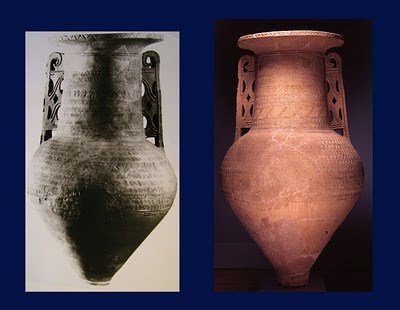
Revised History for the Carlos Museum Pithos

L: image from the Becchina archive
R: pithos in the Michael C. Carlos Museum

In 2004 the Michael C. Carlos Museum acquired a relief pithos dating to the 7th century. Concerns about its acquisition had been raised in 2007. The pithos itself seems to feature in images seized from the Becchina archive suggesting that it passed through Palladion Antike Kunst. 

Yet the newly issued history of the pithos suggests a different path.

PROVENANCE Ex coll. Professor Adolphe Goumaz, Lausanne, Switzerland, from 1960. Thence by descent to Roland C. Ansermet, Neuchatel, Switzerland, by December 2003. Imported to USA in 1991. Purchased by MCCM from Phoenix Ancient Art, Geneva, Switzerland.

The museum's history makes no allowance for the pithos passing through Palladion Antike Kunst as it is claimed that it passed 'by descent' from Goumaz to Ansermet. It is also unclear who was responsible for importing the pithos to the USA in 1991. Why did the family not keep it in Switzerland? Would the Carlos Museum be able to clarify the history with a little more detail?

In 2008 Christie's offered an Attic red-figured skyphos attributed to Makron at auction that was claimed to have resided in the Goumaz collection in 1958 (BAPD 9021866). Yet the Beazley archive makes no link with Goumaz. What is the authenticated documentation linking Goumaz with this skyphos? 

Phoenix Ancient Art offered a 4th century CE menorah reported to be from the Goumaz collection in 2013 [catalogue].

We are mindful that some unsubstantiated histories have been created for objects emerging on the market: the head of Drusus Minor that was claimed to come from an old Algerian collection (but which had been removed from an archaeological store in Italy); the parallel histories [both cannot be correct] for the mummy mask currently in the St Louis Art Museum; the placing of the Leutwitz Apollo in a German estate; the marble statue of Sabina from an old Bavarian collection. This is why is it so important for museums to indicate the authenticated source or sources for the histories that are provided in the record. Doubt can always be expressed with terms such as 'said to be', 'allegedly from', or even 'the owner of the gallery assured us that ...' 

The Becchina archive suggests that there could be another explanation for the route taken by the pithos that the museum has overlooked for 15 years.

I am grateful to Associate Professor Christos Tsirogiannis for suggesting the link with the Becchina archive.
| |
Bookmark and Share so Your Real Friends Know that You Know

Wednesday, 29 December 2021

Steinhardt objects returning to Greece

Minoan larnax formerly in the Steinhardt collection
Source: Manhattan DA

The Hellenic Ministry of Culture and Sports has announced that 47 objects "surrendered" by Michael Steinhardt will be returning to Greece ("Trove of stolen antiquities coming home from US", ekathimerini.com December 29, 2021).

Highlighted items are:
Items that stand out include a Minoan larnax dated to to 1400-1200 BC and valued at US$1million, a $14 million torso of a Kouros statue dated to 560 BC, as well as a bronze griffin protome, Cycladic vessels, figurines and bronze swords.

The paperwork indicates these include:
  • a marble Cycladic spouted bowl [p. 28] acquired from Medici. First surfaced in 1980 allegedly in the collection of Marie LaForet. Sold by Robin Symes to the Beierwaltes in 1997; assigned to Phoenix Ancient Art in 2006; purchased by Steinhardt on November 9, 2006 for $500,000.
  • a 9th century BCE Geometric oinochoe [p. 34]. Smuggled by Georgios Zenebisis to Switzerland and sold to Becchina; sold by Hecht to Steinhardt on November 17, 2000 for $23,485.
  • Attic white ground lekythos attributed to the Triglyph painter [p. 56]. Identified from the Symes archive. Symes sold it to the Beierwalters for $360,000 (June 22, 1995); consigned to Phoenix Ancient Art (2006); Steinhardt purchased from Phoenix Ancient Art for $380,000 (December 14, 2006).
  • a Minoan larnax [pp. 77–78]. Stylistically placed at Rethymnon. Restored from fragments by Flavio Bertolin in Munich; Ralf Kotalla conducted a TL test in April 2016. Purchased by Steinhardt for $575,000 from FAM Services; 
  • Five objects from Naxos [pp. 78–81] acquired from Eugene Alexander between 2010 and 2014. 
    • They consist of a marble female folded arm figure (ECII), purchased December 15, 2010 for $100,000; 
    • two marble plates, acquired November 6, 2012 for $15,000, and April 9, 2014, for $10,000; 
    • a marble kandila, acquired November 6, 2012 for $75,000; 
    • and a marble cup, acquired February 20, 2013 for $20,000.  
  • Bronze griffin protome [p. 81] acquired from Eugene Alexander on November 6, 2012 for $350,000. Reported to be from the Samian Heraion.
  • Marble kouros [pp. 61–62] acquired from Robert Hecht, November 17, 2000 for $2,348,000. Restored by Fritz Bürki in Zurich.
  • Gold broach from Rhodes [pp. 63–64] acquired from Robert Hecht; purchased from Harry Bürki on September 29, 1999 for $728,000. Said to have been found with an alabastron carrying the cartouche of Nekko II.
  • Minoan hoard of 33 items containing spears, metal objects and stone vessels. [pp.64–65] acquired from Robert Hecht; purchased from Harry Bürki on September 29, 1999 for $92,000.
  • a glass oinochoe [p. 112], probably from Rhodes. Consigned by George Ortiz to Robert Haber April 2, 2002; Steinhardt acquired it on February 22, 2008 for $433,500; loaned to New York's Metropolitan Museum of Art on August 11, 2015.
  • bronze female figure from Crete [pp. 113–14] acquired from Noriyoshi Horiuchi. Acquired from Phoenix Ancient Art by Horiuchi on May 15, 1991; December 8, 1994 placed on loan to New York's Metropolitan Museum of Art; December 11, 2009, purchased by Steinhardt for $650,000.

These 47 objects were purchased for $6.2 million, though their current value is considerably more (clearly in excess of $15 million).

| |
Bookmark and Share so Your Real Friends Know that You Know

Wednesday, 8 December 2021

Returning Athenian pottery from the Steinhardt collection

Source: Manhattan District Attorney's Office

The documentation for the Michael Steinhardt  collection identifies several Attic pieces that will be returned to their country of origin, presumably Italy and Greece.
  • Attic black-figured Sphinx cup, 'Tleson, son of Nearchos' (pp. 19–20). Identified from the Medici dossier. Symes sold to Beierwaltes (January 8, 1996); Phoenix Ancient Art (2006); Steinhardt purchased from Phoenix Ancient Art for $310,000 (2007).
  • Attic red-figured oinochoe attributed to the Berlin painter (pp. 20–21). Identified from the Medici dossier. Steinhardt purchased from Harry Bürki for $215,000 (1996); Steinhardt's records show that the oinochoe had been sold by Robert Hecht.
  • Attic black-figured hydria showing Herakles and Kyknos attributed to the Leagros group (p. 21).  Identified from the Medici dossier. Displayed by Christos Bastis at New York's Metropolitan Museum of Art (1987); Bastis died (1999); Steinhardt purchased from Michael Ward for $127,000 (2000). The paperwork omits that the hydria surfaced at Sotheby's (London) July 11–12, 1983, lot 352, and was sold at Sotheby-Parke-Bernet, New York, December 9, 1999, lot 92. [BAPD 9050]
  • Attic black-figured hydria showing women at a fountain-house attributed to the Antimenes painter (pp. 22–23). Identified from the Medici dossier. Robin Symes advertised the hydria (1983); Atlantis Gallery, New York (1987); loan to the J. Paul Getty Museum L87.AE.4 (1987–96); Steinhardt purchased it at Sotheby's for $169,411 (December 17, 1996, lot 49). [BAPD 31596]
  • African head vase (pp. 23–24).  Identified from the Medici dossier.  Displayed in the Musée d'Art et d'Histoire, Geneva (1978–81); J. Paul Getty Museum (1984–96); Symes sold the piece to the Beierwaltes (1996); Beierwaltes consigned it to Phoenix Ancient Art (2006); Steinhardt purchased it from Phoenix Ancient Art for $163,312.50 (2009). 
  • Attic black-figured eye-cup (pp. 35–36). Identified from the Becchina archive. Mario Bruno, Lugano; sold to Becchina; TL tested by Ralf Kotalla, Germany(July 1992); Robert Hecht sold it to Steinhardt for $170,750 (June 15, 2000).
  • Attic black-figured amphora (p. 50). Identified from the Almagià archive. Purchased from a tombarolo for $6,500; sold for $13,000; accessioned by Steinhardt as coming from Almagià (1997). 
  • Attic black-figured plemochoe (pp. 54–55). Identified from the Symes archive. Photographed by Dieter Widmer (1985); held as loan by Sotheby's London for Budico SA, owned by Henri-Albert Jacques (1989); stolen from Sotheby's and recovered by the police; Budico SA sold it through Sotheby's to Steinhardt for $84,083 (December 11, 2002). Note: 'Ex. Private Coll. London, RS + CM' (?Symes and Michaelides).
  • Attic white ground lekythos attributed to the Triglyph painter (p. 56). Identified from the Symes archive. Symes sold it to the Beierwalters for $360,000 (June 22, 1995); consigned to Phoenix Ancient Art (2006); Steinhardt purchased from Phoenix Ancient Art for $380,000 (December 14, 2006).
| |
Bookmark and Share so Your Real Friends Know that You Know

Thursday, 4 November 2021

The Case of the St Louis Art Museum Mummy Mask


I am looking forward to exploring the parallel histories for the Ka-Nefer-Nefer mummy mask at the Transatlantic Cultural Property Crime Symposium (November 2021).

Tantalising Evidence and a Failed Legal Claim: 

The Case of the St Louis Art Museum Mummy Mask 


Abstract 
In 1952 Mohammed Zakaria Goneim, chief inspector of antiquities, excavated an Egyptian mummy and mask at Saqqara. This mummy mask was acquired by the St Louis Art Museum in 1998 from Phoenix Ancient Art for $499,000. The purchase led to a legal claim by the Egyptian authorities. However, the outcome was that the court confirmed the ownership with the St Louis Art Museum. The release of internal documents from the museum reveals a story that suggests that key members of the museum’s curatorial team were aware of sensitivities relating to the history of the mummy mask. 

There are two parallel and irreconcilable accounts of the mask between 1952 and 1998. The vendor had acquired a statement from Charly Mathez in 1997 that claimed that the mummy mask had been seen by him in Brussels in 1952 (or 1958). The mask is then reported to have been part of the collection of Suzana Jelinek in Zagreb, before moving into an anonymous Swiss private collection. The mask was then reported to have been displayed for a short time in Geneva’s Musées d’art et d’histoire in 1997 prior to its sale. 

The Egyptian authorities claimed that the mask had followed a different path and that it was recorded in the archaeological store in Saqqara in 1959. It then moved to the Cairo Museum from 1959 to 1962 when it returned to the store in Saqqara. It went back to Cairo in 1966, and was finally noted as missing in 1973. It appears to be significant that the personal name in hieratic script that was visible on the right hand of the mask when excavated had been removed by the time that the piece passed through the dealer in Switzerland as demonstrated by publicity photographs taken around 1997. 

The museum does not appear to have responded to suggestions (in January 2006) that it should check with the Egyptian authorities to ensure that the mask had not been stolen from the Saqqara store. Zahi Hawass, the then Secretary General of the Egyptian Supreme Council of Antiquities, raised his concerns about the mask in February 2006. This was supported by well-documented instances of thefts from the Saqqara stores, including two alabaster ducks that were returned to Egypt. 

The legal case developed in January 2011, and a case for forfeiture was filed in March 2011; this was dismissed on 31 March 2012 by a US District Judge. A parallel case for declamatory relief was finally withdrawn in June 2014. It does not appear to have been disclosed during the hearings that John H. Taylor, an Egyptologist at the British Museum, had raised his concerns about the mask to SLAM curators in February 1999. Such concerns were apparently left uninvestigated by the museum or the legal teams. 

The SLAM case raises the issue that legal challenges may not be the most effective way to reclaim cultural property. In contrast the Italian government has managed to secure the return of several hundred objects from North American public museums and private collections through the effective use of the media that has placed moral pressure on museums, auction houses and private individuals. The way ahead may be to develop a more rigorous due diligence process for museum acquisitions that would enhance the legal ownership of objects acquired through the market.

Bookmark and Share so Your Real Friends Know that You Know

Monday, 13 August 2018

Beierwaltes take legal action

The Beierwaltes are taking legal action after Swiss authorities seized objects during a raid on a warehouse in Switzerland (Amanda Pampuro, "Colorado Couple Seek to Reclaim Artifacts From Swiss", Court House News 8 August 2018).  The Beierwaltes had consigned their pieces for sale by Phoenix Ancient Art in Geneva. 

The Beierwaltes are seeking $24 million in damages for the seizure of the 18 objects valued at $8 million.

It appears that the Beierwaltes were purchasing objects from Robin Symes. Do any of the 18 objects consigned to Geneva appear in the Schinousa archive? Will the Beierwaltes release the full histories of the objects?

The story mentions that the Beierwaltes
assert they vetted all of their items and “purchased each object in reliance on express or implied representations from reputable dealers and auction houses in the absence of any thefts reported to publicly available databases of stolen art, such as the Art Loss Register.”
This statement fails to note that objects removed from archaeological contexts would not necessarily be reported to the ALR or other similar registers.

See also the material from Eshmun.

Bookmark and Share so Your Real Friends Know that You Know

Monday, 15 January 2018

Sources for Steinhardt seizure revealed

Attic white ground lekythos
Source: Schinousa Archive
I am grateful to Dr Christos Tsirogiannis for sharing information about the items seized from the collection of Michael Steinhardt and from the displays at Phoenix Ancient Art in Manhattan.

The Attic white-ground lekythos has been identified from images in the Schinousa Archive showing that it was part of the stock of Robin Symes. Notice the deposits still on the lekythos. When was the lekythos cleaned? Who did the cleaning?

The other Steinhardt pieces are identified in the Medici Dossier as well as the Becchina Archive.

The pieces from Phoenix Ancient Art include items identified from the Medici Dossier (at least 3 items) and the Becchina Archive (at least 1 item).

I expect that the routes through which these pieces passed will be revealed shortly.


Bookmark and Share so Your Real Friends Know that You Know

Friday, 12 January 2018

Phoenix Ancient Art responds to seizures

Source: ARCA

A spokesperson for Phoenix Ancient Art has responded to the seizures of antiquities that took place last week (see Search Warrant listing the items). In a statement to Artnet News ("New York Antiques Dealer Phoenix Fine Art Raided on Suspicion of Selling Looted Artifacts", 11 January 2018) it was stated:
“We immediately notified the US private collection that consigned the works to us of the situation, and we do know that the works have a long museum exhibition history spanning from the Geneva Musée d’art et d’Histoire, 1978–1981, and at the Getty Museum, Los Angeles, 1984–1996.”
The temporary display of recently surfaced antiquities in public museums is an interesting one. How are these documented? What about the display of the Ka Nefer Nefer mummy mask in Geneva? And was the (anonymous?) loan to the J. Paul Getty Museum by a dealer or a collector? This recalls the loan of fragments of the Berlin painter krater, a pot that was subsequently returned to Italy.

Should museums be accepting loans for antiquities that do not have documented and authenticated histories that stretch back to the period before 1970?

North American museums will be aware of The Association of Art Museum Directors Releases New Guidelines on Loans of Antiquities and Ancient Art  (2006) that states "Potential long-term loans (i.e. loans not part of visiting exhibitions) with incomplete relevant provenance histories should be evaluated under criteria comparable to those for acquisitions". This should now be read against Revisions to the 2008 Guidelines on the Acquisition ofArchaeological Material and Ancient Art (2013), and specifically, "Member museums normally should not acquire a Work unless provenance research substantiates that the Work was outside its country of probable modern discovery before 1970 or was legally exported from its probable country of modern discovery after 1970".


Bookmark and Share so Your Real Friends Know that You Know

Tuesday, 9 January 2018

Further seizures in Manhattan

Source: ARCA
Last Friday the New York State District Attorney's Office raided Phoenix Ancient Art in Manhattan and removed six items (see "List of 6 (additional) objects and warrant details on objects seized from Phoenix Ancient Art by New York State District Attorney's Office", ARCA 9 January 2018). The items include Protocorinthian and East Greek perfumed-oil containers, an Attic head jug, and a Teano ware dove. The dove is almost certainly from an Italian context, and the other objects are types frequently found in funerary contexts in Italy. Together the items are valued at $450,000. The objects appear to be the ones noted in the New York Times: "another six pieces on display at the Phoenix Ancient Art Gallery on 66th Street".

The seizure appears to be linked to the case of Steinhardt.

The full histories of the objects have not been disclosed. What is the authenticated documentary history for each of the items? Did each one surface prior to 1970?


I am reminded that this case of seized Steinhardt material can be traced back to December 2014. This is a reminder that dealers should have been aware of the issues in handling material from this source.


Bookmark and Share so Your Real Friends Know that You Know

Ward and the Balkans in the 1990s

Some years ago I reflected on the Aidonia Treasure and the way that it was displayed by Michael Ward in New York (1993). The treasure was subsequently returned to Greece.

I then wrote about a silver repoussé plaque that surfaced through Ward and Company Works of Art, New York, in the mid-1990s, and three bronze helmeted warriors that appeared in 1998. It has been suggested to me that these items were found with the so-called Koreschnica Krater (although its route to the market has not been disclosed). 

I am intrigued by the extremely rare gold-figured phiale showing Thetis and the armour of Achilles that surfaced through Ward and Company in 1990. Some of the best known examples of gold-figured silver plate were found at Duvanli in Bulgaria.

Where did Ward and Company Works of Art acquire these pieces? What is the authenticated documentary history for them?

Bookmark and Share so Your Real Friends Know that You Know

Friday, 5 January 2018

The Eulenbruch honorific statue

New York, Metropolitan Museum of Art inv. 2001.443
© David Gill
The history of objects in collections are fascinating: the movement of objects between different owners. This bronze honorific statue was received by the Metropolitan Museum of Art as a partial gift from Renée E. and Robert A. Belfer in 2001, with the remainder in 2010 [online catalogue entry].

The MMA's catalogue entry (2007)  [no. 212] dates the figure to the mid-2nd–1st century BC, and identifies it as an honorific statue of a "prominent" individual. The city where this statue was erected is now unknown, although the online entry (but not the print catalogue) notes that it was "said to have come from Syria". The authority for this statement is not provided.

Paul Zanker, in his Roman Portraits: Sculptures in Stone and Bronze in the Collection of The Metropolitan Museum of Art (2016) no. 3, identifies the figure as an orator and dates it to c. 50–30 BC. Zanker observes that the folds of the drapery contain "many traces of soil" suggesting to him that the figure comes from "an excavation". The so-called excavation is not likely to have been a scientific one, or the statue would have been known. One also wonders why a statue that has been out of the ground for so long is presented as if it is fresh out of the ground. There is no mention of any analysis of the soil that could perhaps have given an indication of the findspot. Zanker suggests that the statue "presumably" was found in "western Turkey or neighbouring Syria". Does Zanker reject the MMA's view that the statue was (said to have been) derived from Syria?

The statue was purchased from Phoenix Ancient Art in 2001, the same year that it was donated (anonymously) to the MMA.

Phoenix Ancient Art has been the source of some other notable pieces:
  • The head of Drusus Minor acquired by the Cleveland Museum of Art, and now returned to Italy after it was shown to have been removed from an archaeological store; it had been provided with a history that had placed it in Algeria in the 19th century.
  • The Leutwitz Apollo acquired by the Cleveland Museum of Art; the bronze statue had been provided with a history that had placed it in Leutwitz before the Second World War. A discussion of the history can be found here.
  • The Egyptian mummy case excavated (and published) at Saqqara in 1952, and was acquired by the St Louis Art Museum; it was provided with a history that placed it in a dealer's gallery in Brussels. The full history can be found here.
It is also important to remember the Etruscan architectural terracotta that was returned to Italy from the Princeton University Art Museum. 

It is claimed both by the MMA's online catalogue entry and in Zanker, that the statue was "Reported to be the property of A. Weber of Eulenbruch, near Cologne, Germany, from the late 1970s". The word reported suggests that there is no actual authenticated evidence that it did indeed come from Herr Weber, otherwise the entry would have said something like this, "Formerly the property of ...". 

The MMA felt that it could make the further acquisition in 2010 as it had received "part" of the statue as a gift in 2001. (See the AAMD Guidelines for 2008.) The exception made was: "The work was accepted as a partial gift in 2001 and has been exhibited publicly since 2007. Such over life-size bronze statues are extremely rare, especially ones of the quality of this piece. It represents a major class of Hellenistic honorific statuary not otherwise represented in the Museum’s collection."

The history of this bronze statue in the period before 2001 appears to be unconfirmed. Should the MMA reveal the nature of its due diligence process prior to the acquisition of the bronze?


Bookmark and Share so Your Real Friends Know that You Know

Monday, 24 April 2017

The Tiberius and the Drusus heads

Tiberius and Drusus. Source: PIASA
Documented collecting histories are important. The portrait heads of Drusus Minor and Tiberius excavated at Sessa Aurunca have parallel histories.

Both passed through the sale of PIASA in Paris on 17-18 March 2003, lot  569, and 29 September 2004, lot 340. Both came from the same source ("Cette tête de même provenance que la tête vendue le 18 Mars 2003 ").

The Drusus was reported to have been purchased by Phoenix Ancient Art, who then sold it to the Cleveland Museum of Art in 2012. It was displayed in the New York exhibition, "IMAGO: Four Centuries of Roman Portraiture", with the information that it had formed part of a 19th century Algerian collection ["Phoenix Ancient Art to Exhibit Collection of Roman Portraits, Unveil Its Newly Renovated New York Gallery", 29 November 2007].

The Drusus appeared in Randy Kennedy's article, "Museum Defends Antiquities Collecting" (originally from the New York Times, 12 August 2012). The article specifically states, "The Cleveland Museum’s new portrait of Drusus Minor has no ironclad record pre-1970". It is noted, "But the museum said it believed its history could be traced back to the late 19th century as the property of a prominent family in Algiers." The source for this collecting history is unstated though was in circulation in 2007. David Franklin, the then director of the Cleveland Museum of Art, was quoted, “We’ve done our due diligence and we feel that both these objects have a pre-1970 provenance” [the other piece was Mayan].

The Tiberius was purchased by the Royal-Athena Galleries and then sold to the US Private Collector. I am told that the private collector returned the head to Italy in January 2017.

It is unclear when the pieces were removed from the Antiquarium in Italy.

I am grateful to Dr Jerome Eisenberg for the additional information and clarification.

Bookmark and Share so Your Real Friends Know that You Know

Wednesday, 19 April 2017

The Drusus and Tiberius portraits from Sessa Aurunca

Drusus Minor. Source: Cleveland Museum of Art
The return of the head of Drusus Minor to Italy from the Cleveland Museum of Art has been in part thanks to the diligent research of Giuseppe Scarpati. He has discovered the photographic records of sculptures discovered during the mid-1920s during the excavations of Sessa Aurunca.

The head of Drusus Minor is clearly recognisable from the archive photographs (Scarpati 2008-11: 357, fig. 7, 358 fig. 10). The head passed through PIASA in Paris in 2004, a source that is not without some interest. It was acquired from Phoenix Ancient Art in 2012. (See Gill 2013: 72 for oral histories and objects linked to this dealer, and with a specific mention to the portrait of Drusus.)

David Franklin, the then director of the Cleveland Museum of Art, defended the acquisition of the head at the time. (He resigned from the museum in 2013.) The museum is probably wishing that it had not claimed that the collecting history had been traced back to the 19th century.

The trail of the Drusus portrait had been identified by a companion piece. The head of Tiberius appears to be the one in a North American private collection ("The Magdalene Tiberius")  and published by John Pollini (Pollini 2005; Scarpati 2008-11: 361 figs. 11-14). It was reported to have formed an old French collection in Marseilles dating to the 1960s. It was said to have been found in North Africa (a good reminded of the intellectual consequences of collecting recently surfaced archaeological material). It was acquired by its present proprietors in 2004. The source appears to have been the Royal-Athena Galleries (Art of the Ancient World 15 [2004] no. 24; Scarpati 2014: 33 fig. 9). Will those owners be contacting the Italian authorities in the light of the return of the Drusus portrait?

It is interesting that the (recent) collecting histories of both portraits now do not seem to go back beyond 2004 (i.e. 34 years after the UNESCO Convention). What were their collecting histories immediately prior to 2004?

The Drusus Minor return is merely serving to open up the discussion. Was the Cleveland Museum of Art aware of Scarpati's research prior to the portrait's acquisition?

Now is probably also a good time for the museum staff to revisit the documented collecting history of the Leutwitz Apollo.

Bibliography

Gill, D. W. J. 2013. "Context matters: The Cleveland Apollo goes public." Journal of Art Crime 10: 69-75. [academia.edu]
Pollini, J. 2005. "A new marble head of Tiberius. Portrait typology and ideology." Antike Kunst 48: 55-72. [JSTOR]
Scarpati, G. 2008-11. "Un ritratto di Tiberio da Sessa Aurunca ritrovato note su un probabile ciclo Suessano di statue onorarie Giulio-Claudie." Rendiconti della Accademia di Archeologia Lettere e Belle Arti 75: 345-68. [Academia.edu]
Scarpati, G. 2014. "Il ritratto di Druso minore dal ciclo statuario Giulio-Claudio di Sessa Aurunca." Bollettino d’Arte 24: 29-38. [Academia.edu]

Press Release
"Cleveland Museum of Art to Transfer Roman Sculpture of Drusus Minor to the Republic of Italy", Cleveland Museum of Art April 18, 2017. [press release]
"Il Cleveland Museum of Art restituisce all’Italia una scultura romana di Druso Minore", MiBACT April 18, 2017. [press release]

Bookmark and Share so Your Real Friends Know that You Know

Cleveland Museum of Art to return portrait of Drusus

Drusus. Source: Cleveland Museum of Art
In 2012 the Cleveland Museum of Art purchased a portrait head of Drusus that was reported to be from "an old Algerian collection" (see earlier report). The head had been purchased from Phoenix Ancient Art.

It has been announced that the head will be returned to Italy (Steven Litt, "Cleveland Museum of Art returns ancient Roman portrait of Drusus after learning it was stolen from Italy in WWII", cleveland.com April 18, 2017). It is now understood that the portrait was excavated at Sessa Aurunca, Campania in the mid-1920s. It appears that the head was stolen from the museum there around 1944.

This now raises questions about the due diligence process surrounding the acquisition as well as other material handled by the same dealer. The curatorial team will no doubt be releasing the basis of their pre-acquisition enquiries.

Bookmark and Share so Your Real Friends Know that You Know

Tuesday, 29 September 2015

Further sightings on the London market

Glasgow University researcher Dr Christos Tsirogiannis has identified four items that are due to be auctioned at Christie's King Street (London) on 1 October 2015. I understand that Interpol, the Carabinieri Art Squad and Scotland Yard Art and Antiques Unit have been notified.

Three of the lots come from the Heissmeyer Collection (lots 1-34).
The Heissmeyer collection brings together vases and figural vessels of Greek antiquity from Athens to South Italy, dating from the 8th-4th century B.C. Professor Heissmeyer assembled his collection in affection for the craftsmanship of the ancient potter and painter, considering the vases his 'guests', and as such 'able to move on and delight others'. Prof. Heissmeyer published his collection in two volumes: Vasen und figürliche Gefässe aus der griechischen Antike. Katalog einer süddeutschen Sammlung, Dettelbach, 2008 and Vases and Figure-Shaped Vessels of Greek Antiquity: Catalogue of a Collection in South Germany, Schwäbisch Hall, 2015 (referred to below as 'Vasen, 2008' and 'Vases, 2015').

The pieces are:

Lot 6. Attic head vase.
Estimate: £4000-£6000.
Collecting history:
Private collection, Germany, acquired prior to 1990. with Galerie am Museum Jürgen Haering, Freiburg. Prof. H.-H. Heissmeyer collection, Schwäbisch Hall, acquired from the above in 2005 (inv. no. 32).
Publication: Vasen, 2008, no. 19 and Vases, 2015, p. 67, no. 21.
Although a number for the Beazley Archive is provided (9024860) this does not appear to refer to a specific item.
Tsirogiannis notes that a Polaroid photograph that appears to show this oinochoe features in the Becchina archive. A note shows that it was sent for restoration on 1 December 1989 to Sandro Cimicchi.


Lot 8. Attic black-figured Droop cup
Estimate: £4000-£6000.
Collecting history:
Private collection, Switzerland, acquired prior to 1980. with Galerie am Museum Jürgen Haering, Freiburg. Prof. H.-H. Heissmeyer collection, Schwäbisch Hall, acquired from the above in 1995 (inv. no. 17). 
Publication: Vasen, 2008, no. 3 and Vases, 2015, p. 15, no. 5.
Although a number for the Beazley Archive is provided (9024849) this does not appear to refer to a specific item.
Tsirogiannis notes that the cup appear to feature in the Becchina archive.  A note suggests that this was one of four cups purchased by Raffaele Monticelli on 4 March 1993. Becchina's Polaroid is marked that it was sold to 'Hae[ring]'.

Lot 16. Attic red-figured lekythos, attributed to the Sabouroff painter
Estimate: £7000-£10000
Collecting history:
Private collection, United Kingdom, acquired prior to 1980. with Galerie am Museum Jürgen Haering, Freiburg. Prof. H.-H. Heissmeyer collection, Schwäbisch Hall, acquired from the above in 1992 (inv. no. 23). Beazley Archive no. 21590.
Although a number for the Beazley Archive is provided (21590) this does not appear to refer to a specific item.
Publication: J. H. Oakley, The Achilles Painter, Mainz, 1997, pl. 181C. Vasen, 2008, no. 9 and Vases, 2015, p. 31, no. 10.
Tsirogiannis notes that the lekythos appears in the Becchina archive. A note suggests that the transaction took place in November 1978.


Lot 93. Attic red-figured lekythos attributed to the Nikon painter
Estimate: £25000-£30000
Collecting history:
Anonymous sale; Münzen und Medaillen AG, Basel, 14 November 1986, lot 213. Formerly private collection, Japan, acquired privately in 1997.
Tsirogiannis notes that this lot was confiscated in the Geneva Freeport by the Swiss authorities from Noriyoshi Horiuchi in 2008 (see Operation Andromeda). He also notes that the lekythos has been offered for sale by Phoenix Ancient Art (website) and subsequently sold. [It also features on pinterest.] It is not clear why Christie's have not provided the full collecting history for the lekythos.

It appears that Christie's has not conducted a sufficiently rigorous due diligence process to identify material from the Becchina archive. Will the auction house be withdrawing the lots prior to the sale?

I am grateful to Dr Tsirogiannis for sharing his identifications with me.


Bookmark and Share so Your Real Friends Know that You Know

Monday, 27 July 2015

Aboutaam on the seized sarcophagi

Ali Aboutaam of Phoenix Ancient Art has commented on the lifting of sequestration of a Phoenician sarcophagus (Laure Lugon Zugravu, "Levée du séquestre pour le sarcophage phénicien", Le Temps July 22, 2015). Aboutaam is reported to have said that the Lebanon has now accepted that the sarcophagus had not been stolen.

This was one of three sarcophagi seized in the Geneva Freeport in 2010.

For earlier comments and video see here.

| |
Bookmark and Share so Your Real Friends Know that You Know

Monday, 7 July 2014

The SLAM Mask in Two Places?

I have been reviewing some of the views on the Egyptian mummy mask acquired by the St Louis Art Museum. There is a useful piece in The International Lawyer (Spring 2013) --- based on the forfeiture statement --- that reminds us that the mummy mask was moved from Saqqara to Cairo in 1966 in box 54. And then in 1973 it was found that the mask was missing from box 54.

Thus we can reconstruct the collecting history as follows:

a. The mask is excavated at Saqqara in 1952.
b. Charly Mathez recalls (in 1997) that he had seen the mask in an antiquities dealer's shop in Brussels in 1952.
c. In 1962 the mask was purchased for the Kaloterna collection.
d. The mask was acquired for the collection of Zuzi Jelinek who possessed it for "40 years" (sic.).
e. Sometime between 1962 to 1966, the mask was returned to the archaeological store in Saqqara.
f. In 1966 the mask was moved to Cairo in box 54.
g. In 1973 the mask was found to be missing from box 54.
h. The mask was back in the Jelinek collection.
i. In 1997 the mask was sold to Phoenix Ancient Art.
j. The mask was displayed in Geneva.
k. In 1998 the mask was sold to SLAM.

I have a strong hunch that this reconstruction is flawed.

Perhaps the Director, Trustees and Curatorial Team of SLAM could explain how the timeline for the mummy mask can be presented.

Bookmark and Share so Your Real Friends Know that You Know

Another Bürki object returns to Italy

Source: MMA A psykter column-krater attributed to the Troilos painter was deaccessioned by New York's Metropolitan Museum of Art in June...