
Showing posts with label Anglo-Saxon. Show all posts
Showing posts with label Anglo-Saxon. Show all posts
Wednesday, 30 November 2016
Anglo-Saxon jewellery declared treasure
A piece of Anglo-Saxon jewellery discovered by a metal-detectorist in a Norfolk field near Diss has been declared Treasure ("Anglo-Saxon find in Norfolk declared treasure", BBC News November 29, 2016; see also "Anglo-Saxon pendant: Norfolk student makes 'royal' find", BBC News February 27, 2015). A subsequent excavation showed that this came from a female burial.


Monday, 18 January 2016
Metal-detecting at Roman Saxon-Shore Fort
 |
| (c) David Gill |
Listen here.

Tuesday, 22 December 2015
Lenborough Hoard: appeal
 |
| Displaying the Lenborough Hoard at the British Museum Photo: David Gill |
The money raised is hoped to persuade "funding bodies" to meet the balance, perhaps in the region of just under £1.3 million.
The account of the find raises several issues about the holding of "rallies" on sites that appear on the Historic Environment Record.
For further details see my: "Damaging the Archaeological Record: the Lenborough Hoard", Journal of Art Crime 13 (2015) 51-57 [academia.edu].
Friday, 10 July 2015
The Lenborough Hoard
My article, 'Damaging the archaeological record: The Lenborough Hoard', has appeared in the Journal of Art Crime 13 (Spring 2015) 51-57. The article reviews how the coins were removed from their archaeological context and suggests ways to develop stronger guidelines to protect the archaeological heritage of England and Wales.
Wednesday, 18 March 2015
Rendlesham and metal-detecting
Professor Chris Scull gave an excellent presentation on the Rendlesham project to the Heritage Futures seminar today. He explained how the team was able to map the vicus regius on the landscape. One aspect of the presentation was the constructive use of metal-detectorists to map finds in the study area. It was clear how their carefully recorded work contributed to the understanding of this important Anglo-Saxon site that clearly has a relationship with the major ship burial site at nearby Sutton Hoo.
During the questions and discussion a little detail was revealed about the 'illegal' metal-detectoring on the site that led to investigation of the site. Scull thought that the fact that Rendlesham was known as a 'royal' site had probably attracted metal-detectorists. (I noted that there was never a mention of 'nighthawking' by Scull or members of the audience.) We were informed that a local estate worker had spotted searchers working at night.
Scull made a strong case for responsible and collaborative metal-detecting. But there was also a reminder of the damage that could be sustained to a site that clearly has international significance.
Earlier discussion of Rendelsham here.
Tuesday, 10 February 2015
Lenborough Hoard: update
 |
| Lenborough Hoard Source: finds.org.uk (under CC) |
There appeared to be a curious blip on the PAS website earlier today that meant the normal record was unavailable. I have checked again this evening and it is now all there [here].
The circumstances provided on the website appears as "Weekend Wanderers Xmas Dig". (For further images see here.)
We also need to remember that under The Treasure Act (1996) 'the occupier of the land' can receive part of the reward.
Wednesday, 13 August 2014
The Detectorists of Suffolk
 |
| Cemetery site in Suffolk © David Gill |
Are we conjuring up images of Sutton Hoo, Rendlesham, or perhaps even the Staffordshire Hoard?
The series has been filmed in Suffolk, Norfolk and Suffolk and will apparently feature Orford and Framlingham.
I could think of a couple of walk-in parts for the series including the North American collector who acquires Roman bronzes dug up from a Suffolk farm.
But perhaps I am moving away from fiction.
Saturday, 17 May 2014
Anglo-Saxon brooches from East Anglia
Ansate brooches were rare finds, but metal-detecting has showed they were common part of A-S dress.so I made a gif http://t.co/dNGClEIrVX
— Rosie Weetch (@rosieweetch) May 17, 2014
I was very struck by the distribution maps for finds of Anglo-Saxon ansate brooches produced by Dr Rosie Weetch of the British Museum. It is very striking that the number of recorded "finds" increases from 2010 for both Norfolk and Suffolk. Weetch puts this rise down to the number of brooches recovered by metal-detecting.
It would be interesting to know how many Anglo-Saxon ansate brooches come from secure, excavated contexts.
What are the intellectual consequences if the majority of the brooches do not have secure contexts?
For the record the PAS database has 49 brooches for Suffolk, and 92 brooches for Norfolk.
See also comments by Paul Barford.
Monday, 12 May 2014
Basil Brown Memorial Lecture 2014

Saturday, 15 March 2014
Rendlesham exhibition
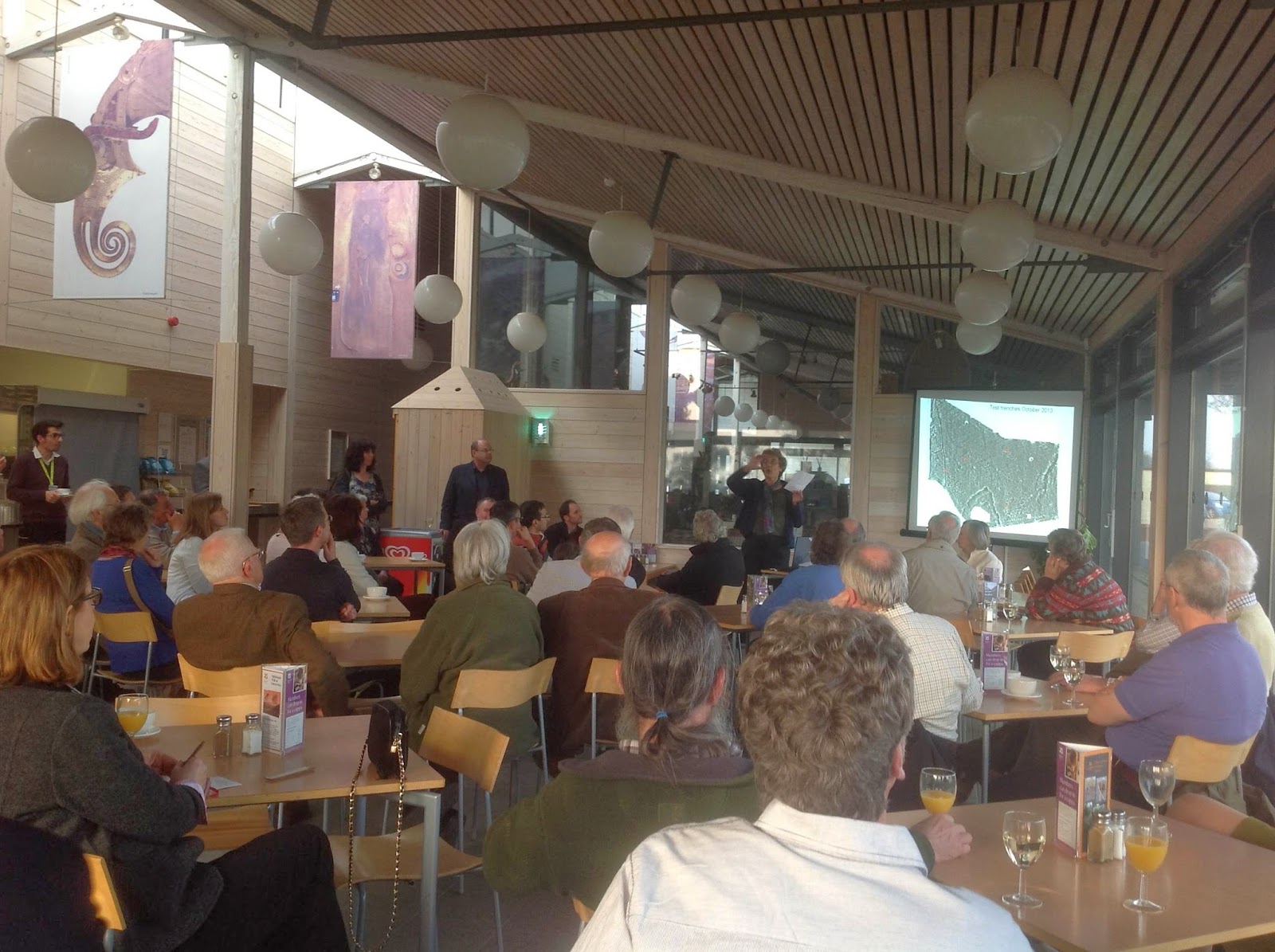 |
| Rendlesham opening at Sutton Hoo © David Gill |
It was stressed that Rendlesham was the elite site — perhaps the location of King Raewald —whereas Sutton Hoo related to "death and memory". It looks as if we now have two major Anglo-Saxon sites in close proximity.
What became clear during the evening was the damage that had been sustained to the site by "nighthawkers". (Before anybody comments, three local metal-detectorists were present at the event as they helped to map small finds in the vicinity of the site.)
There is more on the Rendlesham site from BBC News. The Ipswich Star has been commenting on the damage sustained to the site [press].
We need to recognise that this internationally significant site has been damaged by illicit activity. Information has been lost. It is another reminder of the intellectual consequences of unscientific "exploration" of archaeological sites.
Friday, 1 March 2013
Anglo-Saxon Context Matters
 |
| West Stow Anglo-Saxon Village © David Gill |
It was a timely reminder that there are intellectual consequences for "portablising" buried archaeological objects.
Subscribe to:
Posts (Atom)
The Afrati Armour in Harvard
Source: Harvard Art Museums The repatriation of the Afrati armour from New York's Metropolitan Museum of Art has implications for other ...

-
 Source: Sotheby's A marble head of Alexander the Great has been seized in New York (reported in " Judge Orders Return of Ancien...
-
 Detail of the Sophilos dinos © David Gill The Sophilos dinos in the British Museum has been reconstructed from approximately 50 fragments. I...
-
Source: Hellenic Consulate General in New York In September 2025 a number of antiquities were seized from New York’s Metropolitan Museum of ...
