Showing posts with label Australia. Show all posts

Thursday, 5 March 2015

National Gallery of Australia to return statue to India


The National Gallery of Australia will be returning one of its statues to Australia. This seems to be another instance of unauthenticated documentation.

The full story can be found on Chasing Aphrodite. There is an interesting comment on how new ethical standards are likely to be applied retrospectively ... and making those adopted in the US (by AAMD) look very dated.

Bookmark and Share so Your Real Friends Know that You Know

Monday, 8 September 2014

Shiva Returns to India

In August 2008 I commented on the Shiva acquired by the National Gallery of Australia.

The BBC has now reported that the museum will be returning the bronze to India along with another from the Art Gallery of New South Wales ("Australia to return 'stolen' Hindu statues to India", 5 September 2014). The story quoted a statement from the Australian Prime Minister's office:
Returning the sculptures "is testimony to Australia's good citizenship on such matters and the importance with which Australia views its relationship with India". 
I hope that the Prime Minister and his government team will reflect on how these two major museums acquired the objects in the first place. What went wrong with the due diligence process? How could museums in Australia adopt a more rigorous acquisition policy?

And what about the other objects that were derived from the same source? Will those same Australian museums be handing them over as well?

For the earlier statement from Canberra see here.

Bookmark and Share so Your Real Friends Know that You Know

Friday, 19 October 2012

The Geddes Collection at Auction

Bonhams managed to attract significant adverse publicity when they attempted to auction part of the collection formerly owned by Graham Geddes in 2008.

I note that the sale of antiquities next week (October 24, 2012) includes four ex-Geddes pieces:
  • lot 81. Apulian red-figured hydria, attributed to the Truro painter. Surfaced: Sotheby's, London, 9 December 1985, lot 375. Exhibited: the University of Melbourne, March 1988-July 2003; the Museum of Mediterranean Antiquities, Monash University, Melbourne, Australia, November 2005-April 2008 .
  • lot 82. Apulian hydria, attributed to the Patera painter. Surfaced: Sotheby's London, 21 May 1984, lot 222. Exhibited: the Borchardt Library, La Trobe University, Melbourne, Australia, March 1986-April 2008.
  • lot 85. Gnathian volute krater. Surfaced: Sotheby's London, 9 Dec 1985, lot 378. Exhibited: University of Melbourne, Australia, March 1986 - February 1994.
  • lot 86. Campanian red-figured neck-amphora, attributed to the Pilos Head group. Surfaced: Sotheby's London, July 11th, 1988, lot 178. Exhibited: the Museum of Mediterranean Antiquities, Monash University, Melbourne, Australia, December 1989 - April 2008.
It should be noted that these four pieces surfaced at Sotheby's, London between 1984 and 1988. Such a shared "pedigree" can be noted for other Geddes pieces. The May 1984 sale is particularly significant. Will Bonhams reveal who consigned these four pieces to Sothebys in 1984, 1985, and 1988? What sort of due diligence checks have been made?

The loan of material to various Australian collections is also of note.

Some of the ex-Geddes material can now be found in the Mougins Museum of Classical Archaeology and the National Museum of Archaeology in Madrid.

Bookmark and Share so Your Real Friends Know that You Know

Monday, 6 August 2012

Shiva in Canberra: statement

The National Gallery of Australia has issued a statement about the acquisition of the bronze Shiva.
The National Gallery of Australia is aware of media reports that Indian police have arrested the New York based art dealer, Mr Subhash Kapoor, for allegedly trafficking Indian antiquities and that the case against him is currently underway. 
At this point, the Gallery has not been contacted by Indian police or any other authority regarding this matter. 
The Gallery contacted the Indian High Commission in Canberra earlier this week to ensure a fully co-operative approach will be taken if required. 
The Gallery is one of at least 18 major international art institutions including the Metropolitan Museum of Art in New York; Museum of Fine Arts, Boston; the Smithsonian’s Freer and Sackler Galleries in Washington DC and the Art Institute of Chicago that have acquired works of art through gifts or purchased from Mr Kapoor. 
‘As with all leading art institutions around the world, the Gallery is committed to strict due diligence when acquiring works of art, particularly with regards to determining provenance,’ said Ron Radford AM, Director of the National Gallery of Australia. 
The Gallery purchased its Shiva as Nataraja, Lord of the Dance from Mr Kapoor in 2008 following a thorough due diligence process regarding the quality, provenance and time of its departure from India. 
‘It is yet to be determined if this work is one of the stolen works as has been speculated about in certain media outlets. 
The Gallery has not received any advice from Indian authorities to this effect at this time,’ said Ron Radford. 
The Gallery adheres to the principles of the UNESCO Convention on the Means of Prohibiting and Preventing the Illicit Import and Export and Transfer of Ownership of Cultural Property. The Australian Government is a signatory to this Convention. 
The Gallery has commenced plans to undertake a comprehensive re-examination by a panel of internal and external art experts of the supplied documentation as well as the provenance of work acquired from Mr Kapoor, as many international Galleries are also doing. 
The Gallery is liaising closely with the Indian High Commission in Canberra to ensure that the internationally accepted protocols for dealing with such issues are followed.
There is currently no image available on the NGA website. The earlier collecting history for the piece is unstated.

Bookmark and Share so Your Real Friends Know that You Know

Shiva in Canberra

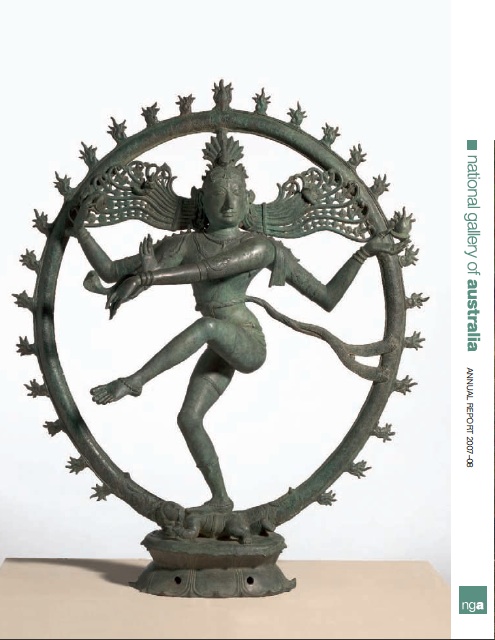
The National Gallery of Australia is finding itself being asked serious questions about its acquisition policies. At the heart of fuss is the bronze sculpture of Shiva as Lord of the Dance, acquired in 2008 with the assistance of National Gallery of Australia Foundation. The bronze appears on the back cover of the Annual Report of the NGA.

Michaela Boland ("NGA admits buying from disgraced dealer", The Weekend Australian August 4, 2012) noted
The National Gallery of Australia has admitted to acquiring 21 items from disgraced New York antiquities dealer Subhash Kapoor, who was arrested on an Interpol warrant and extradited to India, where he is being held on suspicion of trading in stolen precious artefacts. 
Among $11 million worth of antiquities Kapoor has so far admitted to trading is a large 900-year old bronze sculpture of the Indian god Shiva, which the Canberra gallery bought in 2008 and displayed prominently on the back cover of its annual report that year.
The museum seems reluctant to comment:
Gallery director Ron Radford, who was director when the statue was acquired, declined to answer questions from The Weekend Australian about the discovery or say how the gallery would address the concerns of the collecting community.
The NGA now needs to present its due diligence process and to demonstrate that the Shiva had a recorded history that could be recorded back to at least 1970.

Bookmark and Share so Your Real Friends Know that You Know

Australia and Indian antiquities

I have already noted the issue of recently surfaced Indian antiquities in North America. It is now reported that dealer Subhash Kapoor supplied six Indian objects to the Art Gallery of New South Wales ("Shady dealer sold art to AGNSW", The Australian August 6, 2012).

Among the pieces reported to be from Kapoor is a stela from West Bengal showing Varaha "rescuing the earth goddess" (inv. 164.1999). This was "Purchased with funds provided by the Art Gallery Society of New South Wales 1999". Two other pieces had been purchased in 1994, and another also in 1999.

The Director of AGNSW is Dr Michael Brand whose comments drew attention to the way that looting "destroyed the evidence used by archaeologists to build stories"..

This new revelation follows news that Kapoor also sold material to the National Gallery of Australia in Canberra. The NGA said that the acquisition of the objects was subject to a "thorough due diligence process".

The Australian makes a major point "about the lack of thorough research conducted by Australia's collecting institutions when accepting gifts and buying works".

I have had caused elsewhere to note the display of classical material in Australian collections.

Bookmark and Share so Your Real Friends Know that You Know

Saturday, 12 November 2011

Egyptian antiquities and the Australian market

The Egyptian press has reported that a delegation from Egypt has collected 122 Egyptian antiquities in Sydney ("Local Delegation Heads to Australia to Retrieve 122 Artifacts", Egypt State Information Service October 29, 2011).
SCA Secretary General Dr. Mustafa Amin said the most important artifacts to be retrieved are a bust of granite and a statue made of glass in addition to a group of statues including one made of bronze.
This raises the question about the importer, the vendor and the collector. And is this seizure the hint of a well organised network?

Bookmark and Share so Your Real Friends Know that You Know

Tuesday, 4 October 2011

South Italian Pots in Australia

I notice that The Ian Potter Museum of Art at the University of Melbourne will be hosting an exhibition later this month: "Treasures: antiquities from Melbourne private collections" [press release]. The exhibition places private collecting in the context of the European Grand Tour and we are told, "The subsequent dissolution of these European collections created the majority of the objects circulating in the antiquities market today". The statement continues, "Melbourne is fortunate to have a number of important private collections of Greek, Roman, Egyptian and Near Eastern objects".

Andrew Jamieson, the curator in charge of the exhibition, has revealed in an interview that some 10 private collectors are represented (Melbourne Yarra Leader, October 3, 2011).

The University of Melbourne has received loans of Attic and South Italian pottery on previous occasions.

We look forward to seeing the complete list of the exhibits along with their collecting histories.


Bookmark and Share so Your Real Friends Know that You Know

Tuesday, 23 August 2011

Archaeology and War: the Australian dimension

I have commented earlier on the Shellal Mosaic. I have now received the booklet prepared for the Australian War Memorial by A. D. Trendall.

It includes other material collected by the senior Army chaplain, the Reverend William Maitland Woods. The items include three other mosaics from Syria (two reportedly from Homs). In addition there is a marble gravestone of Theosebes from Homs that was discovered in 1919.

The collection includes a funerary portrait from Palmyra that was part of the exchange for two Australian airmen, Lieutenant N. Hazelwood and Air Mechanic Edward Thomas Parr, who were detained in October 1918.

Bookmark and Share so Your Real Friends Know that You Know

Wednesday, 17 August 2011

Excavations in time of war

I have been finishing a paper, "Excavating Under Gunfire: Archaeologists in the Aegean During the First World War", and raised a question on academia.edu about objects excavated on territory acquired from an enemy. I was pointed to a discussion of the Shellal Mosaic that was recovered by Australian troops during the second battle for Gaza; it was actually excavated by the senior Australian military chaplain (see here). There has been much discussion in the Australian and Israeli press: Andrew Taylor, "Questions raised over 'looted' mosaic", Sydney Morning Herald August 14, 2011; 'Removal of Gaza mosaic may constitute war crime', Jerusalem Post August 14, 2011. The mosaic now resides in the Australian War Memorial (here).

I have reviewed the initial publication report as well as viewed the photographs of the mosaic in situ. There is little to suggest that it was "plundered".

I find the legal musings a little misleading.
A leading legal expert said the removal of an antiquity was a crime under international law. 
''In a general sense [the soldiers] could be said to have violated the laws and customs of war,'' said Emeritus Professor Ben Boer from the University of Sydney's Law School. But Australia did not appear to be bound by these laws in April 1917, he added. 
Professor Boer also said international law did not require the Australian government to return the Shellal Mosaic to its rightful owner.
The further complexity is that the mosaic was excavated in territory that was then part of the Ottoman Empire.


Bookmark and Share so Your Real Friends Know that You Know

Thursday, 26 May 2011

Further Apulian pottery formerly in the Geddes Collection

On Tuesday I noted the appearance of an Apulian krater that had formed part of the Geddes collection. The Gnathian krater ("Apulian Monumental Volute Krater") that appears alongside it on the website of the newly formed Mougins Museum of Classical Art had also derived from the same collection. It was sold at Bonham's (London) on 15 October 2008 (lot 23) for £36,000. It, too, had surfaced at Sotheby's (London) in 1985 (9 December, lot 378) and had then be placed on loan to the University of Melbourne, Australia (March 1985 - February 1994).

The observant will wonder if there is some sort of mistake. How could a krater be on loan to the University of Melbourne from March 1985, but be sold in London in December 1985, and then return to Melbourne until 1994? I suspect that there has been some inaccurate recording. Several of the items that were withdrawn from the same Geddes sale were also put on loan to the University of Melbourne.

What was the collecting history of the Gnathian krater prior to its 1985 appearance at Sotheby's?

Bookmark and Share so Your Real Friends Know that You Know

Thursday, 5 May 2011

Chasing Aphrodite: Australian museum noted

Chasing Aphrodite will be revealing that objects in a certain Australian museum appear in the Medici Polaroids.

What else will emerge? Order your copy now.

Bookmark and Share so Your Real Friends Know that You Know

Tuesday, 20 July 2010

Madrid: Three Pots from the Geddes Collection

The October 2008 sale of part of the Graham Geddes collection was disrupted when the Italian Government requested that some of the lots be withdrawn on the eve of the auction in London.

I note that (at least) three ex-Geddes pieces appear in the Várez Fisa collection now on display in the National Museum of Archaeology in Madrid.


  • no. 53: Athenian black-figured amphora showing departing chariot, attributed to the painter of Vatican 365 (inv. 1999/99/61). Although the collecting history is not mentioned in the catalogue, the Beazley Archive [no. 7462] lists the amphora noting that it passed through Sotheby's London 13-14 December 1982, lot 255 and subsequently 8 December 1986, lot 327.
  • no. 137: Apulian pelike showing Eros in a garden, attributed to the Siren Citharist painter (inv. 19999/99/142). The catalogue notes that the piece had been sold at Christie's New York on 4 June 1998, lot 233 [entry], where it fetched $16,100. The Madrid catalogue does not note that the pelike had passed through Sotheby's in London: 9 December 1988, lot 171; 8 December 1994, lot 328.
  • no. 147: Paestan lebes gamikos showing two women either side of a basin, attributed to Asteas (inv. 1999/99/146). A Paestan lebes gamikos attributed to the Asteas / Python workshop had resided in the Geddes collection. This surfaced at Sotheby's London, 21 May 1984, lot 372. It was subsequently sold at Christie's New York on 18 December 1997, lot 149 [entry], for $10,925.


The December 1982 Sotheby's sale is significant. Two pieces that surfaced through it have now been returned to Italy: a Lucanian nestoris from Boston (and once loaned by Geddes) (lot 298) and an amphora attributed to the Berlin painter returned from New York (lot 220). Bonhams had to withdraw an Apulian hydria from auction in October 2008; it had originally surfaced at the May 1984 sale at Sotheby's.

See my list of items linked to Graham Geddes at auction where two of these pieces appear to be listed.

Who consigned these three pieces to Sotheby's in 1982, 1984 and 1988? Why is the Madrid catalogue incomplete?

Bookmark and Share so Your Real Friends Know that You Know

Friday, 23 April 2010

Bonhams and the Accuracy of Collecting Histories


The press release for the sale of antiquities at Bonhams in April 2010 reminded us of some "interesting" provenances. One that caught my eye was linked to lot 139, "A Roman marble figure of a barbarian water carrier". The provenance is given as "Ex European private collection. Subsequently part of an Australian collection acquired in the 1960s." It was then "On loan to La Trobe University, Melbourne, Australia 1981-86."

La Trobe University has featured as a venue for previous antiquities offered by Bonhams. For example, an Attic bell-krater offered in April 2009. It had, in fact, been part of the Graham Geddes collection and had been left unsold in the October 2008 sale at Bonhams. Indeed several pieces from the Geddes collection are known to have been on loan to La Trobe (including a Lucanian nestoris subsequently acquired by Boston's Museum of Fine Art and returned to Italy).

At the end of March I contacted a senior academic at La Trobe University to discover more about the piece. This is the reply: "I don't recall any such sculpture on loan to La Trobe".

Can we be certain that the water carrier was indeed on loan to La Trobe? And if this information is questionable, what do we make of it being in an Australian private collection in the 1960s? Did the staff at Bonhams check the information or did they take it "on trust"? What was their due diligence process? (And remember their track record.)

There are echoes of the Australian sea-farer who consigned part of the tomb of Mutiridis to Bonhams for the sale of antiquities in May 2008.

The staff at Bonhams should be starting to double-check the collecting history for the water carrier as a matter of urgency. And what is the name of the anonymous Australian private collector who has consigned it?

Image
Detail from Bonhams, lot 139.

Bookmark and Share so Your Real Friends Know that You Know

Saturday, 3 January 2009

Australian Antiquities Dealer Arrested In Egypt

A 61-year old Australian antiquities dealer "has been arrested in Egypt for allegedly trying to smuggle two 2300-year-old animal mummies and religious figurines out of the country" (Selma Milovanovic "Antiques dealer faces 15 years in an Egyptian jail", Sydney Morning Herald December 26, 2008).
According to local reports, when security officials opened the suspect suitcase, they allegedly found mummies of a cat and an ibis, both dating back to 300BC. They also allegedly found 19 figurines of the ancient Egyptian gods of Horus and Thoth, wrapped as gifts.
The individual was due to take a flight to Thailand.

The Herald Sun (Australia) reported (January 1, 2009):
A MELBOURNE man arrested in Egypt after allegedly trying to smuggle animal mummies out of the country has been released on bail. Frank Bottaro, 61, a successful Armadale antiquities dealer, will likely have to stay in the country until he appears in court.
See also:

Monday, 20 October 2008

The Graham Geddes Collection: Previous Loans

The lots withdrawn from the sale of the Graham Geddes collection at Bonhams on October 15, 2008 had previously been on display in four separate locations in Melbourne, Australia. Indeed, other parts of the collection had been on loan to different museums (e.g. Apulian pottery at auction in October 2008; earlier material sold through Christie's).

What were the loan policies of these museums? Do the museums require loans to have a recorded history that can be traced back before the 1970 UNESCO Convention?

Melbourne, the National Gallery of Victoria
  • Lot 6. Attic black-figure column krater, attributed to the Swing painter. Loan: April 2005 - April 2008.
  • Lot 10. A large early Apulian red-figure hydria, attributed to the painter of the Berlin Dancing Girl. Loan: April 2005 - April 2008.
[Website]

The University of Melbourne
  • Lot 6. Attic black-figure column krater, attributed to the Swing painter. Loan: March 1988 - February 1994
  • Lot 26. A small Campanian red-figure bell krater, attributed to the Danaid painter. Loan: March 1995 - July 2003
  • Lot 36. A Campanian red-figure neck amphora, attributed to near the Chequer and Dirce painters. Loan: March 1988 - July 2003.
  • Lot 133. A South Italian terracotta figure of Eros. Loan: March 1988 - July 2003.
[website]

  • See Peter Connor, 'Greek vases from the Geddes' Collection on loan in Melbourne University Gallery', Iris, 1988, pp. 21-42. [Reference]

Melbourne, La Trobe University, the Borchardt Library
  • Lot 9. A large Attic red-figure bell krater, attributed to the Retorted painter. Loan: March 1995 - April 2008.
  • Lot 15. An Apulian red-figure trefoil-lipped oinochoe. Loan: February 1997 - April 2008.
  • Lot 28. A small Apulian red-figure bell krater, attributed to the Perrone - Phryxos group. Loan: March 1988 - April 2008.
[website]

Melbourne, Monash University, Museum of Mediterranean Antiquities
  • Lot 10. A large early Apulian red-figure hydria, attributed to the painter of the Berlin Dancing Girl. Loan: March 1995 - April 2005
  • Lot 26. A small Campanian red-figure bell krater, attributed to the Danaid painter. Loan: November 2005 - April 2008
  • Lot 36. A Campanian red-figure neck amphora, attributed to near the Chequer and Dirce painters. Loan: November 2005 - April 2008.
[website]

Thursday, 16 October 2008

Bonhams Withdraws Further Lots: Press Comment

Nick Squires has written for The Daily Telegraph ("Suspicions that Roman artefacts were illegally traded", October 16, 2008). He recycles the Bonhams press release but adds a little more informal comment. The anger felt at Bonhams is clear:
The auction house was furious that the Italian authorities gave just 24 hours' notice about the objects' suspect provenance.

"We were a bit miffed to say the least," a spokesman said. "You can imagine the amount of work that goes into marketing a sale like this around the world.

"Obviously we are not in the business of selling something that shouldn't be sold, but to have a demand made like this at such short notice is not something we take lightly."

Many of the pieces had due to be sold as part of the (Australian) Graham Geddes collection. The Telegraph added:
Bonhams said it expected Italy to make a formal claim on the antiquities, which were owned by British, Australian and American collectors.

Meanwhile Theo Toebosch writing for the NRC Handelsblad has picked up on the reason why Bonhams should have been suspicious and should have conducted a more rigorous "due diligence" process: the revelations made about antiquities from Italy surfacing through Sotheby's in London during the 1980s and early 1990s (see Peter Watson, Sotheby's: Inside Story [London 1997] [WorldCat] [American edition]). At least seven of the withdrawn pieces were derived from this route. Toebosch also comments on the unrepentant tone of the Bonhams press release.

Saturday, 11 October 2008

The Graham Geddes Collection and Apulian Pottery

The sale of the Graham Geddes collection at Bonhams on October 15 will include a number of Apulian pots. (For earlier Apulian pottery at auction see here; for the publicity of the South Italian pottery in this sale see here.)

Lot 10: Hydria. Attributed to the painter of the Berlin Dancing Girl. Purchased: Sotheby's London, Antiquities, May 21st, 1984, lot 384. On loan: the Museum of Mediterranean Antiquities, Monash University, Melbourne (March 1995 - April 2005); the National Gallery of Victoria, Melbourne (April 2005 - April 2008).

Lot 12; Calyx-krater. Attributed to the Judgement Group, by the Painter of Naples 2289. Purchased: Ex Amati Collection, London, acquired in the mid-1970s. Formerly from Christie's. On loan: the University of Melbourne (March 1988 - July 2003).

Lot 15: Oinochoe. Purchased: Sotheby's London, Antiquities, December 8th, 1986, lot 185. On loan: the Borchardt Library, La Trobe University, Melbourne (February 1997 - April 2008).

Lot 16: Oinochoe. Previous history: "Ex Dean Collection, Melbourne, acquired in 1990." On loan: the Museum of Mediterranean Antiquities, Monash University, Melbourne (March 1995 - April 2008).

Lot 17: A pair of oinochoai. Attributed the group of the Virginia Exhibition Painter. Previous history: Ex Amati Collection, London, acquired in the mid-1970s. On loan: the University of Melbourne (March 1988 - July 2003).

Lot 18: Hydria. Attributed to the Truro painter. Purchased: Sotheby's London, Antiquities, December 9th, 1985, lot 375. On loan: the University of Melbourne (March 1988 - July 2003); the Museum of Mediterranean Antiquities, Monash University, Melbourne (November 2005 - April 2008).

Lot 19: Volute-krater. Attributed to the Tenri painter. Purchased: Sotheby's London, Antiquities, July 13th, 1981, lot 354. On loan: the University of Melbourne (March 1988 - July 2003); the Museum of Mediterranean Antiquities, Monash University, Melbourne (November 2005 - April 2008).

Lot 20: Hydria. Attributed to the Patera painter. Purchased: Sotheby's London, Antiquities, May 21st, 1984, lot 222. On loan: the Borchardt Library, La Trobe University, Melbourne (March 1986 - April 2008).

Lot 21: Spherical pyxis, Attributed to the Painter of Berlin F 3383. Purchased: Sotheby's London, Antiquities, December 9th, 1985, lot 371. On loan: the Antiquities Museum, University of Queensland, Brisbane (March 1995 - April 2005).

Lot 22: Volute-krater. Attributed to the Geddes painter. Previous history: "Ex private collection, acquired in 1976. This is the name vase of the Geddes Painter. It was named as such by Dale Trendall as a token of his friendship with Graham Geddes." On loan: the University of Melbourne (March 1988 - July 2003); the Museum of Mediterranean Antiquities, Monash University, Melbourne (November 2005 - April 2008).

Lot 23: Gnathian volute-krater. Purchased: Sotheby's London, Antiquities, December 9th, 1985, lot 378. On loan: the University of Melbourne (March 1985 - February 1994).

Lot 25: Gnathian Oinochoe. Previous history: Ex Amati collection, London, acquired in the mid-1970s. On loan: the University of Melbourne (March 1995 - July 2003).

Lot 27: Bell-krater. Attributed to near the Late Lampas painter. Previous history: Ex Amati Collection, acquired in the mid-1970s. On loan: the Borchardt library, La Trobe University, Melbourne (March 1988 - April 2008).

Lot 28: Bell-krater. Attributed to the Perrone - Phryxos group. Purchased: Sotheby's London, Antiquities, December 8th, 1986, lot 188. On loan: the Borchardt Library, La Trobe University, Melbourne (March 1988 - April 2008).

Lot 29: Fishplate. Attributed to the Cuttlefish Painter, the Binningen Group. Previous history: Ex Amati Collection, London, acquired in the mid-1970s. On loan: the Museum of Mediterranean Antiquities, Monash University, Melbourne (December 1989 - April 2008).

Lot 30: Fishplate. Attributed to the Tadpole painter. Previous history: Ex Amati Collection, London, acquired in the mid-1970s. On loan: the Museum of Mediterranean Antiquities, Monash University, Melbourne (November 1996 - October 2006).

Lot 34: Amphora. Attributed to the Baltimore and Stoke-on-Trent Painters. Purchased: Sotheby's London, Antiquities, July 12th, 1983, lot 604. On loan: the University of Melbourne (March 1995 - July 2003); the Museum of Mediterranean Antiquities, Monash University, Melbourne (November 2005 - April 2008).

Lot 35: Amphora. Attributed to the Wolfenbüttel Painter. Previous history: Christie's South Kensington, Antiquities - The Axel Guttmann Collection of Ancient Arms and Armour, Pt II, April 28th, 2004, lot 109.

Lot 146: Column-krater. Attributed to the Split Mouth Group, associated with the Amphorae and Armidale Painters. Purchased: Sotheby's London, Antiquities, December 14th, 1981, lot 293. On loan: the University of Melbourne (March 1988 - July 2003).

Lot 147
: Amphora. Attributed to the Amphorae Group. Previous history: Ex Downeys Collection, Melbourne, Australia, acquired in 1982. On loan: the University of Melbourne (March 1988 - February 1994).

Lot 148: Bell-krater. Attributed to the Wolfenbüttel Painter. Previous history: Ex Amati collection, London, acquired in the mid-1970s. On loan: the University of Melbourne (March 1995 - July 2003).

Lot 149: Skyphos. Attributed to the Liverpool painter. Purchaed: Sotheby's London, Antiquities, December 14th, 1981, lot 251. On loan: the University of Melbourne (March 1995 - July 2003).

Lot 151
: Lekanis. Attributed to the Kantharos painter. Previous history: Ex Amati Collection, London, acquired in the mid-1970s. On loan: the University of Melbourne (March 1988 - July 2003).

Lot 152: Oinochoe. Attributed to the Baltimore painter. Purchased: Sotheby's London, Antiquities, July 13th, 1981, lot 343. On loan: the Museum of Mediterranean Antiquities, Monash University, Melbourne (March 1988 - April 2008).

Lot 156: Plate. Attributed to the Kantharos painter. Previous history: Ex Amati Collection, London, acquired in the mid-1970s. On loan: the Museum of Mediterranean Antiquities, Monash University, Melbourne (December 1989 - April 2008).

Lot 158
: Squat lekythos. On loan: the University of Melbourne (March 1995 - July 2003). Other information: "Accompanied by a label from Christie's London, stating 16 November 1999, lot 451."

Twelve of these Apulian pots had been acquired at Sotheby's in London.
  • Sotheby's London, Antiquities, July 13th, 1981, lot 343.
  • Sotheby's London, Antiquities, July 13th, 1981, lot 354.
  • Sotheby's London, Antiquities, December 14th, 1981, lot 251.
  • Sotheby's London, Antiquities, December 14th, 1981, lot 293.
  • Sotheby's London, Antiquities, July 12th, 1983, lot 604.
  • Sotheby's London, Antiquities, May 21st, 1984, lot 222.
  • Sotheby's London, Antiquities, May 21st, 1984, lot 384.
  • Sotheby's London, Antiquities, December 9th, 1985, lot 371.
  • Sotheby's London, Antiquities, December 9th, 1985, lot 375.
  • Sotheby's London, Antiquities, December 9th, 1985, lot 378.
  • Sotheby's London, Antiquities, December 8th, 1986, lot 185.
  • Sotheby's London, Antiquities, December 8th, 1986, lot 188.
Most of the Apulian pots have been on loan to public collections in Australia.

Monday, 6 October 2008

Homecomings: Lucanian Pottery

Two pieces of Lucanian pottery have appeared in the "Nostoi" exhibitions. Both pieces are of the same shape, a nestoris (or trozzella). They have been attributed to the Amykos painter and were probably made in the vicinity of Metaponto in southern Italy. Both had been acquired by the Museum of Fine Arts (MFA) in Boston: 1971.49 and 1998.588.

The first was purchased from Dr Leo Mildenberg of Bank Leu AG, Zurich. (It appears to have been supplied with a fabricated history suggesting that the nestoris had passed through a Madrid private collection.) The MFA catalogue (no. 4) notes, "This nestoris may be the earliest known red-figure example".

The second piece had surfaced at Sotheby's in London in December 1982 (lot 298). The nestoris was subsequently placed on loan at the Borchardt Library, La Trobe University, Melbourne from 1988 to 1994; Ian McPhee of La Trobe University informed me in October 2006 that Mr G. Geddes made the loan though he may not have been "the actual owner at the time". The nestoris was then sold at Sotheby's in London (December 1996), purchased by Widgie and Peter Aldrich, and acquired by the MFA in 1998.

Graham Geddes appears to have acquired at least three other items that passed through the December 1982 Sotheby's (London) auction:
  • lot 201: Etruscan black-figured amphora, attributed to the Micali painter. On loan to the Museum of Mediterranean Antiquities, Monash University, Melbourne, Australia, March 1995 - April 2008. Due to be auctioned at Bonham's (London) October 15, 2008, lot 11.
  • lot 255: Attic back-figured neck-amphora, attributed to the painter of Vatican 365. Subsequently Sotheby's December 8, 1986, lot 327. [Beazley Archive 7462]
  • lot 291: Apulian red-figured calyx-krater, attributed to the Darius painter. This apparently passed into a private collection (1982-1994) before forming part of the Geddes collection in 1994; it was sold at Christie's New York in 2001.
This December 1982 sale at Sotheby's also included an Attic red-figured amphora attributed to the Berlin painter that has been returned to Italy from the Metropolitan Museum of Art in New York (and also featured in "Nostoi") (lot 220).

Geddes is reported to have formed one of the largest private collections of South Italian pottery in the world. He bought in good faith at auction, and was guided by Professor A.D. Trendall (see earlier comments). In 1996 Geddes himself said "I prefer to buy items with provenance".

What are the histories ("provenance") of these pieces prior to their surfacing at Sotheby's? Who consigned them?

Krater fragments in Princeton

Greek, Attic, probably by the Kleophrades Painter, ca. 490–480 BCE, Two non-joining fragments from a calyx-krater (mixing bowl) depicting ar...