Showing posts with label Atlantis Antiquities. Show all posts

Friday, 8 December 2023

Silver Pyxis Lid Returned from VMFA


Silver pyxis lid formerly VMFA inv.  82.181.

Among the returning antiquities from the Virginia Museum of Fine Arts is a silver pyxis lid. My colleague Christos Tsirogiannis has confirmed that an image is in the Becchina archive with the annotation indicating a link with Robert Hecht. Another colleague has confirmed that the the lid was a gift of Jonathan Rosen, an associate of Hecht in Atlantis Antiquities.

VMFA has yet to release a list of the returns that contains the inventory numbers as well as the previous histories (so-called 'provenance'). The museum also appears to have scrubbed the digital record of these accessions unlike some other institutions that have recorded their deaccessions. 

| |
Bookmark and Share so Your Real Friends Know that You Know

Tuesday, 20 September 2022

The Steinhardt hydria attributed to the Antimenes painter

Source of images: Manhattan DA.

Among the items seized from the Michael Steinhardt collection and returned to Italy was an Attic black-figured hydria attributed to the Antimenes painter. The hydria had been identified from an image in the Medici Dossier.

The Manhattan DA reports that the hydria had first surfaced with Robin Symes in 1983 (when it was advertised in Apollo). The statement then adds:
By 1987, Symes had transferred the object to the New York-based Atlantis Gallery, part-owned by Robert Hecht, who then loaned it to the Getty Museum. From 1987-1996, the object was on view at the Getty Museum prior to its sale to Steinhardt through Sotheby’s New York on December 17, 1996. 
Steinhardt is report to have purchased the hydria from Sotheby's for $169,411.

The Beazley Archive (BAPD 31596) provides the loan number for the Getty (L87.AE.4) as well as the details for the Sotheby's New York sale (17 December 1996, lot 49). It also suggests that the hydria passed through the Royal-Athena Galleries though this information may not be correct.

Christopher Chippindale and I had rehearsed the history of this specific hydria in our review article of The Medici Conspiracy (2007) [see here]. We clarify that the hydria was placed on loan at the Getty in January 1987, and returned in February 1996. This raises a question about the nature and purpose of loans that were placed at the Getty.

It should be recalled that one of the Attic black-figured neck-amphorae seized from Fordham University was attributed to the circle of the Antimenes painter (BAPD 24304).

It should be noted that the identification of the Steinhardt hydria was made by Associate Professor Christos Tsirogiannis. 

| |
Bookmark and Share so Your Real Friends Know that You Know

Saturday, 3 September 2022

Search Warrant for the Met

Castor and Pollux previously on loan to New York's Metropolitan Museum of Art
© David Gill


Some of the pieces on the search warrant have been discussed by LM in the past:

Bookmark and Share so Your Real Friends Know that You Know

Wednesday, 8 December 2021

Returning Athenian pottery from the Steinhardt collection

Source: Manhattan District Attorney's Office

The documentation for the Michael Steinhardt  collection identifies several Attic pieces that will be returned to their country of origin, presumably Italy and Greece.
  • Attic black-figured Sphinx cup, 'Tleson, son of Nearchos' (pp. 19–20). Identified from the Medici dossier. Symes sold to Beierwaltes (January 8, 1996); Phoenix Ancient Art (2006); Steinhardt purchased from Phoenix Ancient Art for $310,000 (2007).
  • Attic red-figured oinochoe attributed to the Berlin painter (pp. 20–21). Identified from the Medici dossier. Steinhardt purchased from Harry Bürki for $215,000 (1996); Steinhardt's records show that the oinochoe had been sold by Robert Hecht.
  • Attic black-figured hydria showing Herakles and Kyknos attributed to the Leagros group (p. 21).  Identified from the Medici dossier. Displayed by Christos Bastis at New York's Metropolitan Museum of Art (1987); Bastis died (1999); Steinhardt purchased from Michael Ward for $127,000 (2000). The paperwork omits that the hydria surfaced at Sotheby's (London) July 11–12, 1983, lot 352, and was sold at Sotheby-Parke-Bernet, New York, December 9, 1999, lot 92. [BAPD 9050]
  • Attic black-figured hydria showing women at a fountain-house attributed to the Antimenes painter (pp. 22–23). Identified from the Medici dossier. Robin Symes advertised the hydria (1983); Atlantis Gallery, New York (1987); loan to the J. Paul Getty Museum L87.AE.4 (1987–96); Steinhardt purchased it at Sotheby's for $169,411 (December 17, 1996, lot 49). [BAPD 31596]
  • African head vase (pp. 23–24).  Identified from the Medici dossier.  Displayed in the Musée d'Art et d'Histoire, Geneva (1978–81); J. Paul Getty Museum (1984–96); Symes sold the piece to the Beierwaltes (1996); Beierwaltes consigned it to Phoenix Ancient Art (2006); Steinhardt purchased it from Phoenix Ancient Art for $163,312.50 (2009). 
  • Attic black-figured eye-cup (pp. 35–36). Identified from the Becchina archive. Mario Bruno, Lugano; sold to Becchina; TL tested by Ralf Kotalla, Germany(July 1992); Robert Hecht sold it to Steinhardt for $170,750 (June 15, 2000).
  • Attic black-figured amphora (p. 50). Identified from the Almagià archive. Purchased from a tombarolo for $6,500; sold for $13,000; accessioned by Steinhardt as coming from Almagià (1997). 
  • Attic black-figured plemochoe (pp. 54–55). Identified from the Symes archive. Photographed by Dieter Widmer (1985); held as loan by Sotheby's London for Budico SA, owned by Henri-Albert Jacques (1989); stolen from Sotheby's and recovered by the police; Budico SA sold it through Sotheby's to Steinhardt for $84,083 (December 11, 2002). Note: 'Ex. Private Coll. London, RS + CM' (?Symes and Michaelides).
  • Attic white ground lekythos attributed to the Triglyph painter (p. 56). Identified from the Symes archive. Symes sold it to the Beierwalters for $360,000 (June 22, 1995); consigned to Phoenix Ancient Art (2006); Steinhardt purchased from Phoenix Ancient Art for $380,000 (December 14, 2006).
| |
Bookmark and Share so Your Real Friends Know that You Know

Thursday, 24 November 2011

Looking Back to Athena Fund II

I can remember the appearance of the sale catalogue that realised the antiquities of Athena Fund II. Objects that passed through that Fund continue to appear on the market so it would be helpful to write a short summary.

As the Washington Post noted, "McNall also runs an investment fund for Merrill Lynch, called the Athena Fund II, that specializes in ancient art and coins" (Heidi L. Berry, "The Ancient Wealth Of the Hunt Brothers", June 14, 1990). Attitudes towards selling and collecting antiquities were very different in 1990 (Andrea Gabor, "Art of the wheeler-dealers", U.S. News & World Report July 2, 1990).
The smart money is backing ancient art. Onetime Texas billionaire Nelson Bunker Hunt and his brother William went bust speculating on silver, but their collection of ancient coins, vases and bronzes fetched over $ 23 million at last week's Sotheby's auction -- roughly double the original estimates. Just last year, Canal Capital, a firm controlled by Asher Edelman, a corporate raider and art collector, invested "well over $ 10 million" in inventory for the Merrin Gallery, a leading New York City antiquities dealer. Similarly, Merrill Lynch has launched several limited partnerships that invest in ancient coins. "Antiquities have traditionally been overlooked by the public," says Frank Carr, the portfolio manager for Merrill's Athena funds and chief financial officer at Los Angeles-based Numismatic Fine Arts.
The New York magazine gave a little more detail about the sale of Athena Fund II through Hesperia Arts Auction (Andrew Decker, "The Shock of the Old", November 19, 1990). It revealed that the three main figures were Bruce McNall, Jonathan Rosen ("New York collector and real-estate developer"), and Robert E. Hecht ("the éminence grise of New York antiquities collectors"). According to one of the cataloguers for the sale, Jasper Gaunt, the main consignors were Atlantis Antiquities and Athena Fund II. (Atlantis Antiquities is a consignor of some significance for other reasons.) Only today a North American dealer informed me that Robin Symes was the source of much of the material in the Fund.

The Funds were not a great success ("Merrill to Pay Back Investors in Coin and Art Partnerships", New York Times August 24, 1994):
Merrill Lynch & Company said yesterday that it would pay $20 million to $30 million to settle lawsuits by investors in its ancient-art and rare-coin limited partnerships.
Units in the partnerships, which failed, were bought by about 3,500 investors from 1986 to 1990. They will receive the full $1,000 they paid for each unit in the Merrill Lynch Athena Fund I, Athena Fund II and Numismatic Fine Arts World Coin Fund, excluding any distributions they received from the first two funds.
Buyers desiring to acquire ancient art that had passed through such a Fund would want to be sure of the collecting histories of the pieces.

Bookmark and Share so Your Real Friends Know that You Know

Tuesday, 9 December 2008

Antiquities at Christie's: Results

The sale of antiquities at Christie's, Rockefeller Plaza today (December 9, 2008) generated US$4,735,100.

The Cobham Hall Hadrian (lot 164) realized $902,500 (well above the upper estimate of $550,000). The (apparent) third century bronze portrait of the first century emperor Vespasian (lot 180) --- once in the possession of Atlantis Antiquities (in 1982) --- appears to have been left unsold.

Vespasian was one of five "highlights" that failed to sell (see Christie's pre-sale press release). Two others were "an early Christian silver patten" (lot 186) and a Bactrian copper alloy seated female figure (lot 45). The latter had once passed through Koutoulakis, Paris (prior to 1989) before entering a French private collection. The fourth was a Late Period to Early Ptolemaic figure of a treasurer from a European private collection (lot 35). The fifth was a marble portrait of Faustina the Younger (lot 166) from a British private collection ("Acquired by the current owner's father in the 1960s").

The only other "highlight" to sell was a Roman marble figure of a woman, 1st-2nd centuries CE, that had passed through the Merrin Gallery in 1989 before entering a New York private collection (lot 159). This sold for $218,500, below the lower estimate of $250,000.

The press release had suggested the anticipated combined sum from antiquities and ancient jewelry would be in the region of US$7.5 million. In fact the combined sum was far less ($4,735,100 and $641,188).

Thursday, 4 December 2008

Atlantis Antiquities in the Press: an Overview

I have been reviewing the appearance of Atlantis Antiquities in the press.

One of the earliest mentions was back in 1988: Rita Reif, "Archaic Smiles Have Persisted For 2,000 Years", New York Times June 19, 1988. This commented on the exhibition, ''Greek and Etruscan Art of the Archaic Period" [Catalogue]
The exhibition is the first in memory at a New York gallery to present a broad view of the Archaic Period, and the first major show presented at Atlantis, which opened 21 months ago. The 70 works in terra cotta, marble, painted clay, bronze, amber and gold were selected by Robert Hecht Jr., an American antiquities dealer based in Paris. Mr. Hecht is a part-owner of the gallery, along with Jonathan Rosen, a real estate developer and collector of ancient art. Andrea Hecht, the dealer's daughter, is the director of the gallery.
The gallery then featured in a report on antiquities from Turkey (Geraldine Norman, "Talking Turkey; Who owns the treasures of antiquity? The Turkish government has been fighting American museums for the return of some splendid hoards. But only laws that ensure finders fair compensation will prevent smuggling", The Independent June 13, 1993).
It was the sculpted marble leg of a very grand Hellenistic table, which they found on show at Atlantis Antiquities, a New York gallery that he [sc. Hecht] managed for Jonathan Rosen - a millionaire lawyer who is also a keen collector of antiquities. The sculpture depicts a Scythian slave sharpening the knife with which he intends - on Apollo's instructions - to flay Marsyas, who is strung up on a nearby tree.
The sculpture was reported to have been traced back to a farmer Philadelphia in Turkey. The case was resolved when the piece was donated to the American Turkish Society.

Atlantis Antiquities has also been in the news over some of the antiquities returned from the J. Paul Getty Museum (Hugh Eakin, "Embattled Getty Curator Steps Down", The New York Times October 4, 2005). In October 2005 a bronze Etruscan candelabrum was handed over to Italian officials.
The Getty acquired the candelabrum in 1990 from Atlantis Antiquities, a New York gallery, for $60,000, according to evidence in the indictment. But Italian police have traced the object, along with another Getty acquisition named in the indictment, to a private collection in Florence, from which it was stolen. The other object, a bronze tripod, was returned by the Getty to Italy in 1997.

Italian prosecutors say that in both cases the objects were smuggled by Giacomo Medici, an Italian dealer based in Geneva, and passed on, via a third party, to Robert Hecht, the owner of Atlantis Antiquities.
Among the more recent returns to Italy that had passed through Atlantis Antiquities was an Apulian loutrophoros attributed to the Metope group that was purchased by the Getty in 1984 (formerly inv. 84.AE.996) as well as an Attic black-figured amphora, attributed to the painter of Berlin 1686, once in the Fleischman collection. Two pieces once in Boston had passed through the same gallery: an Attic black-figured lekythos attributed to the Diosphos painter (formerly inv. 1989.317) and an Apulian amphora attributed to the Darius painter (formerly inv. 1991.437).

Friday, 11 April 2008

Pots Passing Through The Market (Ancient and Modern)

I have been working my way through Trademarks on Greek vases: addenda (2006). The index has a section, "Vases once on the market, present location unknown". Alan Johnston notes in the "Introduction" (p. vii):
It will not escape those even skimming the following pages that the bulk [sc. of new material] has appeared, depressingly, on the antiquities market, virtually always without provenance; I retain a column "provenance" in the catalogue, but it is thinly populated indeed with respect to the addenda.
Here are some of the recent "surfacings" (but "present location unknown") on the largely unnamed North American and Swiss markets (ordered by Johnston Type) since the publication of the original volume in 1979. (I exclude here the 75 or so pieces from Sotheby's, London that entered the market in the 1980s and 1990s, as well as named dealers in Switzerland). In one case it has been possible to identify the present proprietors.
  1. Type 6A, 1a. Amphora (Type B). Hesperia Arts, auction (27 November 1990, lot 28). [For comments on this sale.]
  2. Type 14A, 1a. Neck-amphora, attributed to the Antimenes painter (von Bothmer). Geneva market.
  3. Type 16A, 12a. Hydria. Previously Sotheby's (London) 7-8 July 1994, lot 289; New York market.
  4. Type 21A, 103a. Column-krater. (Information from von Bothmer). Switzerland, market.
  5. Type 27A, 8. Neck-amphora. Geneva market (information from von Bothmer).
  6. Type 2B, 1a. Hydria. Geneva market (information from von Bothmer).
  7. Type 11B, 25a. Stamnos, attributed to the Siren painter (von Bothmer). Formerly Hunt brothers (no. 12); New York market, Atlantis; Sotheby's (New York) 19 June 1990, lot 13; New York, Shelby White and Leon Levy.
  8. Type 13B, 17a. Neck-amphora. Geneva market (information from von Bothmer).
  9. Type 2F, 18a. Hydria (attributed to the Leagros group). New York market (information from Michael Padgett).
  10. Type 9F, 32b. Lekythos (attributed to the Athena painter?). New York market.
  11. Type 10F, 13a. Pelike. New York market (information from Jasper Gaunt).
The loss of contexts means that there are intellectual consequences when trying to make sense of the distribution of commercial graffiti on Greek pottery.

One of the pots "once on the market, present location unknown" has a recorded history prior to 1970 and its present location is known:
  1. Type 9E, 118a. Amphora, attributed to the Niobid painter. Raymond Duncan (1874-1966) [brother of Isadora Duncan]; Dorée Duncan Seligmann [granddaughter of Raymond Duncan], by inheritance; Robert E. Hecht, Jr., New York, 1961 [mode of acquisition unknown]; New York market, Atlantis (1990); Baltimore, Walters Art Museum 48.2712 (acquired in 1993 by purchase).
Reference
Johnston, A. W. 2006. Trademarks on Greek vases: addenda. Oxford: Aris and Phillips. [Worldcat]

Friday, 28 December 2007

Robert Hecht: some "orphans"

Suzan Mazur has responded to Hugh Eakin's New Yorker interview with Marion True and highlighted some of the unasked questions ("Bob Hecht: Fragments Of An Antiquities Conspiracy?", scoop.co.nz, December 28, 2007). Mazur draws attention to Rita Reif's 1988 New York Times commentary on the Atlantis Antiquities sale (Suzan Mazur, "Add New York Times To Bob Hecht Antiquities Ring "Organigram"?, scoop.co.nz, August 17, 2006).

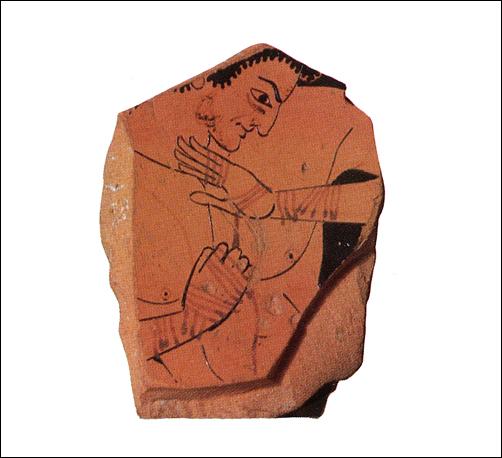
Image
Fragmentary Attic cup showing Thracian boxer sold by Atlantis Antiquities.
Source: scoop.co.nz.

Saturday, 22 December 2007

Recovered Masterpieces: ex Fleischman collection

The Rome exhibition, "Nostoi: Capolavori ritrovati", contains objects from a number of sources. One of the blocks of material formed part of the Barbara and Lawrence Fleischman collection which was acquired by the J. Paul Getty Museum largely in 1996.

These include (citing the exhibition handlist numbers):
4. Attic black-figured amphora (Type B). Attributed to the painter of Berlin 1686 (by Dietrich von Bothmer). Herakles and Geryon. Reassembled by Fritz Bürki (1988); Atlantis Antiquities (1988). Ex Malibu 96.AE.92. Bibl. Passion no. 34; Gill and Chippindale 2007, Table 6, no. 2.

5. Attic black-figured amphora (Panathenaic shape). Attributed to the Three-line group (by Dietrich von Bothmer). Alkestis and Admetos. Fritz Bürki (1989). Ex Malibu 96.AE.93. Bibl. Passion no. 35; Gill and Chippindale 2007, Table 6, no. 3.

13. Attic red-figured cup (Type B). Attributed to the Nikosthenes painter and to the potter Pamphaios (by J. R. Guy). Robin Symes (1988). Ex Malibu 96.AE.97. Bibl. Passion no. 39; Gill and Chippindale 2007, Table 6, no. 4.

34. Etruscan antefix with maenad and Silenos. "Said to come from Cerveteri". Hunt collection. Ex Malibu 96.AD.33. Bibl. Passion no. 92; Gill and Chippindale 2007, Appendix A, no. 24.

37. Etruscan bronze mirror. Odysseus and Penelope. Ex Malibu 96.AC.132. Bibl. Passion no. 83.

40. South Italian bronze aksos in form of siren. Purchased from Lawrence Fleischman. Ex Malibu 92.AC.5. Bibl. Gill and Chippindale 2007, Appendix A, no. 26.

45. Apulian red-figured bell-krater. Attributed to the Choregos painter (by A.D. Trendall). Fritz Bürki. Ex Malibu 96.AE.29. Bibl. Passion. no. 56; Gill and Chippindale 2007, Table 6, no. 5.

48. Paestan red-figured squat lekythos. Garden of the Hesperides. Attributed to Asteas (by A.D. Trendall). Ex Malibu 96.AE.119. Bibl. Passion no. 65; Gill and Chippindale 2007, Appendix A, no. 22.

58. Roman marble statue of Tyche. Robin Symes. Ex Malibu 96.AA.49. Bibl. Passion no. 120; Gill and Chippindale 2007, Table 6, no. 1.

59. Roman fresco fragment showing mask of Herakles. Associated with a fragment in the Shelby White collection. Fritz Bürki. Ex Malibu 96.AG.171. Bibl. Passion. no. 126; Gill and Chippindale 2007, Table 6, no. 7.

65. Roman marble statue of Dionysos with goat. Ex Malibu 96.AA.211. Bibl. Passion no. 179; Gill and Chippindale 2007, Appendix A, no. 4.
References
Exhibition catalogue. 1994. A passion for antiquities: ancient art from the collection of Barbara and Lawrence Fleischman. Malibu, Calif.: J. Paul Getty Museum in association with the Cleveland Museum of Art.
Gill, D. W. J., and C. Chippindale. 2007. "From Malibu to Rome: further developments on the return of antiquities." International Journal of Cultural Property 14: 205-40.

Thursday, 1 November 2007

Princeton antiquities and Italy: the Darius painter

One of the features of the recent returns of antiquities from North American collections to Italy has been the presence of Apulian pottery attributed to the Darius painter.

It started with the return of Boston's amphora (1991.437) showing the murder of Atreus. This had surfaced through Atlantis Antiquities in New York and Fritz Bürki & Son of Zurich. It had been semi-purchased by Shelby White and Leon Levy with a half share by the MFA (purchased "with funds given by the Jerome Levy Foundation").

Then there was the pelike from the Getty (87.AE.23) showing the return of Andromeda. This had been purchased from Fritz Bürki & Son of Zurich.

And now there is the Princeton loutrophoros (y1989-29) with the mourning of Niobe. This was acquired as a "Museum purchase, anonymous gift". (Who sold it to Princeton?)

The three have been listed together before. The Boston catalogue Vase-painting in Italy (1993) noted in a discussion of a work attributed to the Darius painter (no. 41),
Recent years have seen a host of new vases by the Darius Painter with rare or unique mythological subjects ...

The catalogue then gave a list of pieces that included the three that have been, or will be, returned to Italy. It is now becoming clear how these "new vases" were surfacing.

The Boston MFA catalogue list also includes "three volute-kraters in Berlin, one with the raid on the camp of Rhesus (1984.39), one with the rape of Persephone (1984.40), the third with Phrixos, Helle, and the ram (1984.41)". These had all passed through Switzerland and are part of a much larger grave-group.

The MFA, Getty, Princeton (and Berlin) pieces were acquired between 1984 and 1991. Professor Ricardo Elia has noted in a study on the "Looting of Apulian Red-Figure Vases",
An additional 31 per cent of the total corpus [of Apulian pots], more than 4200 vases, has surfaced between 1980-1992. Virtually all of these additional vases are undocumented and unprovenanced and are likely to have been looted from Italian sites.

I have noted before that there has been the (misplaced) suggestion that Elia has overstated the scale of the problem of looting in South Italy ("Apulian Pots and the Missing Memorandum"). But this latest agreement from Princeton (which includes an additional Apulian piece) seems to confirm Elia's research.

Image courtesy of the Princeton University Art Museum

Red figure loutrophoros (ceramic), attributed to the Darius Painter. South Italian, Apulian, ca. 335-325 B.C. One of four objects to be transferred in title to the Italian government but to remain on loan to the Princeton University Art Museum.

Wednesday, 1 August 2007

The Getty will be returning

So the Getty will be returning 40 antiquities to Italy. (See report by Ralph Frammolino and Jason Felch in the LA Times, August 1, 2007.)

The decision was made at the eleventh hour (so to speak) but it is welcomed. The list of the 40 objects has been released by the Getty.

Essentially the items are the same as the ones in the November 2006 list of 26 objects. However there are 14 new additions. As expected there were several items from the Barbara and Lawrence Fleischman collection.

1. Attic Black-Figured Amphora (Painter of Berlin 1686) (96.AE.92). Reassembled by Fritz Bürki (1988); Atlantis Antiquities (1988). Fleischman, Passion, no. 34.

2. Attic Black-Figured Amphora (96.AE.93). Purchased from Fritz Bürki (1989). Said to have been found with two other pots (in the possession of Robert Hecht and Robin Symes). Fleischman, Passion, no. 35.

3. Attic Red-Figured Cup (96.AE.97). Purchased from Symes (1988). Fleischman, Passion, no. 39.

4. Apulian Red-Figured Bell Krater (96.AE.29). Acquired from Fritz Bürki. Fleischman, Passion, no. 56.

5. Bronze Mirror with Relief-Decorated Cover (96.AC.132). Apparently found at Tarquinia. Fleischman, Passion, no. 83.

6. Statuette of Tyche (96.AA.49). Purchased from Robin Symes; purchased from the Fleischmans for US$2 million. Fleischman, Passion, no. 120.

7. Fragment of a fresco: lunette with mask of Hercules – (96.AG.171). Purchased from Fritz Bürki. Associated with a fragment in the Shelby White collection. Fleischman, Passion, no. 126.


The remaining pieces include the acrolithic statue, perhaps from Morgantina, as well as several pieces of Attic pottery.

8. Cult Statue of a Goddess, perhaps Aphrodite (88.AA.76). (=Masterpieces, p. 83)

9. Marble Bust of a Man (85.AA.265)

10. Attic Red-Figured Calyx Krater (“Birds”) (82.AE.83).

11. Attic Red-Figured Neck Amphora (84.AE.63). Attributed to Euthymides. [Details]

12. Attic Red-Figured Amphora with Lid (79.AE.139). Attributed to the Geras painter. [Detail]

13. Attic Red-Figured Kylix (83.AE.287). Attributed to Epiktetos.

14. Attic Janiform Kantharos (83.AE.218). [Detail]

Other items appear in the Polaroids from the Geneva Freeport - so there may be additions to this list.

The appearance of former Fleischman material in both Getty lists supports our earlier comments in The American Journal of Archaeolgy about the way that collection was formed. (Links to related material, though Athens password required for parts.)

A full discussion of the November 2006 items (and with a prediction about some of the additional items) is now in press.

Tuesday, 31 July 2007

Many Getty Returns?

Midnight on 31 July is approaching - and we are waiting to see if the dispute is resolved between the J. Paul Getty Museum and the Italian Government. [See report in the LA Times]

In November 2006 the Getty agreed to return 26 items. Many had been identified from Polaroids seized in the Geneva Freeport on premises associated with Giacomo Medici. The 26 items had been acquired between 1971 and 1996; they included 6 items from the Fleischman collection. Many had appeared as Masterpieces of the Getty Collection. (See my 1998 review.) There are clear links with Atlantis Antiquities (jointly owned by Robert Hecht and Jonathan Rosen), Robin Symes, and Galerie Nefer in Zurich (Frida Tchacos). The evidence is telling and a full discussion of the 26 items by Gill and Chippindale is in press.

At least nine other pieces from the former Fleischman collection appear in the Polaroids. Five had passed through the hands of Fritz Burki, 2 through Symes. Non-Fleischman material include objects acquired from Antike Kunst Palladion of Basel. There appears to be a strong case for the Getty to return these items to Italy - and for them to be added to the 26.

Then there is the acrolithic statue (whether or not it came from Morgantina). It surfaced in a Swiss collection and passed through the hands of Robin Symes. Its history looks suspicious. (And it also seems that the surfacing date of 1939 was fabricated.)

The Getty Youth or Fano Athlete is a different matter. It seems to have surfaced in the 1960s prior to the 1970 UNESCO Convention. That is not to say that there is moral pressure for the Getty to return the sculpture - but the issues are different and the negotiations can follow a different track.

If the bronze athlete is removed from the equation for the moment, can this dispute be resolved to the satsifaction of both sides? Failure to return antiquities which feature in the infamous Polaroids will only further tarnish the Getty's reputation. The clock is ticking.

Monday, 23 July 2007

Counting gigantes in New York

A friend in North America asked me if we were preparing a statistical study of the newly opened classical galleries at the Metropolitan Museum of Art in New York. I would hate to be accused of 'bean counting' by the curator of the Greek and Roman antiquities, but Art of the Classical World in the Metropolitan Museum of Art: Greece, Cyprus, Etruria, Rome (2007) was sitting on my desk for use in another project.

A flick through the donors for the 476 entries presented some interesting names. Here are two that caught my eye.

Nicolas Koutoulakis gave a fragment of a glass bowl with erotic scene (no. 388; inv. 1995.86). His name appears in the infamous 'organigram' published in The Medici Conspiracy with a direct link to 'Robert Hechte' (sic). Koutoulakis' generosity goes back a long way and included an Etruscan Pontic amphora given in 1955 (no. 330; inv. 55.7).

The purchase of a Campanian (or South Italian) statuette of a bronze standing male figure was made possible through the gift of Jeanette and Jonathan Rosen (no. 66; inv. 2000.40). Is this the same Jonathan Rosen linked with Atlantis Antiquities and Robert Hecht? How did the bronze first surface?

Does this catalogue contain other equally prominent names in the world of North American collecting? Sadly the histories of the pieces have not been provided. How many objects passed through the hands of names now familiar from The Medici Conspiracy?

Another Bürki object returns to Italy

Source: MMA A psykter column-krater attributed to the Troilos painter was deaccessioned by New York's Metropolitan Museum of Art in June...