Showing posts with label Bruce McNall. Show all posts

Thursday, 21 September 2023

Bothmer, Almagià and the Michael C. Carlos Museum

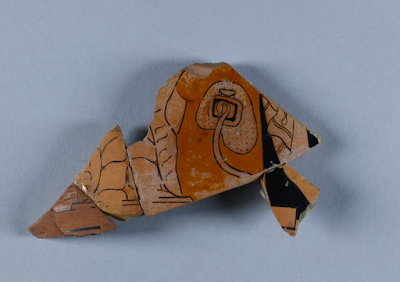
Red-figured calyx-krater fragment
attributed to the Kleophrades painter.
Michael C. Carlos Museum inv. 2006.051.011B

I have noted that Dietrich von Bothmer acquired a fragment of a cup from Edoardo Almagià and then gave it to the J. Paul Getty Museum: the rest of the fragments were supplied by Galerie Nefer (D.W.J. Gill 2022. "Context Matters: Fragmented Athenian Cups." Journal of Art Crime 27: 77–84. ). 

A fragmentary calyx-krater attributed to the Kleophrades painter was presented to the Michael C. Carlos Museum by Bothmer in 2006. It is interpreted as showing the funeral mound of Hektor. Bothmer acquired the first fragment in July 1972, followed by further fragments in September 1978: the sources for these are unknown. However in 1978 another fragment was acquired from Bruce McNall of the Summa Galleries; this was followed by further fragments from Nikolas Koutoulakis in 1981, Edoardo Almagià in 1993, and Harry Bürki in 1994. 

This network of names would suggest that the origins of this krater deserve further investigation. Tsirogiannis and I will be exploring a parallel network, also including Bothmer, in a forthcoming article.

Incidentally, a fragmentary calyx-krater showing the funerary mound of Achilles (?), and compared by Bothmer to the Kleophrades painter, had resided in the private collection of Cornelius C. Vermeule (BAPD 3197). Both kraters seem to have surfaced around the same time.

| |
Bookmark and Share so Your Real Friends Know that You Know

Tuesday, 18 July 2023

Fragments of the Sophilos Dinos

Detail of the Sophilos dinos © David Gill


The Sophilos dinos in the British Museum has been reconstructed from approximately 50 fragments. It was acquired in 1971 from the Honourable Robert Erskine. Brian Shefton knew of the dinos in 1962, and Paul Zanker noted in 1965 that the dinos resided in an English private collection.

Fragments of the dinos were placed on loan from the J. Paul Getty Museum in 1977/78 (and were deaccessioned in 1983): they had been acquired from from Max and Lynda Palevsky in 1976. The couple were the source of numerous figure-decorated fragments acquired by the Getty, including dinos fragments attributed to Kleophrades (and connected with fragments derived from Malcolm Wiener and Jonathan Rosen).

Two further fragments of the London Sophilos dinos were acquired in 1978 from Bruce McNall's Summa Galleries in Beverly Hills (1, 2). 

Where did the Palevskys acquired their Sophilos fragments? And what about the Summa Galleries? Were they from the same source? When did Erskine acquire his fragments? Did he acquire them from, say, a Paris based antiquities dealer? And did that same dealer supply fragments to the gallery in Beverly Hills?

| |
Bookmark and Share so Your Real Friends Know that You Know

Friday, 9 December 2016

Vibia Sabina and the Kyknos krater

Dr Christos Tsiriogiannis has published a significant study of the routes by which the marble statue of Vibia Sabina and the Kyknos krater passed through the market.

Christos Tsirogiannis, "False Closure? Known Unknowns in Repatriated Antiquities Cases", International Journal of Cultural Property 23 (2016) 407-31. [Cambridge University Press online]

Abstract
Based on research into the confiscated photographic and document archives in the hands of the top antiquities dealers (Robin Symes-Christos Michaelides, Robert Hecht, Giacomo Medici, and Gianfranco Becchina), so far more than 250 looted and smuggled masterpieces have been repatriated from the most reputable North American museums, private collections, and galleries, mainly to the Italian and the Greek states. Most of these repatriations were advertised in the press as voluntary action by the institutions and the individuals who possessed them. However, this is far from true; the repatriations were the results of lengthy negotiations, where the presentation of evidence alternated with diplomatic tactics and legal threats in order for the two parties (in some cases, three) to reach an agreement. Among the much-celebrated repatriated antiquities are at least two cases that require further research regarding their legal owner. This article aims to analyze these two cases and to set out new questions. In the end, there is doubt that the state who finally received these antiquities is necessarily the one from which they have been looted and smuggled. Based on this analysis, the article aims to highlight alternative paths to the discovery of the truth, paths that might have been more effective, if they had been followed.

Bookmark and Share so Your Real Friends Know that You Know

Monday, 21 January 2013

Antiquities, the IRS and the Getty

Jason Felch has drawn our attention to some of the issues surrounding the Getty's acquisition of amber apparently derived from Italy. There is a key section in Bruce McNall's memoir, Fun While It Lasted:
Jiri Frel was sniffing around my gallery, picking up an amber carving here, a fragment of a marble statue there ... The great irony in this situation was that Frel had no trouble buying a million-dollar statue, but he couldn't acquire the little vases and bits of jewelry he pored over at Summa Gallery ... And as he traced his finger over a pottery fragment, he explained how I could solve his problem while making myself and my clients a bit richer.
It was an ingenious idea. As he identified smaller items he desired—things at Summa Gallery, in Bob Hecht's holdings, or elsewhere—Jiri would notify me. If the object wasn't in my control, I would acquire it, usually on consignment. Then I would find a client to purchase it, at a most reasonable price. The buyer would then turn around and donate it to the Getty. Here, the arrangement turned tricky. Once the donation was made, Frel would arrange for an appraisal that was much higher than it had cost. The end result was a large tax break for the donor, which covered more than the original price for the piece.
A typical deal might involve three fragments of a Greek vase that I had acquired through Bob Hecht for, say, $100,000. A customer would buy them from me for $200,000. Frel would have them appraised as if they had been restored, which would make them worth $500,000. Done correctly—and it was always done correctly—I would profit on the sale. My customer would get more money back from the Internal Revenue Service in taxes than he or she had laid out for the purchase. And Jiri would add something to the Getty's collections. 
The Getty now needs to identify these donations and release information about the appraisals. Were "fragments of a Greek vase" raised in value through attributions to "well-known" pot-painters? Who made the attributions?

Felch and Frammolino have identified one of the appraisers in Chasing Aphrodite (p. 32).

The Getty looks as if it will be having to re-evaluate its acquisitions and to release the full collecting-histories of the objects.

Bookmark and Share so Your Real Friends Know that You Know

Saturday, 19 January 2013

Amber for Getty

It appears that the Getty is facing further searching questions about the acquisition of amber objects derived from sites in Etruria and Northern Italy (Jason Felch, "Getty Museum review targets its antiquities collection", LA Times January 18, 2013). It seems that they were part of a scheme whereby antiquities were over-valued to obtain higher tax relief for donors. It is alleged that the amber pieces passed through a network that included Giacomo Medici, Fritz Bürki, Robert Hecht, and Bruce McNall. The ambers came through Gordon McLendon.

Felch lays out the issues in his usual clear way.

Online Getty catalogue of amber.

Bookmark and Share so Your Real Friends Know that You Know

Thursday, 24 November 2011

Looking Back to Athena Fund II

I can remember the appearance of the sale catalogue that realised the antiquities of Athena Fund II. Objects that passed through that Fund continue to appear on the market so it would be helpful to write a short summary.

As the Washington Post noted, "McNall also runs an investment fund for Merrill Lynch, called the Athena Fund II, that specializes in ancient art and coins" (Heidi L. Berry, "The Ancient Wealth Of the Hunt Brothers", June 14, 1990). Attitudes towards selling and collecting antiquities were very different in 1990 (Andrea Gabor, "Art of the wheeler-dealers", U.S. News & World Report July 2, 1990).
The smart money is backing ancient art. Onetime Texas billionaire Nelson Bunker Hunt and his brother William went bust speculating on silver, but their collection of ancient coins, vases and bronzes fetched over $ 23 million at last week's Sotheby's auction -- roughly double the original estimates. Just last year, Canal Capital, a firm controlled by Asher Edelman, a corporate raider and art collector, invested "well over $ 10 million" in inventory for the Merrin Gallery, a leading New York City antiquities dealer. Similarly, Merrill Lynch has launched several limited partnerships that invest in ancient coins. "Antiquities have traditionally been overlooked by the public," says Frank Carr, the portfolio manager for Merrill's Athena funds and chief financial officer at Los Angeles-based Numismatic Fine Arts.
The New York magazine gave a little more detail about the sale of Athena Fund II through Hesperia Arts Auction (Andrew Decker, "The Shock of the Old", November 19, 1990). It revealed that the three main figures were Bruce McNall, Jonathan Rosen ("New York collector and real-estate developer"), and Robert E. Hecht ("the éminence grise of New York antiquities collectors"). According to one of the cataloguers for the sale, Jasper Gaunt, the main consignors were Atlantis Antiquities and Athena Fund II. (Atlantis Antiquities is a consignor of some significance for other reasons.) Only today a North American dealer informed me that Robin Symes was the source of much of the material in the Fund.

The Funds were not a great success ("Merrill to Pay Back Investors in Coin and Art Partnerships", New York Times August 24, 1994):
Merrill Lynch & Company said yesterday that it would pay $20 million to $30 million to settle lawsuits by investors in its ancient-art and rare-coin limited partnerships.
Units in the partnerships, which failed, were bought by about 3,500 investors from 1986 to 1990. They will receive the full $1,000 they paid for each unit in the Merrill Lynch Athena Fund I, Athena Fund II and Numismatic Fine Arts World Coin Fund, excluding any distributions they received from the first two funds.
Buyers desiring to acquire ancient art that had passed through such a Fund would want to be sure of the collecting histories of the pieces.
Bookmark and Share so Your Real Friends Know that You Know

The Afrati Armour in Harvard

Source: Harvard Art Museums The repatriation of the Afrati armour from New York's Metropolitan Museum of Art has implications for other ...