Showing posts with label Etruscan. Show all posts

Friday, 10 July 2026

The MMA returns 45 more antiquities to Italy

Source: MMA
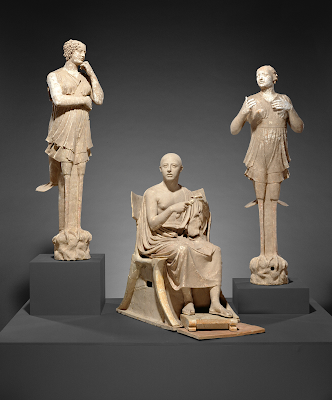
The Manhattan DA has announced that 45 objects derived from New York's Metropolitan Museum have been returned to Italy. They include a marble fishplate and two marble dishes said to have been found together that had been handled by Robert Hecht (the fishplate) or Jonathan P. Rosen (the bowls) (inv. 1984.11.6; 1985.401.1–2). Another group of 40 Italic items had been donated by Mr & Mrs Jonathan P. Rosen (inv. 1991.171.2–41). Some of these pieces feature in the catalogue of the Etruscan collection. It should also be recalled that Rosen was the source for some of the pieces of amber that have already been returned to Italy.

Another piece was an Attic red-figured psykter column-krater attributed to the Troilos painter that is said to be have been removed from Italy by Fritz Bürki (inv. 1986.11.12; BAPD 15922).

Other classical items from the MMA are to be handed back to Greece and Türkiye including the terracottas from the Panionion.

| |
Bookmark and Share so Your Real Friends Know that You Know

Saturday, 13 December 2025

Returns to Italy from the San Antonio Museum of Art

Source: San Antonio Museum of Art
A series of deaccessions has been made in September 2025 by the San Antonio Museum of Art. They consist of mostly South Italian pots and one Etruscan terracotta:

  • South Italian oinochoe (inv. 97.8). Sold by Peter Sharrer.
  • Gnathian hydria (inv. 86.119.3.a–b). Surfaced at Sotheby's (London) December 1982; sold by Atlantis Antiquities.
  • Two Apulian epichyses (inv. 88.11.1.a–b). Surfaced at Sotheby's (London) December 1987.
  • Paestan bell-krater (inv. 2005.1.72). Surfaced at Sotheby's (London) December 1986; Charles Ede Ltd.
  • Paestan fishplate (inv. 87.17). Galerie Hydra, Geneva; Sotheby's (London) December 1986; Charles Ede Ltd.
  • Etruscan terracotta figure of a woman (inv. 88.11.2). Surfaced at Sotheby's (London) December 1987.
Other items were deaccessioned in February 2021, and January 2022

The way that many of these pieces surfaced through Sotheby's (London) is significant. (For others from these same auctions see here.) Galerie Hydra is associated with material linked to Giacomo Medici (see here).
| |
Bookmark and Share so Your Real Friends Know that You Know

Tuesday, 11 April 2023

Developments at Princeton

Etruscan amphora inv. y1984-19.
Source: Daily Princetonian
It seems that five objects relating to Edoardo Almagià are to remain in Princeton University Art Museum (Sandeep Mangat and Miriam Waldvogel, "Five artifacts linked to alum under investigation for art smuggling will remain at University Art Museum", Daily Princetonian April 11, 2023). I am a little confused as the earlier report included pictures and some of the pieces mentioned in the most recent article, for example the Roman doll (inv. y1993-13), the Campanian stamnoid pyxis (inv. 87-3a–b) and fragments of a Roman Arretine bowl (inv. y1992-67), do not feature among the images. 

However, among the pieces staying in Princeton is the Etruscan amphora attributed to the Paris painter (inv. y1984-19). This is stated as: "Gift of Peter Glidewell through Edoardo Almagia, Class of 1973".

It should be remembered that Princeton has already returned a series of Etruscan architectural terracottas that were given by Almagià. These are discussed in: D.W.J. Gill, "Context matters: Princeton and recently surfaced antiquities," Journal of Art Crime 7 (2012): 59-66; id., Context matters: Collating the past, Amelia: ARCA, 2020, pp. 106–14; id., "Returning archaeological objects to Italy," International Journal of Cultural Property 25 (2018): 283–321 [DOI].

The latest article in the Daily Princetonian seems to confuse items that had been loaned by Almagià and those that had been given by him.

The article does include an interesting statement attributed to Almagià: 
"He added that he gave these fragments to Dietrich von Bothmer, a prominent German-American art historian."
We are aware that Almagià appears to have been the source for fragments in Bothmer's collection that had been acquired in 1984, 1986 and 1987. Does this imply that the fragments appearing in the original article were derived from Almagià? And was the Psiax fragment from the Centre Island private collection also from this source?

The Daily Princetonian mentions the seizure of fragments from Bothmer's collection although as far as I am aware no connection with Almagià had been made. These are discussed in: D.W.J. Gill, "Context matters: Fragmented pots, attributions and the role of the academic," Journal of Art Crime 8 (2012): 79-84. However other Bothmer fragments were included in the recent seizure from New York's Metropolitan Museum of Art.

Other figure-decorated fragments derived from Almagià have been returned from the San Antonio Museum of Art that had acquired them in 1985. Material derived from Almagià has featured in the Steinhardt return

I am aware of other Almagià material in a north American university collection that appears to have been derived from Crustumerium in Lazio. (A discussion of the piece along with other items from the same place features in a forthcoming article.)

Is it time for Princeton to provide additional so-called "provenance" information on its website?

| |
Bookmark and Share so Your Real Friends Know that You Know

Friday, 12 August 2022

Further returns from the Getty announced


The items include three terracotta figures known as 'Orpheus and the Sirens' acquired in 1976 (inv. 76.AD.11). They were purchased from Bank Leu in Zurich. (For further information see the catalogue of terracottas at the Getty.)

Four other items from the Getty will be returned:
Recent research by Getty and independent scholars also determined that it is appropriate to return a second-century AD colossal marble head of a divinity; a second-century AD stone mold for casting pendants; an oil painting entitled Oracle at Delphi, 1881, by Camillo Miola; and a fourth-century BC Etruscan bronze thymiaterion. The first three of these objects were acquired by J. Paul Getty and the Getty Museum in the 1970s; the fourth in 1996. None of these objects have been on public view in recent years. Getty is currently working with the Ministry of Culture to arrange their returns.
There is no indication in the press statement about the sources though I understand that several feature in the photographic archives seized in Switzerland and Greece. 

The colossal marble head (inv. 72.AL.96) was acquired from Robin Symes. An Etruscan bronze thymiaterion was acquired in 1996 from the Fleischman collection (inv. 96.AC.253). It was sold to the  Fleischmans in 1987 by Edoardo Almagià. (This would be the second Almagià piece to be returned by the Getty.)

The story also appears in The Art Newspaper (incorrectly stating that the thymiaterion was purchased in 1996).


Bookmark and Share so Your Real Friends Know that You Know

Tuesday, 28 December 2021

Further returns from the Getty

White on Red Lidded Pithos
Formerly Malibu inv. 96.AE.135.
The Manhattan DA Office mentioned the return of seven items from the J. Paul Getty Museum; they were seized on April 2, 2021, and the press release specifically states that they "were trafficked by ALMAGIÀ". [press release

Only one piece is listed in the Manhattan DA press release: "A Pithos with Ulysses, dating to 7th Century B.C.E. and valued at $200,000".

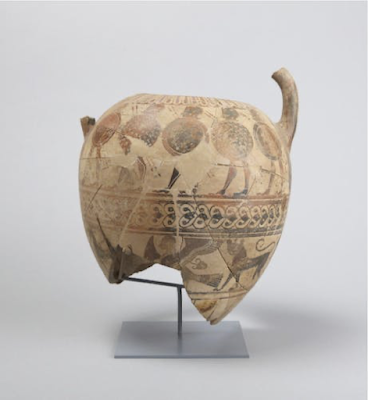
This is the lidded White on Red pithos decorated with the blinding of Polyphemos.  It was given to the Getty by Barbara and Lawrence Fleischman (inv. 96.AE.135; cat. no. 86). The pithos no longer appears on the online Getty catalogue. 

I am grateful to the Getty for providing details of the other pieces:

a. A White on Red Lidded Pithos. Gift of Barbara and Lawrence Fleischman. Inv. 96.AE.136; cat. no. 87.
b. A pair of Caeretan sub-geometric plate attributed to the circle of the Crane painter. Gift of Barbara and Lawrence Fleischman. Inv. 96.AE.137.1-2; cat. no. 88–89, A–B. 
c. A pair of Caeretan sub-geometric plates attributed to the Heron class. Gift of Barbara and Lawrence Fleischman. Inv. 96.AE.138.1-2; cat. no. 88–89, C–D. 
d. An Attic red-figured stemless cup, attributed to the Marlay painter. 'New York art market'. Inv. 86.AE.479; BAPD 41037.

The stemless cup had already been identified by Chasing Aphrodite.


Bookmark and Share so Your Real Friends Know that You Know

Monday, 27 December 2021

Etruscan White on Red Ware Returning to Italy


Bookmark and Share so Your Real Friends Know that You Know

Friday, 24 December 2021

Merrin Gallery returns terracotta to Italy


Among the returns to Italy was an Etruscan terracotta female head that had been acquired by the Merrin Gallery in 1997. The New York Times reports that it had been derived from Giacomo Medici (Tom Mashberg, "Looking for a Stolen Idol? Visit the Museum of the Manhattan D.A.", New York Times November 17, 2021). The head was seized on June 28, 2021 and returned to Italy in December [press release]

Bookmark and Share so Your Real Friends Know that You Know

Another Bürki object returns to Italy

Source: MMA A psykter column-krater attributed to the Troilos painter was deaccessioned by New York's Metropolitan Museum of Art in June...