Showing posts with label UNESCO Convention. Show all posts

Wednesday, 15 April 2020

Context Matters: Collating the Past

Context Matters is based on the twenty essays contributed to the Journal of Art Crime over its first ten years. They are supplemented by articles and review articles that were published alongside them. The chapters were written as museums in Europe and North America were facing a series of claims on recently acquired objects in their collections in the light of the photographic dossiers that had been seized from dealers in Switzerland and Greece. They engage with some of the recent debates over cultural property that include the Ka Ka Nefer mummy mask currently in the St Louis Art Museum, and the Leutwitz Apollo acquired by the Cleveland Museum of Art. Two of the essays reflect on the recent and controversial metal-detecting finds in England, the so-called Crosby Garrett helmet and the Lenborough Hoard. The volume contributes to the wider discussion about the appropriate due diligence process that should be conducted prior to the acquisition of archaeological material. 

Gill, D. W. J. 2020. Context matters: collating the past. ARCA. ISBN-13: 978-1734302615.


Bookmark and Share so Your Real Friends Know that You Know

Wednesday, 24 July 2019

The return of looted objects to their countries of origin


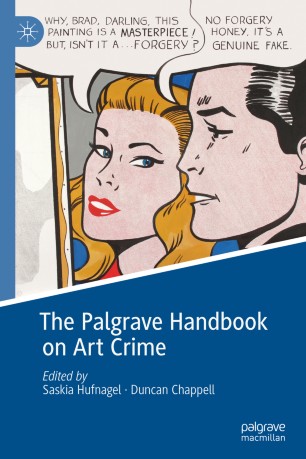
‘The return of looted objects to their countries of origin: the case for change’, in S. Hufnagel and D. Chappell (eds.), The Palgrave handbook on art crime (London: Palgrave Macmillan, 2019), 797–813.

Abstract
The journalistic investigation into the activities of a major London auction house in the 1990s led directly to the seizure of an important cache of documentation and images at the Geneva Freeport. As a result over 350 items have been returned to Italy from dealers, galleries and auction houses, North American public museums and private collectors. The 1970 UNESCO Convention on the Means of Prohibiting and Preventing the Illicit Import, Export and Transfer of Ownership of Cultural Property has provided a benchmark for claims on the return of cultural property. There is a need to enhance the due diligence process undertaken by the market. Although some North American museums have changed their acquisition policies, some curatorial staff display open hostility towards enhanced ethical responsibilities and an unwillingness to comply with further investigations. [online]
 
Bookmark and Share so Your Real Friends Know that You Know

Friday, 1 April 2016

Rigorous due diligence introduced by auction house

A major international auction house has announced today a new rigorous due diligence process for antiquities (archaeological material). It has recognised that the looting of archaeological sites, especially in Italy, Greece, Turkey and Egypt, to provide material for the market is unsustainable in the long term.

A spokesperson for the auction house indicated that the internationally recognised 1970 UNESCO Convention would be the new standard, although existing national and international laws would be taken into account.

This means all lots will be subject to a rigorous process to establish the full collecting history (historically known as the 'provenance'). This includes the authentication of all supporting documentation.

The auction house also recognises that the consultation of online databases of 'stolen' objects do little to identify recently looted objects.

The auction house expects the value of its lots to rise as potential buyers are reassured by the security of their purchases.

It is expected that this new process will be adopted by other auction houses, galleries, dealers and their related trade organisations.

Bookmark and Share so Your Real Friends Know that You Know

Thursday, 10 July 2014

Implications of the Sekhemka Sale

ICOM has raised the issue that the sale of Sekhemka may have implications for the rise of looting in Egypt.
ICOM is ... concerned that the sale of the statue, estimated between 5 and 7.5 million euros [$27 million], according to the same press release, may result in an increase of illicit excavation and trafficking of antiquities in Egypt, an area already exposed to such risks.
This is not a straightforward issue.

First, the Sekhemka statue has been known (and documented) since the mid-nineteenth century (1849/50) when it was acquired by the Second Marquess of Northampton and left Egypt. In other words, Sekhemka came to England well before the formulation of the 1970 UNESCO Convention on the Means of Prohibiting and Preventing the Illicit Import, Export and Transfer of Ownership of Cultural Property [details]. And in a market where so much of the material on offer has surfaced after (or has no authenticated documentation prior to) 1970, the Sekhemka statue offered a well documented collecting history (or, to use an obsolete and misleading term, "provenance"). Collecting histories can add to the value of an object.

Second, the Sekhemka statue does not come in the category of recently looted objects. However, the unarticulated concern of ICOM is that potential looters (or raiders of archaeological storage facilities) in Egypt will see the sorts of sums that could be raised by a single Egyptian sculpture and will try to benefit by grabbing some material that they will endeavour to get onto the European, Middle Eastern, or North American art markets. I doubt that looter would achieve $27 million for a single object: consider the cut for the trail of people need to move the object out of Egypt, the transport costs, an agent in Europe, fees, etc. But looters could think that they will be able to find another piece. But even if they did, it would not have the documented collecting history of Sekhemka, and would therefore fall under immediate suspicion (thereby lowering its value). And such searching by looters damages previously unknown and unexcavated archaeological contexts, and this leads to a loss of knowledge that can never be replaced.

Separate to these two issues is the one that has given most concern to the residents of Northampton, as well as to museum professionals. Should the Northampton Museum and Art Gallery have deaccessioned this major sculpture in order to obtain funds to do something else with its collections? Have the local politicians of Northampton contravened the ethical framework for the UK museum community? These are issues explored elsewhere on Looting Matters.

And will this lead to the future isolation of the Northampton Museum and Art Gallery? And what will be the implications for potential donations and bequests not just to Northampton, but to every single museum in the UK?

Bookmark and Share so Your Real Friends Know that You Know

Wednesday, 11 June 2014

Coins Matter for the CCPIA


Coins matter for the archaeological record. But now US Representatives Charles Rangel and Steve Israel are considering a change to legislation to exempt coins from the Convention on Cultural Property Implementation Act (CCPIA). This act implements the US ratification of the 1970 UNESCO Convention.

Charles Rangel and Steve Israel seem to think that ancient coins are somehow different from other types of archaeological material. Perhaps they need to reflect on the issues surrounding coins from Cyprus, Ptomelaic coins from the Peloponnese, or looting in Bulgaria. There are some misleading claims put around by a certain Washington lobbyist.

Rangel and Israel could also read some views by numismatist Professor Nathan Elkins, and the legal issues by attorney Rick St Hilaire.

If readers of LM do not wish to exempt coins from CCPIA, then they should sign the petition.

Bookmark and Share so Your Real Friends Know that You Know

Wednesday, 14 November 2012

Khmer statue developments

The New York Times has an update on the story relating to the Khmer statue that was being offered by Sotheby's (Tom Mashberg and Ralph Blumenthal, "Sotheby’s Accused of Deceit in Sale of Khmer Statue", New York Times November 13, 2012). The suggestion is that there has been "collusion" between the vendor and the auction house to provide an inappropriate collecting history.
Prosecutors say that in 2010, when the statue was being imported into the United States, the owner submitted an inaccurate affidavit to American customs officials, at Sotheby’s request, stating the statue was “not cultural property” belonging to a religious site.
There is a suggestion that the collecting history for the piece had been fabricated:
Prosecutors also say Sotheby’s tried to mislead potential buyers and the Cambodian and United States governments by concocting a tale that the sculpture had been seen by a “scholar” in London in the 1960s, four years before its actual theft.
As the NYT points out, this could be an attempt to place the statue in circulation prior to the 1970 UNESCO Convention. All that needs to happens is for authenticated documentation to be presented to demonstrate that the sculpture was indeed in London in the 1960s. NYT draws attention to a Sotheyb's email:
The evidence collected by the government includes an e-mail from a Sotheby’s official to the Khmer scholar, Emma C. Bunker, that in part reads, “If I can push the provenance back to 1970, then U.S. museums can participate in the auction without any hindrance.”
Sotheby's have, I believe, been making an effort to address the issue of recently surfaced antiquities, not least in the light of the Medici Conspiracy. I hope that the position that they are adopting over the Khmer statue will not be changing perceptions.

Finally, one little plea! Please could we start using "collecting history" instead of that redundant term provenance?

Bookmark and Share so Your Real Friends Know that You Know

Thursday, 23 February 2012

Timothy Potts: "the problem hasn't gone away"

Lee Rosenbaum of Culturegrrl has published the second part of her interview with Timothy Potts who is moving from Cambridge to the J. Paul Getty Museum. Rosenbaum makes this striking statement:
What most startled me was his [Potts'] lack of thorough knowledge about the Getty's written antiquities-collecting policy, which is more stringent than the UNESCO Convention's guidelines regarding cultural property. (UNESCO's rules, ratified by the U.S., restrict museums from acquiring objects lacking a well documented, clean provenance that goes back at least to November 1970.)

In light of the Getty's history of past antiquities-related mishaps and scandals (which led to its adoption of its unusually strict policy), the failure of Getty officials to fully brief its prospective museum director (and to seek his concurrence) regarding these acquisition rules seems a significant omission, calling into question the current administration's wholehearted commitment to the policy put into place by the previous administration.
There is also a brief comment on the Douris cup acquired by the Kimbell Art Museum.

I suggest that LM readers read the transcript of the interview and make up their own minds.

Bookmark and Share so Your Real Friends Know that You Know

Saturday, 26 November 2011

"A history of provenance was not required back in 1991"

A New York dealer whose gallery is a member of the International Association of Dealers in Ancient Art has recently made the claim: "a history of provenance was not required back in 1991" (see also here).

What does he mean? First, the word "provenance" is (at best) ambiguous and, I would suggest, is obsolete. I have written on this topic in an academic article elsewhere. Essentially what is implied by this dealer is that the declaration of the collecting history was not required.

And that brings me to a second point. Who required the collecting history? Is the dealer suggesting that the information was required by law? Or was such information provided as part of the "professional" service offered by dealers? (And what does the omission of such information by such dealers tells us about their attitudes toward collecting histories?) And were potential buyers wanting this information so that they could avoid buying recently surfaced antiquities?

So to point three: what was special about 1991? Were people concerned about documenting the collecting histories of antiquities in that year? On a formal basis the US Government had passed the Cultural Property Implementation Act (CPIA) in January 1983 [text]. This makes provision for the requirement of appropriate documentation for the items. And if the dealer was not the importer, the documentation, if accurate, would have revealed the information about previous handlers (or handler). The point about CPIA is that it emerged from the implementation of the 1970 UNESCO Convention on the Means of Prohibiting and Preventing the Illicit Import, Export and Transfer of Ownership of Cultural Property.

The point is this: by 1991, dealers in North America were well aware that there was an issue about cultural property that included archaeological material. This raises issues about enforcement by US authorities as well as attitudes relating the acquisition of cultural property by museums and private collectors, as well as the handling of such material by North American dealers and auction-houses. The Medici Conspiracy has made it very clear that ignoring the implications of UNESCO and CPIA had major ramifications for a number of major North American museums, for some North American private collectors, for some auction-houses based in North America, and for some North American based dealers of antiquities. The ignoring of collecting histories, or rather the lack of them, had toxic implications for those handling or acquiring such recently surfaced antiquities.

There is a further issue. Was the ethical aspect of handling recently surfaced antiquities ignored or sidelined in 1991? And what have been the implications of such an attitude for museums, private collectors and dealers?

And dates matter. I note that twenty years before 1991 (but still post the 1970 UNESCO Convention) a New York Gallery sold some Roman fresco fragments to the J. Paul Getty Museum. In November 2006 it was announced that those fragments would be returned to Italy. The reason? I will let the readers come to their own conclusion.

A dealer in 1991 may, perhaps, have felt that collecting histories were unimportant to determine or to declare. But twenty years later, in 2011, due diligence and transparency are fundamental elements of those who trade in cultural property. So if details of the collecting history become known, or appear to be suppressed, they should, I would argue, be made public.


Bookmark and Share so Your Real Friends Know that You Know

Friday, 21 October 2011

Karlsruhe and Greece: new claim on Cycladic material

It appears that the Hellenic Ministry of Culture has asked the Badisches Landesmuseum in Karlsruhe to return two pieces to Greece. They appear to be a marble Cycladic figure and a Bronze Age dish (that I also assume is Cycladic). Both pieces were purchased in 1975 after the 1970 UNESCO Convention.

The request appears to have been made as part of the condition to lend material to the Cycladic exhibition due to be mounted by Karlsruhe from December 2011 (details).

Harald Siebenmorgen, the director of the museum, is reported to have rejected the Greek request.
Siebenmorgen said they were purchased with public funds in 1975 and Greece had no legal claim to them, because of the moratorium on civil claims and Germany had not signed a convention on restitution of art treasures until 1992.

Siebenmorgen told SWR 2 television that a linkage between restitution claims and loans was 'not the international custom at all' and said it was 'like extortion.'

This raises several issues. The acquisitions were made after 1970, and Siebenmorgen will be aware that major North American museums have complied with Italian requests for the return of material that was acquired post 1970 (even though the USA had not become a signatory at that date). What is the full collecting history of the two disputed pieces? Is there good reason to believe that they were looted from archaeological sites in Greece?

Greece has been asked to loan archaeological material to an exhibition and its officials have every right to expect the highest ethical standards from the museum organising the Cycladic show.

Research by Gill and Chippindale has demonstrated the significant impact of looting on the archaeological record of the Cyclades, highlighted, in part, by an earlier exhibition of Cycladic material in Karlsruhe. I would have expected Siebenmorgen to have adopted a more positive and conciliatory approach to the Greek request.


Bookmark and Share so Your Real Friends Know that You Know

Friday, 23 September 2011

The religious calendar from Thorikos

Source: Hellenic Ministry of Culture
The return of the religious calendar from the J. Paul Getty Museum to Greece may set a serious precedent. It appears that Eugene Vanderpool ("A southern Attic miscellany", in Thorikos and the Laurion in Archaic and Classical Times, Miscellanea Graeca, vol. 1: 21-42. Ghent, 1975) knew about the inscription from ASCSA student David F. Ogden (see G. Daux, "Recherches préliminaires sur le calendrier sacrificiel de Thoricos", Comptes-rendus des séances de l'Académie des Inscriptions et Belles-Lettres, 124e année, N. 2, 1980, pp. 463-470). Ogden was a student at ASCSA from 1959 to 1961 and wrote a paper on “Thorikos: A Fresh Survey of the Site with Chart and Plans”. If Ogden had indeed seen the inscription in the region of Thorikos some 10 years before the 1970 UNESCO Convention, why has the Getty agreed to return the inscription?

And if the Getty is willing to return objects that left Greece during the 1960s, what other objects will now be returned? What about parts of the Keros haul?

And what are the implications for other North American (as well as European) museums? Will there be renewed claims on items that left their countries of origin prior to 1970?

Bookmark and Share so Your Real Friends Know that You Know

Thursday, 18 August 2011

Why did North American museums acquire recently surfaced antiquities?

I have been reflecting on how major North American museums managed to get themselves into a situation where they acquired recently surfaced antiquities. Indeed they have exposed themselves to criticism from foreign governments, academia and the media.

I presume the motivation was to build a collection of classical antiquities that would rival other museums. Curatorial careers were built on the finest Greek pot, or should that be vase?, or the most unusual archaic marble statue. but did those curators never stop and think about the sources? Had these genuinely unknown objects really resided in some anonymous villa beside Lake Geneva? Or did these same curators suspect that they were derived from the deliberate destruction of archaeological sites? But did they care? Or were they just naive?

The move to address this problem was brought to the world's attention by bodies such as UNESCO and the AIA. From the North American museum community we should also note Maxwell Anderson's pioneering and visionary EUMILOP scheme.

We continue to note a significant lack of transparency from within the North American museum community over the failure to address concerns over recently acquired and loaned objects.

Have some of the legal and art historical commentators forgotten that there continue to be a number of unresolved issues?

But I should return to the question. Why were these objects acquired? Was it because there was a disregard for the information derived from careful scientific excavation?


| |
Bookmark and Share so Your Real Friends Know that You Know

Wednesday, 27 April 2011

Due Diligence and Auction Houses: the Italian Dimension

Over the last few years there have been several instances from both sides of the Atlantic when auction houses and dealers have offered antiquities for sale that have been identified from images seized in police raids in Switzerland and Greece. The auction houses will no doubt claim, and indeed have claimed, that they have conducted an appropriate due diligence search. Yet it is clear that the procedures followed by the auction houses lack appropriate rigour. They rely on searching databases that will indicate objects stolen from recent collections but not items removed illicitly in recent years from archaeological contexts.

So how can auction houses and dealers avoid offering objects that have surfaced in recent years? Here are three suggestions:
a. Check and authenticate collecting histories (so-called "provenance"). Collecting histories can be fabricated so the paper trail needs to be researched with care.
b. Can the collecting history be traced back to the period prior to the 1970 UNESCO Convention? If not, how can the gap be explained?
c. Contact the relevant authorities in source countries.

I observe that three separate organisations have pressed ahead with sales even when they were aware that there were issues relating to objects. Are those concerns being passed to potential vendors?

Bookmark and Share so Your Real Friends Know that You Know

Tuesday, 1 February 2011

UNESCO: "protect Egyptian cultural heritage"

The Director-General of UNESCO, Irina Bokova, has commented on the situation in Egypt ("UNESCO Director-General launches heritage and press freedom alert for Egypt", UNESCO February 1, 2011).
The Director-General called on all parties to protect Egyptian cultural heritage, symbol of the country’s identity, and to respect freedom of expression, pillar of democracy. Although the situation in Egypt is evolving rapidly, reports from Egypt concerning these two domains are a cause for deep concern, the Director-General said.

“Egyptian cultural heritage, both its monuments and its artefacts, are part of the ancestral heritage of humanity, handed down to us through the ages,” she said. “The value of the 120,000 pieces in the Egyptian Museum in Cairo is inestimable, not only in scientific or financial terms, but because they represent the Egyptian people’s cultural identity. The proof, hundreds of citizens spontaneously formed a chain around the museum to protect it. I solemnly request that all necessary measures be taken to safeguard Egypt’s treasures, in Cairo, Luxor and in all the other cultural and historical sites around the country.”
I am grateful to Chuck Jones for directing me to this story.

Bookmark and Share so Your Real Friends Know that You Know

Wednesday, 10 November 2010

The IADAA position on "looted" antiquities

I have been rereading the IADAA (International Association of Dealers in Ancient Art) position on "looted" and "stolen" antiquities. Their statement is uncompromising:
IADAA also stands against the destruction of the past, whoever is responsible. ... IADAA will use every effort to raise awareness of such destruction. As our code of ethics makes clear, we refuse to deal in pieces, which are looted or stolen.
The code of ethics for the IADAA clearly states:
2. The members of IADAA undertake not to purchase or sell objects until they have established to the best of their ability that such objects were not stolen from excavations, architectural monuments, public institutions or private property.
Do members of the IADAA provide complete and transparent collecting histories for the objects on offer? Do members of the IADAA try to trace objects back to the period before the benchmark 1970 data of the UNESCO Convention?

How do members of the IADAA define "looted" or "stolen" antiquities? How do they conduct due diligence searches?


Bookmark and Share so Your Real Friends Know that You Know

Tuesday, 3 August 2010

Almagià: "The museum has a right to collect; the dealers have a right to deal"

In June I noted the new Italian investigation into antiquities acquired by Princeton University Art Museum. The antiquities are reported to have been handled by Edoardo Almagià whose name had already been linked to antiquities returned to Italy from the Cleveland Museum of Art.

The June report had mentioned that Princeton curator Michael Padgett was the focus of attention. Padgett was interviewed for Princeton Alumni Weekly (W. Barksdale Maynard, "Art museum curator targeted by Italian prosecutors", PAW July 7, 2010). He is quoted:
After working so closely and cooperatively with the Italians in the past, I was very disappointed and surprised that this investigation is now taking place. I am reluctant to comment at length at this early stage, but I do want to clearly state that I am innocent of what the Italian prosecutor is apparently alleging.

It is noted that Maynard now thinks that some "1.5 million items are believed to have been looted from archaeological sites in Italy" since 1970. For anybody who is unconvinced by the scale of the problem of looting and why action needs to be taken, that is a whacking estimated 37,500 antiquities looted every year for 40 years. And that is only from Italy.

The President of Princeton, Professor Shirley M. Tilghman, comments:
What is challenging is that the standards of provenance have been changing over the last 30 years — and rightfully so — and have become much more stringent.
Tilghman, and perhaps the curatorial staff of the Princeton University Art Museum, were unaware of the implications of the 40 year old UNESCO Convention on the Means of Prohibiting and Preventing the Illicit Import, Export and Transfer of Ownership of Cultural Property (see "The 1970 Rule") or the 1973 AIA Declaration on the Acquisition of Antiquities by Museums. Indeed the main change has taken place in the last decade since museums and private collectors woke up to the implications of the Medici Conspiracy. Tilghman (a molecular biologist) also needs to drop the use of "provenance" and adopt the more correct term "collecting history".

The PAW interview also quotes Edoardo Almagià who commented on the 2007 agreement between Italy and Princeton:
You give them your hand, they’ll take your forearm. ... What they took from Princeton [in 2007], it’s ridiculous. The museum has a right to collect; the dealers have a right to deal.
It would be helpful if Princeton could now release a full list of any objects in its collection associated with Almagià as part of the new spirit of transparency announced ("clear and transparent standards") by Tilghman.


Bookmark and Share so Your Real Friends Know that You Know

Thursday, 29 July 2010

Corrupting knowledge: inaccurate information

One issue surrounding recently-surfaced antiquities is that the objects may be supplied with misleading collecting-histories. Sellers may be keen for a potential buyer to think that a Greek pot has resided in a collection formed in the 1920s when in fact it was removed from an Etruscan grave in the 1980s. Another seller could suggest that a Roman silver cup was found in, say, Afghanistan as this would be more exotic than Turkey.

I have been considering this concept as part of the wider intellectual consequences of collecting. I explored the theme in my 2010 article for the Journal of Art Crime. I noted how two pieces that passed through Palladion Antike Kunst in Basel, Switzerland (and acquired by Boston's Museum of Fine Art and the J. Paul Getty Museum) were placed in "old collections": those of Karl Haug in Basel since 1936, and the late nineteenth century Rycroft collection. Such misleading information does not relate just to genuine objects: the Getty kouros, considered by some to be a modern forgery, was said to have formed part of the Jean Lauffenberger collection and could be traced back to a Greek dealer in 1930. The kouros was said to have been sold by Gianfranco Becchina, whose wife Rosie was the proprietor of Palladion Antike Kunst.

The Late Roman hoard known as the Sevso Treasure is linked in the broadest sense with several possible countries (including Hungary, Croatia and Lebanon). The Icklingham Bronzes were once said to have been removed from Britain in the 1940s and then formed part of a collection in Switzerland. The Morgantina Hoard was said to have passed through the hands of a Lebanese dealer and then through a Swiss collection in 1961. (The more recent removal of the hoard from its archaeological context seems to have been dated by a coin apparently dropped by one of the looters.) The marble statue of Sabina returned to Italy from Boston was reportedly from an old Bavarian aristocratic collection.

I have also noted that collecting histories can sometimes be placed back in the period before the 1970 UNESCO Convention. For example a series of Late Antique ('Byzantine') mosaics are reported (in recent years) to have passed through Lebanese dealers in Beirut in 1969. Is this a documented (and authenticated) part of the collecting histories? Or an Attic krater can be said to have resided in an undocumented (and unspecified) Swiss private collection for a number of years that would place it (conveniently) in the late 1960s. Another example could be a piece of sculpture that is said to have been in a Lebanese private collection in the 1950s when other evidence shows it was in another country decades later. Or did Apulian pots from an apparent single grave-group form part of a nineteenth-century collection in Switzerland?

Then there are cases where the collecting history supplied by a dealer can be disputed by other informed authorities thus creating two parallel histories? Was a bronze Apollo found in Greece or had it resided in an obscure East German collection?

These case studies show why museums need to be transparent over the collecting histories of objects in their care whether they are acquisitions or loans.

This issue matters. If misleading information accompanies the object, then not only has the original archaeological context been lost, but the piece may be used by modern scholars to construct a false view about the past.

Bookmark and Share so Your Real Friends Know that You Know

Wednesday, 21 July 2010

Defining Cultural Property: "the significance of the past for the present"

I see from archaeologist Paul Barford's postings that there is some discussion about the definition of 'cultural property'. I thought it would be interesting to turn to The New Oxford Companion to Law (Oxford University Press, 2008) that is sitting at my side. (This is a standard desk companion along with OED and the New Hart's Rules.)

Michael Shanks has written the entry for 'cultural property'. He includes a set of 'disagreements' over key questions, pressing issues ("the looting of ancient sites and the associated illicit trade in antiquities"), as well as some of the arguments used (e.g. "that collectors have a right to own pieces of the past").

Other entries of interest include: antiquities and looting; archaeological heritage; cultural heritage; heritage legislation; heritage markets; heritage, international dimensions; heritage, protection during war; UNESCO World Heritage Centre.

Bookmark and Share so Your Real Friends Know that You Know

Tuesday, 20 July 2010

Japanese Dealer's Stock: Implications for the Market

The seizure of a stock of 20,000 antiquities from a Japanese dealer, reported to be Noryioshi Horiuchi, in Switzerland raises a number of issues.

a. What are the documented sources for all these objects? When did they surface?

b. How many objects can be linked directly to dealers such as Giacomo Medici (e.g. a hydria) and "colleagues"?

c. Was the Japanese dealer consigning objects to auctions and selling items to other dealers in London, New York and elsewhere?

d. Which other countries are likely to have a claim on the stock?

e. What is happening to the objects that have not been returned?

f. What are the documented collecting histories of the objects that have not been handed over to Italy? How many have surfaced on the market since 1970?

During 2010 two high-profile auction-houses, one in London and the other in New York, appear to have offered toxic antiquities linked to Giacomo Medici; one of them also offered material that was linked to Robin Symes.

Has the time come for dealers to move away from simple searches on the Art Loss Register (ALR) and other databases? Instead, should they adopt a more rigorous ethical position and insist on properly documented collecting histories that can be traced back to the period before the 1970 UNESCO Convention?

Dealers and auction-houses could ignore the issue. But those involved in the trade also need to remember the adverse publicity that can be generated by turning a blind eye.

Image
Composite picture of a hydria featured in the Medici Dossier and returned to Italy from Switzerland.


Bookmark and Share so Your Real Friends Know that You Know

Thursday, 15 July 2010

Madrid: Looking back to 1999

The discussion about the antiquities in Madrid reported to be shown in the Medici Dossier and the Becchina Stache has pointed me back to 1999.

There are several things to note from the official press release ("Museos-Colecciones: Estado compra Coleccion Varez Fisa por 2.000 millones pesetas", Spanish Newswire Services October 22, 1999).

First, the Varez Fisa collection was made essentially since 1970 ("en los ultimos treinta anos" [before 1999], the date of the UNESCO Convention.

Second, the collection was acquired at auctions and specialised international art fairs ("ferias internacionales especializadas").

Third, the acquisition was made with the full support of the state. The collection was presented by the Secretary of State for Culture, Miguel Angel Cortes [now the Deputy Spokesman for the Popular Party Parliamentary Group in the Spanish Congress]. He commented "'todos podemos felicitarnos' por esta adquisicion, que encuadro dentro de los acuerdos parlamentarios para llevar las instituciones museisticas 'a la altura de las necesidades culturales'". What were the cultural needs linked to this acquisition? The acquisition price was paid for by the state.

I was also interested in the list of pot-painters featured in the acquisition:

  • Andocides
  • Antimenes
  • Epiktetos
  • Lydos
  • Nikosthenes
  • The Affecter
  • The Berlin painter
  • The Pan painter
  • The Meidias painter
  • The Darius painter

Full details of the collecting histories for these pieces need to emerge. However, I note how pots attributed to the Berlin painter and to the Darius painter have featured prominently in the returns to Italy.


Image
Athenian black-figured amphora from the Medici Dossier.


Bookmark and Share so Your Real Friends Know that You Know

Wednesday, 14 July 2010

Madrid and the "encyclopedic embrace of the world's material culture"

Tom Flynn has an interesting response to the Greek pots in Madrid's Museo Arqueologico Nacional appearing to be linked to the Medici Dossier.

Flynn concentrates on a quote by Miguel Angel Elvira Barba, the director at the time of the acquisition in 1999:
“We have taken an enormous step forward both in terms of quality and quantity; [this] collection now puts us among the ranks of the greatest museums in Europe and the US.”

Flynn interprets this:
Here, then, is further telling evidence, if any were needed, that European and North American museums remain locked in the same competitive race towards an encyclopedic embrace of the world's material culture, no matter what the consequences might be for archaeology.

In other words Madrid's acquisitions were attempting to place it alongside Boston's Museum of Fine Arts, New York's Metropolitan Museum of Art, and the J. Paul Getty Museum. This is an issue left largely unaddressed by James Cuno who has yet (as far as I can see) to comment in detail on why North American (and European) museums and private collectors were happily acquiring recently-surfaced antiquities from Italy (and elsewhere).

Flynn addresses the issue of conflating post-1970 acquisitions and objects that were acquired before that international benchmark.

Image
Detail of amphora showing the departure of a warrior. From the Medici Dossier.

Bookmark and Share so Your Real Friends Know that You Know

Finds from Afrati, Crete

Source of image: Michael C. Carlos Museum Creative Commons The repatriation of Norbert Schimmel's helmets and mitrai from New York's...