Showing posts with label Switzerland. Show all posts

Monday, 15 December 2025

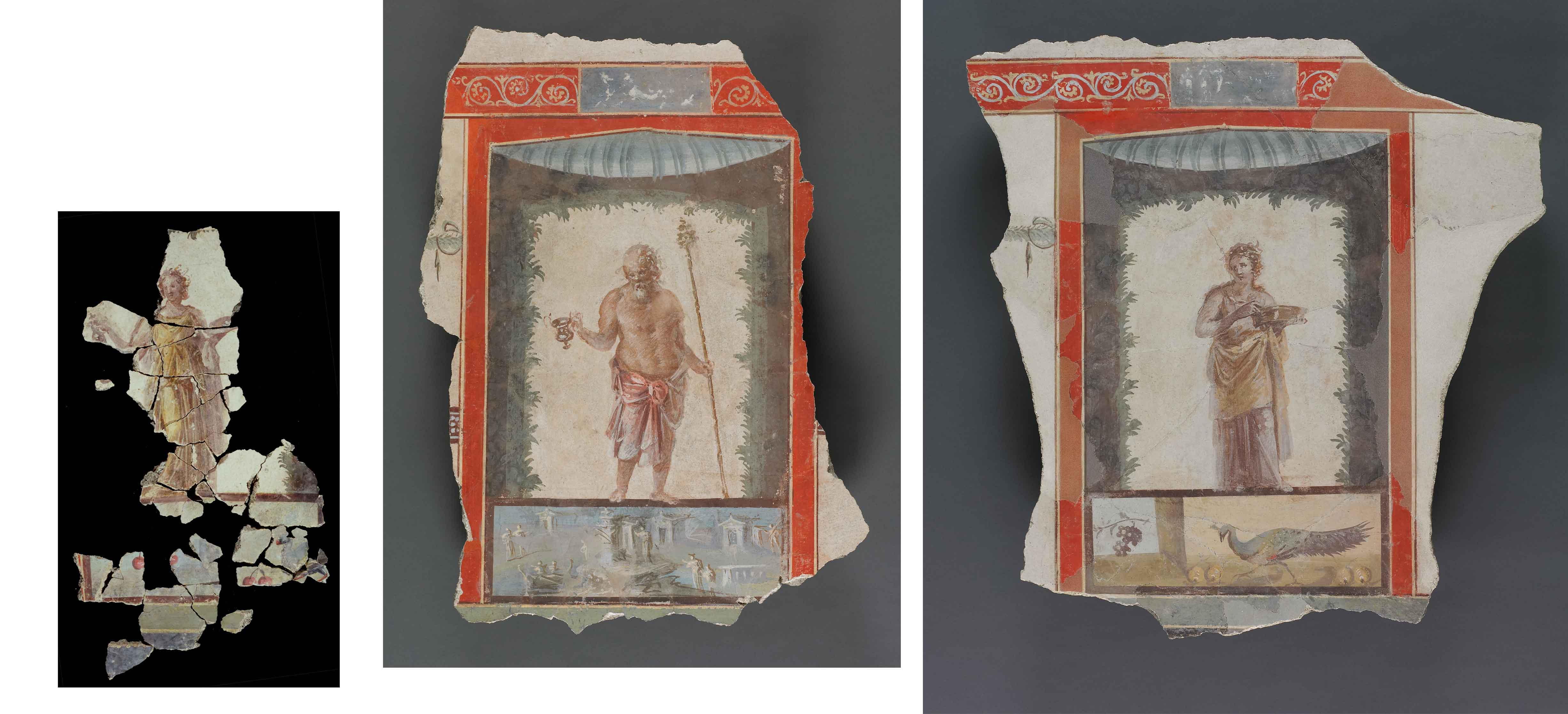
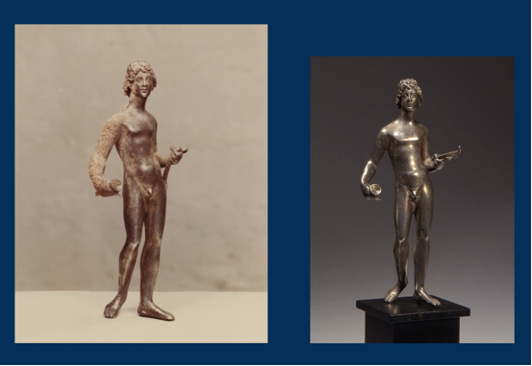
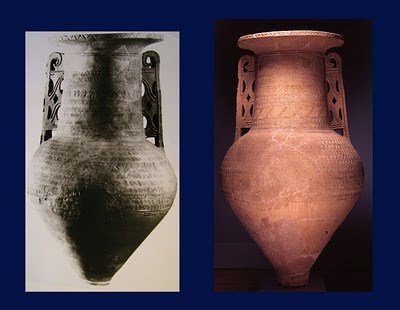
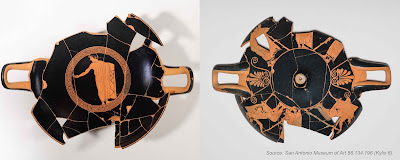
Further returns to Italy from the San Antonio Museum of Art

Source: San Antonio Museum of Art
In addition to the objects deaccessioned by the San Antonio Museum of Art in September 2025, the museum  had done the same for another group in January 2022. These were mentioned (without significant detail) in a press release from the Manhattan DA in 2023. These items included material that surfaced through various sources:

Christie's (Geneva)
Attic red-figured lekythos. Inv. 86.134.75. Surfaced through Christie’s (Geneva) May 1979; Sotheby’s (London) May 1982. 

Christie's (London)
Attic white ground lekythos. Inv. 86.134.170. Surfaced through Christie’s (London) July 1983; July 1985. 

Frederick Schultz
Attic red-figured head kantharos. Inv. 91.24. Surfaced through Frederick Schultz, 1989. 

Galerie Günter Puhze
Attic black-figured lekythos. Inv. 91.80.1. Galerie Günter Puhze, 1989. 

Palladion Antike Kunst
Attic black-figured amphora. Inv. 86.134.31. Surfaced through Palladion Antike Kunst; Sotheby’s (London) December 1981. 
Attic red-figured oinochoe. Inv. 86.134.58. Surfaced through Palladion Antike Kunst; Robert Hecht. 

Robin Symes
Portrait of Hadrian. Inv. 2005.1.81. Robin Symes; Royal-Athena Galleries; Sotheby’s (New York) June 1992. [Image identified in the Medici Dossier.]
"Dating to 200 C.E., the marble head of the Emperor Hadrian was first documented uncleaned and covered in marine encrustations in a polaroid photograph. The polaroid was recovered by Italian law-enforcement authorities during a raid of the office and warehouse of well-known antiquities trafficker Giacomo Medici in 1995. After being smuggled out of Italy by Medici and his co-conspirators, the piece was then laundered with false provenance by dealer-trafficker Robin Symes before being sold in New York County in 1992." (Manhattan DA)
Sotheby's (London)
Corinthian olpe. Inv. 93.17. Surfaced in Sotheby’s (London) July 1990; Charles Ede. 
Attic black-figured amphora. Inv. 86.134.173. Surfaced in Sotheby’s (London) July 1985. 
Attic red-figured lekythos. Inv. 86.134.79. Surfaced through Sotheby’s (London) May 1982. 

Alfredo Turchi
Head of Hermes. Inv. 86.134.145. Sold by Alfredo Turchi.

The head of Hermes was excavated in Rome in the 19th century. 

| |
Bookmark and Share so Your Real Friends Know that You Know

Thursday, 27 November 2025

Two lots withdrawn from Bonham's sale

Becchina Archive
Source: Christos Tsirogiannis.

Dr Christos Tsirogiannis has identified two lots that were due to be auctioned at next week's sale of antiquities at Bonham's (4 December 2025). Both feature in the Becchina archive. They have now been withdrawn (along with lot 126).


Lot 15 is a South Italian terracotta figure. It was said to have been in a private collection in France in 1979 before entering the Nina Borowski collection in the 1990s. It is reported to be part of unnamed private collection in Switzerland. The entry in the Palladion Antike Kunst records suggest that it was part of an unnamed Swiss private collection.

Lot 123 is an Attic red-figured pelike showing an Eros on horseback currently in the Lloyd and Jeanne Raport collection. Tsirogiannis informs me that the pelike was consigned by Becchina to Sotheby's in London on 17 May 1983 (lot 264).

Did the staff at Bonham's attempt to authenticate the information relating to the collecting histories (so-called "provenance") prior to the sale? 


| |
Bookmark and Share so Your Real Friends Know that You Know

Wednesday, 18 September 2024

Attic Funerary Relief Returns to Greece

Sources: Hellas et Roma; Hellenic Ministry of Culture


The Hellenic Ministry of Culture has announced that part of a fourth century BCE Attic marble stele has been returned from an anonymous US private collection [Press Release]. The relief featured in an advertisement for the gallery Palladion Antike Kunst that appeared in the back of a 1982 exhibition catalogue produced by the Swiss-based organisation Hellas et Roma.  (The Ministry of Culture press release misleadingly suggests that the relief appeared in an exhibition catalogue implying that the stele was displayed.) A parallel for the stele was found at Kallithea in 1896; it marked the burial of Agnostrate daughter of Theodotos (Athens NM inv. 1863: cat. no. 417).

Christos Tsirogiannis has verified that images of the returning stele feature in the Becchina archive, and specifically to Nino Savoca, a dealer based in Munich. It appears that the stele first surfaced in the late 1970s. 

This stele forms part of a growing list of objects returned to Greece and Italy that had featured in the Becchina archive. Yet the Hellenic Ministry of Culture seems to be reluctant to seek the return of other objects that feature in this source, notably the Cycladic figure in the Leonard Stern collection (and currently on loan to New York's Metropolitan Museum of Art) and the pithos, probably from Rhodes, in the Michael C. Carlos Museum at Emory University. (The Italian authorities, likewise, do not seem to have requested the return of fragmentary wall-paintings in the J. Paul Getty Museum.) 

Source: Hellenic Ministry of Culture
The stele fragment was returned with two other items: a fragmentary 4th century BCE funerary stele, perhaps from Thessaly, showing a woman (next to a child; note the raised hand) who holds a box; and an hellenistic bronze male figure, perhaps of an athlete. 

| |
Bookmark and Share so Your Real Friends Know that You Know

Friday, 10 November 2023

The Wild Goat Plate Fragment and Francavilla Marittima

Source: Michael C. Carlos Museum


The Michael C. Carlos Museum at Emory University has returned a Wild Goat fragment to the Italian government. The statement notes:
In June 2021, Italy’s Ministry of Culture presented the Carlos with photographic evidence that the Carlos fragment joins with two other fragments from the same plate. One fragment, currently housed in the Museo Nazionale Archeologico della Sibaritide, was unearthed during official excavations at the Timpone della Motta Sanctuary in Francavilla Marittima. The second fragment was returned to Italy from a European museum following evidence it had come from illegal excavations at Timpone della Motta.
This is no doubt associated with the 3500 fragments acquired by the J. Paul Getty Museum in 1979 and 1983: the 1983 batch included joining fragments from the Institute of Archaeology in Bern. Other museums, including the Ny Carlsberg in Copenhagen, are said to have fragments from this same cache. 

The main cache of material was returned to Italy in 2001, four years before the Carlos Museum acquired its fragment. 

| |
Bookmark and Share so Your Real Friends Know that You Know

Monday, 30 October 2023

Michael C. Carlos Museum and Italy

Source: Michael C. Carlos Museum


There have been unannounced developments at the Michael C. Carlos Museum at Emory University (no mention in the press releases). At least three items have had their title transferred to Italy on 29 August 2023 and now appear as loans. I am grateful to Dr Cynthia Patterson who spotted the changes to the records.

The objects include:
  • a Laconian cup attributed to the Rider painter (L2023.004.003). Surfaced via Palladion Antike Kunst, Basel (from at least 1988; first published by Conrad Stibbe in 1990); purchased from Palladion.
  • an Attic black-figured Band Cup (L2023.004.001). Surfaced via Palladion Antike Kunst, Basel (from at least 1975 when it appeared in an advertisement in Apollo); Brian T. Aitken, Acanthus Gallery, New York.
  • an Apulian volute-krater attributed to the Underworld painter (L2023.004.002). Surfaced in Galerie Hydra (Christian Boursaud), Geneva (by 1986); Pierre Sciclounoff (1926-1997), Geneva; purchased through Christoph Leon. 
Galerie Hydra is discussed in Peter Watson's, Sotheby's: Inside Story (1997). The Apulian krater appeared in: C. Aellen, A. Cambitoglou, and J. Chamay, Le Peintre de Darius et son Milieu: Vases grecs d'Italie méridionale (Hellas et Roma, vol. 4. Geneva: Association Hellas et Roma, 1986), 190–99 (Sciclounoff collection); A. D. Trendall, Red Figure Vases of South Italy and Sicily; A Handbook (London: Thames and Hudson, 1989), 261, fig. 210.

Can we presume that the Minoan larnax, known from the Becchina dossier, will be transferred to Greece in the near future? And what about the other material handled by Palladion Antike Kunst? 

| |
Bookmark and Share so Your Real Friends Know that You Know

Saturday, 15 July 2023

A pair of Nereids from an old Swiss collection

Two Nereids in the Louvre.
Source: Louvre


Two Apulian terracotta reliefs showing the Nereids were acquired by the Louvre in 1982 (CA 6823, CA 6824). They are alleged to have been derived from "une ancienne collection suisse" prior to 1939. However, the official museum website fails to mention this prior history.

What is key about these two Nereids is that they feature in the Becchina archive. Will the Louvre disclose the identity of the "old Swiss collection"? And what is the nature of the authenticated documentation that can demonstrate that the Nereids were known prior to 1939? 

Presumably this pair of terracottas form part of the Italian claims. Will the Louvre seek to be co-operative with the request?

What other items were acquired from Becchina or Palladion Antike Kunst?

I am grateful to Christos Tsirogiannis for advising me on the Becchina archive. The identifications were first made by Daniela Rizzo and Maurizio Pellegrini.

Besques, S. 1988. "Deux reliefs apuliens en terre cuite." Monuments et mémoires de la Fondation Eugène Piot 69: 1–28.

| |
Bookmark and Share so Your Real Friends Know that You Know

Tuesday, 14 February 2023

Two octagonal panels probably from the Bay of Naples

Two octagonal panels. Malibu inv. 83.AG.222.5, 7

Yesterday I noted three panels apparently from the same room of a villa that probably stood somewhere in the vicinity of the Bay of Naples. Like the other panels, this pair of frescoes was derived from Palladion Antike Kunst in 1983. Unlike the other pieces these two are not currently on display. 

How did these fragments leave their villa and move to California? Will the curatorial team at the Getty be raising this with their Italian colleagues?


| |
Bookmark and Share so Your Real Friends Know that You Know

Monday, 13 February 2023

The frescoes from a wealthy seaside villa

Three panels acquired by the J. Paul Getty Museum in 1983.
Inv. 83.AG.222.2, 4, 8.

In 1983 the J. Paul Getty Museum acquired a series of Roman frescoes on the 'European market', in fact from Palladion Antike Kunst in Basel. The Getty's handbook suggests that they are derived from ‘a wealthy Roman’s seaside villa in the area of the Bay of Naples’. 

Elizabeth Marlowe has commented on the displayed fragments, suggesting that the panels had been removed from a single room somewhere in the vicinity of Vesuvius. Indeed, there are fragments that were acquired at the same time that clearly come from a third panel, presumably from the same room. Daniela Rizzo and Maurizio Pellegrini have recently drawn attention to the problematic nature of these frescoes and published an image of a further section of the decoration that appears in the Becchina photographic archive. 

How does the Getty interpret the history of the fragments? Is the museum actively seeking to return the sequence of fragments to Italy?


References
Lapatin, K. D. S., and K. Wright. Editors. 2010. The J. Paul Getty Museum: Handbook of the Antiquities Collection. Los Angeles: J. Paul Getty Museum.
Marlowe, E. 2020. "The reinstallation of the Getty Villa: plenty of beauty but only partial truth." AJA 124: 321–32. [Online]
Rizzo, D., and M. Pellegrini. 2021. "The Italian Archaeological Heritage Abroad: Between Agreements, Debates and Indifference." In Stolen Heritage: Multidisciplinary Perspectives on Illicit Trafficking of Cultural Heritage in the EU and the MENA Region, edited by A. Traviglia, L. Milano, C. Tonghini, and R. Giovanelli, Antichistica, vol. 29: 99–114. Venezia: Edizioni Ca’ Foscari. [Online]

| |
Bookmark and Share so Your Real Friends Know that You Know

Monday, 6 February 2023

From Geneva to Athens

L: source, Phoenix Ancient Art
R: source, Hellenic Ministry of Culture

The Hellenic Ministry of Culture has announced the return of 15 antiquities that had been seized from an unnamed antiquities gallery in Geneva [press release]. The Attic black-figured column-krater attributed to Lydos appears to be the one that features in the 2015 catalogue for Phoenix Ancient Art of Geneva and New York. Entry no. 4 shows the krater, reconstructed from 'large fragments', decorated with Herakles and the centaur Nessos. The entry suggests that it formed part of the Lambert collection in Neuchâtel prior to 1972 and then by descent through the family. 

Such histories may have to be treated with caution given the disagreement over the paths taken by the Ka-Nefer-Nefer coffin lid, the head of Drusus, and the Leutwitz Apollo. 

We do not know where the krater was unearthed, but northern Greece seems to be a likely possibility. 

I am grateful to a colleague in Italy who directed me to search the catalogue of Phoenix Ancient Art.

| |
Bookmark and Share so Your Real Friends Know that You Know

Saturday, 3 December 2022

Identifications at Sotheby's in London

Image from the Becchina archive courtesy of Christos Tsirogiannis

Professor Christos Tsirogiannis has identified three objects from the Becchina, Medici and Symes archives that were due to be auctioned at Sotheby's in London on December 7, 2022. His identifications are covered in a report by Dalya Alberge, "Archaeologist urges Sotheby’s to cancel auction of ‘illicit’ artefacts", Daily Telegraph December 3, 2022.

Take for example the Roman bronze protome spout in the form of a dog or spout (lot 121). The history of the piece is provided:
  • Swiss private collection 
  • Royal-Athena Galleries, 
  • New York John W. Kluge, acquired from the above in 1989 (Christie's, New York, The Morven Collection of Ancient Art, December 10th, 2004, no. 590, illus.)
Notice on the image the annotation 'V[ia]/Jer[ome Eisenberg]' confirming the link with the Royal-Athena Galleries. The image is taken from the Becchina archive and records show that it was derived from Mario Bruno. Presumably one of these two sources is to be identified as the 'Swiss private collection'.

In the report in the Telegraph it is noted:
A Sotheby’s spokesman said that they “uphold the highest standards of due diligence”.
How did Sotheby's conduct a rigorous due diligence test on the anonymous Swiss private collection? Had they considered the possibility that Becchina or another such individual was the origin? 

Royal-Athena Galleries should also have raised an alert. Only in November three antiquities from this source were returned to Turkey: e.g. silver Apollo. Or in July this year an Attic krater from the Gallery was returned to Italy. This was among 60 antiquities from Royal-Athena Galleries. Again, had Sotheby's taken this into account as part of their rigorous due diligence process? 

In May 2017 a Paestan lekythos was provided with a nearly identical history to the bronze spout. Did this raise concern? Indeed it is clear that the Kluge collection has been linked to several antiquities that have been returned to Italy. This in itself should have alerted those preparing the catalogue entry for Sotheby's.

Will Sotheby's in London tighten up its processes? Is there a need to raise the standard of the due diligence approach to a more rigorous level?


| |
Bookmark and Share so Your Real Friends Know that You Know

Wednesday, 16 November 2022

A Silver Apollo Returns to Turkey

Left: Symes-Michaelides archive; Right: Royal-Athena Galleries


In November 2022 the US authorities returned a silver statuette of Apollo to Turkey. This was recognised as the figure that had been identified by Christos Tsirogiannis in 2007 as appearing in the Symes-Michaelides archive. It receives a full discussion in his PhD thesis, Unravelling the Hidden Market of Illicit Antiquities: The Robin Symes - Christos Michaelides Network and its International Implications (Cambridge University, PhD Dissertation, 2012). 

The history can be traced through the various sale catalogues in which it appeared.

The figure seems to have surfaced in an exhibition organised by Marie-Louise Vollenweider, Musées de Genève in January 1987 (no. 274), and then featured in the exhibition for Numismatic Fine Arts, Treasures from an Ancient Jewelbox: Gold and Silver of the Ancient World (1992): the catalogue was prepared by Robert Hecht. 

The figure next appeared in the exhibition organised in memory of Michaelides by Robin Symes, Royal Portraits and Hellenistic Kingdoms (New York 1999) no. 24, and then passed into a New York private collection. It was offered at Sotheby’s (New York) on December 7, 2001, lot 76 but was unsold; it entered an Australian private collection in 2002, and was offered at Sotheby’s (New York) June 5, 2008, lot 22 but again was reportedly unsold. It was purchased by Jerome Eisenberg and appeared in Royal-Athena Galleries, Art of the Ancient World 20 (2009) no. 134; Art of the Ancient World 28 (2017) no. 27. It is not clear when the Apollo was seized.

The evidence used to associate the Apollo with a findspot in Turkey has not been disclosed as part of the return, but it has been associated with rulers from Pontus and Cappadocia.

Note. The label in the Antalya Museum states that the figure is bronze but this is incorrect. I am grateful to Christos Tsirogiannis who was able to confirm the material.

| |
Bookmark and Share so Your Real Friends Know that You Know

Düver Frieze Fragment Returns to Turkey

Düver frieze fragment: Antalya Museum (l) and New York market (r)


Among the returns to Turkey is a fragment of the terracotta architectural frieze derived from Düver in Turkey. It was offered on the New York market in October 2021 and had formed part of a New York collection. This is a significant return because Düver was looted in the 1960s before the 1970 UNESCO Convention.

The composition of the frieze was reconstructed after a series of fragments were purchased from auction at Sotheby's (24 February 1964) by a civic museum in England; examples purchased from this sale in a Stockholm collection notes that they were derived from an anonymous Swiss private collection. Further fragments were auctioned at Sotheby's in July 1964 and many of these are reported to have moved to north America. I have already noted one such fragment in the Virginia Museum of Fine Arts (inv. 78.62.5) that was purchased from the Summa Galleries in Beverly Hills. A further fragment in an English university collection was acquired from Robert Hecht.

It is likely that Turkish authorities will be seeking the return of these dispersed fragments so that they can be reunited and displayed to the public.

| |
Bookmark and Share so Your Real Friends Know that You Know

Thursday, 13 October 2022

Cycladic Figure in the Stern Collection Identified from the Becchina Archive

Image courtesy of Christos Tsirogiannis

Christos Tsirogiannis has identified one of the Cycladic figures in the Leonard Stern collection from the Becchina archive. The figure appears in a longer discussion about the agreement to display the Stern collection at the Museum of Cycladic Art in Athens and to place the collection on long-term loan at New York's Metropolitan Museum of Art (Michael Kaplan, "Critics ‘angry’ over Greece’s deal with art collector Leonard Stern", New York Post October 12, 2022). 

The identification was first discussed in: Migdou, E. 2022. "Συλλογή Στερν και Αρχαιοκαπηλία." Athens Voice September 30, 2022.

The Early Spedos figure appears in P. Getz-Gentle, Personal Styles in Early Cycladic Sculpture, pl. 32. The shape of the feet is put down to 'damage during manufacture or soon after'. A reconstruction of the feet is provided in figure 22.

The appearance of the figure in the Becchina archive is a reminder of the unstated sources behind this collection. It raises issues about the due diligence process that was undertaken by the Greek Government prior to the formal agreement. Would the Met want to 'acquire' (on long-term loan) or display something derived from this particular dealer especially as earlier this year a pair of Apulian gold cylinders from the same source had to be returned to Italy?
| |
Bookmark and Share so Your Real Friends Know that You Know

Tuesday, 13 September 2022

Roman Bronze Bust Returned to Italy

Roman bronze bust. Source: Lynda Albertson (via Twitter)


Among the pieces returned to Italy last week was a Roman bronze bust: 
The Bronze Bust of a Man, dating to either the late first century B.C.E or first century C.E. The piece was trafficked by a Paris-based dealer Robert Hecht to a dealer in Switzerland, who ultimately sold the piece to a New York County based individual.
Who was the dealer based in Switzerland? And who was the private New York collector? 

Where was the bust found? 

| |
Bookmark and Share so Your Real Friends Know that You Know

Wednesday, 2 March 2022

Revised History for the Carlos Museum Pithos

L: image from the Becchina archive
R: pithos in the Michael C. Carlos Museum

In 2004 the Michael C. Carlos Museum acquired a relief pithos dating to the 7th century. Concerns about its acquisition had been raised in 2007. The pithos itself seems to feature in images seized from the Becchina archive suggesting that it passed through Palladion Antike Kunst. 

Yet the newly issued history of the pithos suggests a different path.

PROVENANCE Ex coll. Professor Adolphe Goumaz, Lausanne, Switzerland, from 1960. Thence by descent to Roland C. Ansermet, Neuchatel, Switzerland, by December 2003. Imported to USA in 1991. Purchased by MCCM from Phoenix Ancient Art, Geneva, Switzerland.

The museum's history makes no allowance for the pithos passing through Palladion Antike Kunst as it is claimed that it passed 'by descent' from Goumaz to Ansermet. It is also unclear who was responsible for importing the pithos to the USA in 1991. Why did the family not keep it in Switzerland? Would the Carlos Museum be able to clarify the history with a little more detail?

In 2008 Christie's offered an Attic red-figured skyphos attributed to Makron at auction that was claimed to have resided in the Goumaz collection in 1958 (BAPD 9021866). Yet the Beazley archive makes no link with Goumaz. What is the authenticated documentation linking Goumaz with this skyphos? 

Phoenix Ancient Art offered a 4th century CE menorah reported to be from the Goumaz collection in 2013 [catalogue].

We are mindful that some unsubstantiated histories have been created for objects emerging on the market: the head of Drusus Minor that was claimed to come from an old Algerian collection (but which had been removed from an archaeological store in Italy); the parallel histories [both cannot be correct] for the mummy mask currently in the St Louis Art Museum; the placing of the Leutwitz Apollo in a German estate; the marble statue of Sabina from an old Bavarian collection. This is why is it so important for museums to indicate the authenticated source or sources for the histories that are provided in the record. Doubt can always be expressed with terms such as 'said to be', 'allegedly from', or even 'the owner of the gallery assured us that ...' 

The Becchina archive suggests that there could be another explanation for the route taken by the pithos that the museum has overlooked for 15 years.

I am grateful to Associate Professor Christos Tsirogiannis for suggesting the link with the Becchina archive.
| |
Bookmark and Share so Your Real Friends Know that You Know

Monday, 28 February 2022

Apulian grave group in Berlin subject to Italian court order

Apulian grave group currently in Berlin
© David Gill

The apparent grave group consisting of Apulian pottery now in Berlin is the subject of a court order from the Tribunale di Roma ("Scoppia la "guerra" dell'arte Italia-Germania. Il tribunale di Roma confisca 21 vasi al museo di Berlino", ItTempo.it February 25, 2022). The group has been the subject of discussion by LM back in 2007. Three of the volute-kraters are attributed to the Darius painter. This painter was the subject of an exhibition in Geneva: 
Aellen, Christian, Alexandre Cambitoglou, and Jacques Chamay. 1986. Le Peintre de Darius et son Milieu: Vases grecs d'Italie méridionale. Hellas et Roma, vol. 4. Geneva: Association Hellas et Roma.
The Berlin pots were acquired in 1983 (and accessioned in 1984), and they appear in the Medici Dossier. 

The acquisition record links the group to Jacques Chamay of Geneva's Museum of Art and History. 
«l’organo giudicante evidenziava una complicità con Medici degli indagati Jacques Chamay, all’epoca direttore del museo archeologico di Ginevra, e Fiorella Cottier Angeli, restauratrice, nella vendita al museo archeologico di Berlino dei 21 vasi».
It has been suggested that the grave group had once resided in a 19th century collection but there does not appear to be any authenticated documentation to support this claim. 

Will Berlin finally return this group to Italy?

| |
Bookmark and Share so Your Real Friends Know that You Know

Wednesday, 5 January 2022

Barbarano Romano: the Attic fragments

Source: San Antonio Museum of Art

The San Antonio Museum of Art will be returning 192 fragments of Attic black-figured, red-figured and black-glossed cups to Italy. They are reported to have been found at Barbarano Romano to the south of Viterbo and were sold to Gilbert M. Denman, Jr. by Edoardo Almagià in 1985; Denman gave the fragments to the museum the following year (inv. 86.134.196). 

The Steinhardt legal papers cite two pieces of correspondence about pottery fragments from Barbarano Romano: the recipient is clearly in Texas. Almagià states the findspot and explained how the fragments were removed to Switzerland, and then moved to New York where they were cleaned and grouped with the help of a vasologist. Further fragments from the site were then noted, though they remained in Italy. 

It is unclear if the San Antonio fragments and the Texas letters are linked. But this does raise issues about other pot fragments that were handled by Almagià and those associated with him. 

| |
Bookmark and Share so Your Real Friends Know that You Know

Wednesday, 1 December 2021

Becchina and a Sardinian boat-shaped lamp

Entry from the Becchina archive
Courtesy of Dr Christos Tsirogiannis
Associate Professor Christos Tsirogiannis has identified a Sardinian boat-shaped lamb in the seized Becchina archive with what appears to be same piece shortly to be offered at auction in London.

Why does this matter? The archive clearly shows that the lamp passed through Palladion Antike Kunst in 1993. (We note that the value at SFr 60,000 shows that the piece has clearly lost its value over the years.) Yet the auction house claims that this passed into an Austrian private collection after being acquired in Vienna in the 1960s. Now, the 1960s would conveniently place the lamp in the period before the 1970 UNESCO Convention. 

But is the history supposed to be something like this? Sold in Vienna in the 1960s; acquired by an Austrian private collection; sold through Palladion Antike Kunst in Switzerland in 1993; acquired by an anonymous individual or corporate body; consigned for auction in London.

Here are the questions. Was the current vendor unaware that the lamp had passed through the hands of Palladion Antike Kunst in the 1990s? Had the auction house checked the history of the object or had they accepted the oral account? Which Vienna gallery sold the lamp in the 1960s? What is the authenticated documentary evidence? Finally, who consigned the lamp to Palladion Antike Kunst in the 1990s?

We presume that the auction house has contacted the Italian authorities.


Bookmark and Share so Your Real Friends Know that You Know

Thursday, 4 November 2021

The Case of the St Louis Art Museum Mummy Mask


I am looking forward to exploring the parallel histories for the Ka-Nefer-Nefer mummy mask at the Transatlantic Cultural Property Crime Symposium (November 2021).

Tantalising Evidence and a Failed Legal Claim: 

The Case of the St Louis Art Museum Mummy Mask 


Abstract 
In 1952 Mohammed Zakaria Goneim, chief inspector of antiquities, excavated an Egyptian mummy and mask at Saqqara. This mummy mask was acquired by the St Louis Art Museum in 1998 from Phoenix Ancient Art for $499,000. The purchase led to a legal claim by the Egyptian authorities. However, the outcome was that the court confirmed the ownership with the St Louis Art Museum. The release of internal documents from the museum reveals a story that suggests that key members of the museum’s curatorial team were aware of sensitivities relating to the history of the mummy mask. 

There are two parallel and irreconcilable accounts of the mask between 1952 and 1998. The vendor had acquired a statement from Charly Mathez in 1997 that claimed that the mummy mask had been seen by him in Brussels in 1952 (or 1958). The mask is then reported to have been part of the collection of Suzana Jelinek in Zagreb, before moving into an anonymous Swiss private collection. The mask was then reported to have been displayed for a short time in Geneva’s Musées d’art et d’histoire in 1997 prior to its sale. 

The Egyptian authorities claimed that the mask had followed a different path and that it was recorded in the archaeological store in Saqqara in 1959. It then moved to the Cairo Museum from 1959 to 1962 when it returned to the store in Saqqara. It went back to Cairo in 1966, and was finally noted as missing in 1973. It appears to be significant that the personal name in hieratic script that was visible on the right hand of the mask when excavated had been removed by the time that the piece passed through the dealer in Switzerland as demonstrated by publicity photographs taken around 1997. 

The museum does not appear to have responded to suggestions (in January 2006) that it should check with the Egyptian authorities to ensure that the mask had not been stolen from the Saqqara store. Zahi Hawass, the then Secretary General of the Egyptian Supreme Council of Antiquities, raised his concerns about the mask in February 2006. This was supported by well-documented instances of thefts from the Saqqara stores, including two alabaster ducks that were returned to Egypt. 

The legal case developed in January 2011, and a case for forfeiture was filed in March 2011; this was dismissed on 31 March 2012 by a US District Judge. A parallel case for declamatory relief was finally withdrawn in June 2014. It does not appear to have been disclosed during the hearings that John H. Taylor, an Egyptologist at the British Museum, had raised his concerns about the mask to SLAM curators in February 1999. Such concerns were apparently left uninvestigated by the museum or the legal teams. 

The SLAM case raises the issue that legal challenges may not be the most effective way to reclaim cultural property. In contrast the Italian government has managed to secure the return of several hundred objects from North American public museums and private collections through the effective use of the media that has placed moral pressure on museums, auction houses and private individuals. The way ahead may be to develop a more rigorous due diligence process for museum acquisitions that would enhance the legal ownership of objects acquired through the market.

Bookmark and Share so Your Real Friends Know that You Know

Saturday, 12 June 2021

An amphora attributed to the manner of the Princeton painter

Photo: Becchina Archive
Source: Christos Tsirogiannis
An Attic black-figured amphora attributed to the manner of the Princeton painter has been "passed" by the Artemis Gallery of of Louisville CO (June 10, 2021, lot
0029). (The scholar who made the attribution has not been indicated.) The piece shows, "Both sides present a nude youth riding a horse to the right followed by a bird in flight and set between two cloaked confronting figures." 

The history of the piece is presented as follows (although the sequence is not made clear):
East Coast, USA collection; ex-California, USA collection, acquired at Auktion 5, Jean-David Cahn, Basel, 5 September 2005, lot 36; ex-collection, Switzerland (Dr. Gregor Berger, CH-Jona SG, Collection of his father, the late Professor Dr. H.C. Mult Ernst Hern (1928-2006) - former Director of the Basel Museum
However, Christos Tsirogiannis has identified the amphora from the Becchina archive.  He suggested that Becchina sold the amphora at Christie's (Geneva) on May 5, 1979. If so, is this the unattributed amphora ('Horseman between onlookers, bird' on both sides) noted on the Beazley Archive (BAPD 2495)?

What is the sequence of this amphora? Could we suggest the following?
Becchina; sold in Geneva by Christie's (May 5, 1979); Professor Dr. H.C. Mult Ernst Hern (1928-2006), former Director of the Basel Museum; inherited by Dr. Gregor Berger; sold in Basel, Jean-David Cahn (September 5, 2005); California collection; East Coast collection.
When did this amphora leave the tomb (hence, 'intact and quite excellent') in which it was placed?

Bookmark and Share so Your Real Friends Know that You Know

Another Bürki object returns to Italy

Source: MMA A psykter column-krater attributed to the Troilos painter was deaccessioned by New York's Metropolitan Museum of Art in June...