Showing posts with label France. Show all posts

Monday, 28 November 2022

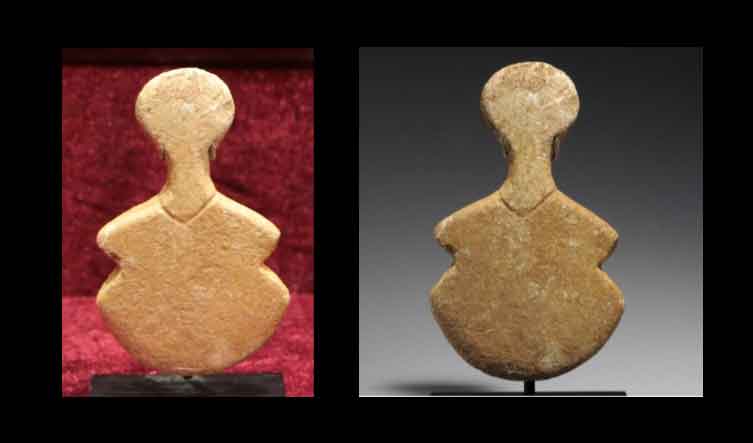
Kusura Type Figure Returned to Turkey

L: Figure Returned to Turkey. R: Figure from Royal-Athena Galleries

Among the recent items returned to Turkey was a Kusura type marble figure. Although there was no statement about the origin of the figure it seems to be the one offered by the Royal-Athena Galleries in New York in 2006 (Art of the Ancient World 17, no. 218) and 2017 (Art of the Ancient World 28, no. 166). It is said to have resided in an anonymous French private collection. 

It will be recalled that 60 items from the Royal-Athena Galleries were returned to Italy in July 2022. Was this Kusura type figure seized at the same time or has it been residing elsewhere? The Manhattan DA does not yet seem to have issued an informative press release about these latest returns to Turkey. 

| |
Bookmark and Share so Your Real Friends Know that You Know

Thursday, 10 May 2018

Symes and a Roman medical set

Top: medical set for auction in Paris
Bottom: image from Schinousa archive
Pierre Bergé & Associés of Paris are offering a rare Roman bronze medical set (16 May 2018, lot 236). Its recorded history is: "Ancienne collection Hishiguro, Tokyo, 1992". The catalogue entry helpfully informs us that the set probably came from a burial ("Cette trousse de chirurgien a probablement été découverte dans une sépulture ...").

The set appears to be the one that has been identified by Dr Christos Tsirogannis from an image in the Schinousa archive thus linking it to Robin Symes.

Given that the catalogue entry suggests that this piece came from a funerary context and that the history of the piece can only be traced back to 1992 (and not to 1970), questions are being raised about the set's origins.

What due diligence was conducted on the medical set prior to offering it for sale? Did Symes sell the set to Hishiguro? How did Symes obtain the set? Who sold it to him?

I understand that the appropriate authorities in France are being informed about the lot.


Bookmark and Share so Your Real Friends Know that You Know

Tuesday, 5 December 2017

An athlete, Robin Symes and the Paris market

Source: Schinoussa archive
Courtesy: Dr Christos Tsirogiannis
Dr Christos Tsirogiannis has identified a Roman marble athlete from the Robin Symes archive. The statue is due to be auctioned in Paris this Friday, 8 December 2017 (Drouot lot 292).

The history of the statue is provided:
  • Royal Athena Galleries, New York:  Art of the Ancient World 4 (1995), p.75-76, lot n°236.
This does not explain why the statue appeared in the confiscated Symes archive. 

Tsirogiannis has also spotted that the statue surfaced at Sotheby's in London Sotheby's on 5th of July 1982. lot 397. Who consigned the statue to that sale? Why does the Paris description fail to mention the Sotheby's information? Would it raise questions about how it surfaced?

Where was the statue between 1982 and 1995?

I understand that the French authorities have been informed about the sale.

Bookmark and Share so Your Real Friends Know that You Know

Monday, 24 April 2017

The Tiberius and the Drusus heads

Tiberius and Drusus. Source: PIASA
Documented collecting histories are important. The portrait heads of Drusus Minor and Tiberius excavated at Sessa Aurunca have parallel histories.

Both passed through the sale of PIASA in Paris on 17-18 March 2003, lot  569, and 29 September 2004, lot 340. Both came from the same source ("Cette tête de même provenance que la tête vendue le 18 Mars 2003 ").

The Drusus was reported to have been purchased by Phoenix Ancient Art, who then sold it to the Cleveland Museum of Art in 2012. It was displayed in the New York exhibition, "IMAGO: Four Centuries of Roman Portraiture", with the information that it had formed part of a 19th century Algerian collection ["Phoenix Ancient Art to Exhibit Collection of Roman Portraits, Unveil Its Newly Renovated New York Gallery", 29 November 2007].

The Drusus appeared in Randy Kennedy's article, "Museum Defends Antiquities Collecting" (originally from the New York Times, 12 August 2012). The article specifically states, "The Cleveland Museum’s new portrait of Drusus Minor has no ironclad record pre-1970". It is noted, "But the museum said it believed its history could be traced back to the late 19th century as the property of a prominent family in Algiers." The source for this collecting history is unstated though was in circulation in 2007. David Franklin, the then director of the Cleveland Museum of Art, was quoted, “We’ve done our due diligence and we feel that both these objects have a pre-1970 provenance” [the other piece was Mayan].

The Tiberius was purchased by the Royal-Athena Galleries and then sold to the US Private Collector. I am told that the private collector returned the head to Italy in January 2017.

It is unclear when the pieces were removed from the Antiquarium in Italy.

I am grateful to Dr Jerome Eisenberg for the additional information and clarification.

Bookmark and Share so Your Real Friends Know that You Know

Wednesday, 19 April 2017

The Drusus and Tiberius portraits from Sessa Aurunca

Drusus Minor. Source: Cleveland Museum of Art
The return of the head of Drusus Minor to Italy from the Cleveland Museum of Art has been in part thanks to the diligent research of Giuseppe Scarpati. He has discovered the photographic records of sculptures discovered during the mid-1920s during the excavations of Sessa Aurunca.

The head of Drusus Minor is clearly recognisable from the archive photographs (Scarpati 2008-11: 357, fig. 7, 358 fig. 10). The head passed through PIASA in Paris in 2004, a source that is not without some interest. It was acquired from Phoenix Ancient Art in 2012. (See Gill 2013: 72 for oral histories and objects linked to this dealer, and with a specific mention to the portrait of Drusus.)

David Franklin, the then director of the Cleveland Museum of Art, defended the acquisition of the head at the time. (He resigned from the museum in 2013.) The museum is probably wishing that it had not claimed that the collecting history had been traced back to the 19th century.

The trail of the Drusus portrait had been identified by a companion piece. The head of Tiberius appears to be the one in a North American private collection ("The Magdalene Tiberius")  and published by John Pollini (Pollini 2005; Scarpati 2008-11: 361 figs. 11-14). It was reported to have formed an old French collection in Marseilles dating to the 1960s. It was said to have been found in North Africa (a good reminded of the intellectual consequences of collecting recently surfaced archaeological material). It was acquired by its present proprietors in 2004. The source appears to have been the Royal-Athena Galleries (Art of the Ancient World 15 [2004] no. 24; Scarpati 2014: 33 fig. 9). Will those owners be contacting the Italian authorities in the light of the return of the Drusus portrait?

It is interesting that the (recent) collecting histories of both portraits now do not seem to go back beyond 2004 (i.e. 34 years after the UNESCO Convention). What were their collecting histories immediately prior to 2004?

The Drusus Minor return is merely serving to open up the discussion. Was the Cleveland Museum of Art aware of Scarpati's research prior to the portrait's acquisition?

Now is probably also a good time for the museum staff to revisit the documented collecting history of the Leutwitz Apollo.

Bibliography

Gill, D. W. J. 2013. "Context matters: The Cleveland Apollo goes public." Journal of Art Crime 10: 69-75. [academia.edu]
Pollini, J. 2005. "A new marble head of Tiberius. Portrait typology and ideology." Antike Kunst 48: 55-72. [JSTOR]
Scarpati, G. 2008-11. "Un ritratto di Tiberio da Sessa Aurunca ritrovato note su un probabile ciclo Suessano di statue onorarie Giulio-Claudie." Rendiconti della Accademia di Archeologia Lettere e Belle Arti 75: 345-68. [Academia.edu]
Scarpati, G. 2014. "Il ritratto di Druso minore dal ciclo statuario Giulio-Claudio di Sessa Aurunca." Bollettino d’Arte 24: 29-38. [Academia.edu]

Press Release
"Cleveland Museum of Art to Transfer Roman Sculpture of Drusus Minor to the Republic of Italy", Cleveland Museum of Art April 18, 2017. [press release]
"Il Cleveland Museum of Art restituisce all’Italia una scultura romana di Druso Minore", MiBACT April 18, 2017. [press release]

Bookmark and Share so Your Real Friends Know that You Know

Tuesday, 19 May 2015

Studying Silver Plate from Gaul

My review article of Kenneth Lapatin (ed.), The Berthouville Silver Treasure and Roman Luxury (Los Angeles: The J. Paul Getty Museum, 2014) has just been published by BMCR [link here]. Lapatin's helpful study reminds us of what can be gained from the methodical study of a distinct group of archaeological material within a wider context of a sanctuary in Gaul. The volume also contains a discussion of Late Roman missoria, some from Italy.

Bookmark and Share so Your Real Friends Know that You Know

Friday, 6 December 2013

The Medici Pan

Sotheby's New York are due to auction a giallo antico marble bust of Pan next week (December 12, 2013, lot 51). The estimate is $10,000-$15,000. Dr Christos Tsirogiannis has pointed out to me that a polaroid image of the sculpture was found on the Geneva Freeport premises of Giacomo Medici. The image is stapled to a form for the Hydra Galerie, an outlet linked to Medici (and see also here).

Sotheby's provide the Pan with the following collecting history: "French private collection, Fontainebleau, acquired circa 1975".

What is the identity of the anonymous French collection? What does the association with Hydra Galerie imply?

Bookmark and Share so Your Real Friends Know that You Know

Tuesday, 21 August 2012

Drusus and PIASA

Source: Cleveland Museum of Art
It appears that the Drusus from an old Algerian collection was sold by PIASA (a point noted by Rick St Hilaire in an important commentary on the portrait).

The first documented surfacing was in September 2004 at a sale in Paris. the press release for the sale notes the head (identified at the time as Tiberius rather than Drusus):
Le 29 septembre à Drouot Richelieu, avait lieu la seconde partie d’une vacation consacrée à l’archéologie, organisée par la maison de ventes PIASA (Picard, Audap, Solanet, Velliet, Teissèdre). Elle comprenait de l’archéologie classique, du Proche-Orient, de l’Egypte, mais aussi de l’art paléochrétien, byzantin et islamique. 
La plus haute enchère a été portée sur une tête monumentale représentant le portrait de l’Empereur Tibère, lot n°340, en marbre blanc à grains fins, Art Romain du Ier siècle, qui a été emportée à 324 013 €. Cette tête provenait d’une collection particulière.
Now PIASA is not without interest. This same syndicate handled a Middle Kingdom alabaster duck, apparently removed from the Saqqara archaeological store, that popped up in the holdings of Rupert Wace in January 2006 (as from a French private collection). How the duck moved from the store to PIASA has not been explained (at least to my knowledge).

Now the Drusus / Tiberius seems to have bobbed onto the market through PIASA about the same time as the duck.

Did the Cleveland Museum of Art investigate PIASA as part of their rigorous due diligence search?

Rick St Hilaire also comments on the way that the collecting history for the portrait is presented in the catalogue of Phoenix Ancient Art.

Bookmark and Share so Your Real Friends Know that You Know

Tuesday, 14 August 2012

Cleveland Comment on Lack of "documentary confirmation"

Source: Cleveland Museum of Art
It is worth noting the way that the Cleveland Museum of Art has drawn comment from various sources (described by Director David Franklin as "that world") over its acquisition of the Drusus from an old Algerian collection, and the Merrin Mayan vase.

Here is a flavour:
The Drusus is now on the AAMD object register. Its collecting history is provided:
Fernand Sintes before 1960; sold at auction at Hôtel Drouot-Richelieu Paris on September 29, 2004, lot. no. 340, unknown purchaser; Phoenix Ancient Art, S.A.(2004); sold to the Cleveland Museum of Art by Phoenix Ancient Art in 2012.
It is perhaps noteworthy that the register entry makes the following comment (emphasis mine): "The Cleveland Museum of Art has provenance information for this work back to the 1960’s, but has been unable to obtain documentary confirmation of portions of the provenance as described below..."

Is the earliest documented surfacing of this portrait no earlier than 2004?

The Merrin Mayan vase has yet to be posted on the AAMD Register.

The Cleveland Museum of Art has also issued a press release ("Cleveland Museum of Art Acquires Two Stellar Antiquities Objects", August 13, 2012), no doubt to counter comment. It includes the alleged (and unsupported) collecting history:
The ownership history of the Drusus Minor portrait has been traced to the late 19th century, when it was the property of the Bacri family of Algiers, Algeria. Sometime before 1960, Fernand Sintes inherited the work, and in 1960 transferred it from Algiers to France. In 2004, it was sold at auction in France.

The Director, David Franklin, emphasises what he terms "responsible collecting" by the Museum:
“I am pleased we can add these important works of art to the museum’s Classical and Pre-Columbian holdings and continue our collecting of the finest examples of art from across cultures and time periods,” stated David Franklin, the Sarah S. and Alexander M. Cutler Director of the Cleveland Museum of Art. “I believe museums play an invaluable role in society as repositories and presenters of the world’s art history, and through responsible collecting, museums make accessible the world’s art objects for the public’s enjoyment and education.”
Perhaps Franklin will produce what appears to be the unauthenticated documentation to defend his acquisition.

Bookmark and Share so Your Real Friends Know that You Know

Monday, 13 August 2012

Drusus from an old Algerian collection

Source: Cleveland Museum of Art
The Cleveland Museum of Art purchased a marble portrait head of Iulius Caesar Drusus Minor (Steven Litt, "Cleveland Museum of Art buys important ancient Roman and Mayan antiquities", Cleveland.com August 12, 2012). The head head has been purchased from Phoenix Ancient Art for an undisclosed sum. Litt provides the collecting history:
The museum said the portrait of Drusus Minor was the property of the Bacri family of Algiers, Algeria, as far back as the late 19th century. The museum said the work was inherited by Fernand Sintes before 1960s, and that Sintes transferred it to France in 1960.
The museum has yet to disclose the authenticated documentation for this reported "pedigree". David Franklin, the director of the Cleveland Museum of Art and expert in Italian Renaissance art, informs the report:
Franklin said the two new purchases follow guidelines established by the Association of Art Museum Directors, which stipulate that museums generally should avoid buying antiquities unless they were documented as being outside their likely country of origin before 1970, the date of an international UNESCO convention aimed at halting the looting of antiquities, or were legally exported thereafter.
What is the evidence that Drusus was known prior to 1970? Franklin appears to expect that questions will be asked about the Drusus.

Cleveland is unwilling to discussion its acquisition of the bronze portrait of Marcus Aurelius that appears to come from Bubon. The collecting history for the so-called Cleveland Apollo (also acquired from Phoenix Ancient Art) has been disputed.

Cleveland was one of the North American museums that agreed to return material to Italy (list here). So there is every reason for the museum to wish to be seen to be conducting a rigorous due diligence process prior to acquisition.

The dispute over the St Louis Art Museum's acquisition of an Egyptian mummy mask, purchased from Phoenix Ancient Art, has shown flaws in the reported collecting history.

The second piece acquired by Cleveland is a Mayan vessel "with a Battle Scene" had apparently passed through the hands of Edward H. Merrin in 1973. (Edward H. Merrin had also handled the "Merrin Zeus" displayed at the Cleveland Museum of Art.)

Bookmark and Share so Your Real Friends Know that You Know

Thursday, 22 April 2010

Smash and grab


There is something very disheartening when you see the results of looting. Objects ripped out of context. Pots broken into fragments. Sculptures smashed. So much damage to supply the market and the appetites of museums and private collectors.

Some collectors will claim that they are preserving the past, but really their desire is to own the past (and to ignore the consequences of the "owning" process).

Do auction-houses and dealers care how recently surfaced antiquities arrived on the market?

Image
Dirt encrusted Roman limestone funerary bust that passed through the stock of a European dealer.

Bookmark and Share so Your Real Friends Know that You Know

Tuesday, 6 April 2010

French Export Licence for Antiquities

What does it mean when an archaeological object is offered at auction with the statement "Accompanied by a French export licence"? Does it guarantee that the object has not been removed from its archaeological context by illicit means? Does it indicate how the object surfaced on the market? Does it mean that the object will not be claimed by the government of the country where it was found?

The left hand of this Roman limestone statue is still covered with traces of encrusted earth. The statue was clearly fresh out of the ground at the time that the photograph was taken. This statue had not come from an "old European collection".

But the statue is clutching one thing: "a French export licence".

Image
Detail from a limestone statue that passed through the stock of a European dealer.

Bookmark and Share so Your Real Friends Know that You Know

Wednesday, 28 October 2009

Theban Tomb 15: who pays for conservation?

I have earlier commented on the Louvre's return of the wall fragments from Theban Tomb 15. Paul Barford has written a discussion of the need to conserve the tomb. Should France be asked to take responsibility?
I think the French government should now be invited to take patronage over TT15, do a proper conservation job and perhaps restoration, and then find a way of making this tomb more secure from further attacks, but also allow its opening to the public and bear all the costs. If they want to "preserve the past", fine. Let them actually do it and not add to the destruction by financing it.
Perhaps the gallery and auction-house that handled the fragments could also be asked to make a contribution.


Bookmark and Share so Your Real Friends Know that You Know

Friday, 9 October 2009

Toxic Antiquities: Lessons from the Louvre

The announcement today that the Louvre would be returning tomb fragments to Egypt raises more disturbing questions. It is being reported that one of the pieces first surfaced at a London auction in the early 1980s. Are museums taking the 1970 benchmark seriously? Does the due diligence process demonstrate a recorded collecting history that can be traced back prior to 1970? Are museums too eager to acquire?

How many other toxic antiquities are still in museum collections?

Bookmark and Share so Your Real Friends Know that You Know

France to Return Tomb Fragments to Egypt

The French Ministry of Culture announced today that the Louvre would be handing over disputed fragments to Egypt (press release October 9, 2009). A scientific commission of 35 experts gave a unanimous decision that the pieces should be returned. The Minister, Frédéric Mitterrand, has followed the commission's advice.

Bookmark and Share so Your Real Friends Know that You Know

Looting Matters: Egypt Puts Pressure on French Museum

Looting Matters: Egypt Puts Pressure on French Museum

Wednesday, 7 October 2009

Egypt Requests Return of Reliefs from Paris

The Tomb of Tetaki in Thebes (TT 15) was investigated by Lord Carnarvon in 1908. It belonged to one of the 18th Dynasty (New Kingdom) officials of Thebes who was alive during the reign of Ahmose (1550-1525 BCE). A photographic record was made at the time of the opening, but, as a result of thefts, Arthur Weigall, the then Chief Inspector, decided to close the tomb. Howard Carter, who had joined Carnarvon in 1909, helped to write up the tomb in Five Years' Explorations at Thebes: a Record of Work Done 1907-1911 (Oxford 1912).

The tomb was reopened in 1924 by Professor Percy Edward Newberry (who held the first chair of Egyptology at the University of Liverpool). A copy of the tomb paintings was made by N. de Garis Davies ("The Tomb of Tetaky at Thebes (No. 15)", The Journal of Egyptian Archaeology 11, 1/2 [1925] 10-18 [JSTOR]).

Further archaeological work on the tomb was conducted by Daniel Polz during the 1990s.

In 2000 and 2003 the Louvre in Paris acquired four funerary reliefs. In today's announcement, Dr Zahi Hawass, Secretary General of Egypt's Supreme Council of Antiquities (SCA), claimed, "The Louvre Museum refused to return four archaeological reliefs to Egypt that were stolen during the 1980s from the tomb of the noble Tetaki" (Paul Schemm, "Egypt cuts ties with France's Louvre museum", AP October 7, 2009). It is claimed that the reliefs were cut out of the tomb during the 1980s.

The vendor of the reliefs has not been stated, and the due diligence processes conducted by the Louvre have not been disclosed. However Frederic Mitterrand, the Minister of Culture for France, stated that the pieces had been acquired in "good faith" ("acquis de bonne foi") [press release]. (On the use of the phrase see here.) A statement from the Ministry continued, "It wasn't until November 2008, after archaeologists rediscovered the tomb from which the frescoes appear to have come, that serious doubts emerged about the legality of their removal from Egyptian territory."

A panel will review the case and decide if the reliefs should be returned to Egypt. Mitterand's statement makes it clear that the reliefs would be returned under the 1970 UNESCO Convention on the Means of Prohibiting and Preventing the Illicit Import, Export and Transfer of Ownership of Cultural Property (see further). This is widely considered to be the benchmark date for considering recently surfaced archaeological material. In the meantime, the Louvre-sponsored excavation at Saqqara has been suspended. A lecture due to be delivered in Egypt by former Louvre curator, Christiane Ziegler, has been cancelled.

Hawass is taking an equally firm line with the St. Louis Art Museum over a mummy case excavated at Saqqara.

Egypt is also seeking the return of "historic" finds (i.e. material acquired prior to 1970) from western museums, among them the Rosetta Stone in London's British Museum (see comments and video of Hawass) and the head of Nefertiti in Berlin.

French authorities seem to be treating Egypt's claim seriously although it appears that the Louvre had refused earlier requests by Hawass.

UPDATE (October 9, 2009): Fragments to be returned to Egypt. Click here.
Bookmark and Share so Your Real Friends Know that You Know

Egypt takes action against the Louvre

It has been announced that Egypt is taking firm action against the Louvre in Paris (Paul Schemm, "Egypt cuts ties with France's Louvre museum", AP October 7, 2009). The issue revolves around the Louvre's possession of four reliefs from the tomb of Tetaki which were acquired in "good faith" in 2000 and 2003.

The statement means that Egypt's Supreme Council of antiquities has suspended the Louvre-sponsored excavation at Saqqara. A lecture due to be given in Egypt by Christiane Ziegler, a former curator at the Louvre has also been cancelled.


Bookmark and Share so Your Real Friends Know that You Know

Saturday, 2 May 2009

"Acquired on the London art market": known before 1970?

I was interested in the collecting histories of pieces at the Bonhams sale this past week (April 29, 2009).

Christos Tsirogiannis in Cambridge has drawn my attention to six lots.
  • lot 48: Roman limestone funerary male bust, Eastern Mediterranean, "Acquired on the London art market in 1998. Accompanied by a French passport", £13,200
  • lot 49: Roman limestone funerary female bust, Eastern Mediterranean, "Acquired on the London art market in 1998. Accompanied by a French passport", £13,200
  • lot 50: Roman limestone funerary male bust, Eastern Mediterranean, "Acquired on the London art market in 1998. Accompanied by a French passport", apparently unsold
  • lot 51: Roman limestone funerary female bust, Eastern Mediterranean, "Acquired on the London art market in 1998. Accompanied by a French passport", £6,600
  • lot 52: Roman limestone funerary male bust, Eastern Mediterranean, "Acquired on the London art market in 1998. Accompanied by a French passport", apparently unsold
  • lot 53: Roman limestone funerary male bust, Eastern Mediterranean, "Acquired on the London art market in 1998. Accompanied by a French passport", apparently unsold

They seem to form a coherent group. Which London dealer or gallery handled the pieces in 1998? What was their collecting history prior to 1998? Have they been in a French collection?

What does the "French passport" imply?


Wednesday, 11 February 2009

YSL and Antiquities

Christie's will be auctioning the Collection Yves Saint Laurent et Pierre Bergé at the Grand Palais, Paris next week (23-25 February 2009). There are 14 lots of 'Ancient Art and Antiquities', mostly classical marble sculpture with two Attic kraters and two Egyptian pieces.

The stated sources are:
  • Galerie Akko van Acker, Paris: lot 695, marble Minotaur (1985; formerly French private collection 1970).
  • Galerie Krimitsas, Paris: lot 679, torso of Narcissus (around 1980); lot 681, Attic bell-krater (around 1970-1980; formerly Woodyat Collection, 1912); lot 682, head of Dionysos (around 1980); lot 688, Attic bell-krater (around 1970-1980); lot 690, head of Diomedes (around 1980); lot 691, Egyptian anthropoid wooden coffin (1975); lot 693, Attic black-glossed hydria (1970)
  • Galerie Marc Lagrand, Paris: lot 680, torso of athlete (1970-1980).
  • Galerie Simone de Monbrison, Paris: lot 694, torso of Mercury (around 1975).
  • Not stated: lot 687, torso of athlete (between 1970 and 1980); lot 689, Roman marble column (1970-1980); lot 692, Egyptian bronze of Mahes (between 1970 and 1980); lot 696, torso of athlete (between 1970 and 1980)
Two pieces have estimates of €300,000 - €500,000 (lots 680 and 695). Only one piece has a recorded history prior to 1970 (lot 681).

Krater fragments in Princeton

Greek, Attic, probably by the Kleophrades Painter, ca. 490–480 BCE, Two non-joining fragments from a calyx-krater (mixing bowl) depicting ar...