Showing posts with label East Anglia. Show all posts

Thursday, 23 November 2017

Treasure Finds and metal-detecting

© David Gill
Ian Richardson has commented on his favourite Treasure Finds (Laurence Cawley, "Treasure finds in England top 1,000 for first time", BBC News 23 November 2017). This coincides with the number of Treasure Finds passing the 1,000 mark for the third year in a row. (See statistical summary here.)

Norfolk and Suffolk top the list with 211 finds. Julie Shoemark, the finds liaison officer for Norfolk, commented that "the rising number of reported treasure finds corresponded to a growth in the numbers of metal detecting clubs."

There is no comment from Richardson on the scale of the lost or damaged archaeological contexts represented by the 1,120 Treasure Finds.


Bookmark and Share so Your Real Friends Know that You Know

Tuesday, 17 October 2017

Looting of archaeological sites in East Anglia

BBC Look East 17 October 2017
BBC Look East has covered the problem of looting on archaeological sites in East Anglia (October 17, 2017). The report covers the problem of illegal metal-detecting on the site of Great Chesterford, the response from the police (including PC Andy Long of Essex Constabulary) and landowners, as well as from metal-detectorists. Police will be installing cameras at key sites, as well as deploying drones to identify criminal activity.

The message that needs to get through is that archaeological contexts are being lost, and key pieces are not being reported.

The programme is available here for 24 hours.

BBC Look East 17 October 2017
Bookmark and Share so Your Real Friends Know that You Know

Wednesday, 30 November 2016

Anglo-Saxon jewellery declared treasure

A piece of Anglo-Saxon jewellery discovered by a metal-detectorist in a Norfolk field near Diss has been declared Treasure ("Anglo-Saxon find in Norfolk declared treasure", BBC News November 29, 2016; see also "Anglo-Saxon pendant: Norfolk student makes 'royal' find", BBC News February 27, 2015). A subsequent excavation showed that this came from a female burial.

Bookmark and Share so Your Real Friends Know that You Know

Wednesday, 18 March 2015

Rendlesham and metal-detecting

Professor Chris Scull gave an excellent presentation on the Rendlesham project to the Heritage Futures seminar today. He explained how the team was able to map the vicus regius on the landscape. One aspect of the presentation was the constructive use of metal-detectorists to map finds in the study area. It was clear how their carefully recorded work contributed to the understanding of this important Anglo-Saxon site that clearly has a relationship with the major ship burial site at nearby Sutton Hoo.

During the questions and discussion a little detail was revealed about the 'illegal' metal-detectoring on the site that led to investigation of the site. Scull thought that the fact that Rendlesham was known as a 'royal' site had probably attracted metal-detectorists. (I noted that there was never a mention of 'nighthawking' by Scull or members of the audience.) We were informed that a local estate worker had spotted searchers working at night.

Scull made a strong case for responsible and collaborative metal-detecting. But there was also a reminder of the damage that could be sustained to a site that clearly has international significance.

Earlier discussion of Rendelsham here.


Bookmark and Share so Your Real Friends Know that You Know

Saturday, 15 March 2014

Rendlesham exhibition

Rendlesham opening at Sutton Hoo © David Gill
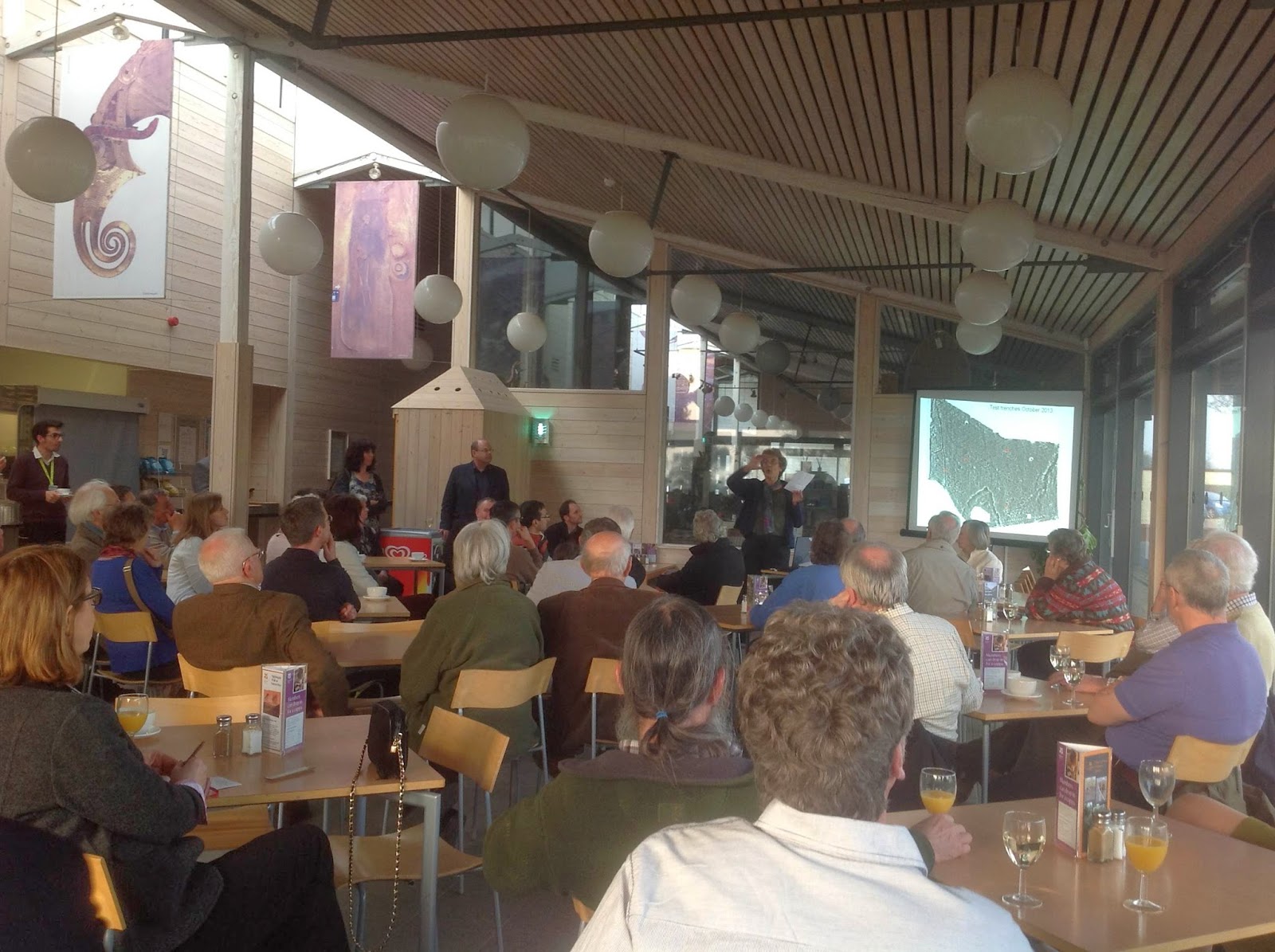
I attended the opening of the exhibition of finds from the Anglo-Saxon site at Rendlehsam last night. This took place at the National Trust's Sutton Hoo visitor centre. It was a glorious evening with talks on the discovery of the site and its interpretation.

It was stressed that Rendlesham was the elite site — perhaps the location of King Raewald —whereas Sutton Hoo related to "death and memory". It looks as if we now have two major Anglo-Saxon sites in close proximity.

What became clear during the evening was the damage that had been sustained to the site by "nighthawkers". (Before anybody comments, three local metal-detectorists were present at the event as they helped to map small finds in the vicinity of the site.)

There is more on the Rendlesham site from BBC News. The Ipswich Star has been commenting on the damage sustained to the site [press].

We need to recognise that this internationally significant site has been damaged by illicit activity. Information has been lost. It is another reminder of the intellectual consequences of unscientific "exploration" of archaeological sites.

Bookmark and Share so Your Real Friends Know that You Know

Another Bürki object returns to Italy

Source: MMA A psykter column-krater attributed to the Troilos painter was deaccessioned by New York's Metropolitan Museum of Art in June...