Showing posts with label Getty Museum. Show all posts

Wednesday, 18 September 2024

Bronze kline returns to Türkiye

Source: J. Paul Getty Museum


The J. Paul Getty Museum has decided to return bronze kline to Türkiye [press release]. This was acquired from Nikolas Koutoulakis in 1982.

The kline and other objects seemingly derived from Türkiye have been discussed elsewhere (Gill 2019).

It is even suggested that the bed or kline ‘probably entered the antiquities market as the result of illicit excavations’ (Baughan and Özgen 2012, 63). It may even coincide with a bronze bed that was reported to have been looted in 1979. Interestingly it was claimed that the bed had passed through the S. Schweitzer collection; such a collection was claimed for one of the pieces that the Getty has returned to Italy and it was noted that this may have been ‘a convenient way to launder recently surfaced antiquities’ (Gill and Chippindale 2007a, 216, 229, no. 23). A further report even suggested that the bed had been acquired by a Paris dealer in 1936, though there seems to be no authenticated documentation.

Why has it taken the Getty so long to resolve this dispute? What other objects in the collection will follow the kline back to Türkiye? 

References
Baughan, E. P., and I. Özgen. 2012. "A bronze kline from Lydia." AK 55: 63–87.
Gill, D. W. J. 2019. "Context matters: Nicolas Koutoulakis, the antiquities market and due diligence." Journal of Art Crime 22: 71–78.
Gill, D. W. J., and C. Chippindale. 2007. "From Malibu to Rome: further developments on the return of antiquities." International Journal of Cultural Property 14: 205-40.

| |
Bookmark and Share so Your Real Friends Know that You Know

Attic Funerary Relief Returns to Greece

Sources: Hellas et Roma; Hellenic Ministry of Culture


The Hellenic Ministry of Culture has announced that part of a fourth century BCE Attic marble stele has been returned from an anonymous US private collection [Press Release]. The relief featured in an advertisement for the gallery Palladion Antike Kunst that appeared in the back of a 1982 exhibition catalogue produced by the Swiss-based organisation Hellas et Roma.  (The Ministry of Culture press release misleadingly suggests that the relief appeared in an exhibition catalogue implying that the stele was displayed.) A parallel for the stele was found at Kallithea in 1896; it marked the burial of Agnostrate daughter of Theodotos (Athens NM inv. 1863: cat. no. 417).

Christos Tsirogiannis has verified that images of the returning stele feature in the Becchina archive, and specifically to Nino Savoca, a dealer based in Munich. It appears that the stele first surfaced in the late 1970s. 

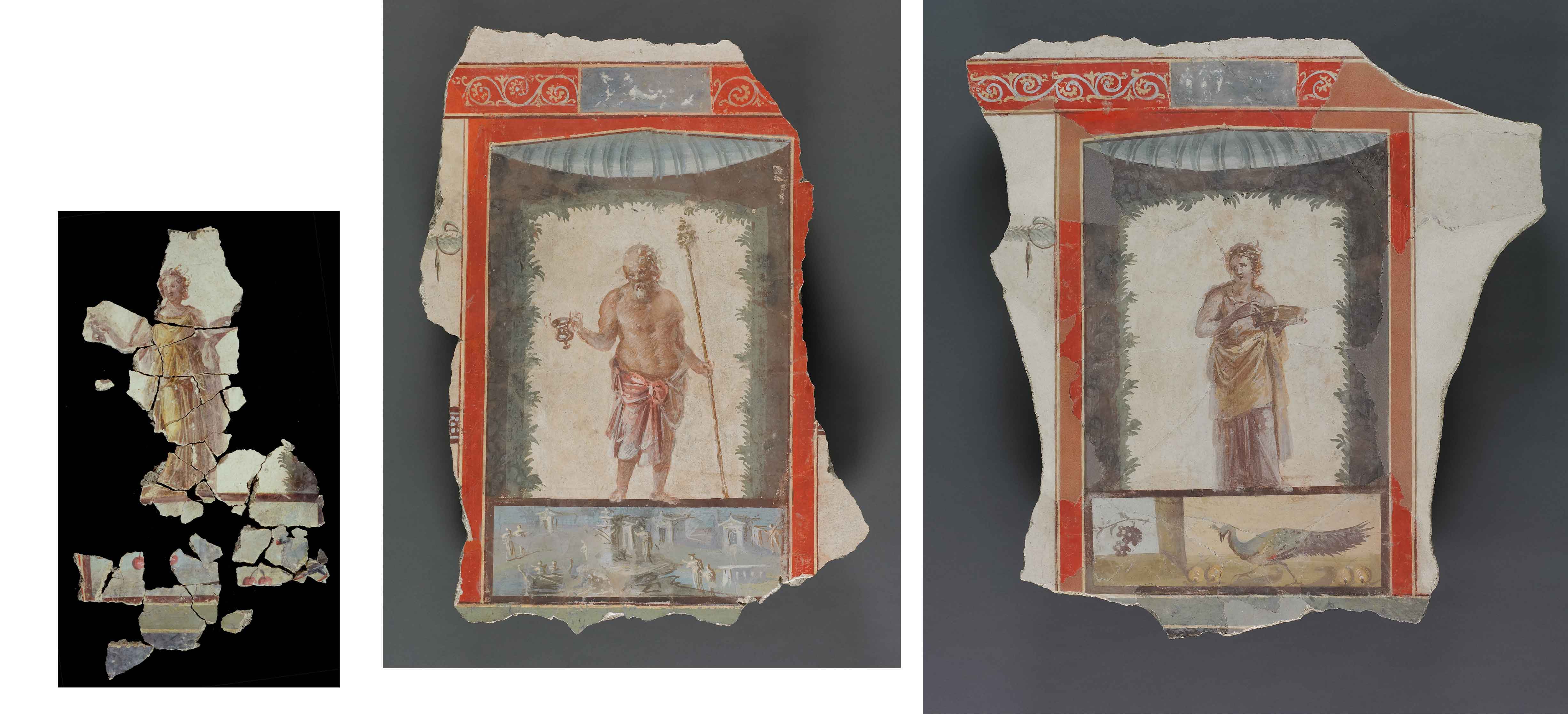
This stele forms part of a growing list of objects returned to Greece and Italy that had featured in the Becchina archive. Yet the Hellenic Ministry of Culture seems to be reluctant to seek the return of other objects that feature in this source, notably the Cycladic figure in the Leonard Stern collection (and currently on loan to New York's Metropolitan Museum of Art) and the pithos, probably from Rhodes, in the Michael C. Carlos Museum at Emory University. (The Italian authorities, likewise, do not seem to have requested the return of fragmentary wall-paintings in the J. Paul Getty Museum.) 

Source: Hellenic Ministry of Culture
The stele fragment was returned with two other items: a fragmentary 4th century BCE funerary stele, perhaps from Thessaly, showing a woman (next to a child; note the raised hand) who holds a box; and an hellenistic bronze male figure, perhaps of an athlete. 

| |
Bookmark and Share so Your Real Friends Know that You Know

Wednesday, 24 April 2024

Another Bubon bronze head likely to be repatriated


It appears that a bronze head acquired by the J. Paul Getty Museum from Nicolas Koutoulakis has been removed from display and appears to be returning to Türkiye (Adam Schrader, "The Getty Museum Returns an Ancient Bronze Head to Turkey", Artnet April 24, 2024). The head had featured in the Fire of Hephaistos exhibition (1996) no. 44: the find-spot was stated as "Reported to be from Ibecik (ancient Bubon in Lycia) in Turkey". Arielle Kozloff had earlier listed the statue among the Bubon pieces in The Bulletin of the Cleveland Museum of Art (1987).

This will put further pressure on the Cleveland Museum of Art in their attempt to disassociate a headless bronze statue from its suggested link with Bubon and its identification with the emperor Marcus Aurelius. Incidentally, the Cleveland statue was illustrated in the Fire of Hephaistos catalogue (cat. 54, fig. 2): "... possibly Marcus Aurelius ... Reported to be from Ibecik (ancient Bubon in Lycia)."

| |
Bookmark and Share so Your Real Friends Know that You Know

Friday, 10 November 2023

The Wild Goat Plate Fragment and Francavilla Marittima

Source: Michael C. Carlos Museum


The Michael C. Carlos Museum at Emory University has returned a Wild Goat fragment to the Italian government. The statement notes:
In June 2021, Italy’s Ministry of Culture presented the Carlos with photographic evidence that the Carlos fragment joins with two other fragments from the same plate. One fragment, currently housed in the Museo Nazionale Archeologico della Sibaritide, was unearthed during official excavations at the Timpone della Motta Sanctuary in Francavilla Marittima. The second fragment was returned to Italy from a European museum following evidence it had come from illegal excavations at Timpone della Motta.
This is no doubt associated with the 3500 fragments acquired by the J. Paul Getty Museum in 1979 and 1983: the 1983 batch included joining fragments from the Institute of Archaeology in Bern. Other museums, including the Ny Carlsberg in Copenhagen, are said to have fragments from this same cache. 

The main cache of material was returned to Italy in 2001, four years before the Carlos Museum acquired its fragment. 

| |
Bookmark and Share so Your Real Friends Know that You Know

Wednesday, 15 February 2023

A Roman fresco fragment and some apparent cut marks

Malibu 83.AG.222.9
Source: J. Paul Getty Museum

Among the fresco panels and fragments from ‘a wealthy Roman’s seaside villa in the area of the Bay of Naples’ acquired by the J. Paul Getty Museum in 1983 from Palladion Antike Kunst is this panel with two fish (inv.  83.AG.222.9). Someone appears, at some point prior to acquisition, to have tried to cut a square panel from the fragment.  Why would they want to damage the panel in that way? 

Is this evidence of how the panel(s) was (were) removed from the archaeological context?  Or was someone trying to cut down the panel to make it easier to move? What would have happened to the remaining section of the fragment?

Such an indication is reminiscent of the panel returned from the Shelby White collection (no. 142; 86.2 cm by 86.5 cm) that came from the same composition as two fragments from the Fleischman collection and acquired (and returned) by the Getty (nos. 125 and 126; 91 cm by 80.5 cm, 61 cm by 81 cm). [See discussion here.]

| |
Bookmark and Share so Your Real Friends Know that You Know

Tuesday, 14 February 2023

Two octagonal panels probably from the Bay of Naples

Two octagonal panels. Malibu inv. 83.AG.222.5, 7

Yesterday I noted three panels apparently from the same room of a villa that probably stood somewhere in the vicinity of the Bay of Naples. Like the other panels, this pair of frescoes was derived from Palladion Antike Kunst in 1983. Unlike the other pieces these two are not currently on display. 

How did these fragments leave their villa and move to California? Will the curatorial team at the Getty be raising this with their Italian colleagues?


| |
Bookmark and Share so Your Real Friends Know that You Know

Monday, 13 February 2023

The frescoes from a wealthy seaside villa

Three panels acquired by the J. Paul Getty Museum in 1983.
Inv. 83.AG.222.2, 4, 8.

In 1983 the J. Paul Getty Museum acquired a series of Roman frescoes on the 'European market', in fact from Palladion Antike Kunst in Basel. The Getty's handbook suggests that they are derived from ‘a wealthy Roman’s seaside villa in the area of the Bay of Naples’. 

Elizabeth Marlowe has commented on the displayed fragments, suggesting that the panels had been removed from a single room somewhere in the vicinity of Vesuvius. Indeed, there are fragments that were acquired at the same time that clearly come from a third panel, presumably from the same room. Daniela Rizzo and Maurizio Pellegrini have recently drawn attention to the problematic nature of these frescoes and published an image of a further section of the decoration that appears in the Becchina photographic archive. 

How does the Getty interpret the history of the fragments? Is the museum actively seeking to return the sequence of fragments to Italy?


References
Lapatin, K. D. S., and K. Wright. Editors. 2010. The J. Paul Getty Museum: Handbook of the Antiquities Collection. Los Angeles: J. Paul Getty Museum.
Marlowe, E. 2020. "The reinstallation of the Getty Villa: plenty of beauty but only partial truth." AJA 124: 321–32. [Online]
Rizzo, D., and M. Pellegrini. 2021. "The Italian Archaeological Heritage Abroad: Between Agreements, Debates and Indifference." In Stolen Heritage: Multidisciplinary Perspectives on Illicit Trafficking of Cultural Heritage in the EU and the MENA Region, edited by A. Traviglia, L. Milano, C. Tonghini, and R. Giovanelli, Antichistica, vol. 29: 99–114. Venezia: Edizioni Ca’ Foscari. [Online]

| |
Bookmark and Share so Your Real Friends Know that You Know

Friday, 7 October 2022

From Geneva to the Steinhardt Collection


Source: Manhattan DA

Five objects (Attic head aryballos; Protocorinthian duck and owl; Corinthian bull's head; Ionian ram's head; Apulian head vase) in the seizure of antiquities from the collection of Michael Steinhardt have something in common: they were placed on loan with Geneva's Musée d'Art et d'Histoire (1978–81). And all of them were subsequently placed on loan with the J. Paul Getty Museum (1984–96). And all of them were sold by Robin Symes to the Beierwaltes in 1996. All but the Apulian head vase appear in images from the Medici Dossier: the head vase itself appears in the Becchina archive (with an Attic skyphos now returned from the Shelby White collection).

Such loans to these two museums were used as a response to seizures  in 2018 from another dealer. It is almost as if the loans created an acceptable collecting history. This raid seems to relate to another group of material. 

The Geneva museum has associations with other loans such as the Ka-Nefer-Nefer mummy mask (though the museum does not have a record of the loan). And the Getty accepted loans of fragments from some of these same individuals, as well as complete pots such as the Steinhardt hydria.

It should be noted that the same Geneva museum appears to be linked to the Apulian grave group acquired by Berlin. 

What part did Geneva play in handling recently surfaced antiquities and providing them with a history? What other objects passed this way? The papers relating to the Steinhardt seizure expand on this aspect.

And how many of these objects were then placed on loan with the J. Paul Getty Museum? 

Note: Identifications from the Medici Dossier and the Becchina Archive were made by Christos Tsirogiannis.

| |
Bookmark and Share so Your Real Friends Know that You Know

Tuesday, 20 September 2022

The Steinhardt hydria attributed to the Antimenes painter

Source of images: Manhattan DA.

Among the items seized from the Michael Steinhardt collection and returned to Italy was an Attic black-figured hydria attributed to the Antimenes painter. The hydria had been identified from an image in the Medici Dossier.

The Manhattan DA reports that the hydria had first surfaced with Robin Symes in 1983 (when it was advertised in Apollo). The statement then adds:
By 1987, Symes had transferred the object to the New York-based Atlantis Gallery, part-owned by Robert Hecht, who then loaned it to the Getty Museum. From 1987-1996, the object was on view at the Getty Museum prior to its sale to Steinhardt through Sotheby’s New York on December 17, 1996. 
Steinhardt is report to have purchased the hydria from Sotheby's for $169,411.

The Beazley Archive (BAPD 31596) provides the loan number for the Getty (L87.AE.4) as well as the details for the Sotheby's New York sale (17 December 1996, lot 49). It also suggests that the hydria passed through the Royal-Athena Galleries though this information may not be correct.

Christopher Chippindale and I had rehearsed the history of this specific hydria in our review article of The Medici Conspiracy (2007) [see here]. We clarify that the hydria was placed on loan at the Getty in January 1987, and returned in February 1996. This raises a question about the nature and purpose of loans that were placed at the Getty.

It should be recalled that one of the Attic black-figured neck-amphorae seized from Fordham University was attributed to the circle of the Antimenes painter (BAPD 24304).

It should be noted that the identification of the Steinhardt hydria was made by Associate Professor Christos Tsirogiannis. 

| |
Bookmark and Share so Your Real Friends Know that You Know

Friday, 12 August 2022

Further returns from the Getty announced


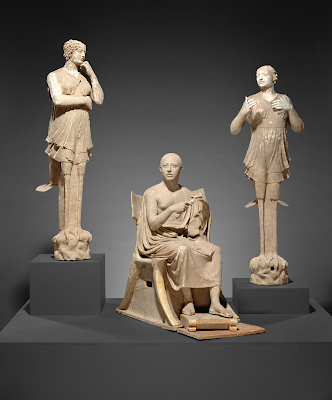
The items include three terracotta figures known as 'Orpheus and the Sirens' acquired in 1976 (inv. 76.AD.11). They were purchased from Bank Leu in Zurich. (For further information see the catalogue of terracottas at the Getty.)

Four other items from the Getty will be returned:
Recent research by Getty and independent scholars also determined that it is appropriate to return a second-century AD colossal marble head of a divinity; a second-century AD stone mold for casting pendants; an oil painting entitled Oracle at Delphi, 1881, by Camillo Miola; and a fourth-century BC Etruscan bronze thymiaterion. The first three of these objects were acquired by J. Paul Getty and the Getty Museum in the 1970s; the fourth in 1996. None of these objects have been on public view in recent years. Getty is currently working with the Ministry of Culture to arrange their returns.
There is no indication in the press statement about the sources though I understand that several feature in the photographic archives seized in Switzerland and Greece. 

The colossal marble head (inv. 72.AL.96) was acquired from Robin Symes. An Etruscan bronze thymiaterion was acquired in 1996 from the Fleischman collection (inv. 96.AC.253). It was sold to the  Fleischmans in 1987 by Edoardo Almagià. (This would be the second Almagià piece to be returned by the Getty.)

The story also appears in The Art Newspaper (incorrectly stating that the thymiaterion was purchased in 1996).


Bookmark and Share so Your Real Friends Know that You Know

Monday, 21 March 2022

Roman Fresco Fragment: The Woman on a Balcony

Fresco Fragment: Woman on a Balcony,
10 B.C.–A.D. 14, Fresco

60 × 45.2 × 3 cm (23 5/8 × 17 13/16 × 1 3/16 in.),
96.AG.172

The J. Paul Getty Museum,
Villa Collection, Malibu, California,
Gift of Barbara and Lawrence Fleischman

The research of Christos Tsirogiannis has been highlighted in The Observer (Dalya Alberge, "Fresco fragment from Pompeii reopens row over 'looted' antiquities", March 20, 2021). The Roman fresco fragment had formed part of the Barbara and Lawrence Fleischman collection. The fragment had been acquired from Fritz Bürki in 1987, but it had also featured in the photographic archive of Robert Hecht. 

There are some 60 items in the Fleischman collection that were acquired from Bürki; only four are formerly listed as derived from Hecht. 

| |
Bookmark and Share so Your Real Friends Know that You Know

Tuesday, 11 January 2022

A Bothmer fragment sourced from Almagià


When 40 of Bothmer pot fragments were returned to Italy from New York's Metropolitan Museum of Art there was the statement from the museum's spokesperson, Elise Topalian, reported by Chasing Aphrodite:
Von Bothmer was a client of Almagia for many years, Topalian said. The fragments von Bothmer obtained from the dealer were returned to Italy “to serve as evidence in the investigation and possible trial of Edoardo Almagia.”
In the statement of fact relating to Michael Steinhardt's collection an example of Almagià's sales from the summer of 1994 is provided. This suggests that Almagià provided "Frammenti Attici" that had been purchased from Mauro Morani $22,000.

One of the pieces purchased by Bothmer from Almagià in 1987 was a fragment, measuring 1.9 cm, of an Attic red-figured cup attributed to the Triptolemos painter (Malibu inv. 87.AE.154). 103 fragments of the same cup were purchased in 1990 from Galerie Nefer (Malibu inv. 90.AE.35). 

Where did Almagià acquire his fragment? Where did the Galerie Nefer acquire its fragments? 

Were other Bothmer fragments in the Getty acquired from Almagià?
| |
Bookmark and Share so Your Real Friends Know that You Know

Tuesday, 28 December 2021

Further returns from the Getty

White on Red Lidded Pithos
Formerly Malibu inv. 96.AE.135.
The Manhattan DA Office mentioned the return of seven items from the J. Paul Getty Museum; they were seized on April 2, 2021, and the press release specifically states that they "were trafficked by ALMAGIÀ". [press release] 

Only one piece is listed in the Manhattan DA press release: "A Pithos with Ulysses, dating to 7th Century B.C.E. and valued at $200,000".

This is the lidded White on Red pithos decorated with the blinding of Polyphemos.  It was given to the Getty by Barbara and Lawrence Fleischman (inv. 96.AE.135; cat. no. 86). The pithos no longer appears on the online Getty catalogue. 

I am grateful to the Getty for providing details of the other pieces:

a. A White on Red Lidded Pithos. Gift of Barbara and Lawrence Fleischman. Inv. 96.AE.136; cat. no. 87.
b. A pair of Caeretan sub-geometric plate attributed to the circle of the Crane painter. Gift of Barbara and Lawrence Fleischman. Inv. 96.AE.137.1-2; cat. no. 88–89, A–B. 
c. A pair of Caeretan sub-geometric plates attributed to the Heron class. Gift of Barbara and Lawrence Fleischman. Inv. 96.AE.138.1-2; cat. no. 88–89, C–D. 
d. An Attic red-figured stemless cup, attributed to the Marlay painter. 'New York art market'. Inv. 86.AE.479; BAPD 41037.

The stemless cup had already been identified by Chasing Aphrodite.


Bookmark and Share so Your Real Friends Know that You Know

Monday, 27 December 2021

Etruscan White on Red Ware Returning to Italy


Bookmark and Share so Your Real Friends Know that You Know

Wednesday, 8 December 2021

Returning Athenian pottery from the Steinhardt collection

Source: Manhattan District Attorney's Office

The documentation for the Michael Steinhardt  collection identifies several Attic pieces that will be returned to their country of origin, presumably Italy and Greece.
  • Attic black-figured Sphinx cup, 'Tleson, son of Nearchos' (pp. 19–20). Identified from the Medici dossier. Symes sold to Beierwaltes (January 8, 1996); Phoenix Ancient Art (2006); Steinhardt purchased from Phoenix Ancient Art for $310,000 (2007).
  • Attic red-figured oinochoe attributed to the Berlin painter (pp. 20–21). Identified from the Medici dossier. Steinhardt purchased from Harry Bürki for $215,000 (1996); Steinhardt's records show that the oinochoe had been sold by Robert Hecht.
  • Attic black-figured hydria showing Herakles and Kyknos attributed to the Leagros group (p. 21).  Identified from the Medici dossier. Displayed by Christos Bastis at New York's Metropolitan Museum of Art (1987); Bastis died (1999); Steinhardt purchased from Michael Ward for $127,000 (2000). The paperwork omits that the hydria surfaced at Sotheby's (London) July 11–12, 1983, lot 352, and was sold at Sotheby-Parke-Bernet, New York, December 9, 1999, lot 92. [BAPD 9050]
  • Attic black-figured hydria showing women at a fountain-house attributed to the Antimenes painter (pp. 22–23). Identified from the Medici dossier. Robin Symes advertised the hydria (1983); Atlantis Gallery, New York (1987); loan to the J. Paul Getty Museum L87.AE.4 (1987–96); Steinhardt purchased it at Sotheby's for $169,411 (December 17, 1996, lot 49). [BAPD 31596]
  • African head vase (pp. 23–24).  Identified from the Medici dossier.  Displayed in the Musée d'Art et d'Histoire, Geneva (1978–81); J. Paul Getty Museum (1984–96); Symes sold the piece to the Beierwaltes (1996); Beierwaltes consigned it to Phoenix Ancient Art (2006); Steinhardt purchased it from Phoenix Ancient Art for $163,312.50 (2009). 
  • Attic black-figured eye-cup (pp. 35–36). Identified from the Becchina archive. Mario Bruno, Lugano; sold to Becchina; TL tested by Ralf Kotalla, Germany(July 1992); Robert Hecht sold it to Steinhardt for $170,750 (June 15, 2000).
  • Attic black-figured amphora (p. 50). Identified from the Almagià archive. Purchased from a tombarolo for $6,500; sold for $13,000; accessioned by Steinhardt as coming from Almagià (1997). 
  • Attic black-figured plemochoe (pp. 54–55). Identified from the Symes archive. Photographed by Dieter Widmer (1985); held as loan by Sotheby's London for Budico SA, owned by Henri-Albert Jacques (1989); stolen from Sotheby's and recovered by the police; Budico SA sold it through Sotheby's to Steinhardt for $84,083 (December 11, 2002). Note: 'Ex. Private Coll. London, RS + CM' (?Symes and Michaelides).
  • Attic white ground lekythos attributed to the Triglyph painter (p. 56). Identified from the Symes archive. Symes sold it to the Beierwalters for $360,000 (June 22, 1995); consigned to Phoenix Ancient Art (2006); Steinhardt purchased from Phoenix Ancient Art for $380,000 (December 14, 2006).
| |
Bookmark and Share so Your Real Friends Know that You Know

Wednesday, 30 December 2020

Fragments attributed to the Berlin painter


What questions should we be considering when we study the fragments of Athenian red-figured pottery that are dispersed between different collections and museums? This short study takes the example of some five pieces attributed to the Berlin painter (BN3, BN9, BN12, BN29, BN38); two have been returned to Italy. When were these fragments moved to different collections? Who was involved? In the case of two of the pieces, the initial fragments were presented to the museum only to be followed by purchases from a different source. Such a pattern of acquisition is not confined to the Berlin painter.

This paper questions the position taken by James Cuno that scholars should not seek the clarify the "provenance" (I prefer "history") of such fragments. 

The fragments are a reminder of the information that has been lost by the unscientific removal of Athenian pottery from funerary and other archaeological contexts.

Gill, D. W. J. 2020. "Fragmented Athenian Pots and the Berlin Painter: Recent Breaks?" Academia Letters, Letter 40: 1–5. [DOI]


Bookmark and Share so Your Real Friends Know that You Know

Monday, 21 December 2020

Donations and purchases at the J. Paul Getty Museum


My latest essay for the Journal of Art Crime looks at the pattern of donations of figure-decorated pot fragments to the J. Paul Getty Museum by Werner Nussberger. Some 6000 pieces were donated to the Getty in 1981. The study identifies how additional pieces from the same pots were purchased from Galerie Nefer in 1985 and 1986. Other handlers of pot fragments are identified. 


Bookmark and Share so Your Real Friends Know that You Know

Thursday, 10 December 2020

Funerary reliefs from Ostia

Funerary reliefs of the Caltilii.
Source: Tampa Museum of Art (L), The J. Paul Getty Museum (R).


The Italian Senator, Margherita Corrado, has raised the issue of funerary reliefs from the tomb of the Caltilii in Ostia ("Italian Senator Margherita Corrado commenting on two suspect Roman altars at the J. Paul Getty Museum and the Tampa Museum of Art", ARCA blog, December 8, 2020).  She has identified two Roman funerary reliefs that appear to come from a family burial area on the Via dei Sepolchri. One is in the J. Paul Getty Museum (inv. 83.AA.209), donated by Achille Moretti, and the other in the Tampa Museum of Art (inv. 1991.001), purchased by The Collectors. 

The Tampa relief is the monument of L. Caltilius Diadumenus (with a mention of L. Caltilius Euhodus) (AE 2001 [2004], no. 621, 'fouilles clandestines'), and the Getty shows the funerary altar of L. Caltilius Stephanus and Caltilia Moschis. Caltilia Moschis also appears in a second relief now in the Palazzo Mattei in Rome (and discussed in Roman Funerary Sculptures no. 27). The Getty relief surfaced in an exhibition, partly arranged with J. Frel, at Geneva's Musée d'histoire et d'art in 1982. Corrado's press release claims that documentation in the seized Becchina archive shows that Palladion Antike Kunst tried to sell the altar to a US museum on behalf of a Swiss-based collector. 

Did the curatorial team at Tampa investigate the history of the relief when concerns were raised about it in 2004? Who handled the relief before it was sold to Tampa?

Bookmark and Share so Your Real Friends Know that You Know

The Afrati Armour in Harvard

Source: Harvard Art Museums The repatriation of the Afrati armour from New York's Metropolitan Museum of Art has implications for other ...