Showing posts with label Robin Symes. Show all posts

Monday, 15 December 2025

Further returns to Italy from the San Antonio Museum of Art

Source: San Antonio Museum of Art
In addition to the objects deaccessioned by the San Antonio Museum of Art in September 2025, the museum  had done the same for another group in January 2022. These were mentioned (without significant detail) in a press release from the Manhattan DA in 2023. These items included material that surfaced through various sources:

Christie's (Geneva)
Attic red-figured lekythos. Inv. 86.134.75. Surfaced through Christie’s (Geneva) May 1979; Sotheby’s (London) May 1982. 

Christie's (London)
Attic white ground lekythos. Inv. 86.134.170. Surfaced through Christie’s (London) July 1983; July 1985. 

Frederick Schultz
Attic red-figured head kantharos. Inv. 91.24. Surfaced through Frederick Schultz, 1989. 

Galerie Günter Puhze
Attic black-figured lekythos. Inv. 91.80.1. Galerie Günter Puhze, 1989. 

Palladion Antike Kunst
Attic black-figured amphora. Inv. 86.134.31. Surfaced through Palladion Antike Kunst; Sotheby’s (London) December 1981. 
Attic red-figured oinochoe. Inv. 86.134.58. Surfaced through Palladion Antike Kunst; Robert Hecht. 

Robin Symes
Portrait of Hadrian. Inv. 2005.1.81. Robin Symes; Royal-Athena Galleries; Sotheby’s (New York) June 1992. [Image identified in the Medici Dossier.]
"Dating to 200 C.E., the marble head of the Emperor Hadrian was first documented uncleaned and covered in marine encrustations in a polaroid photograph. The polaroid was recovered by Italian law-enforcement authorities during a raid of the office and warehouse of well-known antiquities trafficker Giacomo Medici in 1995. After being smuggled out of Italy by Medici and his co-conspirators, the piece was then laundered with false provenance by dealer-trafficker Robin Symes before being sold in New York County in 1992." (Manhattan DA)
Sotheby's (London)
Corinthian olpe. Inv. 93.17. Surfaced in Sotheby’s (London) July 1990; Charles Ede. 
Attic black-figured amphora. Inv. 86.134.173. Surfaced in Sotheby’s (London) July 1985. 
Attic red-figured lekythos. Inv. 86.134.79. Surfaced through Sotheby’s (London) May 1982. 

Alfredo Turchi
Head of Hermes. Inv. 86.134.145. Sold by Alfredo Turchi.

The head of Hermes was excavated in Rome in the 19th century. 

| |
Bookmark and Share so Your Real Friends Know that You Know

Thursday, 6 November 2025

Byzantine Capital Returned to Türkiye


A marble Byzantine capital showing the archangel Michael has been returned to Türkiye from New York's Metropolitan Museum of Art (inv. 1983.167) [JSTOR]: it has been placed on loan at the museum (L.2025.28). The history (so-called "provenance") of the piece is as follows:
Possibly from the monastery of the Virgin Peribleptos, or All-Seeing (now the Sulumanastir, Istanbul); [Robin Symes Limited, London (sold 1983)]; Deaccessioned for transfer of title to Türkiye in September 2025
This adds to the growing list of objects linked to Robin Symes that have been repatriated to Greece, Italy and Türkiye. 

The capital is said (by whom?) to have been found near to the Sulu Manastir. If so, did the Met explore when the capital had left Türkiye? And should such an association be treated with caution?

Evans, H. C., M. Holcomb, and R. Hallman. 2001. "The Arts of Byzantium." The Metropolitan Museum of Art Bulletin 58.

Evans, H. C. Editor. 2004. Byzantium: Faith and Power (1261-1557). New York: The Metropolitan Museum of Art. No. 50. [Online]


| |
Bookmark and Share so Your Real Friends Know that You Know

Thursday, 7 August 2025

More returns from the Metropolitan Museum of Art

Tarentine funerary relief
Source: Metropolitan Museum of Art
The Manhattan DA has provided limited details about the recent return of antiquities to Italy [August 6, 2025; press release]. A cluster of items seems to be derived from Tarentum, and includes three fragments of a funerary relief that were sold to New York's Metropolitan Museum of Art in 1996 by Robin Symes. All had a reported history that suggested that they had been in an anonymous English private collection from the 1950s. Two of the returning items–a limestone column capital and a capital fragment from a naiskos—were gifts by the Aboutaam family in 1995. This group of material should alert other museums that hold Tarentine material supplied by Symes.

Among the 31 antiquities being returned to Italy is a fragmentary Attic black-figured column-krater attributed to Lydos. The fragments were derived from Robin Symes and additional fragments from the Rosens and Dietrich von Bothmer.

The Met has yet to issue a press release about its return.

| |
Bookmark and Share so Your Real Friends Know that You Know

Thursday, 22 May 2025

The Met returns three antiquities to Iraq

Source: Manhattan DA


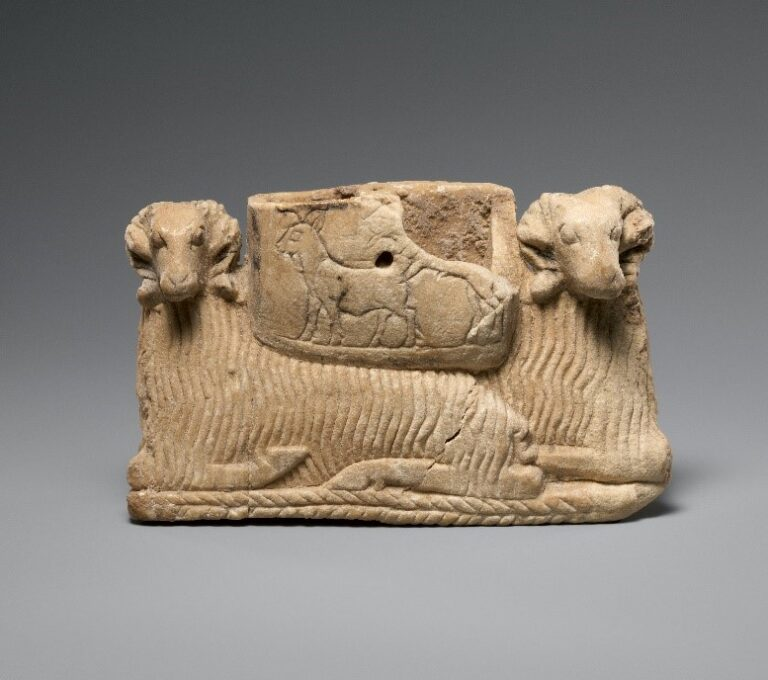
New York's Metropolitan Museum of Art has returned three antiquities to Iraq (Manhattan DA Press Release). The three pieces are:
a. a Sumerian gypsum alabaster vessel supported by two rams, acquired from the Norbert Schimmel Trust in 1989. The history of the piece is provided:
By 1956, with N. Koutoulakis who bought it in Baghdad; from 1966, collection of Cecile de Rothschild; [by 1979, Robin Symes, London]; 1984, purchased by Norbert Schimmel from Robin Symes/ Xoilan Trader Inc., Geneva; from 1984, on loan to the Museum by Norbert Schimmel (L.1984.15.1); acquired by the Museum in 1989, gift of Norbert Schimmel Trust. 

b. a Mesopotamian terracotta female head, acquired from the Norbert Schimmel Trust in 1989. The  history of the piece is provided:
Before 1972, collection of Elie Borowski; by 1972, collection of Norbert Schimmel, New York; from 1983, on loan to the Museum by Norbert Schimmel (L.1983.119.12); acquired by the Museum in 1989, gift of Norbert Schimmel Trust. Deaccessioned for return to Iraq in May 2025.

c. a Mesopotamian terracotta male head, purchased from Robin Symes in 1972. It is reported to have been removed from the site of Isin. The history of the piece is provided:
By 1971, Robin Symes, London; acquired by the Museum in 1972, purchased from Robin Symes, London.

These returns renew the focus on antiquities handled by Robin Symes. The Met's "provenance" team could usefully look at the other Symes material currently on display in the museum. 

| |
Bookmark and Share so Your Real Friends Know that You Know

Friday, 25 October 2024

Archaeological Context Makes Sense

Amphora illustrated in
 the Schinoussa archive
Source: Christos Tsirogiannis
Archaeological contexts matter. 

This may sound like stating the obvious. But walk into a museum that displays, say, Greek or Roman archaeological material and you may start to ask questions that the object in itself cannot answer. Take an Athenian black-figured amphora. The label will probably tell us that it was made in Athens but we probably want to know where it was found. It is fairly large, and not the sort of object that is found in the cemeteries of ancient Athens. It is fairly complete and so has probably been protected in some sort of tomb cut out of the rock: an Etruscan tomb in central Italy is certainly a possibility. Was it found on its own? Was it part of a set of Athenian ceramic sympotic equipment, that is to say part of the wine-drinking apparatus. We may want to ask why the Etruscans buried their dead with imported Athenian pottery: was it about the iconography? But was the amphora necessarily found in (modern) Tuscany? Could it come from one of the Greek colonial settings in southern Italy or Sicily? 

The museum label may tell us that modern scholarship has attributed it to a named (anonymous) pot-painter. But does that assume that such ‘artists’ were recognised in antiquity? Did symposiasts choose to drink wine out of cups decorated by ‘named’ individuals? Or would you want to be buried with a pot decorated by ‘Elbows Out’ or some other similarly named painter? 

Even the date assigned to be pot may be problematic. If the archaeological context is unknown, how do we know the date? Is it similar to another piece? Does that other piece have a secure archaeological context? No? So how do we obtain a date? Do we have to depend on a chronology based on supposed stylistic developments? How does this chronological framework link to known historical events, such as the Persian destruction levels at Athens? 

The Crosby Garrett helmet
displayed next to
the helmet from Ribchester
© David Gill
But the lack of secure archaeological contexts may hamper our knowledge of Roman objects. Take the Roman bronze cavalry helmet said to have been found at Crosby Garrett in Cumbria (north-west England) and then sold at auction in London. While we might assume that this was part of the equipment of a Roman cavalryman on the northern frontier of Britannia, it could be that the helmet was found, say, on the Danube frontier, but that at some point (in recent years) it was decided to say that it was found elsewhere. Archaeological investigations at the alleged findspot in Cumbria have yet to find conclusive evidence that the helmet was indeed found there. 

Lack of context can sometimes mean that scholars misinterpret objects. Take, for example, a fragmentary Greek marble funerary stele that was displayed in an exhibition in a high profile North American museum. It was suggested that the iconography pointed to a findspot in western Türkiye (Ionia). Yet the error of this assumption was confirmed when the lower part of the same stele was found in a rural cemetery in eastern Attica, Greece. 

Top part: stele fragment formerly in
New York private collection (and now repatriated)
Bottom part: excavated in a rural cemetery in eastern Attica


Archaeological context matters. Without it, archaeologists can struggle to make sense of the objects.
| |
Bookmark and Share so Your Real Friends Know that You Know

Friday, 14 July 2023

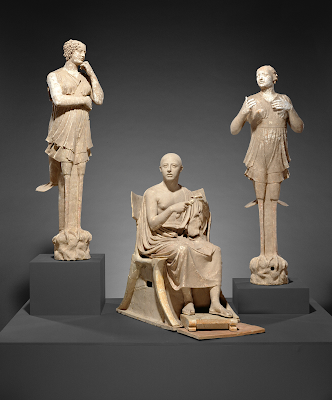
Two Funerary Statues from Cyrene Returned to Libya

Funerary sculpture from Cyrene
Source: Manhattan DA

The Manhattan DA has announced that two funerary statues from Cyrene have been handed over to the Libyan authorities ("D.A. Bragg Announces Return of Two Antiquities To The People of Libya", July 14, 2023). The statues were seized from a storage facility in New York where they had been placed by Robin Symes. It is reported that one of the statues may fit fragments found in recent excavations.

Other statues derived from the cemeteries of Cyrene include one from the Steinhardt collection, and another that had been placed on loan to New York's Metropolitan Museum of Art. Another had passed through Dubai.

| |
Bookmark and Share so Your Real Friends Know that You Know

Saturday, 3 December 2022

Identifications at Sotheby's in London

Image from the Becchina archive courtesy of Christos Tsirogiannis

Professor Christos Tsirogiannis has identified three objects from the Becchina, Medici and Symes archives that were due to be auctioned at Sotheby's in London on December 7, 2022. His identifications are covered in a report by Dalya Alberge, "Archaeologist urges Sotheby’s to cancel auction of ‘illicit’ artefacts", Daily Telegraph December 3, 2022.

Take for example the Roman bronze protome spout in the form of a dog or spout (lot 121). The history of the piece is provided:
  • Swiss private collection 
  • Royal-Athena Galleries, 
  • New York John W. Kluge, acquired from the above in 1989 (Christie's, New York, The Morven Collection of Ancient Art, December 10th, 2004, no. 590, illus.)
Notice on the image the annotation 'V[ia]/Jer[ome Eisenberg]' confirming the link with the Royal-Athena Galleries. The image is taken from the Becchina archive and records show that it was derived from Mario Bruno. Presumably one of these two sources is to be identified as the 'Swiss private collection'.

In the report in the Telegraph it is noted:
A Sotheby’s spokesman said that they “uphold the highest standards of due diligence”.
How did Sotheby's conduct a rigorous due diligence test on the anonymous Swiss private collection? Had they considered the possibility that Becchina or another such individual was the origin? 

Royal-Athena Galleries should also have raised an alert. Only in November three antiquities from this source were returned to Turkey: e.g. silver Apollo. Or in July this year an Attic krater from the Gallery was returned to Italy. This was among 60 antiquities from Royal-Athena Galleries. Again, had Sotheby's taken this into account as part of their rigorous due diligence process? 

In May 2017 a Paestan lekythos was provided with a nearly identical history to the bronze spout. Did this raise concern? Indeed it is clear that the Kluge collection has been linked to several antiquities that have been returned to Italy. This in itself should have alerted those preparing the catalogue entry for Sotheby's.

Will Sotheby's in London tighten up its processes? Is there a need to raise the standard of the due diligence approach to a more rigorous level?


| |
Bookmark and Share so Your Real Friends Know that You Know

Wednesday, 16 November 2022

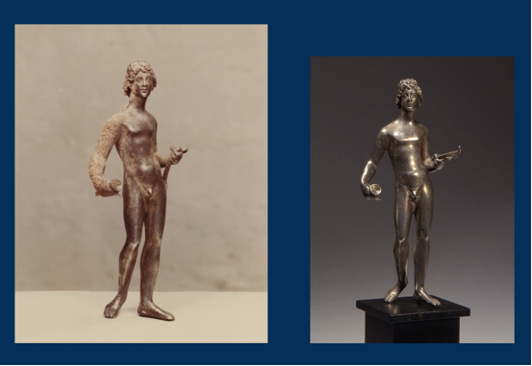
A Silver Apollo Returns to Turkey

Left: Symes-Michaelides archive; Right: Royal-Athena Galleries


In November 2022 the US authorities returned a silver statuette of Apollo to Turkey. This was recognised as the figure that had been identified by Christos Tsirogiannis in 2007 as appearing in the Symes-Michaelides archive. It receives a full discussion in his PhD thesis, Unravelling the Hidden Market of Illicit Antiquities: The Robin Symes - Christos Michaelides Network and its International Implications (Cambridge University, PhD Dissertation, 2012). 

The history can be traced through the various sale catalogues in which it appeared.

The figure seems to have surfaced in an exhibition organised by Marie-Louise Vollenweider, Musées de Genève in January 1987 (no. 274), and then featured in the exhibition for Numismatic Fine Arts, Treasures from an Ancient Jewelbox: Gold and Silver of the Ancient World (1992): the catalogue was prepared by Robert Hecht. 

The figure next appeared in the exhibition organised in memory of Michaelides by Robin Symes, Royal Portraits and Hellenistic Kingdoms (New York 1999) no. 24, and then passed into a New York private collection. It was offered at Sotheby’s (New York) on December 7, 2001, lot 76 but was unsold; it entered an Australian private collection in 2002, and was offered at Sotheby’s (New York) June 5, 2008, lot 22 but again was reportedly unsold. It was purchased by Jerome Eisenberg and appeared in Royal-Athena Galleries, Art of the Ancient World 20 (2009) no. 134; Art of the Ancient World 28 (2017) no. 27. It is not clear when the Apollo was seized.

The evidence used to associate the Apollo with a findspot in Turkey has not been disclosed as part of the return, but it has been associated with rulers from Pontus and Cappadocia.

Note. The label in the Antalya Museum states that the figure is bronze but this is incorrect. I am grateful to Christos Tsirogiannis who was able to confirm the material.

| |
Bookmark and Share so Your Real Friends Know that You Know

Friday, 7 October 2022

From Geneva to the Steinhardt Collection


Source: Manhattan DA

Five objects (Attic head aryballos; Protocorinthian duck and owl; Corinthian bull's head; Ionian ram's head; Apulian head vase) in the seizure of antiquities from the collection of Michael Steinhardt have something in common: they were placed on loan with Geneva's Musée d'Art et d'Histoire (1978–81). And all of them were subsequently placed on loan with the J. Paul Getty Museum (1984–96). And all of them were sold by Robin Symes to the Beierwaltes in 1996. All but the Apulian head vase appear in images from the Medici Dossier: the head vase itself appears in the Becchina archive (with an Attic skyphos now returned from the Shelby White collection).

Such loans to these two museums were used as a response to seizures  in 2018 from another dealer. It is almost as if the loans created an acceptable collecting history. This raid seems to relate to another group of material. 

The Geneva museum has associations with other loans such as the Ka-Nefer-Nefer mummy mask (though the museum does not have a record of the loan). And the Getty accepted loans of fragments from some of these same individuals, as well as complete pots such as the Steinhardt hydria.

It should be noted that the same Geneva museum appears to be linked to the Apulian grave group acquired by Berlin

What part did Geneva play in handling recently surfaced antiquities and providing them with a history? What other objects passed this way? The papers relating to the Steinhardt seizure expand on this aspect.

And how many of these objects were then placed on loan with the J. Paul Getty Museum? 

Note: Identifications from the Medici Dossier and the Becchina Archive were made by Christos Tsirogiannis.

| |
Bookmark and Share so Your Real Friends Know that You Know

Tuesday, 20 September 2022

The Steinhardt hydria attributed to the Antimenes painter

Source of images: Manhattan DA.

Among the items seized from the Michael Steinhardt collection and returned to Italy was an Attic black-figured hydria attributed to the Antimenes painter. The hydria had been identified from an image in the Medici Dossier.

The Manhattan DA reports that the hydria had first surfaced with Robin Symes in 1983 (when it was advertised in Apollo). The statement then adds:
By 1987, Symes had transferred the object to the New York-based Atlantis Gallery, part-owned by Robert Hecht, who then loaned it to the Getty Museum. From 1987-1996, the object was on view at the Getty Museum prior to its sale to Steinhardt through Sotheby’s New York on December 17, 1996. 
Steinhardt is report to have purchased the hydria from Sotheby's for $169,411.

The Beazley Archive (BAPD 31596) provides the loan number for the Getty (L87.AE.4) as well as the details for the Sotheby's New York sale (17 December 1996, lot 49). It also suggests that the hydria passed through the Royal-Athena Galleries though this information may not be correct.

Christopher Chippindale and I had rehearsed the history of this specific hydria in our review article of The Medici Conspiracy (2007) [see here]. We clarify that the hydria was placed on loan at the Getty in January 1987, and returned in February 1996. This raises a question about the nature and purpose of loans that were placed at the Getty.

It should be recalled that one of the Attic black-figured neck-amphorae seized from Fordham University was attributed to the circle of the Antimenes painter (BAPD 24304).

It should be noted that the identification of the Steinhardt hydria was made by Associate Professor Christos Tsirogiannis. 

| |
Bookmark and Share so Your Real Friends Know that You Know

Tuesday, 13 September 2022

Classical Antiquities Returned to Italy from the Metropolitan Museum of Art

Source: Manhattan DA (September 6, 2022) / Lynda Albertson (on Twitter)

21 classical antiquities have been returned to Italy following their seizure from New York's Metropolitan Museum of Art. LM has listed some of the key people associated with the material. 

The objects appear to include (though no definitive list seems to have been issued by the museum):

Sculpture 
b. A marble head of Athena. Inv. 1996.178. 
e. Marble head of a horned youth wearing a diadem. Inv. 2012.479.10. The work has been on loan to, and on display at, The Metropolitan Museum of Art since 2007.  
q. A marble head of a bearded man. Inv. 1993.342. 
t. Castor and Pollux.

Silver Plate 
f. Gilded silver phiale. Inv. 1994.57.

Gold 
l. Pair of gold Apulian cylinders. Inv. 1981.134.1, .2 

Bronzes 
a. A bronze plate. Inv. 1986.322.2.  
s. Bronze statuette of Jupiter. Inv. 1997.159. 1987-1997, on loan to the San Antonio Museum of Art, Texas.

Armour 
m. Bronze helmet of Corinthian type. Inv. 2003.407.3. 
n. Bronze helmet of Italian -Corinthian type. Inv. 2003.407.5. 
o. Bronze helmet of Apulian-Corinthian helmet. Inv. 2003.407.4.  

Athenian Pottery 
Black-figured 
c. Attic bf neck-amphora, attributed to the Princeton painter. Inv. 1991.11.2. 
h. Attic bf lekythos, attributed to the manner of Elbows Out. Inv. 1985.11.3 
j. Attic bf amphora fragment, attributed to Lydos. Inv. 1985.11.1.  
k. Attic bf amphora fragment, attributed to the Amasis painter. Inv. 1985.11.2.  
u. Attic bf amphora fragment, attributed to the Amasis painter. Inv. 1985.53.  

White Ground 
p. Attic wg cup, attributed to the Villa Giulia painter. Inv. 1979.11.15.  

Red-figured 
d. Attic rf cup, signed by Hieron and attributed to Makron. Inv. 1979.11.8, 1988.11.4, 1990.170. 

Terracottas 
r. Terracotta statuette of a draped goddess. Inv. 2000.163. Gift of Robin Symes, in memory of Christo Michailidis, 2000.

Glass 
g. A glass situla with silver handles. Inv. 2000.277. 

| |
Bookmark and Share so Your Real Friends Know that You Know

Wednesday, 7 September 2022

Metropolitan Museum of Art returns material to Italy

White ground cup attributed to the Villa Giulia painter
Source: Manhattan DA

The Metropolitan Museum of Art has now formerly returned further material to Italy ("D.A. Bragg Returns 58 Stolen Antiquities to the People of Italy", Manhattan DA Press Release, September 6, 2022). The items include an Attic white ground cup attributed to the Villa Giulia painter (inv. 1979.11.15). It had been handled by Galerie Antike Kunst Palladion. 

Another piece is the marble head of Athena reported to have been looted from a temple in Central Italy and handled by Giacomo Medici and subsequently by Robin Symes and the Acanthus Gallery (inv. 1996.178). The Medici information was not included on the museum's website.

Bookmark and Share so Your Real Friends Know that You Know

Friday, 12 August 2022

Further returns from the Getty announced


The items include three terracotta figures known as 'Orpheus and the Sirens' acquired in 1976 (inv. 76.AD.11). They were purchased from Bank Leu in Zurich. (For further information see the catalogue of terracottas at the Getty.)

Four other items from the Getty will be returned:
Recent research by Getty and independent scholars also determined that it is appropriate to return a second-century AD colossal marble head of a divinity; a second-century AD stone mold for casting pendants; an oil painting entitled Oracle at Delphi, 1881, by Camillo Miola; and a fourth-century BC Etruscan bronze thymiaterion. The first three of these objects were acquired by J. Paul Getty and the Getty Museum in the 1970s; the fourth in 1996. None of these objects have been on public view in recent years. Getty is currently working with the Ministry of Culture to arrange their returns.
There is no indication in the press statement about the sources though I understand that several feature in the photographic archives seized in Switzerland and Greece. 

The colossal marble head (inv. 72.AL.96) was acquired from Robin Symes. An Etruscan bronze thymiaterion was acquired in 1996 from the Fleischman collection (inv. 96.AC.253). It was sold to the  Fleischmans in 1987 by Edoardo Almagià. (This would be the second Almagià piece to be returned by the Getty.)

The story also appears in The Art Newspaper (incorrectly stating that the thymiaterion was purchased in 1996).


Bookmark and Share so Your Real Friends Know that You Know

Thursday, 30 December 2021

Steinhardt objects returning to Italy

Togate figure from Perugia
Source: Chasing Aphrodite


It has been announced that 51 antiquities will be returning from the Steinhardt collection to Italy. I estimate that they were purchased for $7.5 million. The objects include Etruscan bronzes, a fresco fragment from Herculaneum, and a mosaic removed from a Roman villa on Sicily. It is striking that so many of the items were identified from the seized photographic and documentary archives of Medici, Becchina, Symes, Hecht, and Almagià.

It is clear that only a fraction of the material in these archives has been returned to the countries where they were found. Museums, private collectors, and galleries need to start studying their lists of donors and former owners.

| |
Bookmark and Share so Your Real Friends Know that You Know

Steinhardt material to return to Turkey


A total of 14 antiquities are due to be returned to Turkey from the Michael Steinhardt collection.

These include:
  • Antelope standard and three bird rattles [pp. 58–59] apparently found in eastern Turkey. Purchased by Steinhardt from Robin Symes on April 24, 1991 for $84,000.
  • A female figure with seven gold dress ornaments "found together" [p. 65]. Purchased from Robert Hecht on October 31, 2005 for $499,294.
  • An Anatolian terracotta female figure [pp. 73–74]. Surfaced at Sotheby's (London) in 1975; purchased by the British Rail Pension Fund; purchased by Robert Haber on February 1, 1990; purchased by Steinhardt on August 19, 1990 for $79,610.
  • A small limestone female figure of Kilia type [pp. 83–84]. Purchased from Harry Bürki on April 30, 2002 for $47,500.
  • A silver stag's head rhyton [pp. 68–69]. Reported to be from Milas, Turkey. Purchased by Steinhardt from the Merrin Gallery on November 22, 1991 for $2,600,000; placed on loan to New York's Metropolitan Museum of Art on March 11, 1993.
| |
Bookmark and Share so Your Real Friends Know that You Know

Wednesday, 8 December 2021

Returning Athenian pottery from the Steinhardt collection

Source: Manhattan District Attorney's Office

The documentation for the Michael Steinhardt  collection identifies several Attic pieces that will be returned to their country of origin, presumably Italy and Greece.
  • Attic black-figured Sphinx cup, 'Tleson, son of Nearchos' (pp. 19–20). Identified from the Medici dossier. Symes sold to Beierwaltes (January 8, 1996); Phoenix Ancient Art (2006); Steinhardt purchased from Phoenix Ancient Art for $310,000 (2007).
  • Attic red-figured oinochoe attributed to the Berlin painter (pp. 20–21). Identified from the Medici dossier. Steinhardt purchased from Harry Bürki for $215,000 (1996); Steinhardt's records show that the oinochoe had been sold by Robert Hecht.
  • Attic black-figured hydria showing Herakles and Kyknos attributed to the Leagros group (p. 21).  Identified from the Medici dossier. Displayed by Christos Bastis at New York's Metropolitan Museum of Art (1987); Bastis died (1999); Steinhardt purchased from Michael Ward for $127,000 (2000). The paperwork omits that the hydria surfaced at Sotheby's (London) July 11–12, 1983, lot 352, and was sold at Sotheby-Parke-Bernet, New York, December 9, 1999, lot 92. [BAPD 9050]
  • Attic black-figured hydria showing women at a fountain-house attributed to the Antimenes painter (pp. 22–23). Identified from the Medici dossier. Robin Symes advertised the hydria (1983); Atlantis Gallery, New York (1987); loan to the J. Paul Getty Museum L87.AE.4 (1987–96); Steinhardt purchased it at Sotheby's for $169,411 (December 17, 1996, lot 49). [BAPD 31596]
  • African head vase (pp. 23–24).  Identified from the Medici dossier.  Displayed in the Musée d'Art et d'Histoire, Geneva (1978–81); J. Paul Getty Museum (1984–96); Symes sold the piece to the Beierwaltes (1996); Beierwaltes consigned it to Phoenix Ancient Art (2006); Steinhardt purchased it from Phoenix Ancient Art for $163,312.50 (2009). 
  • Attic black-figured eye-cup (pp. 35–36). Identified from the Becchina archive. Mario Bruno, Lugano; sold to Becchina; TL tested by Ralf Kotalla, Germany(July 1992); Robert Hecht sold it to Steinhardt for $170,750 (June 15, 2000).
  • Attic black-figured amphora (p. 50). Identified from the Almagià archive. Purchased from a tombarolo for $6,500; sold for $13,000; accessioned by Steinhardt as coming from Almagià (1997). 
  • Attic black-figured plemochoe (pp. 54–55). Identified from the Symes archive. Photographed by Dieter Widmer (1985); held as loan by Sotheby's London for Budico SA, owned by Henri-Albert Jacques (1989); stolen from Sotheby's and recovered by the police; Budico SA sold it through Sotheby's to Steinhardt for $84,083 (December 11, 2002). Note: 'Ex. Private Coll. London, RS + CM' (?Symes and Michaelides).
  • Attic white ground lekythos attributed to the Triglyph painter (p. 56). Identified from the Symes archive. Symes sold it to the Beierwalters for $360,000 (June 22, 1995); consigned to Phoenix Ancient Art (2006); Steinhardt purchased from Phoenix Ancient Art for $380,000 (December 14, 2006).
| |
Bookmark and Share so Your Real Friends Know that You Know

Tuesday, 7 December 2021

Ex Symes material on offer in London


Associate Professor Christos Tsirogiannis has identified two Etruscan bronze attachments that are being offered at Sotheby's, London, on December 7, 2021 (lot 68). The history of the pieces is rehearsed:
Mathias Komor, New York, inv. nos. I.514 and I.515 
Clarence Day, Memphis, acquired from the above on February 24th, 1978 (Sotheby's, New York, Antiquities from the Collection of the Late Clarence Day, December 7th, 2010, no. 15, illus.) 
acquired by the present owner at the above sale
Tsirogiannis made the identification for the bronzes in the Schinoussa archive thus showing that they had passed through the hands of Robin Symes.

The detail is provided in Dalya Alberge, "Antiquities for auction could be illicitly sourced, archaeologist claims", The Guardian December 7, 2021.
| |
Bookmark and Share so Your Real Friends Know that You Know

Monday, 6 December 2021

Sources for the returned Michael Steinhardt antiquities


The legal paperwork lists those who handled the 180 antiquities that have been handed over by Michael Steinhardt. Robert Hecht is top of the list with 45 objects. Other names will be familiar to those who study the return of cultural property. 

Bookmark and Share so Your Real Friends Know that You Know

Michael Steinhardt and the J. Paul Getty Museum


The return of antiquities from the collection of Michael Steinhardt that have been valued at $70 million raised questions about other objects. 


Bookmark and Share so Your Real Friends Know that You Know

Another Bürki object returns to Italy

Source: MMA A psykter column-krater attributed to the Troilos painter was deaccessioned by New York's Metropolitan Museum of Art in June...