Showing posts with label Fleischman. Show all posts

Friday, 12 August 2022

Further returns from the Getty announced


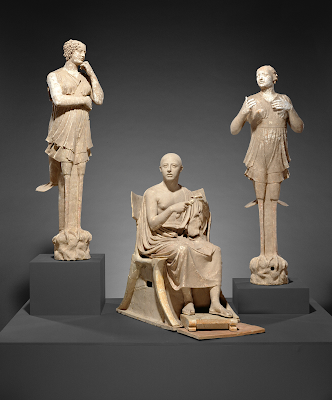
The items include three terracotta figures known as 'Orpheus and the Sirens' acquired in 1976 (inv. 76.AD.11). They were purchased from Bank Leu in Zurich. (For further information see the catalogue of terracottas at the Getty.)

Four other items from the Getty will be returned:
Recent research by Getty and independent scholars also determined that it is appropriate to return a second-century AD colossal marble head of a divinity; a second-century AD stone mold for casting pendants; an oil painting entitled Oracle at Delphi, 1881, by Camillo Miola; and a fourth-century BC Etruscan bronze thymiaterion. The first three of these objects were acquired by J. Paul Getty and the Getty Museum in the 1970s; the fourth in 1996. None of these objects have been on public view in recent years. Getty is currently working with the Ministry of Culture to arrange their returns.
There is no indication in the press statement about the sources though I understand that several feature in the photographic archives seized in Switzerland and Greece. 

The colossal marble head (inv. 72.AL.96) was acquired from Robin Symes. An Etruscan bronze thymiaterion was acquired in 1996 from the Fleischman collection (inv. 96.AC.253). It was sold to the  Fleischmans in 1987 by Edoardo Almagià. (This would be the second Almagià piece to be returned by the Getty.)

The story also appears in The Art Newspaper (incorrectly stating that the thymiaterion was purchased in 1996).


Bookmark and Share so Your Real Friends Know that You Know

Monday, 21 March 2022

Roman Fresco Fragment: The Woman on a Balcony

Fresco Fragment: Woman on a Balcony,
10 B.C.–A.D. 14, Fresco

60 × 45.2 × 3 cm (23 5/8 × 17 13/16 × 1 3/16 in.),
96.AG.172

The J. Paul Getty Museum,
Villa Collection, Malibu, California,
Gift of Barbara and Lawrence Fleischman

The research of Christos Tsirogiannis has been highlighted in The Observer (Dalya Alberge, "Fresco fragment from Pompeii reopens row over 'looted' antiquities", March 20, 2021). The Roman fresco fragment had formed part of the Barbara and Lawrence Fleischman collection. The fragment had been acquired from Fritz Bürki in 1987, but it had also featured in the photographic archive of Robert Hecht. 

There are some 60 items in the Fleischman collection that were acquired from Bürki; only four are formerly listed as derived from Hecht. 

| |
Bookmark and Share so Your Real Friends Know that You Know

Tuesday, 28 December 2021

Further returns from the Getty

White on Red Lidded Pithos
Formerly Malibu inv. 96.AE.135.
The Manhattan DA Office mentioned the return of seven items from the J. Paul Getty Museum; they were seized on April 2, 2021, and the press release specifically states that they "were trafficked by ALMAGIÀ". [press release

Only one piece is listed in the Manhattan DA press release: "A Pithos with Ulysses, dating to 7th Century B.C.E. and valued at $200,000".

This is the lidded White on Red pithos decorated with the blinding of Polyphemos.  It was given to the Getty by Barbara and Lawrence Fleischman (inv. 96.AE.135; cat. no. 86). The pithos no longer appears on the online Getty catalogue. 

I am grateful to the Getty for providing details of the other pieces:

a. A White on Red Lidded Pithos. Gift of Barbara and Lawrence Fleischman. Inv. 96.AE.136; cat. no. 87.
b. A pair of Caeretan sub-geometric plate attributed to the circle of the Crane painter. Gift of Barbara and Lawrence Fleischman. Inv. 96.AE.137.1-2; cat. no. 88–89, A–B. 
c. A pair of Caeretan sub-geometric plates attributed to the Heron class. Gift of Barbara and Lawrence Fleischman. Inv. 96.AE.138.1-2; cat. no. 88–89, C–D. 
d. An Attic red-figured stemless cup, attributed to the Marlay painter. 'New York art market'. Inv. 86.AE.479; BAPD 41037.

The stemless cup had already been identified by Chasing Aphrodite.


Bookmark and Share so Your Real Friends Know that You Know

Monday, 27 December 2021

Etruscan White on Red Ware Returning to Italy


Bookmark and Share so Your Real Friends Know that You Know

Wednesday, 30 December 2020

Fragments attributed to the Berlin painter


What questions should we be considering when we study the fragments of Athenian red-figured pottery that are dispersed between different collections and museums? This short study takes the example of some five pieces attributed to the Berlin painter (BN3, BN9, BN12, BN29, BN38); two have been returned to Italy. When were these fragments moved to different collections? Who was involved? In the case of two of the pieces, the initial fragments were presented to the museum only to be followed by purchases from a different source. Such a pattern of acquisition is not confined to the Berlin painter.

This paper questions the position taken by James Cuno that scholars should not seek the clarify the "provenance" (I prefer "history") of such fragments. 

The fragments are a reminder of the information that has been lost by the unscientific removal of Athenian pottery from funerary and other archaeological contexts.

Gill, D. W. J. 2020. "Fragmented Athenian Pots and the Berlin Painter: Recent Breaks?" Academia Letters, Letter 40: 1–5. [DOI]


Bookmark and Share so Your Real Friends Know that You Know

Wednesday, 1 April 2020

Peter Sharrer and the Getty

It would be interesting to know the source of the Greek Neolithic figures (eleven in number) and vase fragments that the Getty acquired in 1995. They appear in the published list as "donated jointly by Barbara and Lawrence Fleischman and Herbert L. Lucas". But the Getty's online catalogue tells that they were sold by Peter Sharrer Ancient Art of New York. 

Why the differing accounts? Are the listed donors just the people who paid the bills?

Lucas, incidentally, donated fragments for the krater attributed to the Berlin painter that the Getty returned to Italy.

Sharrer also sold a proto-Corinthian recumbent ram and a Corinthian lion rattle to the Getty in 1986, and a Minoan jar in 1990. Sharrer is also known to have purchased from Robin Symes, e.g. the portrait head of Faustina the Younger.

Bookmark and Share so Your Real Friends Know that You Know

Saturday, 4 January 2020

The Woman on a Balcony: Hecht and Bürki

Unknown
Fresco Fragment: Woman on a Balcony, 10 B.C.–A.D. 14, Fresco
60 × 45.2 × 3 cm (23 5/8 × 17 13/16 × 1 3/16 in.), 96.AG.172
The J. Paul Getty Museum, Villa Collection, Malibu, California, Gift of Barbara and Lawrence Fleischman

Christos Tsirogiannis has published the history of the fresco fragment, 'Woman on a Balcony', that was acquired by the Getty from Barbara and Lawrence Fleischman. The fragment was sold to the Fleischmans in 1987 by Fritz Bürki. Why is the image of this fragment among the photographs seized from the property of Robert Hecht?

Around 60 of the Fleischman pieces were acquired from Bürki. How many of these were actually derived from Hecht?

The research of Tsirogannis appears to be opening up the way for new claims to be made by the Italian authorities on objects in North American museums.

Reference

Tsirogiannis, C. 2019. "Nekyia: ‘Woman on a balcony’ at the Jean Paul Getty Museum." Journal of Art Crime 22: 65–69.

Bookmark and Share so Your Real Friends Know that You Know

Thursday, 15 June 2017

Getty returns Fleischman Zeus to Italy

Seated Zeus to return to Italy.
Source: MiBACT
The Italian Government has announcted that the Getty Museum has returned a seated Zeus to Italy ("FRANCESCHINI, IL GETTY MUSEUM SIGLA ACCORDO CON L’ITALIA PER LA RESTITUZIONE DELLO ZEUS IN TRONO RIENTRA A NAPOLI STATUA DEL I SECOLO A.C.", press release, 13 June 2017; "The J. Paul Getty Museum and Italian officials announce agreement to return first century B.C. sculpture to Italy", press release, 13 June 2017). The statue is a copy of the great chryselphantine statue of Zeus from Olympia.

The statue was acquired by Barbara and Lawrence Fleischman from Robin Symes in 1987. It was sold to the Getty in 1992 (inv. 92.AA.10), although the published statement only recorded that it had been in a New York private collection [JSTOR].

Jessica Gelt ("Getty agrees to return 1st century BC sculpture to Italy", LA Times, 13 June 2017) notes what the press releases omit:
Getty Museum Director Timothy Potts said the Italian government came into possession of a fragment that it believed joined the sculpture at the Getty. Italian officials tested their theory on a visit to the museum in 2014. 
“The fragment gave every indication that it was a part of the sculpture we had,” Potts said in an interview. “It came from the general region of Naples, so it meant this object had come from there.”
The Fleischman collection formed part of earlier research that I had conducted with Christopher Chippindale (Chippindale, Christopher, and David W. J. Gill. “Material Consequences of Contemporary Classical Collecting.” American Journal of Archaeology, vol. 104, no. 3, 2000, pp. 463–511. JSTOR, www.jstor.org/stable/507226.). The Zeus joins a large number of former Fleischman pieces that have already been returned to Italy (including one piece from the Cleveland Museum of Art).

Bookmark and Share so Your Real Friends Know that You Know

Saturday, 15 November 2014

Nelson Bunker Hunt

The death of collector Nelson Bunker Hunt was announced in October 2014. A number of obituaries have appeared in the British press:


Only the Telegraph mentioned his collections of antiquities and coins:
Forced into personal bankruptcy that required them to liquidate assets, the brothers auctioned off immense collections of Greek, Roman, Byzantine and Islamic coins, raising more than $30 million. Sotheby’s in New York sold their art collections, and they were even forced to offload household items, including an enamel teapot which went for $20.
The frontispiece of the 1983 catalogue was the Etruscan terracotta antefix that was acquired by Laurence and Barbara Flieschman and returned to Italy from the J. Paul Getty Museum. The cover shows the Kyknos krater that was returned to Italy by Shelby White.

The Euphronios cup from the Hunt collection is the starting point for Vernon's Silver's The Lost Chalice.

As I noted back in 2008 the returns to Italy included pieces from significant North American private collectors.

Bookmark and Share so Your Real Friends Know that You Know

Monday, 8 April 2013

Sicily at the Getty

Head of Hades, about 400 - 300 B.C.
Source: J. Paul Getty Museum inv. 85.AD.105
The Getty has issued a list of the objects due to appear in its exhibition on Sicily: Art and Invention between Greece and Rome. [details]

The pieces from the Getty are (with some additional information supplied by me):

23. Incense Burner Supported by Nike. 86.AD.681. [no. 5] 'Restored from a number of fragments'. 'European Art Market'. [Which dealer?]

92. Head of Hades. From Morgantina. 85.AD.105. Formerly Robin Symes; Maurice Temepelsman. The head will be returning to Italy.

93. Head of goddess. 76.AD.34. Gift of Max Gerchik.

96. Footed dinos attributed to the Syleus Painter. 89.AE.73. [no. 5]. Attribution by J.R. Guy. 'Reconstructed from fragments'. 'European Art Market'. [Which dealer?]

98. Disk with a Head of Medusa (Oscillum). 71.AD.255.

106. Statuette of a woman with child. 71.AD.347

109. Statuette of a pig. 78.AD.346. Gift of David Collins.

117. Apulian Krater fragment attributed to the Black Fury Group. 86.AE.417. [no. 7] 'Walter and Molly Bareiss Collection'. [Bareiss no. 44, checklist no. 221] Attribution by A.D. Trendall.
 
119. Statuette of Odysseus under a ram. 79.AD.37. Gift of Lee Rizzuto.

121. Mixing Vessel with Odysseus under a ram. 96.AE.303. Gift of Barbara and Lawrence Fleischman. [Fleischman no. 289.]

135. Comic Mask of a Satyr. 96.AD.305. Gift of Barbara and Lawrence Fleischman. [Fleischman no. 291.]

142. Statuette of a Dancer Playing the Lyre. 73.AD.151

144. Sicilian Calyx krater attributed to the Group of Louvre K240. 96.AE.30. Gift of Barbara and Lawrence Fleischman. [Fleischman no. 64.]

It is significant that the Head of Hades (no. 92) is included. But what collecting histories will be provided for nos. 23 and 96? And what about the sources for nos 121, 135, and 144? Or no. 93?

The exhibition appears to be including the Morgantina silver hoard now in Aidone.


Bookmark and Share so Your Real Friends Know that You Know

Thursday, 26 July 2012

Cleveland returns to Italy

Rhyton formerly in the Cleveland Museum of Art
The Cleveland Museum of Art has yet to issue collecting histories for the antiquities that were returned to Italy. So for convenience I have reissued the list in order of acquisition with some additional information.

The pieces appeared in the Bulletin of the Cleveland Museum of Art:

1975.23: Etruscan duck askos. Purchase, J.H. Wade Fund [JSTOR]
1975.91: Sicilian pig. Gift of Dr Leo Mildenberg [JSTOR]
1977.92: Rhyton. Purchase, John L. Severance Fund [JSTOR]
1986.200: Apulian or Campanian lekanis. Gift of Jonathan P. Rosen [JSTOR]
1986.201: Gnathian epichysis. Gift of Jonathan P. Rosen [JSTOR]
1986.202: Gnathian epichysis. Gift of Jonathan P. Rosen [JSTOR]
1986.203: Gnathian lekythos. Gift of Jonathan P. Rosen [JSTOR]
1986.204: Campanian acorn lekythos. Gift of Jonathan P. Rosen [JSTOR]
1987.209: Campanian bird askos. Gift of Mr and Mrs Lawrence A. Fleischman [JSTOR]
1988.41: Apulian krater, Darius painter. Leonard C. Hanna, Jr. Fund [JSTOR]
1990.1: Sardinian warrior. Leonard C. Hanna, Jr. Fund [JSTOR]
1990.81: Corinthian krater. Purchase, J.H. Wade Fund [JSTOR]
1996.16-17: Etruscan silver bracelets. Gift of Edoardo M. Almagia and Courteney Keep in honor of Arielle P. Kozloff.

Bookmark and Share so Your Real Friends Know that You Know

Saturday, 21 May 2011

Chasing Aphrodite: Reviews

A review of Chasing Aphrodite will appear in tomorrow's LA Times (review, May 22, 2011). Wendy Smith starts with the question that came to her mind as she read about the acquisitions at the J. Paul Getty Museum: "What were they thinking?"

Smith considers the "loophole" that allowed the Getty to acquire material that appeared to be fresh out of the ground while using rhetoric to distance the museum from any association with looting.

We are reminded of the problems with the Fleischman collection that undermined the revised museum acquisition policy.
"True, at once the greatest sinner and the greatest champion of reform, has been made to pay for the crimes of all American museums," Felch and Frammolino conclude. That seems an accurate assessment, though it could also be argued that True's breathtaking ability to say one thing while doing another, coupled with the Getty's institutional arrogance, made her a fair target. This chronicle of her painful, protracted fall from grace certainly makes for a riveting cautionary tale.

Bookmark and Share so Your Real Friends Know that You Know

Monday, 22 November 2010

The collecting history of the Merrin Zeus

It appears that my suggestion that the bronze Zeus returned to Italy was significant. This means that we can reconstruct the recent collecting history:

a. 1980. Statue reported to have been removed from the Museo Nazionale Romano.
b. 1982. Statue surfaced in the supplementary exhibition, The Search for Alexander, in The Fine Arts Museum of San Francisco (no. S-10).
c. 1983. Statue appeared in the supplementary exhibition, The Search for Alexander, in the Royal Ontario Museum, Toronto (no. S-14).
d. 1984. Statue published by Joyce Geary Volk in California Studies in Classical Antiquity. Owner stated to be Edward H. Merrin of New York City. Collecting history stated: "Mr. Merrin purchased it from a dealer who had obtained it from a Swiss collector in the late 1960s".
e. 1988-89. Statue appeared in The Gods Delight: The Human Figure in Classical Bronze, organized by Arielle P. Kozloff and David Gordon Mitten (no. 29).  Owner stated to be: Mr. and Mrs. Lawrence A. Fleischman.  Exhibited: The Cleveland Museum of Art; The Los Angeles County Museum of Art; the Museum of Fine Arts, Boston.
f. 2004. Statue auctioned at Sotheby's New York December 9, lot 249. Sold for $164,800. Sold as: Fleischman collection, New York.
g. 2010. Statue returned to Italy.

If the identification is correct, and I have no reason at present to doubt it, then there are serious questions to ask.

Where did Edward H. Merrin obtain the bronze Zeus? What is the name of the "dealer who had obtained it from a Swiss collector in the late 1960s"? And what is the identity of the anonymous Swiss dealer?


Bookmark and Share so Your Real Friends Know that You Know

Friday, 19 November 2010

The bronze Zeus returned to Italy

Earlier today I noted the return of a marble female torso and a bronze Zeus to Italy. The statue of the Zeus is distinctive with the right arm lost below the elbow. (There is now a short statement on the Carabinieri website; see also "Zeus statue returned to Italian museum after 30 years", Daily Telegraph November 19, 2010)

Paul Barford also noted the story and added a quote from AFP.
The bronze statue, which was stolen from the National Roman Museum in 1980, was sold by Sotheby's auction house in New York in 2006 and later put on display at an exhibition in Cleveland in the US state of Ohio.
I have been unable to find a bronze Zeus at auction at Sotheby's in 2006. However a bronze figure of a Zeus, some 24 cm tall, with a "missing right hand" (it appears to be missing from the elbow) was auctioned at Sotheby's New York on 9 December 2004, lot 249.

The Zeus auctioned at Sotheby's in 2004 had been exhibited at the Cleveland Museum of Art:
The Gods Delight: The Human Figure in Classical Bronze, Arielle P. Kozloff and David Gordon Mitten, eds., catalogue of the exhibition at The Cleveland Museum of Art, November 16th, 1988 - January 8th, 1989, the Los Angeles County Museum of Art, February 9th - April 9th, 1989, and the Museum of Fine Arts, Boston, May 9th - July 9th, 1989, Cleveland, 1988, no. 29, pp. 168-172, illus.
At the time of the Cleveland exhibition this Zeus was the property of Mr and Mrs Lawrence A. Fleischman. The Fleischman statue had appeared in the Search for Alexander exhibition at The Fine Arts Museums of San Francisco in 1982. It was published by Joyce Geary Volk ("A Lysippan Zeus", California Studies in Classical Antiquity 3, 2 [1984] 272-83) who reported that in 1984 the Zeus was the property of Edward H. Merrin: "Mr Merrin purchased it from a dealer who had obtained it from a Swiss collector in the late 1960s".

Image
AP via artdaily.com

Bookmark and Share so Your Real Friends Know that You Know

Thursday, 21 January 2010

Antiquities from Italy: the Bürki connection


Anyone following the return of antiquities will have come across the name of Fritz Bürki of Switzerland. When Boston's Museum of Fine Art returned thirteen antiquities to Italy in October 2006, the name of Bürki featured large. The most prominent piece was a marble statue of Sabina, the wife of the emperor Hadrian. This had been said to have resided in the collection of a Bavarian aristocratic family; its sale to the FMA had been negotiated by Robert Hecht. One of the other pieces was an Apulian amphora attributed to the Darius painter; it was sold by Bürki in 1991 jointly to Shelby White and Leon Levy, and to the MFA (with funds given by the Jerome Levy Foundation).

Bürki reappeared as a vendor to Barbara and Lawrence Fleischman. Among their collection was a Pontic amphora (identified by a polaroid seized in a raid on the Geneva Freeport). Another was an Apulian bell-krater attributed to the Choregos painter. One of the significant pieces was a fragment of wall-painting; this came from the same composition as a fragment returned to Italy by Shelby White. These Fleischman pieces were later passed to the J. Paul Getty Museum; their return was agreed in November 2006.

The J. Paul Getty Museum acquired several items from Bürki. Among them was an Attic black-figured zone cup, attributed (by J. Robert Guy) to the manner of the Lysippidies painter, purchased in 1987. A more elaborate piece was the Attic mask kantharos attributed to the Foundry painter (by J. Robert Guy) and acquired in 1985. The museum acquired an Apulian pelike attributed to the Darius painter in 1987.

Other museums have not been so forthcoming about their sources for objects that have been returned to Italy. However it was reported in November 2008 that Bürki is listed among the vendors for material returned from the Cleveland Museum of Art. Bürki is reported to have conserved the Sarpedon (Euphronios) krater before it was sold to New York's Metropolitan Museum of Art by Robert Hecht.

Now the Italian police have announced that they are actively pursuing some 350 items handled by Bürki. It appears that they are circulating DVDs of the objects to dealers and auction-houses. It will certainly have the effect of dampening down the market. It appears that the objects were recorded as a result of a raid on Bürki's Zurich premises in October 2001.

The renewed interest in Bürki will once again focus on how the looting of archaeological sites in Italy has long-lasting impact on those who acquire archaeological material for public and private collections. The solution is clear: the market should only agree to handle objects that have a documented collecting history that can be traced back to the period before 1970 (the date of the UNESCO Convention).

Image
Portrait of Sabina, purchased from Fritz Bürki of Zurich, through Robert E. Hecht to the Boston Museum of Fine Arts in 1979. Returned to Italy in 2006.


Bookmark and Share so Your Real Friends Know that You Know

Monday, 28 September 2009

Rome Exhibition: L'Arma per l'Arte

At the end of last week I was able to visit the Museo Nazionale di Castel Sant'Angelo in Rome for the new exhibition, 'L'Arma per l'Arte: Antologia di meraviglie'. This show celebrates the 40th anniversary of the Comando Carabinieri per la Tutela del Patrimonio Culturale. There are 60 exhibits including paintings and other works of art.

The exhibition contains a selection of the objects returned from North America as well as some other recovered antiquities:
1. Protocorinthian olpe. Formerly Princeton University Art Museum 995-149.
2. Caeretan hydria. Odysseus and Polyphemos. Formerly Shelby White collection (and on loan to the Metropolitan Museum of Art, New York).
3. Attic black-figured cup. Symposium. Formerly Malibu, J. Paul Getty Museum 87.AE.22.
4. Attic red-figured calyx-krater. Zeus and Ganymede. Eucharides painter. Formerly Shelby White collection (and on loan to the Metropolitan Museum of Art, New York).
5. Attic red-figured calyx-krater. Orestes.  Formerly Malibu, J. Paul Getty Museum 87.AE.66.
6. Apulian loutrophoros. Formerly Malibu, J. Paul Getty Museum 84.AE.966.
7. Bronze statue of Victoria. From Herculaneum. Formerly Royal-Athena Galleries, New York.
8. Marble statue of Tyche.  Formerly Malibu, J. Paul Getty Museum 96.AA.49.
9. Marble statue of Sabina. Formerly Boston, Museum of Fine Arts 1979.556.
10. Bronze Etruscan candelabrum. Recovered from private collection at Vulci (2005).
11. Attic red-figured calyx-krater. Death of Sarpedon. Formerly New York, Metropolitan Museum of Art 1972.11.10 (L.2006.10).
12. Bronze statue of Zeus. Firenze, Museo Archeologico Nazionale inv. 2291. Recovered in 1985.
13. Bronze handles from krater. Tuscania (VT), Museo Archeologico inv. 70820. Recovered in 1982.
14. Marble relief with Hercules. Napoli, Museo Arheologico Nazionale inv. 6683. Recovered in 1978.
15. Marble group of Capitoline Triad. Palestrina, Museo Archeologico inv. 80546. Recovered in 1994.
48. Etruscan bronze candelabrum. Melfi (PZ), Museo Archeologico Nazionale di Melfese inv. 110076. From Ruvo del Monte. Recovered in 1981.
49. Marble sarcophagus fragment. Amazonomachy. Roma, Antiquarium Comunale del celio, inv. Ant. Com. 34095. Recovered in 1998.

Exhibition catalogue edited by Lisa Della Volpe (ISBN 978 88 8347 488 0). [Publisher]

For a discussion of some of these returns:
  • Gill, D. W. J. 2009. "Homecomings: learning from the return of antiquities to Italy." In Art and Crime: exploring the dark side of the art world, edited by N. Charney: 13-25. Santa Barbara: Praeger.
  • Chippindale, C., and D. W. J. Gill. 2000. "Material consequences of contemporary classical collecting." American Journal of Archaeology 104: 463-511.
  • Gill, D. W. J., and C. Chippindale. 2006. "From Boston to Rome: reflections on returning antiquities." International Journal of Cultural Property 13: 311-31.
  • —. 2007a. "From Malibu to Rome: further developments on the return of antiquities." International Journal of Cultural Property 14: 205-40.

Bookmark and Share so Your Real Friends Know that You Know

Wednesday, 8 April 2009

Wall fragments to be reunited


The J. Paul Getty Museum has announced that it will be returning a further Roman wall-painting fragment to Italy ("The J. Paul Getty Museum will return a 1st century Roman freso to Italy in May 2009", press release, April 7, 2009). The piece is described as "a landscape scene" and that it was acquired in 1996.

Michael Brand, the director, is quoted:
Our decision to return this fragment is based on a newly published image we saw about a year ago that included another fresco fragment that was being repatriated to Italy by a private collector. This image placed our landscape fresco alongside this newly repatriated fragment ... Seeing these fragments together made it clear that the two were part of the same wall design and belonged together.
I presume that this fragment was one of the Fleischman fragments acquired in 1996 ("Gift of Barbara and Lawrence Fleischman"). It is likely that this latest fragment is the one that appeared as A Passion for Antiquities no. 125 ("Fresco Fragment: Vignettes of Cityscape") = inv. no. 96.AG.170 ("Wall Fragment with Landscape Scenes").

This will join two other fragments returned to Italy: one from the J. Paul Getty Museum, the other from the Shelby White collection (see my comments from January 2008 with initial reconstrcution). A fourth fragment was apparently seized from Giacomo Medici in Geneva.

The latest fragment will be returned in May 2009.

The arrangement of the fragments has been created by David Gill and is intended to give an impression of the original design. It is not an accurate reconstruction though the fragments are at the same approximate scale. This was originally created in January 2008.

Wednesday, 18 March 2009

"Found in a river": Tarentine coins for sale

Nomos AG of Zurich is offering a set of 4 silver diobols of Tarentum and a bronze lidded box in a Zurich sale (May 6, 2009; details). The sale is highlighted in a press release (July 25, 2008):
Nomos AG announces its first public auction of Fine Ancient and Early European Coins and Medals to be held on the afternoon of May 6th, 2009, in Zürich. The auction will take place at the Widder Hotel, a five star luxury facility in the center of town. Many major coins of great beauty and importance have already been consigned to the sale. The sale will be fully and expertly catalogued by Dr. Alan Walker, Director of Nomos AG, and will feature an elegant catalogue layout and design.
These Tarentine coins appears to be part of a group:
When found the box contained four diobols of Tarentum, all dating circa 280-228 (though probably in the earlier part of that period), and all with a helmeted head of Athena on their obverses and a standing figure of Herakles grappling with the Nemean Lion on their reverses.
The pieces formed part of the collection of Dr. Leo Mildenberg ("in 2000"). The catalogue entry suggests that the box surfaced in recent years:
According to the information that was supplied by Dr. Mildenberg, this box was found in a river and when the deposits that filled it were cleaned out, these four silver coins were found within it. This is by no means improbable: the box itself is probably slightly earlier than the coins, but idea that it contained them seems perfectly reasonable. Its small size implies it was meant to be used to hold relatively precious items. Given the kind of people who still brought things to Dr. Mildenberg in his later years, and this was brought to him a year or two before he died, it is very unlikely that anyone would have thought it worth while to create a fictitious history for the object (especially since the coins themselves were then of relatively minor value). It was undoubtedly shown to him because it was the kind of curiosity everyone knew he enjoyed seeing. In any event, being able to have the actual container in which the present coins were found is both exciting and romantic.
Mildenberg died in 2001 and this piece appears to have been acquired by him "in 2000" ("a year or two before he died"). Curiosity would prompt questions about the finders and previous owners of this box and its contents. What sort of people "still brought things" to Mildenberg "in his later years"?

A Lucanian nestoris sold by Mildenberg (see earlier discussion) was among the objects returned to Italy by the Museum of Fine Arts, Boston [abstract].

The box is also worthy of comment. The cataloguer (presumably Dr Alan S. Walker [for his views on cultural property see his revealing and frank review available from the web pages of the Committee on Ways and Means]) draws a parallel with a bronze "Box with relief-decorated lid" that once formed part of the Barbara and Lawrence Fleischman collection (A Passion for Antiquities no. 29) and now in the J. Paul Getty Museum (inv. 96.AC.87). (No previous publication, history or find-spot were noted for the Fleischman box.)

The coin cataloguer adds:
The box is so close in form to the Fleischman example, now Getty 96.AC 87 (dated to 350-310 BC), that one wonders whether it could have been made in the same atelier. While its cataloguers pointed out its resemblance to the cinerary urns used in Macedonian tombs (especially that of Philip II), the fact that this one surely came from Magna Graecia makes one wonder whether the Fleischman piece came from there as well.
Magna Graecia is another way of saying that this box with four silver coins minted at Tarentum came from southern Italy.

And if it was found in Italy, what was the date of its discovery? How and when did it leave the country?

(The cataloguer should, perhaps, note that the gold larnax from Tomb II at Vergina is unlikely to have belonged to Philip II given the implications of the weight inscriptions on the silver plate. [Abstract])

I am grateful to Nathan Elkins for drawing my attention to this lot.

Thursday, 4 December 2008

Atlantis Antiquities in the Press: an Overview

I have been reviewing the appearance of Atlantis Antiquities in the press.

One of the earliest mentions was back in 1988: Rita Reif, "Archaic Smiles Have Persisted For 2,000 Years", New York Times June 19, 1988. This commented on the exhibition, ''Greek and Etruscan Art of the Archaic Period" [Catalogue]
The exhibition is the first in memory at a New York gallery to present a broad view of the Archaic Period, and the first major show presented at Atlantis, which opened 21 months ago. The 70 works in terra cotta, marble, painted clay, bronze, amber and gold were selected by Robert Hecht Jr., an American antiquities dealer based in Paris. Mr. Hecht is a part-owner of the gallery, along with Jonathan Rosen, a real estate developer and collector of ancient art. Andrea Hecht, the dealer's daughter, is the director of the gallery.
The gallery then featured in a report on antiquities from Turkey (Geraldine Norman, "Talking Turkey; Who owns the treasures of antiquity? The Turkish government has been fighting American museums for the return of some splendid hoards. But only laws that ensure finders fair compensation will prevent smuggling", The Independent June 13, 1993).
It was the sculpted marble leg of a very grand Hellenistic table, which they found on show at Atlantis Antiquities, a New York gallery that he [sc. Hecht] managed for Jonathan Rosen - a millionaire lawyer who is also a keen collector of antiquities. The sculpture depicts a Scythian slave sharpening the knife with which he intends - on Apollo's instructions - to flay Marsyas, who is strung up on a nearby tree.
The sculpture was reported to have been traced back to a farmer Philadelphia in Turkey. The case was resolved when the piece was donated to the American Turkish Society.

Atlantis Antiquities has also been in the news over some of the antiquities returned from the J. Paul Getty Museum (Hugh Eakin, "Embattled Getty Curator Steps Down", The New York Times October 4, 2005). In October 2005 a bronze Etruscan candelabrum was handed over to Italian officials.
The Getty acquired the candelabrum in 1990 from Atlantis Antiquities, a New York gallery, for $60,000, according to evidence in the indictment. But Italian police have traced the object, along with another Getty acquisition named in the indictment, to a private collection in Florence, from which it was stolen. The other object, a bronze tripod, was returned by the Getty to Italy in 1997.

Italian prosecutors say that in both cases the objects were smuggled by Giacomo Medici, an Italian dealer based in Geneva, and passed on, via a third party, to Robert Hecht, the owner of Atlantis Antiquities.
Among the more recent returns to Italy that had passed through Atlantis Antiquities was an Apulian loutrophoros attributed to the Metope group that was purchased by the Getty in 1984 (formerly inv. 84.AE.996) as well as an Attic black-figured amphora, attributed to the painter of Berlin 1686, once in the Fleischman collection. Two pieces once in Boston had passed through the same gallery: an Attic black-figured lekythos attributed to the Diosphos painter (formerly inv. 1989.317) and an Apulian amphora attributed to the Darius painter (formerly inv. 1991.437).

Another Bürki object returns to Italy

Source: MMA A psykter column-krater attributed to the Troilos painter was deaccessioned by New York's Metropolitan Museum of Art in June...