I have commented earlier today on the claim on two pieces in the Badisches Landesmuseum in Karlsruhe. We should note that Lord Renfrew is due to lecture in Karlsruhe on 23 February 2012 as part of the activities surrounding the exhibition. He has spoken out about the looting of archaeological sites in the Cyclades.
There is a suggestion that the Cycladic figure and bowl were derived from Dr Elie Borowski. Will the museum confirm or deny that Borowski was the source? I note that the museum acquired several pieces, including at least two Cycladic figures, in 1975.
Discussion of the archaeological ethics surrounding the collecting of antiquities and archaeological material.
Showing posts with label Lord Renfrew. Show all posts
Friday, 21 October 2011
Tuesday, 10 May 2011
James Cuno as President of the Getty Trust: Reactions
![]() |
| Source: Getty Trust |
Jori Finkel has written up the announcement for the LA Times ("Getty Trust's new CEO: Art Institute of Chicago's James Cuno", May 10, 2011). Cuno is quoted:
Cuno says that his appointment does not signal a change in Getty's antiquities policies. "No, I'm certain they won't change. The decisions that the Getty made were absolutely right for the Getty," he says.
"In terms of my criticism of cultural property laws, I think reasonable people can disagree on these matters, and I very much look forward to engaging in conversations with colleagues around the world. I think we are all seeking the same thing: to preserve the objects of antiquity and broaden public and scholarly access to them."
Lord Renfrew was contacted for a comment:
Colin Renfrew, a leading archaeologist at Cambridge University, calls Cuno a "seemingly odd choice" to lead the Getty because of his position on this topic.
"But if he maintains the new acquisition policy, he may do no harm," Renfrew says. "If he persuades the trustees to renege on that policy he will make the Getty once again the black sheep of the Western world. We shall have to wait and see."
Benjamin Genocchio of Art+Auction is reported in the LA Times. His response, "Why the Getty's Choice of James Cuno as CEO Is Clueless", is blunt. Here is a flavour:
So why would the Getty board have chosen to replicate the same disastrous management structure — to hire another veteran museum director (from the same Chicago institution, no less) to be its president, who in turn will have to choose a museum director to work for him? This is not just déjà vu, it smacks of an institution that is incapable of even recognizing that there is a problem with its management structure. They have just set themselves up for the same old antagonisms to arise all over again.The publication of Chasing Aphrodite later this month will only serve to highlight institutional problems within the Trust as well as the Museum.
Lee Rosenbaum has also written an excellent response ("Archaeologists’ Red Flag: James Cuno Named Getty Trust President", May 10, 2011). Here is a short section:
This intemperate rhetoric, presuming to tell other countries that they have no "right" to enact their own cultural-property laws and suggesting that they also have no right to derive a sense of national identity and self-esteem from the rich cultures that historically flourished in their lands, is waving a red flag in front of archaeologists and officials from the source countries for antiquities---the very people with whom the Getty has been conscientiously trying to reach a rapprochement.
What is my feeling? Cuno has made his position clear through Who Owns Antiquity? and Whose Culture? I have yet to see him expand on the fragments of pottery from the Robert Guy collection that were discussed in Whose Muse? though there are some issues that still need to be addressed. I have reviewed two of these volumes: one in the American Journal of Archaeology [link] [other reviews] and the other for the Journal of Art Crime [quote].
Tuesday, 28 December 2010
Debating the Portable Antiquities Scheme
I am grateful to the editorial team of the Papers from the Institute of Archaeology (UCL) to write a forum piece on the Portable Antiquities Scheme and the Treasure Act. Brian Hole gives the background in his editorial.
This is now available online with responses from:
- Trevor Austin, General Secretary, National Council for Metal Detecting
- Paul Barford
- Gabriel Moshenska, Institute of Archaeology, UCL
- Lord Renfrew of Kaimsthorn
- Sally Worrell, Portable Antiquities Scheme
Thursday, 18 November 2010
Lord Renfrew calls for transparency
The sale of the so-called Crosby Garrett helmet for £2.2 million ($3.6 million) has started to raise some uncomfortable questions. It is now clear if the helmet was found by "a young guy" (Georgiana Aitken of Christie's) or "an unnamed father and son" from Peterlee County Durham (The Independent). Dr Roger Bland of the Portable Antiquities Scheme (PAS) has talked about "the real gap" in The Treasure Act (1996). (Indeed the real issue is the term used for the act.)
A month ago Lord Renfrew of Kaimsthorn called a review of The Treasure Act in a letter to The Times (London).
On October 20, 2010 Lord Renfrew tabled a written question:
Baroness Rawlings (the President of the British Antique Dealers' Association [BADA]) presented a written reply:
Lord Renfrew has now returned to the theme in the House of Lords by asking the question (November 11, 2010):
Baroness Rawlings reminded Lord Renfrew of her written reply. In response Lord Renfrew noted:
Lord Redesdale returned to the issue of the Crosby Garrett helmet:
But Lord Redesdale also raises the issue about eBay. He appears to be suggesting that archaeological material from the United Kingdom is slipping abroad. Are these just chance finds? Or are there those who make a deliberate search for archaeological material? And are all these items recorded by the Portable Antiquities Scheme? How much material goes unrecorded?
Baroness Rawlings responded by talking about 'provenance' (or more accuratley 'collecting histories'):
The sale of the Crosby Garrett helmet may well be seen as a turning-point in the debate over the market in archaeological material.
A month ago Lord Renfrew of Kaimsthorn called a review of The Treasure Act in a letter to The Times (London).
On October 20, 2010 Lord Renfrew tabled a written question:
To Ask Her Majesty's Government whether they will review the definition of "treasure" so that major heritage discoveries, such as the Roman parade helmet found at Crosby Garrett and recently sold by public auction, should fall within the scope of the Treasure Act.[HL2515]
Baroness Rawlings (the President of the British Antique Dealers' Association [BADA]) presented a written reply:
The Department for Culture, Media and Sport plans to review the Treasure Act Code of Practice and this will include the definition of Treasure contained in the Treasure Act 1996. This review will take the form of a public consultation and so will provide the opportunity to consider whether it would be appropriate to extend the definition of treasure to include items such as the Roman parade helmet found at Crosby Garrett.
Lord Renfrew has now returned to the theme in the House of Lords by asking the question (November 11, 2010):
To ask Her Majesty’s Government whether they will review the definition of “treasure” in the Treasure Act 1996 in the light of the sale at auction of the Roman parade helmet recently found in Cumbria for £2 million.
Baroness Rawlings reminded Lord Renfrew of her written reply. In response Lord Renfrew noted:
It is strange that a national treasure can be sold at public auction by an anonymous vendor to an anonymous buyer.But he then added a question that must cause concern for those dealing in antiquities within the United Kingdom:
will the Government consider reviewing the law on antiquities at sale by auction in favour of some transparency?Transparency would mean auction houses and galleries providing full details of collecting histories and vendors.
Lord Redesdale returned to the issue of the Crosby Garrett helmet:
My Lords, are moves afoot to look at the practices of the auction houses, given that this helmet was found in many pieces and an enormous amount of archaeological information was lost when conservators put the pieces back together without consulting archaeologists? Is that a practice that auction houses should undertake, given that loss of information on a very rare artefact? Are the Government looking at sales of antiquities through internet sites such as eBay? That is becoming a real source of worry, as much of our heritage is disappearing abroad without any record whatever.The restorer's report on the helmet is indeed enlightening and I am very grateful to Georgiana Aitken of Christie's for sending me a copy. There is indeed real concern that such an unusual object - could we use the term 'national treasure'? - was not put in the hands of an archaeological conservator.
But Lord Redesdale also raises the issue about eBay. He appears to be suggesting that archaeological material from the United Kingdom is slipping abroad. Are these just chance finds? Or are there those who make a deliberate search for archaeological material? And are all these items recorded by the Portable Antiquities Scheme? How much material goes unrecorded?
Baroness Rawlings responded by talking about 'provenance' (or more accuratley 'collecting histories'):
It is in the interests of both auctioneers and dealers to check that the provenance of items is acceptable to reduce any risk of prosecution for handling stolen goods or dealing in tainted or mended goods.This brings us back to Lord Renfrew's point for the need of greater transparnechy in the market and the full disclousre of documented collecting histories when archaeological material is offered for sale on the market.
The sale of the Crosby Garrett helmet may well be seen as a turning-point in the debate over the market in archaeological material.
Friday, 27 August 2010
The history of looting
Professor Richard Evans, President-elect of Wolfson College, Cambridge, gave a lecture on 'Looted Art and its Restitution: moral and cultural dilemmas for the twenty-first century' on 7 June 2010 as the Third Lee Seng Tee Distinguished Lecture. A video of the lecture is now available.
There is a quick overview of looting in the ancient world (though nothing on Pergamon and the great display celebrating the defeat of the Gauls) and a mention of the Parthenon marbles and the Rosetta Stone. Much of the lecture addresses the issue of Nazi loot and Soviet seizures after the Second World War. There is even something on dental gold ending up in Swiss bank vaults. Evans has interesting comments about art dealers in the 1950s being more interested in the authenticity than the collecting history (i.e. provenance).
There is a discussion of looting in the Balkans as well as in Iraq following the Second Gulf War (including the Baghdad Museum).
There is consideration of the work by UK Spoliation Advisory Panel.
Evans turns to the concept of the Universal Museum, where "world culture" is shared.
In questions, Evans is asked directly to state his position on the Parthenon ("Elgin") marbles. Lord Renfrew asked the second question about recent archaeological looting and cultural property in New York's Metropolitan Museum of Art. Another question raised the issue about the statute of limitation.
There is a quick overview of looting in the ancient world (though nothing on Pergamon and the great display celebrating the defeat of the Gauls) and a mention of the Parthenon marbles and the Rosetta Stone. Much of the lecture addresses the issue of Nazi loot and Soviet seizures after the Second World War. There is even something on dental gold ending up in Swiss bank vaults. Evans has interesting comments about art dealers in the 1950s being more interested in the authenticity than the collecting history (i.e. provenance).
There is a discussion of looting in the Balkans as well as in Iraq following the Second Gulf War (including the Baghdad Museum).
There is consideration of the work by UK Spoliation Advisory Panel.
Evans turns to the concept of the Universal Museum, where "world culture" is shared.
In questions, Evans is asked directly to state his position on the Parthenon ("Elgin") marbles. Lord Renfrew asked the second question about recent archaeological looting and cultural property in New York's Metropolitan Museum of Art. Another question raised the issue about the statute of limitation.
Tuesday, 27 April 2010
"London's reputation as a clearing house for looted antiquities"
Cambridge researcher Christos Tsirogiannis is interviewed:
"The destruction leaves objects out of context. Even if [an object] is a masterpiece, our duty is to give people history."Renfrew calls for dealers to reveal the identity of vendors: "That would be a step towards clarifying the problem".
The article also reflects on the role of the Art Loss Register and its place in the identification of "stolen" antiquities.
Wednesday, 31 March 2010
Looking back to 1986
Peter Watson's Sotheby's: Inside Story (1997) discusses the background to the December 1986 sale at Sotheby's in London (p. 120). This marked the transition to consignments by Editions Service (and ultimately from Giacomo Medici). There is no need to rehearse here the impact of "The Medici Conspiracy" with some 120 antiquities returned from key North American museums as well as a high-profile private collections.
But the December 1986 sale is important. Two lots from the sale had to be withdrawn from the sale of the Geddes Collection at Bonham's in October 2008.
- Lot 15: Apulian oinochoe. Surfaced: Sotheby's London, Antiquities, December 8th, 1986, lot 185.
- Lot 28: Apulian bell-krater. Surfaced: Sotheby's London, Antiquities, December 8th, 1986, lot 188.
Any auction-house offering material that surfaced in the December 1986 sale would want to be certain that their piece or pieces could not be linked to Medici.
Tuesday, 30 March 2010
The Miho Museum: time to resolve its dispute with Italy?
Lord Renfrew has reminded us of the unresolved case of the antiquities in the Miho Museum. He mentioned the museum at several points through his Rome lecture and wove it into his closing words:
If the striking advances recently achieved by the Italian authorities in combating the illicit traffic in looted antiquities are to be of wide general, indeed international value, a number of steps will be necessary. The first of these could be the formal and published acceptance of the 1970 Rule by museums and then by private collectors in all countries.
The second should be the true internationalisation of such a position. That would include, for instance, the recognition by Japan of its obligations under the 1970 UNESCO Convention, and the equivalent recognition by the Trustees of the Miho Museum of their own responsibilities. I do not imply here that the Miho Museum is alone in flouting the conventions of good conduct in this respect, but it is certainly prominent. And here it should be remembered that many museums, even private museums, have charitable status in relation to taxation. That status should be questioned by national authorities if the institution is seen to be flouting either international law or the widely shared ethical standards implied by the UNESCO Convention. Only then can progress be made.Details of the controversial acquisitions by the Miho Museum emerged in the Rome trial of Robert Hecht and Marion True in June 2007. The Italian prosecutors had images of a Roman marble oscilla. Although these are images that are likely to have been seized in the Geneva Freeport, there was a comparable dossier seized in Basel. Earlier reports have indicated that there are some 50 objects in the Miho Museum that are under investigation by the Italian authorities. (Other countries, including Iran, may also be looking at their collection.) There are also indications that some antiquities in the Miho Museum were supplied by Gianfranco Becchina.
The Miho Museum opened in 1997 with a list of high-profile guests including museum directors and private collectors. The collection of European antiquities was reportedly formed from 1990. One of the key figures was the dealer Noriyoshi Horiuchi who trained as lawyer but turned into an antiquities dealer under the guidance of Dr Elie Borowski (Souren Melikian, "A Splendid Art Collection Goes On Display in Japan", International Herald Tribune November 6, 1997). Horiuchi spoke about concerns relating to authenticity as well as "illegally excavated objects" (Rita Reif, "A Japanese vision of the ancient world", New York Times August 16, 1998):
"We bought only from major dealers ... And we invited museum curators, scholars, collectors, restorers and dealers to look at the collection and urged everyone to tell us of any problems they saw."It would be interesting for the Miho Museum to declare the names of the major dealers who provided the antiquities for the collection.
The Miho Museum needs to find a reasonable resolution with the Italian authorities or it will continue to be perceived as a museum that does not hold an internationally recognised ethical standard for acquisitions.
In 2000 the Miho Museum returned a statue of a bodhisattva, purchased "legally through a reliable art dealer based in Switzerland", to China (Mari Yamaguchi, "Japanese museum investigating Chinese statue's history", AP April 20, 2000). Hiroaki Katayama, the chief curator at the Miho Museum was quoted:
we decided to investigate because we want to know the truth and serve our research purposes.The Shinji Shumeikai, the sect linked to the Miho Museum's founder, has as its values the "pursuit of truth, virtue and beauty". Now is the time for the Miho Museum to investigate the Italian claims with rigour.
There is also a lesson for other museums that have been seeking to build up collections of antiquities in an age when the finite archaeological record has been under so much threat from looting and the illicit trade in antiquities.
Image
Composite of Roman marble oscilla in the Miho Museum that have no declared collecting histories.
Saturday, 27 March 2010
Renfrew on Post-disjunctive Forensic Re-contextualisation
Lord Renfrew has issued a summary of the paper ("Combating the Illicit antiquities trade: progress and problems") he gave at the International Meeting on Illicit Traffic in Cultural Property organised by the Ministero per i Beni e le Attività Culturale, in Rome in December 2009. He acknowledged the "real international progress" that has been made, including the return of antiquities from major returns (see our earlier discussion).
Renfrew alludes to other ongoing cases:
Renfrew emphasises 1970 as the benchmark for collecting histories. This is certainly now recognised by the North American community as a key date for acquisitions, though, in my opinion, there is still the issue of long-term loans.
Renfrew touches on the issue of cultural property claims that pre-date 1970 such as the Parthenon marbles and the Benin bronzes. He also discusses the Martin Schøyen collection of incantation bowls that were on loan to UCL.
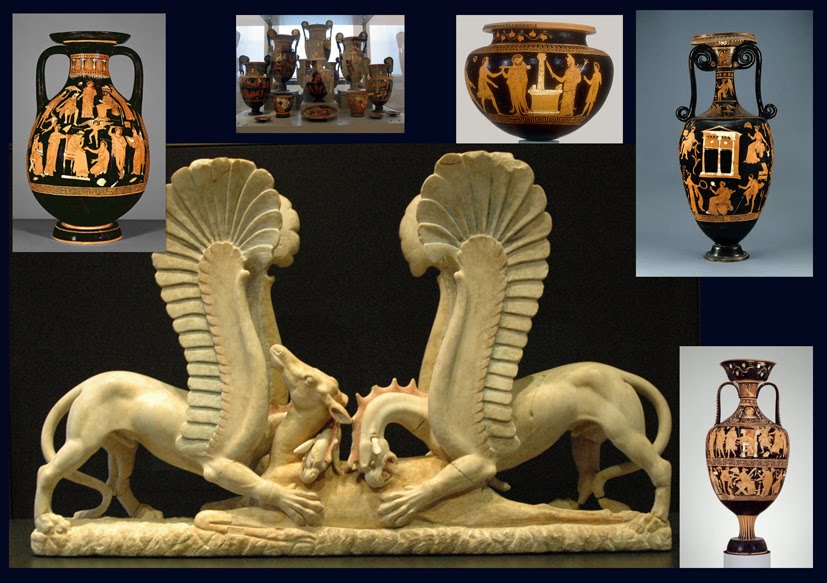
There is a useful reflection on the return of the marbles allegedly found at Ascoli Satriano and returned by the J. Paul Getty Museum. These are now on display in Rome. Renfrew writes:
I had seen the extraordinary marble sculpture of the Griffins at Malibu, both at the Villa where they were originally exhibited by the J. Paul Getty Museum and then at the inaugural installation at the new Getty Museum in Los Angeles. Indeed so striking and unexpected was the impression then made on me that I was quite doubtful of their authenticity. That is one of the prices which one pays when antiquities are clandestinely removed from their context of discovery.
And now, at the Palazzo Massimo I saw not only the Griffins and the remarkable painted marble basin but a whole assemblage of marble artefacts, including the painted calyx crater and the splendidly severe group of marble vessels (loutrophoros, epichysis, oinochoe) which apparently formed part of the original tomb group. A single de-contextualised artwork now had an important series of accompanying pieces. These added greatly to the significance of the extraordinary Griffin piece. But in addition they themselves became of vastly greater importance.But the marbles are only part of the "assemblage". It has been reported elsewhere that they were found with "a number of vases by the Darius Painter" (see earlier discussion). One of the interesting features of the returns from North America have been the pots attributed to the Apulian pot-painter dubbed the Darius painter: from Boston's Museum of Fine Arts, the Cleveland Museum of Art, Malibu's The J. Paul Getty Museum, New York's Metropolitan Museum of Art, and the Princeton University Art Museum. And we must not forget the tomb-group incorporating pots attributed to this painter in Berlin. Could the marbles have been associated with any of these pots? Indeed is it possible that they were found with Apulian cavalry armour? The answer is we just do not know details of the tomb and its original contents.
Renfrew turns to other re-contextualised material; he dubs it "post-disjunctive forensic re-contextualisation". (Surprisingly, he does not mention Morgantina where Malcolm Bell appears to have discovered the holes from which the silver hoards appear to have been removed.) Renfrew suggests other examples such as the Sarpedon krater for Cerveteri, and the fragmentary marble figures from Keros in the Cyclades ("the Keros haul").
The summary of Renfrew's lecture makes it clear that Italy has been able to address the issue of looting. Now it is the turn of museums, collectors, and dealers to avoid acquiring or selling pieces that do not have a recorded collecting history that can be traced back to the period before 1970.
Image
Composite of some of the returns from North America and other items on display in a European Collection.
Monday, 9 November 2009
UCL and the Incantation Bowls: further comment
Towards the end of October Lord Renfrew of Kaimsthorn cited the UCL incantation bowls in a speech in the House of Lords. The Observer has now published a detailed comment on the story (Vanessa Thorpe and James Doeser, "UK scholars linked to 'stolen' bowls of Babylon", The Observer November 8, 2009). The authors appear to have used a copy of the report on the bowls that has been placed in the Library of the House of Lords.
Thorpe and Doeser cite the report:
The UCL report concludes that "the bowls are subject to the Iraq United Nations sanctions order 2003 as cultural objects illicitly removed from Iraq after 6 August 1990 and that UCL has therefore a duty to deliver them to a constable".The history of the report is also discussed:
The learned team of academics and researchers who worked on the report concluded that both the university and Schøyen were guilty of not showing enough curiosity about the source of the 654 bowls, although it is not suggested that Schøyen knew they might have been looted when he bought them. The team recommended they be returned immediately and asked for the findings to be made public. But in 2007 the report's three authors were made to keep quiet about their conclusions and UCL paid an undisclosed sum of compensation to Schøyen. The authors are believed to have been unhappy about the legal gag.
Tuesday, 3 November 2009
Lord Renfrew calls for greater diligence over selling antiquities
Last week Lord Renfrew of Kaimsthorn called for greater diligence over the selling of archaeological material in the UK. He gave as a specific example the case of the lots that had to be withdrawn from a Bonhams sale in October 2008 (see my comments from last year).
Renfrew is quoted from his speech in the House of Lords:
Bonhams the auctioneers withdrew from its London antiquities sale at the request of the Italian Government some 10 antiquities, among them items formerly owned by the now sadly notorious dealer Mr Robin Symes. I understand that the Italian authorities had already made representations to the Home Office about several warehouses in London containing antiquities formerly in his ownership—many of them, it is alleged, illegally excavated in Italy.Does this need further legislation? A better solution would be for those dealing in archaeological material to show a more rigorous level of due diligence.
What is an auctioneer in this country doing, selling antiquities without a documented provenance? It is scandalous that this practice continues, and to put an end to it is one purpose of this amendment. There are serious matters here, which demand government attention.
Friday, 30 October 2009
UCL and the Incantation Bowls: Lord Renfrew comments
Earlier this week Lord Renfrew of Kaimsthorn was speaking in the House of Lords on the "Amendment of Treasure Act 1996" [record]. After mentioning the Sevso Treasure he turned to the UCL Incantation Bowls:
The second case to which I shall refer is as scandalous but less well known in view of intimations of libel action by the lawyers of Mr Martin Schøyen, a Norwegian shipowner. He purchased a major series of 654 Aramaic incantation bowls that had been imported into this country in the 1990s in dubious circumstances and lent them for study to a London university. When the university realised that they might be looted antiquities, it rightly set up a committee of inquiry on which I had the honour of sitting under the chairmanship of the distinguished lawyer, Mr David Freeman. We determined that they had indeed been looted from Iraq, or more precisely concluded,
“on the balance of probabilities that the bowls were removed from Iraq, and that their removal took place after 6th August 1990”,
and was therefore illegal. We recommended,
“the return of the incantation bowls to the Department of Antiquities of the State of Iraq”.
A copy of that report is in the Library of the House.
Despite that, I am sorry to say that the bowls were not returned to Iraq: they were returned to the custody of Mr Martin Schøyen. Under the new clause proposed in Amendments 70 and 68, lending and borrowing would both be dealing in terms of the Bill. It would be an offence to deal in undocumented archaeological objects in such a way—and so it should be: it is scandalous that the heritage of Iraq has been treated in this way.
Saturday, 10 January 2009
Renfrew, the Met and the 1970 Rule
The public release of the revised Collections Management Policy of New York's Metropolitan Museum of Art seems to have been prompted by Lord Renfrew's SAFE lecture. Lee Rosenbaum on Culturegrrl has some useful comparisons to make with the revised (and enlightened) policy at the J. Paul Getty Museum where the local laws of countries are taken into account.
Rosenbaum also comments on the "cloudy" transparency at the Met ...
Perhaps Thomas Campbell could talk about the implications of the new policy in his next YouTube "broadcast".
Rosenbaum also comments on the "cloudy" transparency at the Met ...
Perhaps Thomas Campbell could talk about the implications of the new policy in his next YouTube "broadcast".
Monday, 5 January 2009
New acquisition policy for the Metropolitan Museum of Art
It seems that Lord Renfrew's 2009 SAFE lecture has prompted a response from New York's Metropolitan Museum of Art. SAFE has released the news that the MMA will be accepting the AAMD's guidelines; Elyse Topalian, Vice President for Communications at the MMA sent an email to SAFE on January 2 stating that:
SAFE has posted details of the new MMA policy. This includes the statement:
This is a major step forward and addresses earlier concerns.
in June 2008 the Executive Committee of the Board of Trustees of the Metropolitan Museum of Art accepted the Association of Art Museum Directors's June 4, 2008 Guidelines on the Acquisition of Archaeological Materials and Ancient Art, and on November 12, 2008, the Board of Trustees adopted a revised Collections Management Policy incorporating those guidelines.
SAFE has posted details of the new MMA policy. This includes the statement:
The Museum normally shall not acquire a work unless provenance research substantiates that the work was outside its country of probable modern discovery before 1970 or was legally exported from its probable country of modern discovery after 1970.Lee Rosenbaum had indicated that such an announcement would be forthcoming back in June 2008.
This is a major step forward and addresses earlier concerns.
Friday, 2 January 2009
Renfrew on 1970 as a Benchmark
Lord Renfrew will be giving the 2009 SAFE Beacon Award Lecture, "Combating the Illicit Antiquities Trade: the 1970 Rule as a Turning Point (or How the Metropolitan Museum lags behind the Getty)". Mike Boehm has commented on the forthcoming lecture in "Getty's antiquities policy gets kudos vs. the Met" (LA Times blog January 1 2009).Renfrew has already criticised James Cuno for not accepting 1970 as a key date. (For wider reactions to James Cuno's views see here.)
But times are changing and key bodies are choosing the earlier date. The American Association of Museums (AAM) encourages the use of 1970 for the acquisition of antiquities. The Association of Art Museum Directors (AAMD) advocates the use of 1970 for the acquisition of antiquities as does its Object Register.
I have discussed 1970 against the 1983 deadline here; after all, material from North American museums that was returned to Italy was acquired from 1971 onwards. And what happens to disputed material that was acquired before 1970?
Renfrew seems to have New York's Metropolitan Museum of Art (MMA) in his spotlights. He has no need to go further than the exhibition celebrating the Philippe de Montebello Years. It is also worth reflecting on the collecting histories of the ex-MMA pieces that appeared in the Nostoi exhibitions in Rome and Athens (see also "Orphans and the Berlin painter"), in addition to the Morgantina silver.
Of course there is a marked difference between the MMA and the J. Paul Getty Museum when it comes to the objects that they have returned to Italy. The Getty has embraced transparency and has provided full disclosure (see Gill and Chippindale on the return). Will the MMA follow this important lead?
Saturday, 29 November 2008
Renfrew as Collector
There is a short profile of Lord Renfrew as a collector in the Financial Times (Mary Jane Checkland, "My favourite things", November 29, 2008). He talks about his collection of contemporary art and adds a comment on collectors of antiquities:
I’m much in favour of collecting, so long as it doesn’t involve objects recently taken from the ground. In my opinion all too many collections are scandalous for this very reason. I don’t mind so much people buying antiquities looted a century ago, but not if the items in question entered the market post-1970 when the convention on the illegal trade in antiquities was signed.
Sunday, 9 November 2008
Iraq and Antiquities: Looking Back to 2003
It seems to be "fashionable" to be looking back to "old" news stories about Iraq ... so I had better warn you now that this comment looks back to 2003.
As the missiles started to fall on Baghdad, The Times (London) reported the fears for archaeological sites and objects in Iraq (Dalya Alberge, "War and its aftermath threaten Iraqi treasures", The Times, March 26, 2003).
Lord Renfrew was said to be "demanding to know whether a coalition of American collectors and curators is seeking to acquire Iraqi antiquities after the fall of President Saddam Hussein." This coalition was described as:
Renfrew asked the question:
As the missiles started to fall on Baghdad, The Times (London) reported the fears for archaeological sites and objects in Iraq (Dalya Alberge, "War and its aftermath threaten Iraqi treasures", The Times, March 26, 2003).
Lord Renfrew was said to be "demanding to know whether a coalition of American collectors and curators is seeking to acquire Iraqi antiquities after the fall of President Saddam Hussein." This coalition was described as:
A group of wealthy and influential arts figures calling themselves the American Council for Cultural Policy (ACCP) is arguing that the legitimate dispersal of cultural material is one of the best ways to protect it. The coalition's members wield such influence that they secured a high-level meeting in January with US State and Defence Department officials, to the alarm of archaeologists.The Times noted that members of the American Council for Cultural Policy (ACCP) included "Shelby White, a leading antiquities collector, as well as museum directors and curators". The claimed aim of the group was "to save the country's wealth of archaeological sites".
Renfrew asked the question:
What on earth are they doing seeking to meet with the US Defence Department at this sensitive time?It looks as if Renfrew was right.
These collectors and curators want to be free to buy antiquities that come from archaeological sites and relax the export laws. They want the antiquities legislation of Iraq to be relaxed in the aftermath of war. If there's an intervention, there's a real risk of serious looting.
Saturday, 8 November 2008
Renfrew on Cuno: Museums as Custodians
Earlier this week Lord Renfrew was in debate with James Cuno on the BBC. Renfrew's view of James Cuno's position is now made crystal clear in his review of Cuno's Who Owns Antiquity? for the Burlington Magazine. Renfrew noted the "readable and lucidly argued book James Cuno sets out what might, ten years ago, have been described as the art museum director’s case on the proprieties of ownership and acquisition". Cuno's position is considered to be "traditional" (and by implication rather dated).Renfrew notes a weakness in Cuno's approach:
But the issues in the two cases – modern, clandestine looting, versus colonial or imperial appropriation, mainly during the nineteenth century and by the leading world powers of the day – are not the same.Such a mix does however come together in the present Nostoi exhibition in Athens where recent returns from Italy and Greece are placed alongside returns of parts of the Parthenon frieze (Palermo and the Vatican).
Renfrew concludes his review with a critical assessment of Cuno's position and the way that he has ignored the evidence of looting from Italy (a point that I will be making in my review which is now in press):
There are many interesting arguments here. And it should indeed be possible to ensure that the great universal museums of the world can fulfil their mission without at the same time conniving in the illicit traffic in antiquities which funds the continuing destruction of archaeological sites today. But Cuno’s implication that the rich institutions of the modern world can be left to regulate their own affairs, without clear acquisition codes and without international regulation, is belied by recent evidence. Peter Watson’s book, The Medici Conspiracy: the Illicit Journey of Looted Antiquities, from Italy’s Tomb Raiders to the World’s Greatest Museums (New York 2006) makes all too clear how museum curators and widely respected dealers have sometimes been complicit in the traffic in looted antiquities. Acquisitive museums have too often been in league with wealthy collectors, encouraging them to amass substantial assemblages of antiquities without any exercise of due diligence, and then accepting these by gift or bequest, some years later, on the grounds that they have now become ‘recognised collections’. This is the unpleasant reality that has recently led the Association of Art Museum Directors to move towards the acceptance of the 1970 rule, a position which the Museums Association of the United Kingdom, like the Department of Culture, Media and Sport, adopted some years ago. Most of us would share the aspiration underlying Cuno’s question ‘Who owns art?’ that the past is the inheritance of us all. More dubious, however, is the fitness of institutions such as the one he directs, to be the custodians of this inheritance. Until they accept and publish an ethical acquisitions policy, their position – like that of the author – will be open to question.
Wednesday, 5 November 2008
Cuno and Renfrew on recently-surfaced antiquities
James Cuno and Lord Renfrew discussed the issue of recently surfaced antiquities on the BBC's flagship Today news programme. They were interviewed by Sarah Montague who brought a crispness to the proceedings.Cuno stressed the ownership of the world's ancient past and returned to his oft-quoted theme that there was no direct link between antiquity and modern nation states.
Renfrew agreed that antiquity belongs to us all, but reminded the listeners that this shared ownership also brings responsibilities. He then changed the direction of the interview towards the issue of looting: "The great problem at present is the destruction of the record of the past through looting." He suggested that museums and private collectors should not be free to buy recently-surfaced antiquities.
While Cuno accepted the issue of looting, Renfrew criticised Cuno for not using the 1970 UNESCO Convention as a benchmark. Cuno responded that he did not accept 1970 as a "legal" date and placed his emphasis on national laws. Montague was quick to remind Cuno that from 1970 museums should have been aware of the ethical issues.
Renfrew dismissed Cuno's position: "It isn't good enough". He then emphasised that museums should only acquire objects that were "Safely out of the ground before 1970".
The discussion was firm and polite - and for once Cuno was firmly on the defensive.
Match to Renfrew.
Image
© David Gill.
Saturday, 26 January 2008
Lord Renfrew on "Dodgy Dealers"
Lord Renfrew has been lecturing in Scotland as part of the Tercentenary Celebrations of the Society of Antiquaries (Susan Mansfield, "Cemetery looting robs archaeologists of DNA link to past", The Scotsman, January 26, 2008). As part of the lecture he turned to the problem of looting and the way that it destroys knowledge.
But only last week I noted these words from one prominent dealer in antiquities who commented on the return of antiquities from Shelby White (Shelby White: "positive for the future of collecting antiquities"):
"It's a colossal problem. It's destroying the record of the past. It's got much worse over the past 30 years, so the opportunity of getting really good data about the past is being very substantially damaged or reduced."Renfrew then turned to the people he felt were responsible:
Looting has increased, he says, largely because of the "rapacious" demands of collectors in the West. Ancient sites are excavated clandestinely and their contents removed, so the chance for archaeologists to study and document them is lost for ever.
"For example, we get a lot of information from cemeteries. But if a looter has gone in and dug up half the graves, you've not going to get that information about the entire community. Now there are very few ancient cemeteries that
continue undisturbed."
He criticises museums and collectors in the United States, Japan and Russia for buying antiquities from "dodgy dealers" without checking their provenance.Now we are seeing returns of antiquities to Italy and Greece from public institutions, private collectors and dealers will we see a change in selling and collecting habits in the antiquities market? It would be good to think so.
"They are completely thwarting the good ambition of better understanding the human past. They are actually financing the looting. They know the antiquities they are buying are likely to be looted."
But only last week I noted these words from one prominent dealer in antiquities who commented on the return of antiquities from Shelby White (Shelby White: "positive for the future of collecting antiquities"):
Overall, this is positive for the future of collecting antiquities and for the future of a trade that's crucial to America's culture ... Collectors in antiquities should be conducting more due diligence than in the past.There is a long way to go.
Subscribe to:
Posts (Atom)
Another Bürki object returns to Italy
Source: MMA A psykter column-krater attributed to the Troilos painter was deaccessioned by New York's Metropolitan Museum of Art in June...
-
Source: Sotheby's A marble head of Alexander the Great has been seized in New York (reported in " Judge Orders Return of Ancien...
-
Source: ICE. There are times when you wonder if there is a lack of imagination when it comes to naming operations but 'Mummy's C...
-
Detail of the Sophilos dinos © David Gill The Sophilos dinos in the British Museum has been reconstructed from approximately 50 fragments. I...