Showing posts with label Schinousa. Show all posts

Wednesday, 16 November 2022

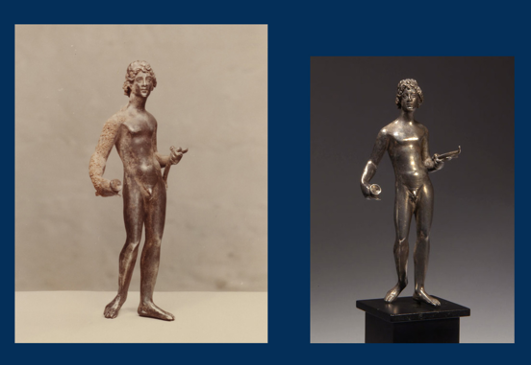
A Silver Apollo Returns to Turkey

Left: Symes-Michaelides archive; Right: Royal-Athena Galleries


In November 2022 the US authorities returned a silver statuette of Apollo to Turkey. This was recognised as the figure that had been identified by Christos Tsirogiannis in 2007 as appearing in the Symes-Michaelides archive. It receives a full discussion in his PhD thesis, Unravelling the Hidden Market of Illicit Antiquities: The Robin Symes - Christos Michaelides Network and its International Implications (Cambridge University, PhD Dissertation, 2012). 

The history can be traced through the various sale catalogues in which it appeared.

The figure seems to have surfaced in an exhibition organised by Marie-Louise Vollenweider, Musées de Genève in January 1987 (no. 274), and then featured in the exhibition for Numismatic Fine Arts, Treasures from an Ancient Jewelbox: Gold and Silver of the Ancient World (1992): the catalogue was prepared by Robert Hecht. 

The figure next appeared in the exhibition organised in memory of Michaelides by Robin Symes, Royal Portraits and Hellenistic Kingdoms (New York 1999) no. 24, and then passed into a New York private collection. It was offered at Sotheby’s (New York) on December 7, 2001, lot 76 but was unsold; it entered an Australian private collection in 2002, and was offered at Sotheby’s (New York) June 5, 2008, lot 22 but again was reportedly unsold. It was purchased by Jerome Eisenberg and appeared in Royal-Athena Galleries, Art of the Ancient World 20 (2009) no. 134; Art of the Ancient World 28 (2017) no. 27. It is not clear when the Apollo was seized.

The evidence used to associate the Apollo with a findspot in Turkey has not been disclosed as part of the return, but it has been associated with rulers from Pontus and Cappadocia.

Note. The label in the Antalya Museum states that the figure is bronze but this is incorrect. I am grateful to Christos Tsirogiannis who was able to confirm the material.

| |
Bookmark and Share so Your Real Friends Know that You Know

Tuesday, 7 December 2021

Ex Symes material on offer in London


Associate Professor Christos Tsirogiannis has identified two Etruscan bronze attachments that are being offered at Sotheby's, London, on December 7, 2021 (lot 68). The history of the pieces is rehearsed:
Mathias Komor, New York, inv. nos. I.514 and I.515 
Clarence Day, Memphis, acquired from the above on February 24th, 1978 (Sotheby's, New York, Antiquities from the Collection of the Late Clarence Day, December 7th, 2010, no. 15, illus.) 
acquired by the present owner at the above sale
Tsirogiannis made the identification for the bronzes in the Schinoussa archive thus showing that they had passed through the hands of Robin Symes.

The detail is provided in Dalya Alberge, "Antiquities for auction could be illicitly sourced, archaeologist claims", The Guardian December 7, 2021.
| |
Bookmark and Share so Your Real Friends Know that You Know

Wednesday, 10 October 2018

Adding to the history of an Attic black-figured amphora

Attic black-figured amphora
Source: Schinousa archive, courtesy of Dr Christos Tsirogiannis

The post-excavation histories of objects are important as we map the that cultural property passes through collections and the markets. This is clear for an Attic black-figured amphora, attributed to Group E, that is due to be auctioned at Christie's New York on October 31, 2018 (lot 31). It shows Herakles and the Nemean lion, and Theseus and the Minotaur.

The auction catalogue claims that it surfaced in the hands of John Hewett in London in 1970 (or earlier), then to a private collection in Europe, followed by a series of auctions:
  • A European private collection; Antiquities  Sotheby's, London, 11 July 1988, lot 130
  • thence to a private collection, New York
  • Antiquities Christie's, New York, 15 December 1992, lot 81
  • Antiquities Sotheby's, New York, 17 December 1996, lot 50
  • Antiquities, Sotheby's, New York, 4 June 1998, lot 102
The amphora appears in the Beazley Archive (BAPD 350425). This provides the history sequence as follows (though in the list of auction catalogues seems to confuse Sotheby's and Christie's). Note that the sequence does not quite match the one provided by Christie's.

  • 1: London, market 
  • 2: London, market, Sotheby's 
  • 3: New York (NY), market, Sotheby's 
  • 4: London, private 
  • 5: New York (NY), market, Sotheby's
Cambridge-based researcher, Dr Christos Tsirogiannis, has spotted that the amphora appears in the Schinousa archive. He also observes that the photographs of the amphora in BAPD show salt deposits, perhaps indicating that the amphora had only recently emerged from its context. These also contrast with the photographs in the Schinousa archive that appear to have been taken after conservation / restoration.

When did the amphora reside with Robin Symes? Was this the European private collection? Or was this the London private collection between December 1996 and June 1998? Or are these private collections different again?

The amphora was known to Sir John Beazley and was listed by him in 1971. It is, however, surprising that the auction catalogue entry and the BAPD record do not coincide more closely. And the amphora's presence in the hands of Robin Symes adds to our knowledge of how the amphora passed through the market. 


Bookmark and Share so Your Real Friends Know that You Know

Tuesday, 7 August 2018

Schinousa outcome and reaction to expert witness

In November 2006 four members of a shipping family were charged. It was reported at the time in the Greek press that '152 artifacts were found at the villa on Schinoussa and at the family's Athenian home in Psychico, northern Athens' ("Four charged over artifact stash", 23 November 2006).

The verdict on the Schinousa case was reached on Thursday 26 July 2018. A translation of the verdict has been circulated by the State lawyer: ‘The Court by majority found guilty Despina and Dimitri Papadimitriou for the act of misappropriation of monuments and convicted each one of them to suspended imprisonment of 4 years. It also ratified the seizure and ordered the confiscation of the seized items’.

The day after the verdict, 27 July 2018, Dr Christos Tsirogannis, who had served as an expert witness in the case, received a letter from the London law firm acting for their Greek clients.

Dr Sam Hardy has written extended comments on this latest development, and ARCA provides an overview of the case.

Bookmark and Share so Your Real Friends Know that You Know

Tuesday, 19 June 2018

The Symes Athlete

Athlete from the Schinoussa Archive.
Source: Dr Christos Tsirogiannis
Dr Christos Tsirogiannis has identified a Roman marble athlete from the Schinoussa photographic archive. The sculpture, "A Roman Marble Figure of an Athlete, circa 1st/2nd Century A.D.", is acknowledged as "perhaps acquired from Robin Symes". The photographic evidence can now confirm this part in the statue's history. 

The sculpture is due to be auctioned at Sotheby's, London on 3 July 2018 (lot 23). The estimate is £30,000–£50,000. The stated history is as follows:

  • John Hewett (1919-1994), London, perhaps acquired from Robin Symes 
  • James Freeman, Kyoto, probably acquired from the above in the early 1970s 
  • acquired from the above by Willard and Elizabeth Clark on December 21st, 1980
Tsirogiannis has observed that the statue in the Schinoussa archive is "uncleaned and unrestored, since soil encrustations are obvious on its surface".  Note also the damage to the right thigh.

Did Symes sell the statue to Hewett? Or did Hewett sell it to Symes? Or did Symes sell the statue to Freeman? Or did Hewett sell to Freeman? When did these transactions take place?

What is the authenticated documentation that can confirm the statue's history? When did it surface?

Bookmark and Share so Your Real Friends Know that You Know

Thursday, 10 May 2018

Symes and a Roman medical set

Top: medical set for auction in Paris
Bottom: image from Schinousa archive
Pierre Bergé & Associés of Paris are offering a rare Roman bronze medical set (16 May 2018, lot 236). Its recorded history is: "Ancienne collection Hishiguro, Tokyo, 1992". The catalogue entry helpfully informs us that the set probably came from a burial ("Cette trousse de chirurgien a probablement été découverte dans une sépulture ...").

The set appears to be the one that has been identified by Dr Christos Tsirogannis from an image in the Schinousa archive thus linking it to Robin Symes.

Given that the catalogue entry suggests that this piece came from a funerary context and that the history of the piece can only be traced back to 1992 (and not to 1970), questions are being raised about the set's origins.

What due diligence was conducted on the medical set prior to offering it for sale? Did Symes sell the set to Hishiguro? How did Symes obtain the set? Who sold it to him?

I understand that the appropriate authorities in France are being informed about the lot.


Bookmark and Share so Your Real Friends Know that You Know

Wednesday, 2 May 2018

Symes and a Geometric horse

Source: Schinousa archive
courtesy of Dr Christos Tsirogiannis
Dr Christos Tsirogiannis has identified a geometric horse from the Symes archive. The horse is due to be auctioned at 'The Shape of Beauty: Sculpture from the Collection of Howard and Saretta Barnet' at Sotheby's New York on 14 May 2018 (lot 4). 

Sotheby's provide a history of the horse and do acknowledge the link with Symes:

  • Münzen und Medaillen AG, Basel, May 6, 1967, lot 2 
  • Robin Symes, London, very probably acquired at the above auction 
  • Howard and Saretta Barnet, New York, acquired from the above on November 16, 1973

When did the horse leave Greece? Who consigned it to the sale in Basel? Did the Barnets acquire other material from Symes?


Bookmark and Share so Your Real Friends Know that You Know

Friday, 2 February 2018

Ownership of Paestan krater handed back to Italy

Paestan krater. Source: Art Daily

The Speed Art Museum in Louisville, Kentucky has agreed to transfer ownership of a Paestan calyx-krater to the Italian authorities ("The Speed Art Museum and Italian Ministry reach loan agreement on ancient calyx-krater", Art Daily 2018). It will, however, remain on loan in the museum. The krater, showing Dionysos playing the sympotic game of kottabos, was acquired in 1990 from Robin Symes (inv. 90.7).

It appears that the krater was identified by Dr Christos Tsirogiannis in 2015 from images in both the Medici Dossier and the Schinousa archive. Symes had claimed that the krater had come from a private collector in Paris.

This is one of a series of Paestan objects that have been returned to Italy. They include the Asteas krater from the J. Paul Getty Museum, the Paestan krater from New York's Metropolitan Museum of Art, a Paestan squat lekythos from the Fleischman collection, a Paestan squat lekythos from a Manhattan gallery, and the Paestan funerary painting.

The fact that the Speed Art Museum has responded to these concerns is encouraging. Stephen Reily commented on the "shared interest in the responsible celebration of Italian cultural heritage".

One wonders if the Michael C. Carlos Museum will also be responding to the identification of objects in its collection from the Becchina archive.

Bookmark and Share so Your Real Friends Know that You Know

Monday, 15 January 2018

Sources for Steinhardt seizure revealed

Attic white ground lekythos
Source: Schinousa Archive
I am grateful to Dr Christos Tsirogiannis for sharing information about the items seized from the collection of Michael Steinhardt and from the displays at Phoenix Ancient Art in Manhattan.

The Attic white-ground lekythos has been identified from images in the Schinousa Archive showing that it was part of the stock of Robin Symes. Notice the deposits still on the lekythos. When was the lekythos cleaned? Who did the cleaning?

The other Steinhardt pieces are identified in the Medici Dossier as well as the Becchina Archive.

The pieces from Phoenix Ancient Art include items identified from the Medici Dossier (at least 3 items) and the Becchina Archive (at least 1 item).

I expect that the routes through which these pieces passed will be revealed shortly.


Bookmark and Share so Your Real Friends Know that You Know

Tuesday, 5 December 2017

An athlete, Robin Symes and the Paris market

Source: Schinoussa archive
Courtesy: Dr Christos Tsirogiannis
Dr Christos Tsirogiannis has identified a Roman marble athlete from the Robin Symes archive. The statue is due to be auctioned in Paris this Friday, 8 December 2017 (Drouot lot 292).

The history of the statue is provided:
  • Royal Athena Galleries, New York:  Art of the Ancient World 4 (1995), p.75-76, lot n°236.
This does not explain why the statue appeared in the confiscated Symes archive. 

Tsirogiannis has also spotted that the statue surfaced at Sotheby's in London Sotheby's on 5th of July 1982. lot 397. Who consigned the statue to that sale? Why does the Paris description fail to mention the Sotheby's information? Would it raise questions about how it surfaced?

Where was the statue between 1982 and 1995?

I understand that the French authorities have been informed about the sale.

Bookmark and Share so Your Real Friends Know that You Know

Tuesday, 21 February 2017

More surfacings from Symes and Medici in London

Source: Schinousa Archive.
Dr Christos Tsirogiannis spotted three items that were auctioned in Westminster, London today.

It is a good reminder of the apparently poor due diligence process conducted by some sectors of the antiquities market.

a. Lot 49 Scythian rhyton. Sold: £3100. Collecting history: 'Property of a London gentleman; acquired from a major Mayfair gallery; acquired on the London art market before 2000.' As this seems to appear in the Schinousa archive it should be associated with the London dealer Robin Symes.

b. Lot 79 Silver Sycthian moose.
Sold: £2790. Collecting history: 'Property of a London gentleman; acquired from a major Mayfair gallery; acquired on the London art market before 2000.' This also seems to appear in the Schinousa archive indicating an association with Symes.
Source: Schinousa Archive.
Source: Medici Dossier

c. Lot 183. Roman head of a youth. Opening bid: £900. Collecting history: 'Property of a London gentleman; acquired from a major Mayfair gallery; acquired on the London art market before 2000.'  This head appears to be the one that features in the Medici Dossier seized in the Geneva Freeport.

These three examples suggest that owners of material that passed through the hands of Symes and Medici are now looking for less high profile ways of disposing of their collections. Notice that in all three cases the date of surfacing is said to be 'before 2000' yet clearly well after the 1970 UNESCO Convention.

I understand that the relevant UK and European police authorities have been informed of the auction.


Bookmark and Share so Your Real Friends Know that You Know

Tuesday, 11 October 2016

Draped goddess from "a distinguished private collection"

Goddess from Schinoussa Archive
Source: Dr Christos Tsirogiannis
Christie's is due to be auctioning a 'Roman marble draped goddess' in their auction at the Rockefeller Plaza, New York on 25 October 2016 (lot 92). It is recorded as the "property from a distinguished private collection". The collecting history ("provenance") is provided as: "with Perpitch Gallery, Paris"; and acquired from there by the current owner "prior to 1991". The estimated value is $100,000 to $150,000.

1991 is some distance in time from the benchmark date of 1970 provided by the UNESCO Convention.

The goddess appears to be the same as the one identified by Dr Christos Tsirogiannis in the Schinoussa Archive. This suggests that the goddess, at some point, passed through the hands of Robin Symes.

Why is the collecting history for the goddess that appears in the sale catalogue incomplete? Had the due diligence process failed to make the apparent link with Symes? How had the object's history between 1970 and 1991 been explained?

Bookmark and Share so Your Real Friends Know that You Know

Wednesday, 18 February 2015

The Dioskouroi from Syria

Dioskouroi
featuring in the Schinoussa Archive
and on display in New York MMA

New York's Metropolitan Museum of Art has been displaying a pair of Roman statues (on loan since 2008). The reported (but unauthenticated) collecting history attempts to place the pieces in a Mithraeum at Sidon with their discovery in the 19th century. However the paperwork seized in Basel (see here), Switzerland places them in Syria. Is this another case of 'adjusted' findspots?

It is important to stress that these statues were not removed during the present conflict.

A parallel discussion needs to take place around the Christian mosaics acquired by Fordham University.

Bookmark and Share so Your Real Friends Know that You Know

Friday, 12 December 2014

Symes Statue Unsold at Sotheby's


Egyptian statue from Schinoussa Archive
Source: ARCA / Tsirogiannis

It seems that the Egyptian statue that had appeared to pass through the hands of Robin Symes has been left unsold at Sotheby's today.

Bookmark and Share so Your Real Friends Know that You Know

Robin Symes, the Egyptian Priest and Sotheby's

Egyptian priest from Schinoussa Archive
Source: ARCA / Tsirogiannis
Later today Sotheby's will be auctioning "AN EGYPTIAN DIORITE FIGURE OF A PRIEST OF THE TEMPLE OF MUT, LATE 25TH/EARLY 26TH DYNASTY, CIRCA 670-610 B.C." (lot 6). The collecting history is provided:

  • private collection (Christie's, London, April 27th, 1976, no. 135, illus.) 
  • Khnoum, Geneva, 1992 
  • Drouot-Richelieu, Paris, October 1st, 1996, no. 462, illus. 
  • Safani Gallery, New York 
  • Jack Josephson Collection (Sotheby’s, New York, June 5th, 2008, lot 57, illus.) 

In 2008 it sold for $422,500.

Who was the vendor in 1976? And who was the statue's proprietor prior to 1976? When did the statue leave Egypt?

The statue has been exhibited at:

  • the Michael C. Carlos Museum, Emory University, August 2008-August 2013 
  • the Albany Institute of History and Art, “The Mystery of the Albany Mummies”, September 21st, 2013-June 8th, 2014

Part of the collecting history has been expanded. Glasgow University researcher Dr Christos Tsirogiannis has spotted that the statue appears in the Schinoussa archive and therefore makes the link with Robin Symes.

Egyptian objects with similar collecting histories were withdrawn from auction at Christie's yesterday. We can only presume that the staff at Sotheby's have been in touch with the Egyptian authorities.

Will the statue be withdrawn from the sale today?

Bookmark and Share so Your Real Friends Know that You Know

Thursday, 11 December 2014

Christie's: withdrawn lots

Attic red-figured krater / Swingler
Source: Tsirogiannis
Those following Christie's sale of antiquities will have noted the following lots have been withdrawn:
  • Lot 51: AN EGYPTIAN ALABASTER FIGURAL JUG. "This Lot is Withdrawn."
  • Lot 95: Athenian red-figured krater. "This Lot is Withdrawn."
  • Lot 133: A FALISCAN BLACK-GLAZED ASKOS. "This lot has been withdrawn from the sale." Collecting history: "with Phoenix Ancient Art, Geneva, 1997"; "PROPERTY FROM THE MICHAEL AND JUDY STEINHARDT COLLECTION".
  • Lot 139: A ROMAN MARBLE COLUMN CAPITAL. "This Lot is Withdrawn."
Dr Christos Tsirogannis had linked lot 95 to photographs associated with David Swingler, and lots 51 and 139 to the Schinoussa archive. It is not clear why the askos was withdrawn from the sale, although it joins the Sardinian figure also from the Steinhardt collection.

Who owned the askos prior to 1997? What does it say about other objects that were derived from this route? What about the mummy mask that was acquired by the St Louis Art Museum (SLAM) in 1998?

Do the staff at Christie's need to review their due diligence process to make it more rigorous?

And why have the lots been withdrawn when in the past the sales have proceeded? Can we detect a change in policy at the auction-house?

Bookmark and Share so Your Real Friends Know that You Know

Wednesday, 10 December 2014

Robin Symes and lots at Christie's

Authenticated and therefore reliable collecting histories are important. Auction catalogues need to be able to demonstrate the previous owners of a lot. After all, potential buyers need to understand what they are buying.

Dr Christos Tsirogannis has identified two of the lots that are to be auctioned this week at Christie's from the Schinoussa Archive (linked to Robin Symes). This raises questions about when the objects passed through Symes' hands.

Lot 51, AN EGYPTIAN ALABASTER FIGURAL JUG

  • with Nicholas Wright, London, prior to 1980. 
  • Private Collection, U.K., 1992. 
  • with Charles Ede, London. 
  • PROPERTY FROM THE HARER FAMILY TRUST COLLECTION


Lot 139, A ROMAN MARBLE COLUMN CAPITAL

  • Antiquities, Sotheby's, London, 18 May 1987, lot 210 (part). 
  • Antiquities, Sotheby's, New York, 25 June 1992, lot 138.


For lot 51, is Robin Symes the anonymous private collector? Is this the best way to describe him?
For lot 139, when did Symes possess the capital?

Bookmark and Share so Your Real Friends Know that You Know

Thursday, 16 January 2014

Italy requests return of Symes material from UK

An earlier return to Italy (from Switzerland).
Source: Carabinieri
Cristina Ruiz and Javier Pes are reporting in The Art Newspaper ("Italy threatens to sue UK firm over ancient ‘loot’", January 16, 2014) that the Italian government has requested that the UK Government return some 700 objects identified as being removed from Italy. The Italian authorities had worked with DCMS to identify relevant material following agreement in the autumn of 2007. It appears that if there is no response that the Italians will consider taking legal action the UK company handling the seized assets of dealer Robin Symes. It could be the first series use of the Dealing in Cultural Offences Act (2003).

Cambridge University researcher, Dr Christos Tsirogiannis, is quoted. It appears that he requested the information during his research into Symes. (I had also made several enquiries but without success.)

The news report states, "Sources close to the Italian investigators say that Italy has provided ample evidence to substantiate its claim and that it is up to the liquidator to prove that the material is not looted." This is likely to have been photographic images mainly derived from the Schinousa archive but could include other dossiers seized in Switzerland.

Greece also appears to have identified material among the assets but has yet to make a formal request.

Bookmark and Share so Your Real Friends Know that You Know

Friday, 13 December 2013

Medici and Symes material in New York

Fabio Isman has a piece on the Medici and Symes pieces surfacing on the New York market ("Pezzi di Medici e Symes all’asta: fino a quando?", Artemagazine December 2013). This draws on the identifications made by Dr Christos Tsirogiannis. It also has the images of one of the objects in the Swiss Gallery.

The piece is a reminder that auction-houses need to undertake a more rigorous due diligence process to prevent these toxic antiquities from appearing at the sales.

Bookmark and Share so Your Real Friends Know that You Know

The Symes Pan: Update

I had noted that Cambridge University researcher, Dr Christos Tsirogiannis, had spotted that a Pan on offer at Christie's today appeared in the Schinousa archive. The lot has been withdrawn.

Bookmark and Share so Your Real Friends Know that You Know

Krater fragments in Princeton

Greek, Attic, probably by the Kleophrades Painter, ca. 490–480 BCE, Two non-joining fragments from a calyx-krater (mixing bowl) depicting ar...