Showing posts with label Manhattan DA. Show all posts

Thursday, 16 July 2026

Another Bürki object returns to Italy

Source: MMA


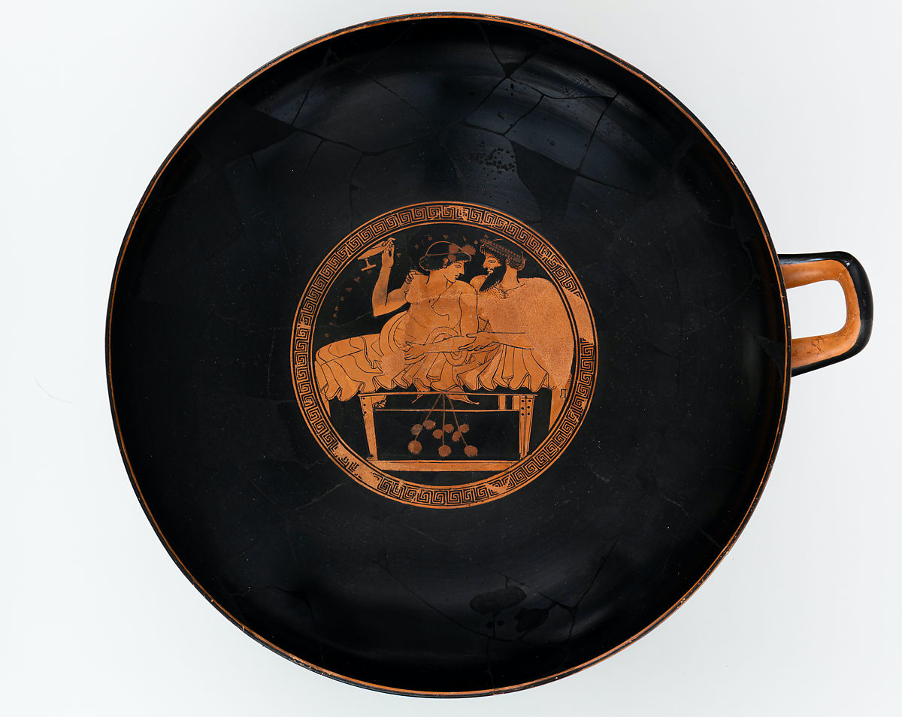
A psykter column-krater attributed to the Troilos painter was deaccessioned by New York's Metropolitan Museum of Art in June 2026 (1986.11.12; BAPD 15922). The history of the piece was recorded by the MMA:
[By 1982, (perhaps late 1970s), with Sandro Cimicchi, Basel, Switzerland]; [until 1985, with Christoph Leon, Basel, Switzerland]; [1985-86, with Christie’s, London]; acquired in 1986, purchased from Christie’s, London (lot 141).
However, the Manhattan DA added that the krater was 'smuggled out of Italy by Fritz Bürki'. The Christie's sale was on July 16, 1986.

The references on the MMA website omit the publication in the volume of Essays in Honor of Dietrich von Bothmer (2002).

| |
Bookmark and Share so Your Real Friends Know that You Know

Monday, 27 April 2026

Further returns to Italy from the MMA

Formerly New York MMA 1991.11.6.1–2.
Source: MMA
New York's Metropolitan Museum of Art has returned another batch of Greek and Roman antiquities as a result of investigations by the Manhattan DA into objects handled by Frieda Tchacos, Gianfranco Becchina, and Fritz Bürki [see Manhattan DA press release].

Only one piece is highlighted in the press release, a fragmentary Sicilian terracotta relief:
Two additional adjoining fragments of the votive relief were found in the archaeological excavations of the temple of Demeter Malophoros at Selinunte, Sicily, less than ten miles from Becchina’s hometown. Those fragments remain in the Palermo Museum.
This is linked to the Becchina investigation. The relief had formed part of the Norbert Schimmel collection. One other Schimmel piece is among the repatriated objects, a bronze handle attachment in the form of a mask. Other Schimmel items appeared in earlier returns.

The two Bürki linked pieces were objects presented by Dietrich von Bothmer, an Attic bilingual cup attributed to near Psiax, and a fragmentary cup attributed to Epiktetos.

The Tchacos pieces include a pair of spherical Greek gold earrings, a pair of Roman silver cups —one carries a weight inscription for the pair — and an inscribed lid of a Roman cinerarium (Sextus Flavius Pencarpus). There is also a forged Roman funerary inscription.

These latest returns have implications for other material. A batch of material from Selinunte is discussed in my Artwashing the Past (2025) [chapter 11]. The Tchacos investigation will lead to the numerous fragments acquired by other museums (as well as the nearly 300 fragments in the Bothmer collection: and these are just the ones identified in the sample).

I am grateful to Jason Felch for drawing my attention to one of the Schimmel pieces.

Bookmark and Share so Your Real Friends Know that You Know

Thursday, 13 November 2025

Hecht fragment returns to Italy

Source: MMA
In January 2024 New York's Metropolitan Museum of Art deaccessioned the foot of an Attic black-figured band cup related to the Lysippides painter (inv. 2017.18; BAPD 340463). The fragment surfaced with Hesperia Arts in Philadelphia in 1957 and was discussed by Sir John Beazley in 1961. It then passed into the hands of Münzen und Medaillen in Basel (1963) and was then sold to the Toledo Museum of Art (inv. 63.25). It featured in the first fascicule of the CVA (1976). The fragment was deacessioned and sold through Christie's, New York (October 25, 2016, lot 15).

A press release (February 18, 2025) from the Manhattan DA informs us:
The Kylix was found and illegally excavated from the Etruscan archaeological site of Vulci in the 1960s before it was smuggled out of Italy by the New York and Paris-based dealer Robert Hecht.
In fact, the cup must have been removed in the 1950s (or earlier). But what is the basis of this new evidence?

More importantly, what does it means for museums that acquired items that passed through Hesperia Arts in the 1950s and 1960s? Eight items appear in the Beazley Archive Pottery Database, including a clutch formerly in the collection of J.V. Noble. There are even more pieces listed under "Philadelphia market": a quick check on some of the pieces quickly established a named link with Robert Hecht or Hesperia Arts. And I noted another black-figured amphora that certainly passed through Hesperia Arts but that information was not recorded on BAPD. 

Is Italy now pursuing items that surfaced well before the 1970 UNESCO Convention? Will this result in a further set of returns?

| |
Bookmark and Share so Your Real Friends Know that You Know

Monday, 10 November 2025

Further returns to Greece from the Met

Source: Hellenic Consulate General in New York

In September 2025 a number of antiquities were seized from New York’s Metropolitan Museum of Art and at least six formed part of the return to Greece announced at the beginning of October. All have been acquired from Andrés A. Mata in 2001 and 2004, and all had been purchased from Fortuna Fine Arts. They include two stone axe heads (2004.342.3–4), a Cretan or Cycladic terracotta jug (2004.342.2), a Cycladic collared jar (2004.342.1), and two iron swords (2001.346, 2001.543). One of the swords was given to the museum in honour of Carlos A. Picón. 

A further piece was mentioned in the press release, an archaic bronze gorgon applique. It had apparently surfaced through Robert Hecht, who sold it to Fortuna Fine Arts. It then added: 
Fortuna then falsely claimed that the Gorgon came from William Froelich, a name frequently used by Fortuna and other galleries in its false provenance. Thereafter, the Gorgon was sold to a private collector who placed the antiquity on loan at the Met. The Antiquities Trafficking Unit seized the Gorgon from the Met in 2025. 

This appears to be the figure that formed part of the exhibition, ‘Dangerous Beauty’, and was identified as coming from the collection of Andrés A. Mata. (The figure can be seen in press photograph of the October 2025 handover.)

Another gorgon applique that passed through Fortuna Fine Arts was acquired by the Carlos Museum at Emory University in 2017: it was a gift of Mata, Sybil and Ed Ralston, and Judy and Michael Steinhardt (2017.025.001). Mata also gave an inscribed bronze hydria rim to the museum in 2014 in honour of Jasper Gaunt (2014.023.001). 

The mention of Froelich is important as it appears, in connection with Fortuna Fine Arts, in the history of a Tarentine limestone funerary relief acquired by the Met in 2013. Froelich and Fortuna came together in the history of a Canosan terracotta figure of Zeus that was withdrawn from a sale at Christie’s. The history also mentions Boris Mussienko. This name appears against a bronze Aphrodite on loan to the Met from a private collector and returned to Italy.

Fortuna then falsely claimed that the Statuette came from Boris Mussienko, a name frequently used by Fortuna and other galleries in its false provenance. Thereafter, the Statuette was sold to a private collector who placed the antiquity on loan at the Met. The Antiquities Trafficking Unit seized the Statuette from the Met in 2025.

The Met seizures may well have serious implications for other collections.

| |
Bookmark and Share so Your Real Friends Know that You Know

Wednesday, 5 November 2025

Returns to Greece from New York's Metropolitan Museum of Art

Source: MMA


The Metropolitan Museum of Art has announced that it returned 12 antiquities to the Hellenic Republic of Greece in October. 
The Metropolitan Museum of Art announced today that it is returning 12 objects to the Hellenic Republic of Greece, including: four pieces of jewelry, two iron machaira (swords), two bronze belt clasps, two terracotta jugs, and two stone axe heads, and one group of silver spirals. The archaeological works range in date from 2700 BCE to 400 BCE. The works range in date from 2700 BCE to 400 BCE. Through the Museum’s cooperation with the Manhattan DA’s office, and as a result of its investigation into Fortuna Fine Arts, the Museum recently received new information that made it clear that the works should be repatriated, resulting in a constructive resolution.
The return is presumably part of this oblique press release from the Manhattan DA that acknowledges help from Fortune Fine Arts. Some of the items can be recognised here.

Although the press release does not give further details (and the press release list is not entirely accurate), these items can be identified as:
  • gold pendant, [1999.12
    • [Until 1999, with Fortuna Fine Arts, Inc., New York]; acquired in 1999, purchased from Fortuna Fine Arts, Inc. Deaccessioned for return to the Hellenic Republic in September 2025.
  • two silver bracelets [1991.170.1] [1991.170.2]
    • [Until 1991, with Selim Dere, New York]; acquired in 1991, gift of Selim Dere. Deaccessioned for return to the Hellenic Republic in September 2025.
  • Gold and silver bracelet, [1993.314]
    • [Until 1993, with Selim Dere, New York]; acquired in 1993, anonymous gift. Deaccessioned for return to the Hellenic Republic in September 2025.
  • two iron machaira (swords), [2001.346] [2001.543]
    • [Until 2001, with Fortuna Fine Arts, Inc.]; acquired in 2001, purchased from Fortuna Fine Arts, Inc. Deaccessioned for return to the Hellenic Republic in September 2025.
    • [Until 2001, with Fortuna Fine Arts, Inc., New York]; 2001, purchsed by Andres A. Mata from Fortuna Fine Arts, Inc.; acquired in 2001, gift of Andres A. Mata, in honor of Carlos A. Picon, 2001. Deaccessioned for return to the Hellenic Republic in September 2025.
  • two Macedonian bronze belt clasps, [2001.578] [2001.579]
    • [Until 2001, with Fortuna Fine Arts, Inc.]; acquired in 2001, purchased from Fortuna Fine Arts, Inc. Deaccessioned for return to the Hellenic Republic in September 2025.
      • 2001.579: Purchase, Mrs. Constance Goulandris Gift, in memory of Christos G. Bastis, 2001
  • Cycladic or Cretan terracotta jug,  [2004.342.2]
    • [Until 2004, with Fortuna Fine Arts, Inc., New York]; June 2004, purchased by Andres A. Mata from Fortuna Fine Arts, Inc.; acquired in 2004, gift of Andres A. Mata. Deaccessioned for return to the Hellenic Republic in September 2025.
  • Cycladic collared jar, [2004.342.1]
    • [Until 2004, with Fortuna Fine Arts, Inc., New York]; June 2004, purchased by Andrés Mata from Fortuna Fine Arts, Inc., New York; acquired in August 2004, gift of A. Mata. Deaccessioned for return to the Hellenic Republic in September 2025.
  • two stone axe heads, [2004.342.3]] [2004.342.4]
    • [Until 2004, with Fortuna Fine Arts, Inc., New York]; June 2004, purchsed by Andres A. Mata from Fortuna Fine Arts, Inc.; acquired in August 2004, gift of Andres A. Mata. Deaccessioned for return to the Hellenic Republic in September 2025.
  • one group of silver spirals. [1992.367.1–.6a, b]
    • [Until 1992, with Selim Dere, New York]; acquired in 1992, anonymous gift. Deaccessioned for return to the Hellenic Republic in September 2025.
Other pieces of interest (not apparently discussed in the press release) include:
  • a terracotta figure returned to Italy [2000.39]
    • Private collection, England; [until 2000, with Fortuna Fine Arts, Inc.]; acquired in 2000, purchased from Fortuna Fine Arts, Inc. Deaccessioned for return to the Republic of Italy in September 2025.
  • a marble head of Demosthenes returned to Türkiye [2012.479.9]
    • Mussienko Family Collection, Maryland, 1973. Sold by Fortuna Fine Arts, New York, to Ariadne Gallery, New York, in 1987. Sold by the Ariadne Gallery to Morris Pinto, New York, before December, 1992. Consigned by Morris Pinto to Christie’s New York, December 15, 1992, lot 14, passed in. Consigned by Morris Pinto to the Acanthus Gallery, New York. Acquired by Renée E. and Robert A. Belfer from the Acanthus Gallery, New York, before 1998. Given by Renée E. and Robert A. Belfer to The Metropolitan Museum of Art in 2012. Deaccessioned for return to the Republic of Türkiye in September 2025.
The press release remarks:
As part of a commitment to transparency, The Met has launched object webpages for all restituted works of art, specifying that the object has been returned and to what country.
It would be helpful, in the spirit of transparency, if the so-called provenance team provided more precise information about their returns. A concerted effort to tidy up the "repatriated objects" page would be a start.

| |
Bookmark and Share so Your Real Friends Know that You Know

Thursday, 7 August 2025

More returns from the Metropolitan Museum of Art

Tarentine funerary relief
Source: Metropolitan Museum of Art
The Manhattan DA has provided limited details about the recent return of antiquities to Italy [August 6, 2025; press release]. A cluster of items seems to be derived from Tarentum, and includes three fragments of a funerary relief that were sold to New York's Metropolitan Museum of Art in 1996 by Robin Symes. All had a reported history that suggested that they had been in an anonymous English private collection from the 1950s. Two of the returning items–a limestone column capital and a capital fragment from a naiskos—were gifts by the Aboutaam family in 1995. This group of material should alert other museums that hold Tarentine material supplied by Symes.

Among the 31 antiquities being returned to Italy is a fragmentary Attic black-figured column-krater attributed to Lydos. The fragments were derived from Robin Symes and additional fragments from the Rosens and Dietrich von Bothmer.

The Met has yet to issue a press release about its return.

| |
Bookmark and Share so Your Real Friends Know that You Know

Thursday, 3 October 2024

Another Bubon Head Returns to Türkiye

Source: Manhattan DA


A bearded head from the Santa Barbara Museum of Art (inv. 1971.51.2) has been returned to Türkiye [press release]. The head was included in Cornelius Vermeule's list of figures associated with Bubon (F). Mario A. del Chiaro dated it to the late third century CE, and noted that it came from Türkiye ("Western Asia Minor"). The press release added this information:
Bearded Head of a Man, dating to the 3rd century C.E., was looted from Bubon in 1966 and smuggled out by Turkish traffickers for Robert Hecht. The Bearded Head of a Man was ultimately sold by New York-based dealer Matthias Komor to a private collector, who donated the piece to the Santa Barbara Museum of Art, where it was seized by the ATU.

The press release noted that this was one of three Bubon associated pieces that were being returned to Türkiye. One was the Koutoulakis head in the J. Paul Getty Museum but the third is not identified. One possibility is that the third piece was one of two that passed through a Manhattan gallery in 2006 (Vermeule O and P).

These latest returns will place further pressure on the Cleveland Museum of Art to come to an amicable agreement over the statue once described as Marcus Aurelius (Vermeule D).

Reference
Del Chiaro, M. A. 1974. "New Acquisitions of Roman Sculpture at the Santa Barbara Museum of Art." AJA 78: 68–70, pl. 20.

| |
Bookmark and Share so Your Real Friends Know that You Know

Wednesday, 24 April 2024

Another Bubon bronze head likely to be repatriated


It appears that a bronze head acquired by the J. Paul Getty Museum from Nicolas Koutoulakis has been removed from display and appears to be returning to Türkiye (Adam Schrader, "The Getty Museum Returns an Ancient Bronze Head to Turkey", Artnet April 24, 2024). The head had featured in the Fire of Hephaistos exhibition (1996) no. 44: the find-spot was stated as "Reported to be from Ibecik (ancient Bubon in Lycia) in Turkey". Arielle Kozloff had earlier listed the statue among the Bubon pieces in The Bulletin of the Cleveland Museum of Art (1987).

This will put further pressure on the Cleveland Museum of Art in their attempt to disassociate a headless bronze statue from its suggested link with Bubon and its identification with the emperor Marcus Aurelius. Incidentally, the Cleveland statue was illustrated in the Fire of Hephaistos catalogue (cat. 54, fig. 2): "... possibly Marcus Aurelius ... Reported to be from Ibecik (ancient Bubon in Lycia)."

| |
Bookmark and Share so Your Real Friends Know that You Know

Monday, 16 October 2023

Becchina and the Michael C. Carlos Museum

Source: Michael C. Carlos Museum


An Attic marble funerary sculpture was acquired by the Michael C. Carlos Museum in 2023 from Michael Ward of New York (inv. 2003.005.001). The online catalogue entry indicates that the sculpture was derived from Gianfranco Becchina. 

We note that Ward is cited in the most recent set of returns (October 2023) by the Manhattan DA.

What is the documented history of the sculpture between 1970 and 2003? Has this 'gap' been explained by authenticated paperwork? What rigorous due diligence checks were conducted prior to acquisition? Will the Carlos release the documentation for this sculpture in the spirit of academic transparency?

Is it significant that this important sculpture is not on public display?

Becchina is one of the individuals who handled the Minoan larnax acquired by the Carlos in 2002.

| |
Bookmark and Share so Your Real Friends Know that You Know

Friday, 14 July 2023

Two Funerary Statues from Cyrene Returned to Libya

Funerary sculpture from Cyrene
Source: Manhattan DA

The Manhattan DA has announced that two funerary statues from Cyrene have been handed over to the Libyan authorities ("D.A. Bragg Announces Return of Two Antiquities To The People of Libya", July 14, 2023). The statues were seized from a storage facility in New York where they had been placed by Robin Symes. It is reported that one of the statues may fit fragments found in recent excavations.

Other statues derived from the cemeteries of Cyrene include one from the Steinhardt collection, and another that had been placed on loan to New York's Metropolitan Museum of Art. Another had passed through Dubai.

| |
Bookmark and Share so Your Real Friends Know that You Know

Thursday, 20 April 2023

Fragments from a cup attributed to Makron

Cup seized from
New York's Metropolitan Museum of Art

The New York Times has run a discussion of one of the Attic red-figured cups seized from New York's Metropolitan Museum of Art in 2022 (Graham Bowley and Tom Mashberg, "The Kylix Marvel: Why Experts Distrust the Story of an Ancient Cup’s Rebirth", April 19, 2023). The article looks at the way that this cup (and a companion piece also in the same museum) was put together from a series of fragments starting with pieces acquired from Fritz Bürki and the Summa Galleries, followed by pieces derived from Frieda Tchacos and Dietrich von Bothmer. 

The article includes identifications made by Christos Tsirogiannis from the Medici Dossier.

| |
Bookmark and Share so Your Real Friends Know that You Know

Wednesday, 12 April 2023

Princeton Fragments from an Attic Cup

Princeton y1988.16 and y1989-19a–r
Source: Daily Princetonian
In 1988 Princeton University Art Museum purchased through the Classical Purchase Fund a fragment of an Attic red-figured cup attributed to the Villa Giulia painter (inv. y1988.16). The following year Dietrich von Bothmer presented a series of fragments from the same cup (inv. y1989-19a–r). The note in the Record acknowledged the join.

What was the source for the fragment purchased in 1988? And what was the sources (or sources) for Bothmer's fragments?

The cup is one of the pieces under investigation by the Manhattan DA.

| |
Bookmark and Share so Your Real Friends Know that You Know

Saturday, 8 April 2023

Amphora fragment seized from Princeton

Amphora fragment attributed to Psiax
Source: Daily Princetonian


An Attic belly amphora fragment attributed to Psiax (by Dietrich von Bothmer) was among the 11 objects seized from Princeton University Art Museum by the Manhattan DA (inv. 1997-469: BAPD 902285). The fragment was acquired by 1997 as an anonymous gift by exchange, though we also know that it was derived from a "Centre Island private collection". 

Among the other objects seized were six pieces on loan from Edoardo Almagià. Further details have yet to be released.

We know of another calyx-krater attributed to Psiax that had also formed part of a "Centre Island private collection". 

| |
Bookmark and Share so Your Real Friends Know that You Know

Wednesday, 22 March 2023

Bronze Hydria Returns to Greece

Source: Homeland Security

Further photographs of the latest return to Greece have been released. The bronze hydria from the Shelby White collection is of particular interest (Greek Bronze Vessels no. 8). Jasper Gaunt drew a parallel with a bronze hydria in the Michael C. Carlos Museum at Emory University (inv. 2002.012.001). The 'provenance' for this second hydria is given as:
Ex coll. Doris Seebacher, Munich, Germany. Purchased by MCCM from Robert Hecht (1919-2012) [Robert Hecht Gallery], New York, New York.
Is this the Doris Seebacher linked to Nino Savoca? Should the Michael C. Carlos Museum be contacting the Hellenic Ministry of Culture?

| |
Bookmark and Share so Your Real Friends Know that You Know

Further returns to Greece

Source: Manhattan DA

The Manhattan DA has announced the return of 29 antiquities, worth over $20 million, to Greece ("D.A. Bragg Returns 29 Antiquities to Greece", March 21, 2023 press release; see also here).

The items include a gold coin celebrating the assassination of Julius Caesar that surfaced on the Munich market in 2016.

The press release mentions the seizure of a bronze krater:
The Bronze Calyx Krater, which dates to 350 B.C.E., once held the bones of a deceased individual in a chamber tomb. It was looted and smuggled into Switzerland, where it was cleaned and restored by Fritz and Harry Bürki, the Zurich-based restorers and business partners of Robert Hecht. Hecht then arranged to smuggle the piece into New York, where it was sold to Leon Levy and Shelby White. It was seized by the Office in January of this year.
This seems to be a companion to the krater apparently looted from Pieria that was returned to Greece in 2008.

Unmentioned in the release, but placed next to the krater, was a bronze hydria that appears to be the one from the Shelby White collection (Bronzes no. 8). It is decorated beneath the vertical handle with a relief of Orpheus and a satyr. Chi and Gaunt draw attention to a companion piece in the Michael C. Carlos Museum (inv. 2002.012.001) that was acquired from Robert Hecht.

The release also mentions the return of a Late Neolithic marble group:
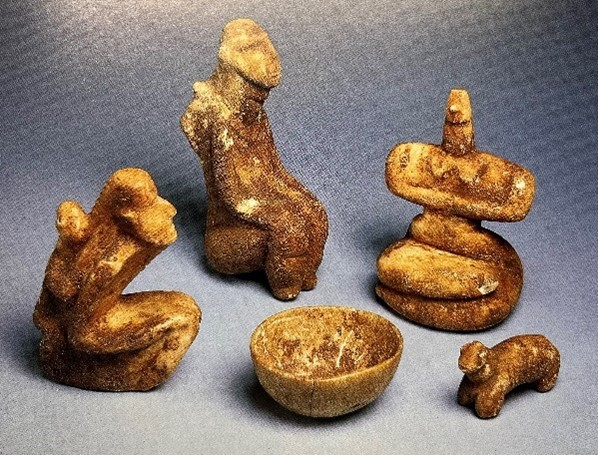
The Neolithic Family Group, which dates to 5000-3500 B.C.E and valued at $3 million. This group of objects compromises five human and animal figures carved from marble, and was looted from the island of Euboea by a Greek trafficker who smuggled the pieces into Switzerland. In 1982 dealer-trafficker Nicolas Koutoulakis sold the group to New York-based collectors Leon Levy and Shelby White. White loaned the group to the Metropolitan Museum of Art in 2000, where they remained on display until March of this year, when it was seized by the Office.
The group had been owned by Charles Gillet and Marion Schuster. They are "said to be from Euboea, or the east coast of Attica opposite, near Porto Raphti, perhaps from an islet attached to the mainland in prehistoric times" (Glories no. 8). It is interesting that the release emphasises the findspot on Euboea rather than Porto Raphti or more generally Attica preferred by Getz-Preziosi and Thimme. There are aspects of the group that make me wonder if they are ancient, a concern raised by Thimme back in 1977.

Next to the Late Neolithic group, but unmentioned in the release, was a double Cycladic figure: a small female figure standing on the head of a larger one. This appears to be the figure in the Shelby White collection (NAC no. 18; Glories no. 9; Katonah no. 15). Next to them was an Early Cycladic II bowl that also appears to be from the Shelby White collection (Glories no. 15).

Among the other items that appear to have been other items that formed part of the Shelby White collection:
  • Glories no. 76: A Late Geometric pair of horses 'said to have been found on Corfu, and for at least twenty years was in a collection in Austria. In October 1970, the group was lent to the Kunsthistorisches Museum in Vienna for restoration.'
  • Glories no. 80: an armlet, two lidded pyxides, and an oinochoe from a hoard of at least 40 pieces found in northern Greece.
  • Glories no. 141: a gold treasure consisting of a pair of coiled snake armbands, a pair of earrings with swans, a gold and carnelian necklace, a gold ring with carnelian intaglio, part of a gold wreath, and a gold diadem. 
The press release mentions that the Royal-Athena Galleries have co-operated with the investigation suggesting that some of the other items were from that source (perhaps including a fragment of wall-painting).

I note that Christos Tsirogiannis was involved with some of the identifications. 

We await for a full list of the return.

| |
Bookmark and Share so Your Real Friends Know that You Know

Saturday, 3 December 2022

Apulian Dinos Seized from NYC Private Collection

Source: Manhattan DA.

It seems that another piece displayed in the exhibition, Glories of the Past, was seized from a NYC private collection in June 2021 (though the information has only just been made available). The object is an Apulian dinos attributed to the painter of Louvre MNB 1148 (Glories no. 128). The catalogue entry by Dietrich von Bothmer notes that the dinos 'has been broken into many fragments and repaired'. Who restored the piece?

This adds to the 14 other pieces from the exhibition that have been returned to Greece, Italy or Turkey.

I am grateful to Jason Felch for pointing me in the direction of the relevant Search Warrant. 

| |
Bookmark and Share so Your Real Friends Know that You Know

Friday, 2 December 2022

$24 million worth of antiquities reported to have been seized from NYC collector

Source: BusinessTurkeyToday.com

I understand that back in April this year 18 antiquities valued at $24.393 million were seized from a New York private collection. The most valuable was a bronze statue of Lucius Verus valued at $15 million, followed by an Attic red-figured calyx-krater and a bronze bust, each valued at $3 million. Some of these items had been displayed in an exhibition, Glories of the Past, at New York's Metropolitan Museum of Art. Two of the seized items have been returned to Turkey, and others to Italy: it is unclear if and when one or more of the items will be returned to Greece.

The Art Newspaper revealed today that the objects formed part of the Shelby White collection (Claire Voon, "Looted antiquities returned to Turkey and Italy were seized from New York home of Met trustee Shelby White", December 2,  2022).

Source: Manhattan DA.


I grateful to Jason Felch for assistance with this post, and to Christos Tsirogiannis who made many of the identifications. 

| |
Bookmark and Share so Your Real Friends Know that You Know

Thursday, 1 December 2022

Returning Glories of the Past

Source: Manhattan DA.
The return of the marble sarcophagus fragments and the bronze statue of Lucius Verus from Bubon highlight how far the Leon Levy and Shelby White collection has been the source of returns to Greece, Italy and Turkey.

Many of these identifications were made by Christos Tsirogiannis.

Returned items that appeared in Glories of the Past include:
87: Bronze statue of naked youth. [Italy]
97: Fragment of an Attic funerary stele. [Greece]
102: Chalcidian neck-amphora, attributed to the painter of the Cambridge Hydria Cavalcade. [Italy]
104: Attic black-figured neck-amphora of Panathenaic shape, attributed to the painter of Louvre F6. [Italy]
107: Attic black-figured neck-amphora, attributed to the painter of the Medea group. [Italy]
112: Attic black-figured psykter. [Italy]
113: Attic black-figured skyphos. [Italy]
117: Attic red-figured calyx-krater, A: Zeus and Ganymede, B: Herakles and Iolaos, attributed to the Eucharides painter. [Italy]
129: Apulian guttus with ram's head spout. [Italy]
131: Apulian fishplate attributed to the Cuttlefish painter. [Italy]
142: Fragment of Roman fresco. [Italy]
143: Fragment of Roman fresco. [Italy]
169: Four fragments of Roman sarcophagus. [Turkey]
174: Bronze statue of Lucius Verus from Bubon. [Turkey]

Concerns about the Shelby White and Leon Levy collection were discussed in:
Chippindale, C., and D. W. J. Gill. 2000. "Material consequences of contemporary classical collecting." AJA 104: 463-511. [DOI]

There appear to be other returned items that do not feature in Glories.

| |
Bookmark and Share so Your Real Friends Know that You Know

Monday, 28 November 2022

Bronze Attis Returns to Turkey

L: Bronze returned to Turkey. R: Bronze in Royal-Athena Galleries


Among the objects returned to Turkey was a small bronze identified as Attis. This appears to be the bronze acquired from Galerie Nefer in July 1984 and then sold through Royal-Athena Galleries (Art of the Ancient World 4 [1985] no. 144) to the J.H. collection, Dearborn, Michigan. It was then placed on loan with Ohio State University; Picker Art Gallery, Colgate University; and Fitchburg Art Museum. It was then back on sale at the Royal-Athena Galleries (Art of the Ancient World 29 [2018] no. 18).

Note that the 2018 catalogue entry mentions the oriental 'costume and cap' but rather than identifying it as Attis suggests Orpheus.

What other material did the Royal-Athena Galleries acquire from Galerie Nefer? 

I presume that the Manhattan DA will at some point issue a list of material that has been returned to Italy and Turkey from the stock of the Royal-Athena Galleries. Should those museums and collectors that acquired material from this source now be checking the histories of the objects? 

| |
Bookmark and Share so Your Real Friends Know that You Know

Tuesday, 15 November 2022

Lucius Verus from Bubon Returns to Antalya

Source: BusinessTurkeyToday.com

Back in 2008 I discussed on LM that the bronze statue of Lucius Verus was one of a series of statues that had originated in the sebasteion at Bubon in Turkey (and an earlier discussion in the American Journal of Archaeology in 2000). It now appears that this statue from the collection of Shelby White (Glories no. 174) has been returned to the Antalya Museum (see story here and here). This return comes soon after the return of further Shelby White material to Italy (discussed here).

This return has serious implications for other museums (e.g. the J. Paul Getty Museum, the Cleveland Museum of Art, Fordham University, and the Ny Carlsberg in Copenhagen) that have bronze statues, or parts of bronze statues, that are derived from, linked to, or associated with Bubon (see previous posts here). 

The return includes other material such as part of the terracotta architectural frieze from the temple at Düver that had surfaced on the North American antiquities market. This will cause concerns for a number of museums, including several in the UK, that acquired parts of the series.

Further details are available in a release from the American Embassy in Ankara. 

| |
Bookmark and Share so Your Real Friends Know that You Know

Another Bürki object returns to Italy

Source: MMA A psykter column-krater attributed to the Troilos painter was deaccessioned by New York's Metropolitan Museum of Art in June...