Showing posts with label Steinhardt. Show all posts

Monday, 10 November 2025

Further returns to Greece from the Met

Source: Hellenic Consulate General in New York

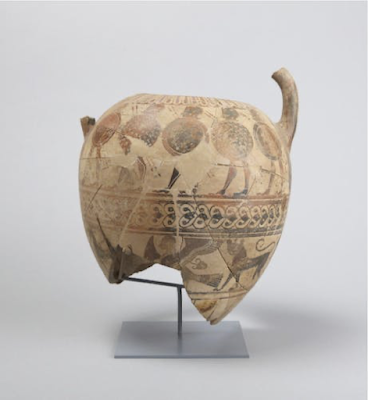
In September 2025 a number of antiquities were seized from New York’s Metropolitan Museum of Art and at least six formed part of the return to Greece announced at the beginning of October. All have been acquired from Andrés A. Mata in 2001 and 2004, and all had been purchased from Fortuna Fine Arts. They include two stone axe heads (2004.342.3–4), a Cretan or Cycladic terracotta jug (2004.342.2), a Cycladic collared jar (2004.342.1), and two iron swords (2001.346, 2001.543). One of the swords was given to the museum in honour of Carlos A. Picón. 

A further piece was mentioned in the press release, an archaic bronze gorgon applique. It had apparently surfaced through Robert Hecht, who sold it to Fortuna Fine Arts. It then added: 
Fortuna then falsely claimed that the Gorgon came from William Froelich, a name frequently used by Fortuna and other galleries in its false provenance. Thereafter, the Gorgon was sold to a private collector who placed the antiquity on loan at the Met. The Antiquities Trafficking Unit seized the Gorgon from the Met in 2025. 

This appears to be the figure that formed part of the exhibition, ‘Dangerous Beauty’, and was identified as coming from the collection of Andrés A. Mata. (The figure can be seen in press photograph of the October 2025 handover.)

Another gorgon applique that passed through Fortuna Fine Arts was acquired by the Carlos Museum at Emory University in 2017: it was a gift of Mata, Sybil and Ed Ralston, and Judy and Michael Steinhardt (2017.025.001). Mata also gave an inscribed bronze hydria rim to the museum in 2014 in honour of Jasper Gaunt (2014.023.001). 

The mention of Froelich is important as it appears, in connection with Fortuna Fine Arts, in the history of a Tarentine limestone funerary relief acquired by the Met in 2013. Froelich and Fortuna came together in the history of a Canosan terracotta figure of Zeus that was withdrawn from a sale at Christie’s. The history also mentions Boris Mussienko. This name appears against a bronze Aphrodite on loan to the Met from a private collector and returned to Italy.

Fortuna then falsely claimed that the Statuette came from Boris Mussienko, a name frequently used by Fortuna and other galleries in its false provenance. Thereafter, the Statuette was sold to a private collector who placed the antiquity on loan at the Met. The Antiquities Trafficking Unit seized the Statuette from the Met in 2025.

The Met seizures may well have serious implications for other collections.

| |
Bookmark and Share so Your Real Friends Know that You Know

Tuesday, 11 April 2023

Developments at Princeton

Etruscan amphora inv. y1984-19.
Source: Daily Princetonian
It seems that five objects relating to Edoardo Almagià are to remain in Princeton University Art Museum (Sandeep Mangat and Miriam Waldvogel, "Five artifacts linked to alum under investigation for art smuggling will remain at University Art Museum", Daily Princetonian April 11, 2023). I am a little confused as the earlier report included pictures and some of the pieces mentioned in the most recent article, for example the Roman doll (inv. y1993-13), the Campanian stamnoid pyxis (inv. 87-3a–b) and fragments of a Roman Arretine bowl (inv. y1992-67), do not feature among the images. 

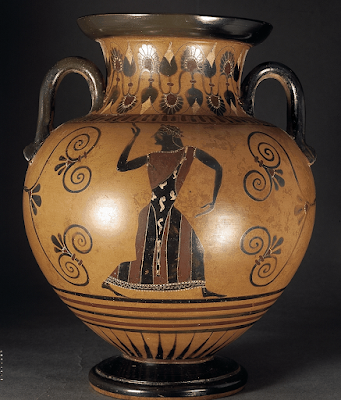
However, among the pieces staying in Princeton is the Etruscan amphora attributed to the Paris painter (inv. y1984-19). This is stated as: "Gift of Peter Glidewell through Edoardo Almagia, Class of 1973".

It should be remembered that Princeton has already returned a series of Etruscan architectural terracottas that were given by Almagià. These are discussed in: D.W.J. Gill, "Context matters: Princeton and recently surfaced antiquities," Journal of Art Crime 7 (2012): 59-66; id., Context matters: Collating the past, Amelia: ARCA, 2020, pp. 106–14; id., "Returning archaeological objects to Italy," International Journal of Cultural Property 25 (2018): 283–321 [DOI].

The latest article in the Daily Princetonian seems to confuse items that had been loaned by Almagià and those that had been given by him.

The article does include an interesting statement attributed to Almagià: 
"He added that he gave these fragments to Dietrich von Bothmer, a prominent German-American art historian."
We are aware that Almagià appears to have been the source for fragments in Bothmer's collection that had been acquired in 1984, 1986 and 1987. Does this imply that the fragments appearing in the original article were derived from Almagià? And was the Psiax fragment from the Centre Island private collection also from this source?

The Daily Princetonian mentions the seizure of fragments from Bothmer's collection although as far as I am aware no connection with Almagià had been made. These are discussed in: D.W.J. Gill, "Context matters: Fragmented pots, attributions and the role of the academic," Journal of Art Crime 8 (2012): 79-84. However other Bothmer fragments were included in the recent seizure from New York's Metropolitan Museum of Art.

Other figure-decorated fragments derived from Almagià have been returned from the San Antonio Museum of Art that had acquired them in 1985. Material derived from Almagià has featured in the Steinhardt return

I am aware of other Almagià material in a north American university collection that appears to have been derived from Crustumerium in Lazio. (A discussion of the piece along with other items from the same place features in a forthcoming article.)

Is it time for Princeton to provide additional so-called "provenance" information on its website?

| |
Bookmark and Share so Your Real Friends Know that You Know

Thursday, 13 October 2022

Are Claims Against North American Collections Successful?

Source: Christos Tsirogiannis

Leonard Stern has responded to criticisms of his agreement over the display of his collection of Cycladic sculptures by commenting,  "Usually [countries such as Greece] fight to get their stuff back and don’t succeed" (Michael Kaplan, "Critics ‘angry’ over Greece’s deal with art collector Leonard Stern", New York Post October 12, 2022). Stern is perhaps unaware of the scale of returns: I calculate that over 850 items have been returned to Italy from North American public and private collections, as well as from auction-houses and galleries.

Greece has perhaps not been as active in the process as Italy. Indeed, the Minoan larnax that was identified in the Becchina archive by Christos Tsirogiannis remains at the Michael C. Carlos Museum at Emory University. But we should remember that 55 items worth $20 million from the Michael Steinhardt Collection were returned to Greece earlier in 2022: they included several Cycladic items. And a bronze krater from another New York collection was returned to Greece.

| |
Bookmark and Share so Your Real Friends Know that You Know

Friday, 7 October 2022

From Geneva to the Steinhardt Collection


Source: Manhattan DA

Five objects (Attic head aryballos; Protocorinthian duck and owl; Corinthian bull's head; Ionian ram's head; Apulian head vase) in the seizure of antiquities from the collection of Michael Steinhardt have something in common: they were placed on loan with Geneva's Musée d'Art et d'Histoire (1978–81). And all of them were subsequently placed on loan with the J. Paul Getty Museum (1984–96). And all of them were sold by Robin Symes to the Beierwaltes in 1996. All but the Apulian head vase appear in images from the Medici Dossier: the head vase itself appears in the Becchina archive (with an Attic skyphos now returned from the Shelby White collection).

Such loans to these two museums were used as a response to seizures  in 2018 from another dealer. It is almost as if the loans created an acceptable collecting history. This raid seems to relate to another group of material. 

The Geneva museum has associations with other loans such as the Ka-Nefer-Nefer mummy mask (though the museum does not have a record of the loan). And the Getty accepted loans of fragments from some of these same individuals, as well as complete pots such as the Steinhardt hydria.

It should be noted that the same Geneva museum appears to be linked to the Apulian grave group acquired by Berlin

What part did Geneva play in handling recently surfaced antiquities and providing them with a history? What other objects passed this way? The papers relating to the Steinhardt seizure expand on this aspect.

And how many of these objects were then placed on loan with the J. Paul Getty Museum? 

Note: Identifications from the Medici Dossier and the Becchina Archive were made by Christos Tsirogiannis.

| |
Bookmark and Share so Your Real Friends Know that You Know

Wednesday, 21 September 2022

Oscilla from the Steinhardt Collection

Source: Manhattan DA
Among the objects returned to Italy from the collection formed by Michael Steinhardt were four Roman oscilla. The Manhattan DA Statement of Facts expands:
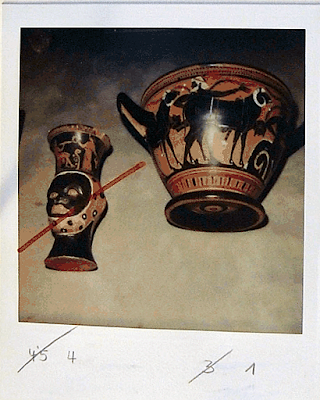
A set of four marble oscillum (collectively “the Marble Oscilla”), or Roman disks suspended on chains between columns in gardens, appear in dirt-encrusted fragments in multiple Polaroid photographs recovered from the Medici Archive. ... Depicting satyrs and female followers of Dionysus, the Marble Oscilla were crafted in Italy between 100 B.C.E. and 100 C.E. The Marble Oscilla first surfaced on the international art market in 1992, when Steinhardt purchased the antiquities from Robin Symes with no prior provenance for $175,000. In 1998, Steinhardt sent the Marble Oscilla to a Brooklyn-based restorer for“cleaning and repair.” 
The suggestion is that these oscilla probably came from the garden of a residence. Was this a residence buried during the eruption of Vesuvius?

Two further oscilla are known from Polaroids: these are now displayed in the Miho Museum, Japan. Concerns about their origins were first raised in 2007. Daniella Rizzo and Maurizio Pellegrini have recently indicated that the oscilla feature, like the Steinhardt ones, in the Medici Dossier. They also suggested that they come from 'the Vesuvian area'. Carlos Picón separately has indicated that the parallels for such items come from the area around Vesuvius.

One wonders if the Steinhardt and the Miho oscilla come from the same complex but we will have to await the definitive publication of the Steinhardt examples. 

Will the return of the Steinhardt oscilla place renewed pressure on the Miho Museum to return their pieces so that the series, perhaps originally displayed in the same garden space, can be reunited in Italy?

The identifications of the Steinhardt oscilla were made by Associate Professor Christos Tsirogiannis. 

Source: Miho Museum


| |
Bookmark and Share so Your Real Friends Know that You Know

The Intellectual Consequences of Collecting an Attic Black-Figured Amphora

Source: Manhattan DA

Among the returns to Italy from the Michael Steinhardt collection was an Attic black-figured amphora showing a Maenad. The amphora is known from the Almagià archive (Exhibits 33A and 33B).

The Manhattan DA Statement of Facts notes:
Almagià’s Green Book lists one “Attic BF [Black-Figure] Amphora” purchased from a tombarolo for $6,500, and then sold for $13,000. Almagià’s day planner lists “Steinhardt” on March 18, 1997, preceding a note on April 2, 1997, “prendere vase da [sic] Steinhardt” (take vase of Steinhardt). Although Steinhardt’s records note that there is “no record of purchase,” the records also indicate that Steinhardt accessioned the Attic Black-Figure Amphora in 1997 from Almagià.
Essentially all we know is that Steinhardt acquired this amphora in 1997, and that Almagià had purchased it from a tombarolo.

The mention of the tombarolo suggests that the find-spot was somewhere in Italy: the Statement of Facts suggests both Etruria and Sicily as possibilities. Note that we cannot be sure of the part of Italy where the amphora was found, let alone the specific place or cemetery. That information has been lost for good.

The relatively complete nature of the amphora suggests that it was discovered in a substantial tomb. But what other objects were found alongside it? Was there a single burial or multiple burials? What was the gender of the main person buried in the tomb? If the tomb was in Etruria, were there decorations on the wall? Would other associated finds have helped with the dating? Could it have been older that other pieces in the tomb?

Vasologists may be even now seeking to provide an attribution for the amphora. Perhaps they will note that it has certain characteristics in the potting. Will it be placed in a particular class of pot? But what about the parallels? Where were they found? Or were they, too, without context? 

The looting of this unusual amphora has stripped it of its useful archaeological information. That is one of the intellectual consequences of collecting newly surfaced material.

| |
Bookmark and Share so Your Real Friends Know that You Know

Tuesday, 20 September 2022

Becchina and the Shelby White collection

Source: Manhattan DA

LM noted that two of the objects displayed by the Manhattan DA for return to Italy were in the Shelby White collection. The Attic black-figured skyphos showing Odysseus escaping from the Cave of Polyphemos  clearly appears in one of the photographs seized from the Becchina archive. 

Does this explain why the Italian authorities are revisiting the Shelby White collection? Is it because the previous returns had not taken proper account of the Becchina archive?

It would be interesting to learn how and when Shelby White and Leon Levy acquired the skyphos. Was it directly from Galerie Antike Kunst Palladion? Or was it through another party?

Incidentally, the other piece in the photograph was acquired by a separate New York collection.

It should be noted that the identification of the Shelby White skyphos was made by Associate Professor Christos Tsirogiannis. 

| |
Bookmark and Share so Your Real Friends Know that You Know

The Steinhardt hydria attributed to the Antimenes painter

Source of images: Manhattan DA.

Among the items seized from the Michael Steinhardt collection and returned to Italy was an Attic black-figured hydria attributed to the Antimenes painter. The hydria had been identified from an image in the Medici Dossier.

The Manhattan DA reports that the hydria had first surfaced with Robin Symes in 1983 (when it was advertised in Apollo). The statement then adds:
By 1987, Symes had transferred the object to the New York-based Atlantis Gallery, part-owned by Robert Hecht, who then loaned it to the Getty Museum. From 1987-1996, the object was on view at the Getty Museum prior to its sale to Steinhardt through Sotheby’s New York on December 17, 1996. 
Steinhardt is report to have purchased the hydria from Sotheby's for $169,411.

The Beazley Archive (BAPD 31596) provides the loan number for the Getty (L87.AE.4) as well as the details for the Sotheby's New York sale (17 December 1996, lot 49). It also suggests that the hydria passed through the Royal-Athena Galleries though this information may not be correct.

Christopher Chippindale and I had rehearsed the history of this specific hydria in our review article of The Medici Conspiracy (2007) [see here]. We clarify that the hydria was placed on loan at the Getty in January 1987, and returned in February 1996. This raises a question about the nature and purpose of loans that were placed at the Getty.

It should be recalled that one of the Attic black-figured neck-amphorae seized from Fordham University was attributed to the circle of the Antimenes painter (BAPD 24304).

It should be noted that the identification of the Steinhardt hydria was made by Associate Professor Christos Tsirogiannis. 

| |
Bookmark and Share so Your Real Friends Know that You Know

Wednesday, 14 September 2022

The Steinhardt Fresco from Herculaneum

Source: Manhattan DA


Among the antiquities seized from the collection of Michael Steinhardt was a fragment of Roman fresco showing the infant Hercules killing a snake (Exhibit 87). The Manhattan DA Statement suggested that the fresco had been looted in 1995 from a villa destroyed in the eruption of Vesuvius somewhere in the vicinity of Oliva dei Monaci. A letter sent to the Italian authorities, along with photographs of the finds, identified Pasquale Camera who had sold on the pieces to Raffaele Monticelli for $120,000. Monticelli then sold the fresco to to Robert Hecht for $240,000.

Steinhardt was reported to have been in correspondence with Jasper Gaunt on November 10, 1995 relating to the delivery of a "crate": Steinhardt received an invoice for the fresco from Harry Bürki on November 22, 1995 ($650,000). Bürki later (February 17, 1999) claimed that the fresco had been in his family's collection for some 25 years and that it had been acquired from a "Bulgarian medical doctor".

The interplay between Bürki and Hecht should be noted, as well as the creation of a false collecting history.

| |
Bookmark and Share so Your Real Friends Know that You Know

The Intellectual Consequences of Collecting a Panathenaic Amphora

Panathenaic Amphora
formerly in the Michael Steinhardt collection
Source: HSI New York / Manhattan DA
One of my long-standing concerns about looting and the subsequent collection of antiquities is that valuable archaeological information is lost. Findspots, contexts and associations are lost, with them the ability to assign appropriate dates. 

I would like to consider the Athenian Panathenaic amphora from the Steinhardt collection that has been returned to Egypt. The Manhattan DA's statement of fact about the Panathenaic amphora points the reader to the coastal site of Thonis-Heracleion.
The style and details on the Vase from the Pan-Athenian Games are characteristic of black-figure pots recovered from recent underwater excavations at Thonis-Heracleion, off the coast of Egypt.
As far as I know, there have been no Panathenaic amphorae (or fragments) found at Thunis-Heracleion. Indeed, I have only identified five Panathenaic amphora fragments (not complete pots) from Egypt: five from Naucratis (one of which is associated with the Hellenion) and one from Hadra (i.e. near the later foundation of Alexandria). If this amphora does indeed comes from Egypt it would be a most unusual find.

Furthermore, the Panathenaic amphora shows no sign that it comes from a submerged cemetery at Thonis-Heracleion. Or have looters discovered a cemetery site on land? 

However, there are numerous complete Panathenaic amphorae discovered in Cyrenaica in Libya. (See Faraj M. Elrashedy, Imports of post-Archaic Greek pottery into Cyrenaica from the end of the Archaic to the beginning of the Hellenistic period [BAR International Series, vol. 1022. Oxford: Archaeopress, 2002]). There are complete amphorae and fragments from Cyrene, Apollonia, Euesperides (Berenice / Benghazi), Tocra, Barca, Ptolemais and other sites. Could the Steinhardt amphora have been found in one of the cemeteries of, say, Cyrene, and then been smuggled to Egypt where it was associated with Thonis-Heracleion? 

The Manhattan DA may, of course, have access to other evidence that points to Thonis-Heracleion with a little more certainty. Or was this a hunch from someone researching the Steinhardt collection? 

The association of the Steinhardt amphora with Thonis-Heracleion seems, for now, unlikely and the mention of the alleged findspot should not be encouraged unless further information comes to light or is disclosed. Indeed, one wonders if the amphora should have been returned to Libya rather than Egypt. 

The case of the amphora is a reminder of the way that key information is irretrievably lost through the looting process.

| |
Bookmark and Share so Your Real Friends Know that You Know

Tuesday, 13 September 2022

The Steinhardt Oinochoe Attributed to the Berlin painter

Oinochoe attributed to the Berlin painter
Source: Manhattan DA

The recent exhibition of Athenian pots attributed to the Berlin painter listed among the new attributions a single oinochoe from the Judy and Michael Steinhardt collection (BN44). It shows a youth feeding a Maltese dog.

The attribution had been made by J. Robert Guy though the date when this was made is not noted.

A polaroid of the oinochoe is reported to be in the Medici Dossier. The Manhattan DA's statement relating to the seizure of antiquities from the Steinhardt collection noted:
The Berlin Painter Oinochoe first surfaced on the international art market in 1996, when Steinhardt purportedly purchased the Berlin Painter Oinochoe from Harry Bürki with no prior provenance for $215,000. 
The statement notes that while the invoice stated that Bürki was the vendor, "Steinhardt’s records reflect that the real seller of the object was the American-born trafficker Robert Hecht."

This is one of several pots attributed to the Berlin painter that have been returned to Italy. And it should be a matter of concern to academics writing on Athenian pottery that such a high percentage of pots attributed to this painter have no secure archaeological contexts. 

It should be noted that the identification was made by Associate Professor Christos Tsirogiannis.

See D.W.J. Gill, 'Fragmented Athenian Pots and the Berlin Painter: Recent Breaks?' Academia Letters (2020): 1–5 [DOI].  

| |
Bookmark and Share so Your Real Friends Know that You Know

Steinhardt Panathenaic Amphora Returns to Egypt

Panathenaic amphora. Left: HSI New York. Right: Manhattan DA [Exhibit 73]

The return of antiquities to Egypt via the Manhattan DA included a Panathenaic amphora ("D.A. Bragg Returns 16 Stolen Antiquities to the People of Egypt", September 7, 2022). Images from the event show that it was one of the objects seized from the collection of Michael Steinhardt. 

The Manhattan DA document suggested an association with the site of Thonis-Heracleion
The style and details on the Vase from the Pan-Athenian Games are characteristic of black-figure pots recovered from recent underwater excavations at Thonis-Heracleion, off the coast of Egypt.
Such a findspot would be surprising given that there is no indication that the amphora has been derived from an underwater location. Was the amphora found elsewhere in Egypt?

The amphora was purchased by the dealer, Gil Chaya, in Dubai from Mohd Said Issa Mousa Jaradot. Steinhardt purchased the amphora on December 23,  2008, for $300,000.

| |
Bookmark and Share so Your Real Friends Know that You Know

Wednesday, 20 July 2022

New Returns to Italy Announced: Some Linked to Edoardo Almagià

Source: Manhattan DA

It was announced today that 142 antiquities will be returning to Italy (Press Release, "D.A. Bragg Returns 142 Antiquities Valued at Nearly $14 Million to the People of Italy", July 20, 2022). The returns consisted of 
"60 were recovered from Royal-Athena Galleries, 48 were recovered from STEINHARDT, and an additional 34 were seized pursuant to other ongoing investigations".
The Steinhardt material included:
Among the items being repatriated today is the Ercolano Fresco, which was seized as part of the investigation into STEINHARDT. Depicting an infant Hercules strangling a snake, the piece dates to 50 C.E. and was looted in 1995 from a villa in Herculaneum, an archaeological site that was buried for millennia under volcanic ash from the fiery eruption of Mount Vesuvius. STEINHARDT purchased the Ercolano in 1995 for $650,000 with no verifiable prior provenance. It is currently valued at $1,000,000.
Other items identified include:
Three fresco paintings dating to the 4th century B.C.E. from Paestum, an ancient Greek city located in southern Italy, which were seized pursuant to an ongoing investigation. These paintings depict scenes of mourning women, and were hacked from the wall of a tomb by looters.
An Archaic pithos (storage jar) dating back to 700 B.C.E. that was seized pursuant to an ongoing investigation into Edoardo ALMAGIÀ, an Italian native and former New York resident.
The press release also acknowledges the following museums and a single gallery:
Indiana University’s Eskenazi Museum of Art, the Museum of Fine Arts-Boston, Royal-Athena Galleries, and the Toledo Museum of Art
One wonders if the Indiana material is linked to Almagià. 

The Boston material includes 9 pots apparently derived from Crustumerium in Latium that was acquired in 1995:
Probably about 1993/1994, illicitly excavated from Crustumerium, Italy and sold to Edoardo Almagià, New York; 1995, sold by Almagià to Jonathan Kagan and Sallie Fried, New York; 1995, year-end gift of Jonathan Kagan and Sallie Fried to the MFA (Accession Date: January 24, 1996); December 16, 2021, deaccessioned by the MFA for transfer to the New York County District Attorney and return to the Republic of Italy.
So far Boston is the only museum that appears to have provided full information.

| |
Bookmark and Share so Your Real Friends Know that You Know

Tuesday, 1 March 2022

Steinhardt helmet returns to Bulgaria

Helmet from the Steinhardt collection
Source: Manhattan DA

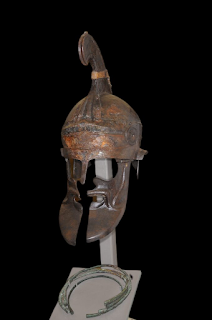
A fourth century BCE helmet once in the Michael Steinhardt collection has been returned to Bulgaria ("Ancient Helmet Likely Belonging to Philip of Macedon Returned to the People of Bulgaria", Manhattan DA, February 10, 2022). It is reported to have been discovered near Pletena in south-west Bulgaria. Steinhardt purchased the helmet from Axel Weber of Köln, Germany, on March 24, 1998 for $175,000. 

| |
Bookmark and Share so Your Real Friends Know that You Know

Thursday, 24 February 2022

Steinhardt Antiquities Returned to Greece

Kouros seized from the Steinhardt Collection
Source: Manhattan DA

Antiquities worth some $20 million that were seized from the collection of Michael Steinhardt have been handed over to Greece (Press Release, "55 Antiquities Valued at More Than $20 Million Repatriated to the People of Greece", February 2022). 

The kouros as well as a Minoan hoard were all acquired from Robert Hecht. 

The release also notes: "Eight other pieces that were seized pursuant to another ongoing investigation were also repatriated." Does this mean that there is due to be another announcement?

LM listed the antiquities that would be returning to Greece back in December 2021. 

Friday, 21 January 2022

Steinhardt antiquities return to Turkey

Silver rhyton
Source: Manhattan DA

The Manhattan DA has announced that 14 antiquities from the Michael Steinhardt collection have been returned to Turkey ("D.A. Bragg: 28 Antiquities Repatriated to the People of Turkey", press release January 21, 2022).

Among them is an important silver stag's head rhyton that is reported to have been found at Milas, Turkey. Steinhardt purchased the piece from the Merrin Gallery on November 22, 1991 for $2,600,000, and subsequently placed it on loan to New York's Metropolitan Museum of Art on March 11, 1993.

This is not the only ex Merrin piece to have been placed on loan to the Metropolitan Museum of Art. 
| |
Bookmark and Share so Your Real Friends Know that You Know

Thursday, 13 January 2022

Steinhardt head from Cyrene returns to Libya

Source: Manhattan DA
The marble head of a woman has been returned to Libya after being "surrendered" by New York collector Michael Steinhardt ("D.A. Bragg: $1.2M Antiquity Seized From Michael Steinhardt Returned to the People of Libya", Manhattan DA press release, January 12, 2022). The head, dating to the mid fourth century BCE, has been valued at $1.2 million. The head is reported to have been looted from a tomb in the vicinity of Cyrene.

The head was purchased on November 10, 2000 from the Manhattan dealer Michael Ward for $1.2 million. The invoice is reported to have noted, "possibly from North Africa". 

Michael Ward also handled the "Aidonia Treasure" that was returned to Greece; a Campanian calyx-krater returned to Italy from the Dallas Museum of Art that had been acquired from Becchina; and items that have been associated with the discovery of the Korsechnica krater

Michael Ward had acquired an Attic black-figured hydria from the Bastis collection; this was sold to Steinhardt and will form part of the returns to Italy.
| |
Bookmark and Share so Your Real Friends Know that You Know

Tuesday, 11 January 2022

A Bothmer fragment sourced from Almagià


When 40 of Bothmer pot fragments were returned to Italy from New York's Metropolitan Museum of Art there was the statement from the museum's spokesperson, Elise Topalian, reported by Chasing Aphrodite:
Von Bothmer was a client of Almagia for many years, Topalian said. The fragments von Bothmer obtained from the dealer were returned to Italy “to serve as evidence in the investigation and possible trial of Edoardo Almagia.”
In the statement of fact relating to Michael Steinhardt's collection an example of Almagià's sales from the summer of 1994 is provided. This suggests that Almagià provided "Frammenti Attici" that had been purchased from Mauro Morani $22,000.

One of the pieces purchased by Bothmer from Almagià in 1987 was a fragment, measuring 1.9 cm, of an Attic red-figured cup attributed to the Triptolemos painter (Malibu inv. 87.AE.154). 103 fragments of the same cup were purchased in 1990 from Galerie Nefer (Malibu inv. 90.AE.35). 

Where did Almagià acquire his fragment? Where did the Galerie Nefer acquire its fragments? 

Were other Bothmer fragments in the Getty acquired from Almagià?
| |
Bookmark and Share so Your Real Friends Know that You Know

Wednesday, 5 January 2022

Barbarano Romano: the Attic fragments

Source: San Antonio Museum of Art

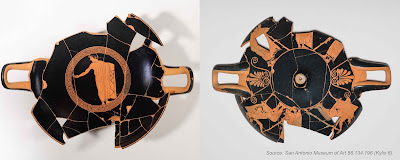
The San Antonio Museum of Art will be returning 192 fragments of Attic black-figured, red-figured and black-glossed cups to Italy. They are reported to have been found at Barbarano Romano to the south of Viterbo and were sold to Gilbert M. Denman, Jr. by Edoardo Almagià in 1985; Denman gave the fragments to the museum the following year (inv. 86.134.196). 

The Steinhardt legal papers cite two pieces of correspondence about pottery fragments from Barbarano Romano: the recipient is clearly in Texas. Almagià states the findspot and explained how the fragments were removed to Switzerland, and then moved to New York where they were cleaned and grouped with the help of a vasologist. Further fragments from the site were then noted, though they remained in Italy. 

It is unclear if the San Antonio fragments and the Texas letters are linked. But this does raise issues about other pot fragments that were handled by Almagià and those associated with him. 

| |
Bookmark and Share so Your Real Friends Know that You Know

Friday, 31 December 2021

Three gorgons from an Etruscan brazier


Among the returns to Italy from the Michael Steinhardt collection are three bronze feet in the form of gorgons with outstretched arms. The three gorgons appear to have featured in the catalogue for the Royal-Athena Galleries (2012). They were presented with the following history:
One ex Leo Mildenberg collection, acquired in the 1960s; two ex private collection, Ticino, Switzerland, acquired in the 1960s.
According to the legal papers relating to the Steinhardt case, Jerome Eisenberg acquired the bronzes for $105,000 from Jurgen Haering Gallery of Freiberg at the Basel Ancient Art Fair (November 2010). 

But what about the earlier history? The bronzes are reported to feature in the Becchina archive. The legal paperwork suggests that Becchina sold them to Vincenzo Zuchetto for SF 100,000 (May 1, 1985). It is unclear when the bronzes moved to Freiberg. The legal papers suggests that Haering claimed that the feet came from the ‘collection Mildenberg, Zurich, Switzerland, since the 1960s’. 

The legal paperwork makes interesting reading. It is stated that while the gorgons were still in the hands of Royal-Athena Galleries, Erdal Dere, owner of Fortuna Fine Arts, contacted Steinhardt claiming that the feet were in the possession of Verena Brunner who would not part with them for $125,000 (September 4, 2014). The very next day the gorgons were sold to Fortuna Fine Art for $130,000 (September 5, 2014) and on the same day Fortuna Fine Arts sold them to Steinhardt for $150,000 (September 5, 2014). The invoice from Fortuna fine Arts is claimed to state:
Ex. Old Private European Collection (Ticino, Switzerland, 1960s). Ex. Dr. Leo Mildenberg Collection, Switzerland 1960s to Verena L. Brunner, Niece of Dr. Leo Mildenberg. Michigan 1980s to Present.

The story then gets more complicated. The Manhattan DA's investigation then discovered that Mildenberg's niece, Verena Brunner, had never apparently spoken to Erdal Dere, and that she had not seen the gorgons until she was shown a photograph as part of the Steinhardt investigation. The Manahttan DA also contacted the executor of the Mildenberg estate who stated that the gorgons had not formed part of the estate. It was also suggested that gorgons would not have been the sort of object that would have been collected by Mildenberg.

How did these gorgons enter the market? What is the evidence that they formed part of the Mildenberg collection? How and when did they pass, or were supposed to pass, from the Mildenberg and two private collections to Becchina? What is the authenticated documentary evidence?

I am grateful to Associate Professor Christos Tsirogiannis for discussing this with me.

| |
Bookmark and Share so Your Real Friends Know that You Know

Another Bürki object returns to Italy

Source: MMA A psykter column-krater attributed to the Troilos painter was deaccessioned by New York's Metropolitan Museum of Art in June...