Showing posts with label Etruria. Show all posts

Tuesday, 11 April 2023

Developments at Princeton

Etruscan amphora inv. y1984-19.
Source: Daily Princetonian
It seems that five objects relating to Edoardo Almagià are to remain in Princeton University Art Museum (Sandeep Mangat and Miriam Waldvogel, "Five artifacts linked to alum under investigation for art smuggling will remain at University Art Museum", Daily Princetonian April 11, 2023). I am a little confused as the earlier report included pictures and some of the pieces mentioned in the most recent article, for example the Roman doll (inv. y1993-13), the Campanian stamnoid pyxis (inv. 87-3a–b) and fragments of a Roman Arretine bowl (inv. y1992-67), do not feature among the images. 

However, among the pieces staying in Princeton is the Etruscan amphora attributed to the Paris painter (inv. y1984-19). This is stated as: "Gift of Peter Glidewell through Edoardo Almagia, Class of 1973".

It should be remembered that Princeton has already returned a series of Etruscan architectural terracottas that were given by Almagià. These are discussed in: D.W.J. Gill, "Context matters: Princeton and recently surfaced antiquities," Journal of Art Crime 7 (2012): 59-66; id., Context matters: Collating the past, Amelia: ARCA, 2020, pp. 106–14; id., "Returning archaeological objects to Italy," International Journal of Cultural Property 25 (2018): 283–321 [DOI].

The latest article in the Daily Princetonian seems to confuse items that had been loaned by Almagià and those that had been given by him.

The article does include an interesting statement attributed to Almagià: 
"He added that he gave these fragments to Dietrich von Bothmer, a prominent German-American art historian."
We are aware that Almagià appears to have been the source for fragments in Bothmer's collection that had been acquired in 1984, 1986 and 1987. Does this imply that the fragments appearing in the original article were derived from Almagià? And was the Psiax fragment from the Centre Island private collection also from this source?

The Daily Princetonian mentions the seizure of fragments from Bothmer's collection although as far as I am aware no connection with Almagià had been made. These are discussed in: D.W.J. Gill, "Context matters: Fragmented pots, attributions and the role of the academic," Journal of Art Crime 8 (2012): 79-84. However other Bothmer fragments were included in the recent seizure from New York's Metropolitan Museum of Art.

Other figure-decorated fragments derived from Almagià have been returned from the San Antonio Museum of Art that had acquired them in 1985. Material derived from Almagià has featured in the Steinhardt return

I am aware of other Almagià material in a north American university collection that appears to have been derived from Crustumerium in Lazio. (A discussion of the piece along with other items from the same place features in a forthcoming article.)

Is it time for Princeton to provide additional so-called "provenance" information on its website?

| |
Bookmark and Share so Your Real Friends Know that You Know

Wednesday, 5 January 2022

Barbarano Romano: the Attic fragments

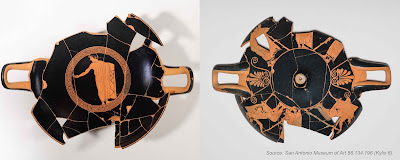
Source: San Antonio Museum of Art

The San Antonio Museum of Art will be returning 192 fragments of Attic black-figured, red-figured and black-glossed cups to Italy. They are reported to have been found at Barbarano Romano to the south of Viterbo and were sold to Gilbert M. Denman, Jr. by Edoardo Almagià in 1985; Denman gave the fragments to the museum the following year (inv. 86.134.196). 

The Steinhardt legal papers cite two pieces of correspondence about pottery fragments from Barbarano Romano: the recipient is clearly in Texas. Almagià states the findspot and explained how the fragments were removed to Switzerland, and then moved to New York where they were cleaned and grouped with the help of a vasologist. Further fragments from the site were then noted, though they remained in Italy. 

It is unclear if the San Antonio fragments and the Texas letters are linked. But this does raise issues about other pot fragments that were handled by Almagià and those associated with him. 

| |
Bookmark and Share so Your Real Friends Know that You Know

Tuesday, 28 December 2021

Further returns from the Getty

White on Red Lidded Pithos
Formerly Malibu inv. 96.AE.135.
The Manhattan DA Office mentioned the return of seven items from the J. Paul Getty Museum; they were seized on April 2, 2021, and the press release specifically states that they "were trafficked by ALMAGIÀ". [press release

Only one piece is listed in the Manhattan DA press release: "A Pithos with Ulysses, dating to 7th Century B.C.E. and valued at $200,000".

This is the lidded White on Red pithos decorated with the blinding of Polyphemos.  It was given to the Getty by Barbara and Lawrence Fleischman (inv. 96.AE.135; cat. no. 86). The pithos no longer appears on the online Getty catalogue. 

I am grateful to the Getty for providing details of the other pieces:

a. A White on Red Lidded Pithos. Gift of Barbara and Lawrence Fleischman. Inv. 96.AE.136; cat. no. 87.
b. A pair of Caeretan sub-geometric plate attributed to the circle of the Crane painter. Gift of Barbara and Lawrence Fleischman. Inv. 96.AE.137.1-2; cat. no. 88–89, A–B. 
c. A pair of Caeretan sub-geometric plates attributed to the Heron class. Gift of Barbara and Lawrence Fleischman. Inv. 96.AE.138.1-2; cat. no. 88–89, C–D. 
d. An Attic red-figured stemless cup, attributed to the Marlay painter. 'New York art market'. Inv. 86.AE.479; BAPD 41037.

The stemless cup had already been identified by Chasing Aphrodite.


Bookmark and Share so Your Real Friends Know that You Know

Monday, 27 December 2021

Etruscan White on Red Ware Returning to Italy


Bookmark and Share so Your Real Friends Know that You Know

Thursday, 9 December 2021

The surrendered Steinhardt collection and the Medici dossier

Left: Medici Dossier, courtesy of Christos Tsirogiannis
Right: New York State District Attorney Office 
Research by Associate Professor Christos Tsirogiannis has made innumerable identifications of objects from the Medici Dossier. The paperwork for the Steinhardt collection makes it clear how many items had passed before the Polaroid camera of that source.

The items include:
  • Etruscan togate figure, from Perugia (pp. 16–17).
  • Two bronze figures of Pegasus (pp. 17–18).
  • Villanovan helmet (pp. 18–19).
  • Two Etruscan terracotta panels, from Cerveteri (pp. 19).
  • Attic sphinx cup, Tleson (pp. 19–20).
  • Oinochoe attributed to the Berlin painter (pp. 20–21)
  • Attic Leagros hydria (pp. 21–22).
  • Attic Antimenes hydria (pp. 22–23).
  • Attic head vase (pp. 23–24).
  • Protocorinthian duck (p. 24).
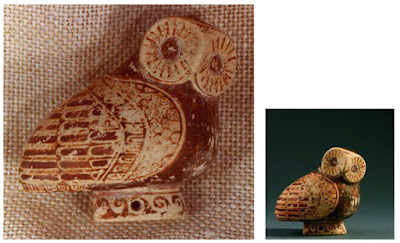
  • Protocorinthian owl (pp. 24–25).
  • Ionian ram's head (p. 25).
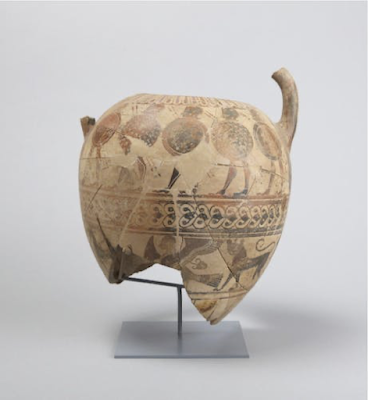
  • Corinthian bull's head (pp. 25–26).
  • Corinthian lion vessel (p. 26).
  • Faliscan askos (p. 27).
  • Four marble oscilla (p. 27)
  • Cycladic spouted bowl (p. 28).
It is a reminder that the 'Medici Conspiracy' continues to make an impact on cultural property issues.
| |
Bookmark and Share so Your Real Friends Know that You Know

Tuesday, 7 December 2021

Ex Symes material on offer in London


Associate Professor Christos Tsirogiannis has identified two Etruscan bronze attachments that are being offered at Sotheby's, London, on December 7, 2021 (lot 68). The history of the pieces is rehearsed:
Mathias Komor, New York, inv. nos. I.514 and I.515 
Clarence Day, Memphis, acquired from the above on February 24th, 1978 (Sotheby's, New York, Antiquities from the Collection of the Late Clarence Day, December 7th, 2010, no. 15, illus.) 
acquired by the present owner at the above sale
Tsirogiannis made the identification for the bronzes in the Schinoussa archive thus showing that they had passed through the hands of Robin Symes.

The detail is provided in Dalya Alberge, "Antiquities for auction could be illicitly sourced, archaeologist claims", The Guardian December 7, 2021.
| |
Bookmark and Share so Your Real Friends Know that You Know

Wednesday, 6 March 2019

Etruscan terracotta antefix returned to Italy

Etruscan terracotta antefix. Source: Christie's (left), MiBAC (right)

An Etruscan terracotta antefix was among the items returned to Italy from Christie's [see ARCA]. The piece had been recognised from the Medici Dossier by Dr Christos Tsirogiannis when it was offered at auction by Christie's in London on 15 April 2015 (lot 103) [see Looting Matters]. It had then been withdrawn, along with three other lots [see ARCA].

The antefix had surfaced at Sotheby's in London on 9 December 1985 (lot 273). (In 2009 Looting Matters had highlighted issues about objects surfacing through Sotheby's in 1985.)

Why does the Christie's press release fail to mention the link with the Medici Dossier and the identification by Tsirogiannis?

Bookmark and Share so Your Real Friends Know that You Know

Wednesday, 11 April 2018

Pontic amphora withdrawn from sale in New York

Pontic amphora from the Becchina archive.
Source: Dr Christos Tsirogiannis

Christie's (New York, 18 April 2018, lot 26) has withdrawn a Pontic amphora, attributed to the Paris painter, after the pot was identified from the Becchina archive by Dr Christos Tsirogiannis. 

Christie's state that the history of the piece is as follows:

  • with Galerie Günter Puhze, Freiburg;
  • Acquired by the current owner from the above, 1993;
  • Manhattan private collection.
Tsirogiannis has drawn attention to the notes from the Becchina archive that shows that the amphora was dated 22 June 1993 (along with the price paid and sold, in Swiss Francs, viz. 30,000 / 47,000 SF). 

If the amphora was purchased from the Freiburg gallery in 1993, and that the piece was still with Becchina in late June of the same year, was Puhze buying directly from Becchina? What other Puhze material came from this same source?

Who restored the amphora? When did this happen?

An Attic black-figured amphora that had passed through Puhze (after surfacing through Sotheby's) was returned to Italy. 


Bookmark and Share so Your Real Friends Know that You Know

Thursday, 1 December 2016

An Etruscan bronze athlete from an old Swiss collection

Source: Schinousa archive
Dr Christos Tsirogiannis has drawn attention to four items in the December sale of antiquities at Gorny & Mosch in Munich.

I am particularly interested in the fifth century BC Etruscan bronze figure of a youth. The collecting history is given as follows:
Ex Sammlung R.G., Deutschland. Bei Royal Athena Galleries, New York, Catalogue XXI, 2010, 43. Ex Sotheby´s Catalogue of Antiquities 13. Juli 1981, 341.
If we tidy this up, it could be presented as:
R.G. Collection, Germany; Sotheby's (London) 13 July 1981, lot 341; Royal Athena Galleries, New York, Catalogue XXI, 2010, no. 43.
However if you check the Royal-Athena Galleries catalogue for 2010, the following collecting history is provided:
Athos Moretti collection, Bellinzona, Switzerland; Royal-Athena Galleries, 1985; R.G. Collection, Calodyne, Mauritius, 1985-2008.
From my notes on the piece I can provide a little more information:
Athos Moretti collection, Bellinzona, Switzerland; Sotheby's (London) 13-14 July 1981, lot 341; Royal-Athena Galleries, Catalogue IV, 1985, no. 185; Dr Leo Mildenberg for the R.G. Collection; R.G. Collection, Calodyne, Mauritius, 1985-2008.
I am curious about the information in the Gorny & Mosch catalogue:

  • Why is there no mention of the Athos Moretti collection in Bellinzona? What is the authenticated documentation that it was in this collection?
  • Why is there no mention of the Royal-Athena Galleries catalogue of 1985?
  • Why is there no mention of Dr Leo Mildenberg?
  • Why place the R.G. collection in Germany rather than Mauritius?

The more intriguing question is when was the bronze handled by Robin Symes? And why is there no mention of this?

It would be interesting to learn more about the collection of Dr Athos Moretti, not least because the Dallas Museum of Art is reported to have acquired a large part of his collection of jewellery in 1991.

It does suggest that the due diligence process for Gorny & Mosch needs to be tightened. For previous mentions of this auction house see Operation Ghelas.

Bookmark and Share so Your Real Friends Know that You Know

Thursday, 22 September 2016

Architectural terracottas from Pyrgi

It now appears that some of the architectural terracottas returned from Copenhagen to Italy [press release] were derived from the Etruscan sanctuary site at Pyrgi, the port serving Cerveteri. It is unclear why the museum authorities in Denmark have been so reluctant to disclose a full list of what has been returned. What is becoming clear is that many of the objects were handled by or associated with individuals such as Robert Hecht, Giacomo Medici, and Fritz Bürki.

Other European museums, especially those in Germany, Holland and the UK, need to be looking carefully at objects that were acquired from these same sources.


Bookmark and Share so Your Real Friends Know that You Know

Thursday, 28 July 2016

Ny Carlsberg Glyptotek: Terracottas

Further details are emerging on the Etruscan architectural terracottas that have been returned from the Ny Carlsberg Glyptotek in Copenhagen to Italy.

Here is a selection of the architectural terracottas from the return. They are suggestive of material from several Etruscan temples in the region of Cerveteri.

  • HIN 696-703. Raking simas. Similar to pieces from Cerveteri. Christiansen & Winter 2010, pp. 28-29, no. 1 
  • HIN 704. Raking simas. Similar to pieces from Cerveteri. Christiansen & Winter 2010, pp. 38-39, no. 7  
  • HIN 705. Raking simas. Similar to pieces from Cerveteri. Christiansen & Winter 2010, p. 38, no. 7
  • HIN 706. Raking simas. Similar to pieces from Cerveteri. Christiansen & Winter 2010, pp. 38-39, no. 7  
  • HIN 707. Raking simas. Similar to pieces from Cerveteri. Christiansen & Winter 2010, pp. 38-39, no. 7  
  • HIN 708. Raking simas. Similar to pieces from Cerveteri. Christiansen & Winter 2010, pp. 38-40, no. 7  
  • HIN 709, 710. Revetment plaques. Similar to pieces from Cerveteri. Christiansen & Winter 2010, pp. 116-117, no. 55  
  • HIN 711, 712. Revetment plaques. Similar to pieces from Cerveteri. Christiansen & Winter 2010, pp. 116-117, no. 55  
  • HIN 713-716. Revetment plaques. Similar to pieces from Cerveteri. Christiansen & Winter 2010, pp. 30-31, no. 2  
  • HIN 717-719. Revetment plaques. Similar to pieces from Cerveteri. Christiansen & Winter 2010, pp. 30-31, no. 2 
  • HIN 720-721. Seated sphinx. Cerveteri. Christiansen & Winter 2010, pp. 144-147, no. 69 
  • HIN 722. Acroterion. Similar to pieces from Cerveteri. Christiansen & Winter 2010, pp. 148-149, no. 70  
  • HIN 722. Acroterion base. Similar to pieces from Cerveteri. 
  • HIN 722E. Acroterion. Similar to pieces from Cerveteri. Christiansen & Winter 2010, pp. 148-149, no. 70 
  • HIN 722F. Acroterion. Similar to pieces from Cerveteri. Christiansen & Winter 2010, pp. 148-149, no. 70 
  • HIN 723. Acroterion. Similar to pieces from Cerveteri. Christiansen & Winter 2010, pp. 148-149, no. 70 
  • HIN 724. Acroterion. Similar to pieces from Cerveteri. Christiansen & Winter 2010, pp. 152-153, no. 72  
  • HIN 725. Antefix. Similar to pieces from Cerveteri. Christiansen & Winter 2010, pp. 60-61, no. 19  
  • HIN 726. Antefix. Similar to pieces from Cerveteri. Christiansen & Winter 2010, p. 57, no. 17 
  • HIN 727. Columen plaque. Similar to pieces from Cerveteri. Christiansen & Winter 2010, p. 169, no. 76  
  • HIN 728. Columen plaque. Similar to pieces from Cerveteri. Christiansen & Winter 2010, p. 168, no. 76  
  • HIN 729. Acroterion. Similar to pieces from Cerveteri. Christiansen & Winter 2010, pp. 152-153, no. 72 
  • HIN 731. Acroterion. Similar to pieces from Cerveteri. Christiansen & Winter 2010, pp. 148-149, no. 70  
  • HIN 734. Acroterion. Similar to pieces from Cerveteri. Christiansen & Winter 2010, pp. 148-149, no. 70  
  • HIN 737. Acroterion. Cerveteri. Lulof in Christiansen & Winter 2010, pp. 154-157, no. 73 
  • HIN 738. Columen plaque. Similar to pieces from Cerveteri. Christiansen & Winter 2010, p. 168, no. 76 
  • HIN 739. Raking simas. Similar to pieces from Cerveteri. Christiansen & Winter 2010, p. 46, no. 11  
  • HIN 742. Tiles. Similar to pieces from Cerveteri. Christiansen & Winter 2010, p.33, no. 4
  • HIN 743. Tiles. Similar to pieces from Cerveteri. Christiansen & Winter 2010, p.33, no. 4 
  • HIN 744. Raking sima. Similar to pieces from Cerveteri. Christiansen & Winter 2010, p. 38, no. 7   
  • HIN 745. Painted wall plaques. Similar to pieces from Cerveteri. Christiansen & Winter 2010, p. 188, no. 83  
  • HIN 746. Raking sima. Cerveteri. Christiansen & Winter 2010, p. 38, no. 7  
  • HIN 747. Plaques. Similar to pieces from Cerveteri. Christiansen & Winter 2010, p. 118, no. 56  
  • HIN 750. Painted wall plaque. Similar to pieces from Cerveteri. Christiansen & Winter 2010, p. 189, no. 84  
  • HIN 751. Raking sima. Similar to pieces from Cerveteri. Christiansen & Winter 2010, p. 38, no. 7  
  • HIN 752. Painted wall plaque. Similar to pieces from Cerveteri. Christiansen & Winter 2010, p. 188, no. 83  
  • HIN 753. Raking sima. Similar to pieces from Cerveteri. Christiansen & Winter 2010, p. 41, no. 7  
  • HIN 754. Raking sima. Similar to pieces from Cerveteri. Christiansen & Winter 2010, p. 41, no. 7  
  • HIN 755. Raking sima. Similar to pieces from Cerveteri. Christiansen & Winter 2010, p. 51  
  • HIN 756. Raking sima. Similar to pieces from Cerveteri. Christiansen & Winter 2010, p. 51  
  • HIN 758. Raking sima. Similar to pieces from Cerveteri. Christiansen & Winter 2010, p. 51  
  • HIN 759. Raking sima. Similar to pieces from Cerveteri. Christiansen & Winter 2010, p. 41, no. 7  
  • HIN 768. Acroterion. Similar to pieces from Cerveteri. Christiansen Christiansen & Winter 2010, pp. 150-151, no. 71  
  • HIN 772. Tiles. Similar to pieces from Cerveteri. Christiansen & Winter 2010, p. 33, no. 4 
  • HIN 773. Acroterion. Similar to pieces from Cerveteri. Christiansen & Winter 2010, pp. 152-153, no. 72  
  • HIN 775. Acroterion. Similar to pieces from Cerveteri. Christiansen & Winter 2010, pp. 150-151, no. 71  
  • HIN 872. Acroterion. Cerveteri. Lulof in Christiansen & Winter 2010, pp. 154-157, no. 73
  • HIN 873. Raking sima. Similar to pieces from Cerveteri. Christiansen & Winter 2010, p. 44, no. 9   
  • HIN 874-877. Taking sima. Similar to pieces from Cerveteri. Christiansen & Winter 2010, p. 45, no. 1  


Bookmark and Share so Your Real Friends Know that You Know

Friday, 15 July 2016

Ny Carlsberg returns: the pottery

Here are details of some of the pottery from the Ny Carlsberg returns:

  • IN 3417. Messapian trozella (nestoris). Acquired 1970 from the Art Market. Find-spot: Monte Salete (Grottaglie) in Apulia. CVA 1, pl. 105-106, no. 82.
  • IN 3419. East Greek alabastron in the form of a sandalled foot. Acquired 1970. Allegedly found at Gela (Sicily). CVA 1, pl. 129, no. 123.
  • IN 3444. East Greek alabastron in the form of a helmeted head. Acquired 1972. CVA 1, pl 127, no. 115.
  • IN 3445. East Greek alabastron in the form of the head of an eagle. Acquired 1973. CVA 1, pl. 131, no. 129.
  • IN 3498. East Greek alabastron in the form of a left leg. Acquired 1974. CVA 1, pl. 130, no. 122.
  • IN 3606. Attic Panathenaic amphora, attributed to the Robinson group. Acquired 1980 on the art market. CVA 1, pls. 45-48, no. 28.


Bookmark and Share so Your Real Friends Know that You Know

Ny Carlsberg Returns Objects to Italy

Tomb XI from Colle del Forno. Photo: Ana Cecilia Gonzalez
Back in 2008 I wrote about the Italian claims against the Ny Carlsberg in Copenhagen that had started in 2002. Earlier this month an announcement was made that Denmark would be returning objects to Italy.

A list of the material, some 501 objects, has now been released:

  • 150 objects from the tomb XI ( Colle del Forno necropolis in Sabina ) with an Etruscan wagon , inv . no. HIN 527-550 , HIN 552-668, HIN 670-672 and HIN 675 
  • 110 Etruscan architectural fragments from Cerveteri and Veii, inv . no. HIN 696-800 and HIN 802-806 
  • 98 architectural fragments and antefixes from Veii , inv . no. HIN 822-919 
  • 59 individual antique objects , inv. no. IN 3500 and IN 3502-3559 
  • 17 architectural fragments, inv . no. IN 3426-3442 
  • 19 Etruscan artifacts from Vulci and Cerveteri, inv . no. HIN 676-693 and HIN 695
  • 34 individual antique objects, inv IN 3415, IN 3417-3419, IN 3423-3424, IN 3444-3445, IN 3447, 3498-3499 , IN 3570-3576, IN 3606-3607, IN 3622-3623, IN 3625, HIN 522-526 , HIN 669, HIN 673-674, HIN 821 and HIN 920-921 
  • 14 Etruscan artifacts from Vulci and Cerveteri, inv. no. HIN 807-820 

The objects from Tomb XI from the Colle del Forno were acquired in 1970 and 1971.

I am grateful to Jakob Fibiger Andreasen for images and details, and to Lynda Albertson for other information.

For the sequence of numbers:
  • HIN 522-526
  • HIN 527-550 , HIN 552-668, 
  • HIN 669
  • HIN 670-672 
  • HIN 673-674
  • HIN 675 
  • HIN 676-693 and HIN 695
  • HIN 696-800
  • HIN 802-806 
  • HIN 807-820
  • HIN 821
  • HIN 822-919 
  • HIN 920-921
  • IN 3415, IN 3417-3419, IN 3423-3424
  • IN 3426-3442 
  • IN 3444-3445, IN 3447, 3498-3499
  • IN 3500 
  • IN 3502-3559 
  • IN 3570-3576, IN 3606-3607, IN 3622-3623, IN 3625


Bookmark and Share so Your Real Friends Know that You Know

Thursday, 4 February 2016

Robin Symes, Returns from Geneva and the Medici Dossier

Source: Medici Dossier
Dr Christos Tsirogiannis has identified the Etruscan male and female heads from the two sarcophagi returned from Geneva to Italy. The two feature in the Medici Dossier.

This raises issues about how this material moved from Medici to Symes. Was the return based on positive photographic identification?

In addition, where was the sarcophagus conserved? Who was responsible for the restoration?

We look forward to the official Italian press release where further information is likely to be revealed.

Bookmark and Share so Your Real Friends Know that You Know

Monday, 1 February 2016

Robin Symes and the Geneva Porto Franco

Fabio Isman has written about the 45 cases of antiquities returned from Switzerland to Italy ("Sulle tracce del sarcofago misteriosi", Il Messaggero January 31, 2016). I noted the return last month.

It appears that the objects were owned by Robin Symes but placed under an assumed named. Among the finds were Apulian pottery, fragmentary Pompeian wall-paintings and thousands of fragments of the painted interior wall of what appears to be an Etruscan temple.

Isman reminds us of the Symes material that remains in London (see his earlier discussion of this group).

Bookmark and Share so Your Real Friends Know that You Know

Friday, 15 January 2016

From Switzerland to Italy: "Symes material" returns

The media in Switzerland are reporting that material stored by London-based antiquities dealer Robin Symes have been returned to Italy ("Trésors d'un célèbre trafiquant cachés à Genève", Le Temps [Geneva] 15 January 2016). The items were seized in the freeport in 2001. The size of the haul is reflected in the statement that there were 45 containers.

The source is stated:
Comment ce trésor est-il arrivé à Genève? Interrogé, le parquet genevois ne fait aucun commentaire, se bornant à préciser que les pièces avaient été apportées du Royaume-Uni par un marchand d'art anglais très en vue à une certaine époque et ayant plusieurs fois défrayé la chronique. Son nom, qui nous a été confirmé par des professionnels du milieu: Robin Symes.
This does not appear to have been confirmed by the Italian authorities.

If this is confirmed as ex-Symes stock then it will place additional pressure on the British authorities to return material seized in warehouses in London.

Bookmark and Share so Your Real Friends Know that You Know

Saturday, 11 April 2015

Lots withdrawn from Christie's

The four lots at Christie's that had been identified by Glasgow University researcher, Dr Christos Tsirogiannis, have been withdrawn from the auction next week:

  • Lot 83: Attic black-figured amphora, attributed to the Swing painter. The property of a gentleman.
  • Lot 103: Etruscan terracotta antefix. Property from a London collection.
  • Lot 108: Apulian hydria, attributed to a follower of the Snub Nose and Varrese painters. Property from a London collection.
  • Lot 113: Gnathian bottle, attributed to the White Sakkos Group. [Note only one of the two pieces has been withdrawn.]
It appears that the Italian authorities were in touch with the auction house and we look forward to a statement in due course.


Bookmark and Share so Your Real Friends Know that You Know

Thursday, 9 April 2015

An Etruscan antefix and Christian Boursaud

I have been looking through the consignment list of Christian Boursaud, dated 24 September 1985. The items were intended for the December 1985 sale at Sotheby's in London (9 December 1985).

Number 37 is listed as 'ANTEFIXE ETRUSQUE TERRE CUITE' with a reserve of £2000.

I presume that a due diligence search would make the link should the antefix resurface on the antiquities market.

Bookmark and Share so Your Real Friends Know that You Know

Saturday, 15 November 2014

Nelson Bunker Hunt

The death of collector Nelson Bunker Hunt was announced in October 2014. A number of obituaries have appeared in the British press:


Only the Telegraph mentioned his collections of antiquities and coins:
Forced into personal bankruptcy that required them to liquidate assets, the brothers auctioned off immense collections of Greek, Roman, Byzantine and Islamic coins, raising more than $30 million. Sotheby’s in New York sold their art collections, and they were even forced to offload household items, including an enamel teapot which went for $20.
The frontispiece of the 1983 catalogue was the Etruscan terracotta antefix that was acquired by Laurence and Barbara Flieschman and returned to Italy from the J. Paul Getty Museum. The cover shows the Kyknos krater that was returned to Italy by Shelby White.

The Euphronios cup from the Hunt collection is the starting point for Vernon's Silver's The Lost Chalice.

As I noted back in 2008 the returns to Italy included pieces from significant North American private collectors.

Bookmark and Share so Your Real Friends Know that You Know

Thursday, 30 January 2014

Fordham's Villanovan Hut

It appears that Fordham University is not a stranger to "illicit antiquities". It appears that an impasto "cinerary hut urn" (inv. 4.021) given to the university by William and Jane Walsh (presumably in 2006) had an interesting collecting history. Jennifer Udell has stated that the urn was "illegally excavated, exported, and sold at auction". In fact, the urn was not "excavated" but rather "dug up" or "looted". And where was it sold at auction?

In 2010 the legal title to the hut was handed over to Italy, and the Italian authorities have placed the hut on long-term loan at Fordham.

Interestingly there does not appear to be anything in the press releases for Fordham or the Italian Ministry of Culture. But credit to Udell for making this information public.

We should not forget the bronze Villanovan hut in Princeton. Will that be handed over to the Italian authorities?

Bookmark and Share so Your Real Friends Know that You Know

Another Bürki object returns to Italy

Source: MMA A psykter column-krater attributed to the Troilos painter was deaccessioned by New York's Metropolitan Museum of Art in June...