Showing posts with label UNESCO. Show all posts

Wednesday, 29 November 2023

The Parthenon Sculptures and the political arena

Metope from the Parthenon © David Gill

Listeners to Prime Minister's Questions in Parliament today can hardly have failed to notice that the Parthenon marbles are very much a live issue (see "PMQs: Rishi Sunak accuses Greek PM of grandstanding over Elgin Marbles", BBC News 29 November 2023). This follows the cancellation of a planned meeting between the British Prime Minister and the Greek Prime Minister that had been due to take place earlier in the week ("Sunak cancels Greek PM meeting in Parthenon Sculptures row", BBC News 28 November 2023). 

So much of the debate has been about whether or not the British Museum has the legal powers to return the sculptures. The Leader of the Opposition has hinted that he would be open to supporting a loan to Athens ("Parthenon Sculptures: Row about politics as much as history", BBC News 28 November 2023). 

But the art historical position is surely this: was the intention of the sculptors who created these architectural marbles—as well as Pheidias who oversaw the project—that they should be displayed together rather than to be dispersed? And should they be placed so that the public can see them in line of sight with the Parthenon? 

Then there is a cultural question: how can the display of the sculptures in Athens enhance the UNESCO World Heritage Site of the Athenian Akropolis? 

© David Gill


| |
Bookmark and Share so Your Real Friends Know that You Know

Monday, 5 December 2022

UK Prime Minister's Position on Parthenon Sculptures Clarified

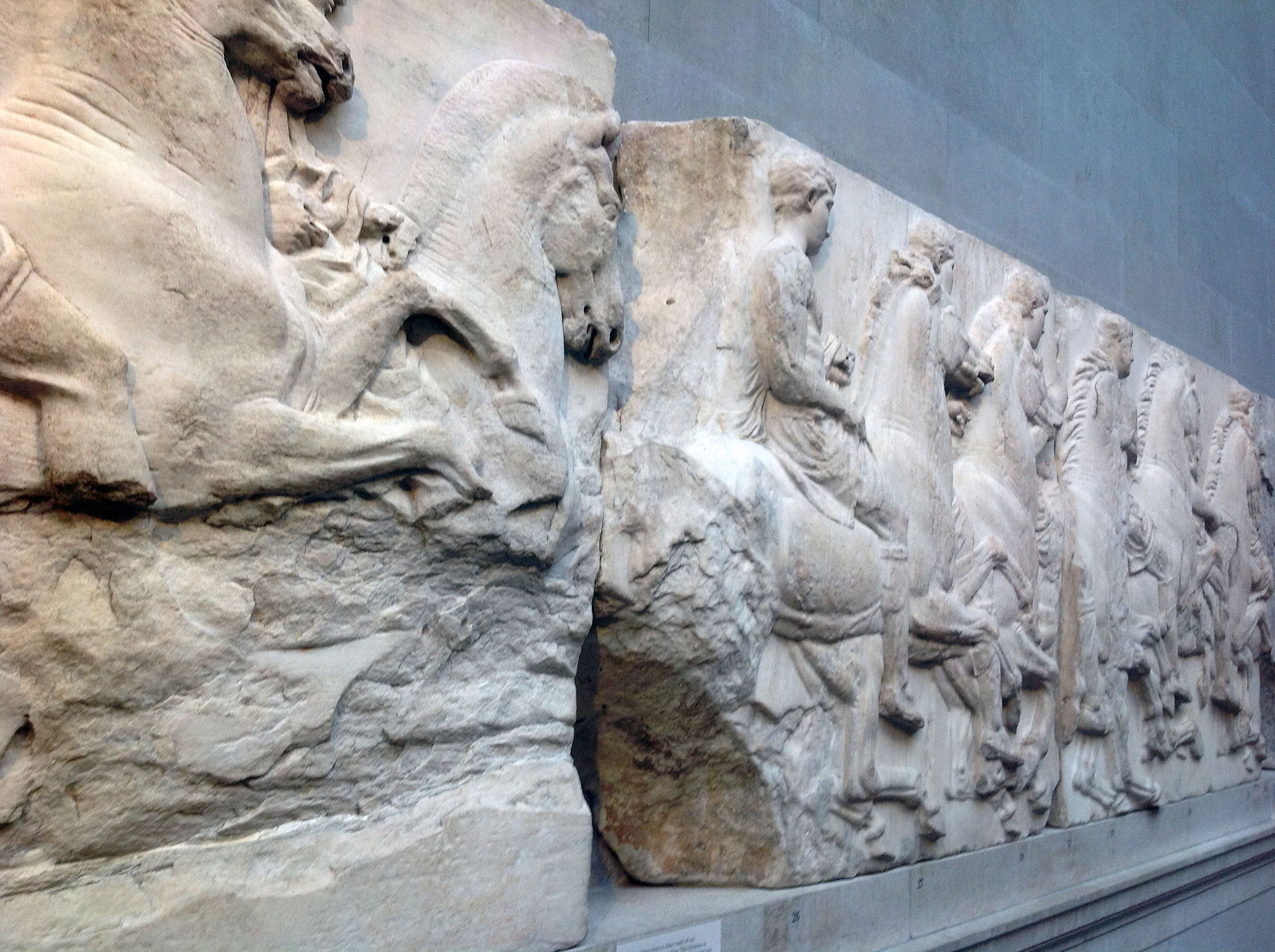
Part of the Parthenon frieze in the British Museum © David Gill


The British Museum is reported to be in an advanced state of discussion with the Greek authorities over the architectural sculptures originally created for the Parthenon on the Athenian Acropolis (Katie Razzall, "Deal to return Elgin Marbles to Greece at advanced stage - reports", BBC News December 3, 2022). Discussions have been taking place between George Osborne, the chair of the British Museum, and Kyriakos Mitsotakis, the Greek Prime Minister. More recent reports suggest that agreement is far from close ("Greece, Britain discussing Parthenon Marbles return but deal not close", ekathimerini.com December 5, 2022). It notes the UK Government position:
Asked about British Prime Minister Rishi Sunak’s position on their return, a spokesman said Britain had no plans to change laws which prevent removing objects from the collection apart from in certain circumstances. 
 “Our position on this hasn’t changed. Decisions relating to the care and management of the collections are a matter for the museum and its trustees,” the spokesman said.
It should be remembered that the UK Government compiled a substantial report on the Parthenon sculptures. This is discussed in:
Gill, D. W. J., and C. Chippindale. 2002. "The trade in looted antiquities and the return of cultural property: a British parliamentary inquiry." International Journal of Cultural Property 11: 50-64. [DOI]
The sculptures form an integral part of the main temple that is part of the UNESCO World Heritage Site. 

| |
Bookmark and Share so Your Real Friends Know that You Know

Wednesday, 8 June 2016

The Parthenon Sculptures: Moving on?

Parthenon frieze © David Gill
The 200th anniversary of the arrival of the Parthenon marbles in the British Museum is being marked. The anniversary is explored by Contantine Sandis ("Britain has kept the ‘Elgin Marbles’ for 200 years – now it's time to pass them on", The Conversation June 7, 2016). He suggests:
The time is right for all surviving sculptures to be reunited under this single roof [The New Acropolis Museum]. They should be displayed, for free, in a joint Greek and British international museum. This bicentenary provides the perfect opportunity for the two nations to collaborate instead of bicker over ownership. The British Museum would be praised worldwide for all its actions, culminating in a collaborative partnership that genuinely benefits humanity. It is high time that ownership of the past became a thing of the past and we began to think in terms of joint custody instead.
These are architectural marbles, and they need to be reunited visually in the same city as the extant monument, the Parthenon, that forms part of the UNESCO World Heritage Site.

Bookmark and Share so Your Real Friends Know that You Know

Monday, 31 August 2015

Palmyra: Temple of Bel destroyed

The BBC is now reporting that the Temple of Bel at Palmyra has been partially destroyed ("Syria's Palmyra Temple of Bel 'severely damaged' by IS", BBC News August 31, 2015). This is the latest in a sequence of deliberate destruction of this UNESCO World Heritage site.

Bookmark and Share so Your Real Friends Know that You Know

Monday, 24 August 2015

UNESCO on the Temple of Baal Shamin

UNESCO has issued a statement on the reported destruction of the temple of Baal Shamin at Palmyra.
UNESCO stands by all Syrian people in their efforts to safeguard their heritage, a heritage for all humanity


Bookmark and Share so Your Real Friends Know that You Know

Monday, 30 March 2015

"Enabling the whole world to see, study and enjoy the sculptures of the Parthenon"

The Duveen Gallery © David Gill
Sir Richard Lambert has responded to the request by the Greek Government to mediate on the Parthenon sculptures [26 March 2015, letter]. The key message from the Trustees is this: "After full and careful consideration, we have decided respectfully to decline this request".

The position of the Encyclopedic Museum is presented: "Museums holding Greek works, whether in Greece, the UK or elsewhere in the world, are naturally united in a shared endeavour to show the importance of the legacy of ancient Greece. The British Museum is committed to playing its full part in sharing the value of that legacy for all humanity".

Visitor figures are pulled out: More than 6 million visitors a year visit the British Museum, and thereby the Parthenon Sculptures, free of charge. 

Lambert concludes his letter: "In conclusion, therefore, we would invite our colleagues in Greek museums to continue to work with us and to explore new ways of enabling the whole world to see, study and enjoy the sculptures of the Parthenon". He could have added "... in London, not Athens".

Yet the statement misses the key point. The architectural and visual context for these wonderful fifth century sculptures is in Athens, under Greek light.

I recorded my thoughts on this topic back in 2009.

Bookmark and Share so Your Real Friends Know that You Know

Friday, 6 March 2015

Damage to Nimrud

Various media outlets are reporting the deliberate damage to the archaeological site of Nimrud.

The Director General of UNESCO has issued a press release ("UNESCO Director General condemns destruction of Nimrud in Iraq", 6 February 2015).

“I condemn in the strongest possible manner the destruction of the archaeological site of Nimrud site in Iraq. This is yet another attack against the Iraqi people, reminding us that nothing is safe from the cultural cleansing underway in the country: it targets human lives, minorities, and is marked by the systematic destruction of humanity’s ancient heritage,” said UNESCO Director General Irina Bokova. 
“We cannot remain silent. The deliberate destruction of cultural heritage constitutes a war crime. I call on all political and religious leaders in the region to stand up and remind everyone that there is absolutely no political or religious justification for the destruction of humanity’s cultural heritage. 
“I call on all of those who can, especially youth, in Iraq and elsewhere, to do everything possible to protect this heritage, to claim it as their own, and as the heritage of the whole of humanity. 
“I appeal also to all cultural institutions, museums, journalists, professors, and scientists to share and explain the importance of this heritage and the Mesopotamian civilization. We must respond to this criminal chaos that destroys culture with more culture. 
“I have alerted the president of the Security Council as well as the Prosecutor of the International Criminal Court. The entire international community must join its efforts, in solidarity with the government and people of Iraq, to put an end to this catastrophe. 
Likewise, UNESCO is determined to do whatever is needed to document and protect the heritage of Iraq and lead the fight against the illicit traffic of cultural artefacts, which directly contributes to the financing of terrorism. At stake is the survival of the Iraqi culture and society”
This is an attack on humanity's shared and valued heritage.

But we also remember the people of Iraq caught up in this conflict.

Bookmark and Share so Your Real Friends Know that You Know

Tuesday, 17 February 2015

Looting in Syria

© David Gill
BBC's File on Four investigative team have made a detailed exploration of the movement of looted antiquities from Syria to the markets of western Europe. They look at material that is on offer for sale in Beirut, and other objects that have been seized in Lebanon. The journalist asked specifically about Roman mosaics.

One of those interviewed spoke about the shift in volume of material moving out of Syria since the start of the recent conflict.

The BBC emphasised the need to verify information especially about the amounts of money highlighted from captured UCB sticks.

One of the UNESCO officials spoke of the need to dampen down the market as she expected some objects could be stored for some years. A middleman in Turkey talked about one object that had sold for $1.1 million.

Some material apparently from the region was spotted on the London market.

There was a discussion of the lack of regulation ("unacceptable") in the antiquities market in London.


Bookmark and Share so Your Real Friends Know that You Know

Wednesday, 10 December 2014

Why loan the odd pedimental sculpture from the Parthenon?

The personification of the river Ilissos from the Parthenon
© David Gill
Lee Rosenbaum has explored why Nel MacGregor has been keen to make a loan of the 'Ilissos' statue to the Hermitage Museum ("Preparing for Lawsuit? Why Might Neil MacGregor Be Doubling Down on His Elgin Marbles Bet?", Culturegrrl December 9, 2014).

Rosenbaum suggests the following as a possible explanation of MacGregor's tactic:
More people view these cultural treasures in London than in Athens. And now, with the incipient loan program, the British Museum’s reach could be further broadened. Therefore, the world is better off if custodianship of these treasures remains in London.
This one statue is part of a pedimental group, that forms part of an architectural whole from a major fifth century BC temple known as the Parthenon. Is the time coming when these sculptures are placed in a specially designed museum and within line of site from the Athenian akropolis, a UNESCO World Heritage site?

Bookmark and Share so Your Real Friends Know that You Know

Wednesday, 27 June 2012

Recovered Treasures


UNESCO has mounted a small exhibition of "Recovered Treasures" in Paris (June-July 2012). A short description is provided:

Source: MiBAC
31 stolen and recovered original works of art from the IVth century B.C. to the XVIIth century will be exhibited including several archaeological vases, two portions of a fresco, a painting by Guercino, another by Ludovico Carracci, a precious XIIth century ivory cross, several pages of illuminated manuscripts, one of the first letters by Christopher Columbus printed in Latin, two XVth century panel paintings by Bernardino Fungai.
Among the items on display is the Asteas krater returned from the J. Paul Getty Museum.


Bookmark and Share so Your Real Friends Know that You Know

Krater fragments in Princeton

Greek, Attic, probably by the Kleophrades Painter, ca. 490–480 BCE, Two non-joining fragments from a calyx-krater (mixing bowl) depicting ar...