Showing posts with label Portable Antiquities Scheme. Show all posts

Thursday, 13 February 2020

A parade helmet among 50 Roman finds

2020
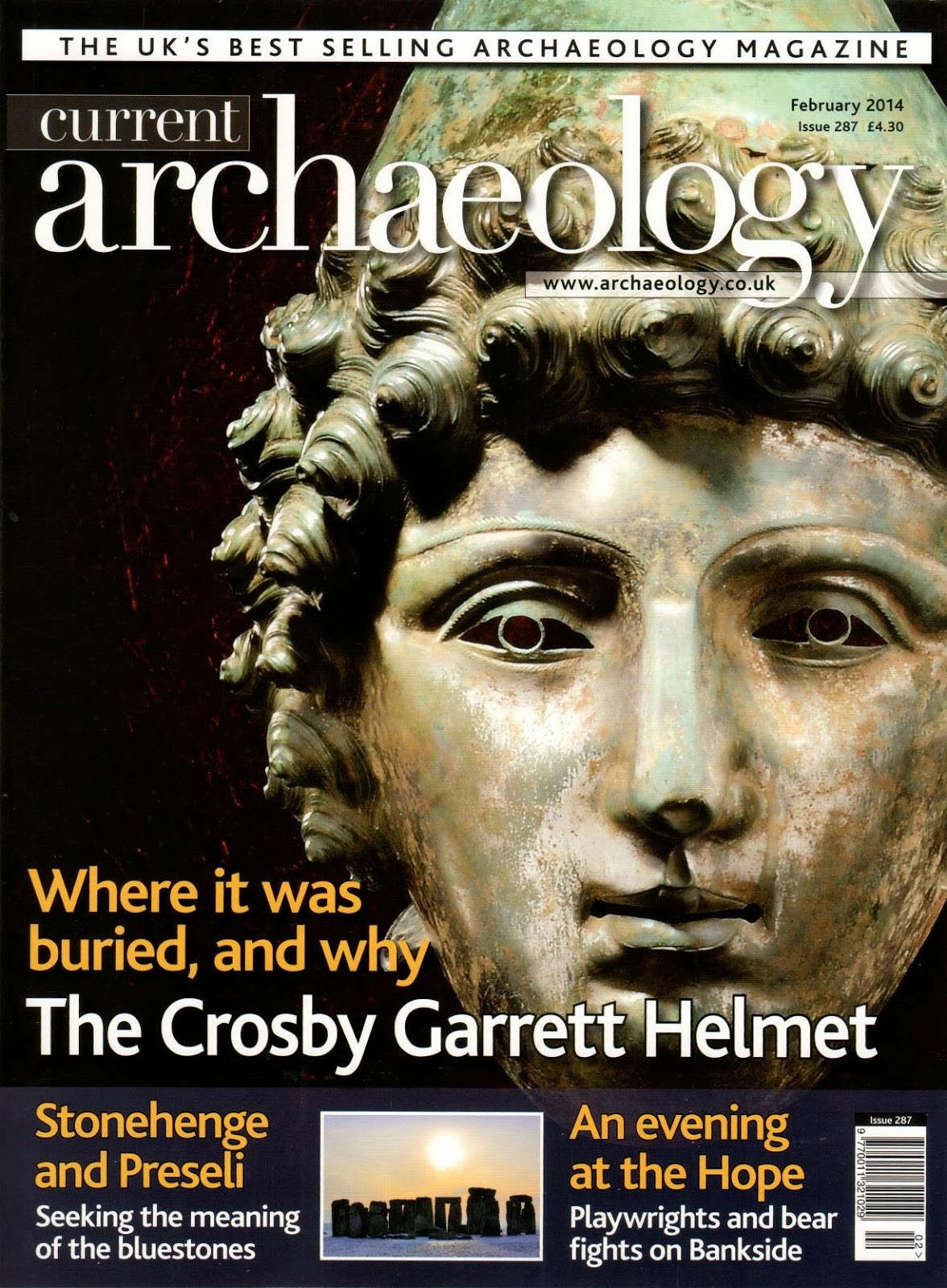
John Pearce and Sally Worrell have presented 50 largely decontextualised Roman finds from England. Among them (no. 4) is the so-called 'Crosby Garrett helmet' that some claim comes from Cumbria, though there remains a possibility that it was recovered near Catterick on the other side of the Pennines. 

How reliable are these reported find-spots? Why is there no discussion of the loss of archaeological context?

For some of the issues related to this helmet are discussed here.

Bookmark and Share so Your Real Friends Know that You Know

Monday, 30 July 2018

Michael Lewis on Metal Detecting


Michael Lewis has been talking about metal-detecting as part of the V&A Culture in Crisis Programme. He has stressed the benefit about searching ploughsoil. But what about the findspot of the Lenborough Hoard?

Lewis moves to discuss why the metal-detecting community has not signed up to the revised Code of Practice.

He touches on the issue of possible "criminal" elements who are out to loot archaeological site, and give the "hobby" a tarnished reputation.

The interviewer, Laura Jones, asked about the loss of context as a result of metal-detecting. Lewis talks about finds from below the ploughsoil, and suggests that there needs to be immediate archaeological help. He mentions the Watlington Hoard and the wait needed before the excavation could take place.

Lewis discusses the Staffordshire Hoard (but see here) as one of his favourite finds.

It would have been interesting to hear Lewis talk about the so-called Crosby Garrett helmet and the accuracy of its reported find-spot.

Lewis and Jones fail to engage with concerns about the damage being sustained to the archaeological record in England and Wales. Jones even suggests that people at home will be "wanting to be part of this", and that the Scheme actively protects the archaeological heritage of England and Wales, an issue directly addressed by the forum piece in the Papers of the Institute of Archaeology.


Bookmark and Share so Your Real Friends Know that You Know

Tuesday, 17 October 2017

Looting of archaeological sites in East Anglia

BBC Look East 17 October 2017
BBC Look East has covered the problem of looting on archaeological sites in East Anglia (October 17, 2017). The report covers the problem of illegal metal-detecting on the site of Great Chesterford, the response from the police (including PC Andy Long of Essex Constabulary) and landowners, as well as from metal-detectorists. Police will be installing cameras at key sites, as well as deploying drones to identify criminal activity.

The message that needs to get through is that archaeological contexts are being lost, and key pieces are not being reported.

The programme is available here for 24 hours.

BBC Look East 17 October 2017
Bookmark and Share so Your Real Friends Know that You Know

Tuesday, 3 January 2017

Metal-detecting and archaeology

Displays in Lincoln © David Gill
The recent archaeological survey work at the Anglo-Saxon vicus at Rendlesham in Suffolk has reminded me of the contribution of controlled metal-detecting on archaeological sites. But the account of the discovery of this significant site is partly due to the unauthorised activity of metal-detectorists on the site.

The archaeological community needs to be reminded that there is a difference between scientifically excavated material and finds that are scooped out of the ground and literally carried away in a supermarket carrier bag. Contrast the difference between the Lenborough Hoard (and see my discussion here) and the Beau Street Hoard. I was full of praise for the excavation of the Beau Street Hoard (e.g. "It is a good reminder of the amount of information that can be gleaned from a properly excavated, conserved and studied Roman coin hoard").

As we start 2017, would it be possible for there to be a sensible discussion of how the archaeological heritage of England and Wales can be protected from unauthorised disturbance?

Bookmark and Share so Your Real Friends Know that You Know

Monday, 18 January 2016

Treasure hotspots in England

There is a report on the BBC that identifies "The best places in England for unearthing lost treasure" (Laurence Cawley, BBC News 17 January 2016). The report claims: "Research by the BBC has revealed Norfolk as the best spot for treasure hunters."

The report is full of praise for the Portable Antiquities Scheme:
In the 1980s, archaeologists and metal detectorists were at war over the nation's subterranean heritage. 
But in the 20 years since the PAS set out clear guidance for the reporting of finds by the public, the relationship between responsible detectorists and archaeologists has thawed. 
It so happens that Norfolk features in the Nighthawking Survey (2009) and in my discussion of PAS ("The Portable Antiquities Scheme and the Treasure Act: Protecting the Archaeology of England and Wales?", 2010). I also gave Norfolk as an example in my 2009 response to the Survey.

The BBC report also gives a little more detail of the "hundreds of holes" at the site of the Roman "Saxon Shore" fort at Bradwell in Essex: "Animals don't dig using a flat-sided object, Nor do they pat the ground back on top of the hole or take out a ring-pull and leave it by the side of the hole."


Bookmark and Share so Your Real Friends Know that You Know

Friday, 10 July 2015

The Lenborough Hoard

My article, 'Damaging the archaeological record: The Lenborough Hoard', has appeared in the Journal of Art Crime 13 (Spring 2015) 51-57. The article reviews how the coins were removed from their archaeological context and suggests ways to develop stronger guidelines to protect the archaeological heritage of England and Wales.

Bookmark and Share so Your Real Friends Know that You Know

Tuesday, 24 March 2015

Bland on the so-called Crosby Garrett helmet and the Lenborough Hoard

Roger Bland has placed his paper on 'The Portable Antiquities Scheme and Treasure Act: the Current Situation' given at the Museums Association March 2015 Dig It: Museums and Archaeology Conference online.

I notice that he discusses two topics discussed on LM. The first is the so-called Crosby Garrett helmet. Bland notes:
This was found by a metal detector user who reported it to one of our FLOs who was able to establish exactly where it was found.
I have discussed this helmet in print elsewhere (available online). Bland does not draw attention to the fact that the two FLOs [not one!] were not shown the reported find spot for some three months (i.e. on 30 August 2010).

Bland then talked about the subsequent excavation:
This at least proved that the object had come from Crosby Garrett – some people commenting on the web had doubted that – and that it had a context, as it came from a so - called `native’ settlement. The immediate context of the helmet remains difficult to pin down: it seems to have been buried below a rough stone floor, though whether that belonged to a building, a road, or possibly a cairn is unclear.
I have discussed this investigation and I found that the evidence was not compelling.

Lenborough Hoard
Source: finds.org.uk (under CC)
At the end of the talk Bland turned to the Lenborough Hoard as an example of a hoard falling under the Treasure Act:
Four days before Christmas the Finds Liaison Officer (FLO) for the Portable Antiquities Scheme in Bucks was invited to record the finds made by detectorists at a metal detecting rally at Lenborough, just south of Buckingham. Within half an hour of arriving and setting up her recording table, news came that something interesting had been found! As the light went at the end of the day a hoard of more than 5,000 silver coins, wrapped in a damaged lead parcel, had been excavated. The coins had been piled onto a thin rectangle of lead sheet with cut edges. The longer edges had then been lifted and folded over on themselves and the ends pinched together to make an elliptical parcel. Through the damage on the upper surface a tightly packed, jumble of coins could be seen. They did not appear to have been laid in any order and there was no trace of, or room for them to have been in leather pouches. This was a rescue job and Ros, as our sole FLO at event with about a hundred metal detector users, did a heroic job in the circumstances and ensured that all the coins were recovered.
This hoard has been discussed on LM before. In particular there is the issue of the historic nature of the location where the rally was held. And what about the less than orthodox removal of the coins, in contrast to the Beau Street Hoard that was removed in a scientific way that has allowed detailed study and interpretation?

Bland has only placed his notes on line and not his refined final views. But his online presentation appears to overlook some of the key issues relating to both these 'finds'.

Bookmark and Share so Your Real Friends Know that You Know

Friday, 27 February 2015

The workings of PAS

I have valued my relationship with the British Museum over several decades. It has been a feature of my life for as long as I can remember.

I have read some of the material that has come out from Paul Barford's request for information. I hope that senior members of PAS will reflect on the way that staff have responded to awkward questions. Have they always reacted in a professional way? Could things have been handled differently?

Bookmark and Share so Your Real Friends Know that You Know

Friday, 20 February 2015

The so-called Crosby Garrett helmet

The 'Crosby Garrett' helmet on display in the British Museum
© David Gill
My article on the so-called Crosby Garrett helmet that appeared in the Journal of Art Crime is now available on academia.edu. This documents the varying accounts of the discovery, reporting, 'restoration', sale, and display.

Bookmark and Share so Your Real Friends Know that You Know

Friday, 13 February 2015

The Lenborough Hoard and loss of knowledge

The Lenborough Hoard
Source: www.finds.org.uk
I noticed that The Times (London has covered the Lenborough Hoard (Jack Malvern, "Metal-detector row led to £1m Anglo Saxon coin hoard", 11 February 2015). Much of the story recycles the British Museum press release but it includes a section on Paul Barford, an "archaeological blogger". The Times draws attention to the information that has been lost by the scooping of the coins into a carrier bag.

Bookmark and Share so Your Real Friends Know that You Know

Wednesday, 11 February 2015

The Lenborough Hoard and the future of PAS

Lenborough Hoard
Source: finds.org.uk (CC)
The Lenborough Hoard is now featured on the BBC ("Hoard of Anglo Saxon coins largest discovered under Treasure Act", 11 February 2015). It is essentially a recycled press release (see here), and even includes a mention of the alleged "excavation".

We should also note that Dr Roger Bland has suggested that the future of PAS is far from certain.
However, the head of the antiquities scheme that funds the finds, Roger Bland, said the future was looking uncertain because of budget reductions. 
"I'm not sure whether we're going to be able to renew the contracts for nine of the 32 posts that we've got in the scheme from the 1 April. 
"I'm quite concerned but I also feel that we've been in difficult places before and we've managed to keep going," he said.

Meanwhile Dr Daniel Pett of PAS has tweeted me a message.

This was no doubt in reaction to my post yesterday. My search arrived at a page so that when you clicked on the link you just saw code - and the image was one of Lego. I can only presume that the BM has set up their backup server so that the public (and search engines) can see it. Perhaps that is a loophole that should be closed.

Bookmark and Share so Your Real Friends Know that You Know

Tuesday, 10 February 2015

Lenborough Hoard: update

Lenborough Hoard
Source: finds.org.uk (under CC)

There appeared to be a curious blip on the PAS website earlier today that meant the normal record was unavailable. I have checked again this evening and it is now all there [here].

The circumstances provided on the website appears as "Weekend Wanderers Xmas Dig". (For further images see here.)

We also need to remember that under The Treasure Act (1996) 'the occupier of the land' can receive part of the reward.

Bookmark and Share so Your Real Friends Know that You Know

The amazing archaeological hoard

I see that the Lenborough Hoard features prominently in the press release for the launch of the Treasure Annual Report 2012 [press release, "Largest Anglo-Saxon coin hoard tops list of latest nationwide treasure finds". 10 February 2015].
... the largest Anglo Saxon coin hoard found since the Treasure Act began is announced. This amazing archaeological hoard of around 5,200 coins was discovered in the village of Lenborough, Buckinghamshire. This discovery highlights the ongoing importance of the Portable Antiquities Scheme and Treasure Act in ensuring that the most important finds are secured for the nation.
Neil MacGregor also comments on the hoard:
More Treasure finds are being reported than ever before and unique objects are documented and conserved for study and public display, such as the recent find of the largest Anglo-Saxon coin hoard recorded since the Treasure Act of 1996. These achievements are a testament to the network of Finds Liaison Officers, who play a key role in ensuring archaeological finds found by the public are properly reported and recorded.

Is the Lenborough Hoard the best example to use of how FLOs are deployed in the field? Could some of the issues that arose have been anticipated by the FLO? Are archaeologists just interested in recording objects and creating databases? What about the careful excavation of coin hoards that we have seen elsewhere?

The finder Paul Coleman is also quoted in the press release:
'When I saw the first few coins I was really excited because I knew I had found a hoard, however the excitement grew and grew as the size and importance of the find became apparent. Ros Tyrrell, the FLO who was in charge of the excavation, was spot on when she said "now I know a little of what Egyptologist Howard Carter must have felt, when he first looked into the tomb of Tutankhamen."'
What is meant by 'excavation' here? Did Carter scoop up the Tutankhamun finds into a handy F&M pannier? (No doubt an informed reader of LM will have studied the packing materials of the excavation.)

Coleman has indicated that he is willing to turn down the reward ("Jobless man set to miss out on £1 million hoard reward", Buckingham Today 10 February 2015).
Mr Vaizey said: “I’d especially like to thank the finders and landowners who have graciously waived their right to a reward so that local museums can acquire treasure. 
“It is an initiative that the government has been keen to support and it demonstrates that metal detectorists have a genuine interest in the past, and are not just interested in archaeology for personal gain.” 
The coins are being showcased at the British Museum this morning with curator, Gareth Williams, discussing his research into the hoard but the eventual resting place of the coins is yet to be decided.
It is pity that the apparent rushed removal of the coins will have meant that valuable contextual knowledge was lost.

Bookmark and Share so Your Real Friends Know that You Know

Monday, 12 January 2015

Learning from the Lenborough Hoard

The Lenborough Hoard has raised some important issues for the Portable Antiquities Scheme. Can I make some suggestions for PAS staff who attend 'events'?

  • Do not be surprised if finds are made are made at an archaeological site featured in the Historic Environment Record.
  • Take the appropriate digging and recording equipment with you.
  • Remember to take some appropriate containers for any finds.
  • Do not be afraid to ask for the exploration of a 'deposit' to be stopped so that it can excavated in an appropriate manner in order to preserve information.
  • Make a plan so that a location can be secured if a major find is made and has to be left overnight.
It is becoming clear that significant information has been lost by the rushed removal of the coin hoard from its archaeological deposit.


Bookmark and Share so Your Real Friends Know that You Know

Monday, 5 January 2015

PAS: Code of practice for responsible metal detecting

Some readers of LM may be unfamiliar with the "Code of practice for responsible metal detecting" on the website of the Portable Antiquities Scheme (PAS). I extract some key points here.
Before you go metal-detecting 
"Adhering to the laws concerning protected sites (e.g. those defined as Scheduled Monuments or Sites of Special Scientific Interest: you can obtain details of these from the landowner/occupier, Finds Liaison Officer, Historic Environment Record ...)" 
While you are metal-detecting 
"Wherever possible working on ground that has already been disturbed (such as ploughed land or that which has formerly been ploughed), and only within the depth of ploughing. If detecting takes place on undisturbed pasture, be careful to ensure that no damage is done to the archaeological value of the land, including earthworks." 
"Minimising any ground disturbance through the use of suitable tools and by reinstating any excavated material as neatly as possible. Endeavour not to damage stratified archaeological deposits." 
After you have been metal-detecting 
"Seeking expert help if you discover something large below the ploughsoil, or a concentration of finds or unusual material, or wreck remains, and ensuring that the landowner/occupier's permission is obtained to do so. Your local Finds Liaison Officer may be able to help or will be able to advise of an appropriate person. Reporting the find does not change your rights of discovery, but will result in far more archaeological evidence being discovered."
The Lenborough Hoard discovered just before Christmas appears to have been on a site that includes a deserted medieval village and "ridge and furrow" field system. (The Historic Environment Record for Buckinghmashire notes, "Medieval house platforms, hollow-ways and ridge and furrow seen on aerial photographs".) The fact that the hoard was found some 60 cm below the (undisturbed) surface appears to be significant.

Bookmark and Share so Your Real Friends Know that You Know

Friday, 2 January 2015

The Lenborough Hoard

The BBC is now reporting on the finding of a major late Anglo-Saxon (to early Norman) hoard near Aylesbury in Buckinghamshire ("Thousands of ancient coins discovered in Buckinghamshire field", 2 January 2015).
Paul Coleman from the Weekend Wanderers Detecting Club discovered more than 5,000 coins buried inside a lead bucket two feet under a field near Aylesbury.
This has earlier been reported as a find made at Lenborough ("Silver coins worth £1m found on farm", Buckingham Today 31 December 2014). Paul Barford has drawn attention to the fact that the find was made at the location of a deserted medieval village, and a Medieval Manor House (see website of metal-detecting group: "Tons of history here, DMV site, Medieval Manor house and windmill site, Roman treasure found at adjacent village and much more....").

Two feet underground does not sound like a surface find. What stratigraphical and contextual information has been lost? (For a discussion of these issues see the forum article in Papers of the Institute of Archaeology 2010.)

The hoard will be considered under The Treasure Act. The FLO from the Portable Antiquities Scheme (PAS) was present for part of the removal. The local paper reported:
Archaeologist Ros Tyrrell, the Finds Liaison Officer for Bucks, who is based at the Bucks County Museum in Aylesbury, was at the rally to record any finds made on the day, when the major hoard of more than 5,251½ Anglo Saxon silver coins was uncovered. Miss Tyrrell was immediately called over to help excavate the coins.
We look forward to seeing the publication of the excavation as well as the finds in due course.


Bookmark and Share so Your Real Friends Know that You Know

Monday, 26 May 2014

The So-Called Crosby Garrett Helmet

The Crosby Garrett and the Ribchester helmets
on display in The British Museum
© David Gill
The latest volume of the Journal of Art Crime is now available. It includes my essay on the so-called Crosby Garrett helmet timed to coincide with the public display in the British Museum.

The article considers the new evidence presented by the study of the reported find-spot. It returns to the issue of The Treasure Act and the need to make amendments.

Reference
‘Context matters: The So-called Crosby Garrett Helmet’, Journal of Art Crime 11 (2014) 53-59.


Bookmark and Share so Your Real Friends Know that You Know

Saturday, 17 May 2014

Anglo-Saxon brooches from East Anglia


I was very struck by the distribution maps for finds of Anglo-Saxon ansate brooches produced by Dr Rosie Weetch of the British Museum. It is very striking that the number of recorded "finds" increases from 2010 for both Norfolk and Suffolk. Weetch puts this rise down to the number of brooches recovered by metal-detecting.

It would be interesting to know how many Anglo-Saxon ansate brooches come from secure, excavated contexts.

What are the intellectual consequences if the majority of the brooches do not have secure contexts?

For the record the PAS database has 49 brooches for Suffolk, and 92 brooches for Norfolk.

See also comments by Paul Barford.

Bookmark and Share so Your Real Friends Know that You Know

Tuesday, 15 April 2014

"Near North Cove Hoard": valuation

The finder of the the "Near North Cove Hoard" in Suffolk has been interviewed on the BBC website ("Suffolk Bronze Age axe and ring hoard 'undervalued'", April 12, 2014). The Bronze Age finds were discovered near Lowestoft in 2011 and their value has now been set at £550 (instead of the £6200 that the finder was expecting). The finder, Steven Walker, is quoted:
"I've been metal-detecting for 15 years and this was my best ever find and my experience does not inspire confidence in the official valuation process. 
Unless changes are made, people aren't going to donate their treasure finds to the nation."

Further details are available from PAS.

SF-BDA986SF-BDA986PAS record number: SF-BDA986
Object type: Hoard
Broadperiod: Bronze Age
County of discovery: Suffolk
Stable url: http://finds.org.uk/database/artefacts/record/id/458499


Bookmark and Share so Your Real Friends Know that You Know

Tuesday, 4 February 2014

Legal Fibbery and the so-called Crosby Garrett helmet

The Heritage Journal has discussed my scepticism about the alleged find-spot of the so-called Crosby Garrett helmet.

There is an interesting expansion on legal "fibbery" and HJ rightly wonders how many objects in the PAS database have falsified find-spots.

This is a wider issue. Anyone following the Nostoi debate relating to antiquities returned from North American collections will know that collecting histories can be fabricated.

Bookmark and Share so Your Real Friends Know that You Know

Krater fragments in Princeton

Greek, Attic, probably by the Kleophrades Painter, ca. 490–480 BCE, Two non-joining fragments from a calyx-krater (mixing bowl) depicting ar...