Image
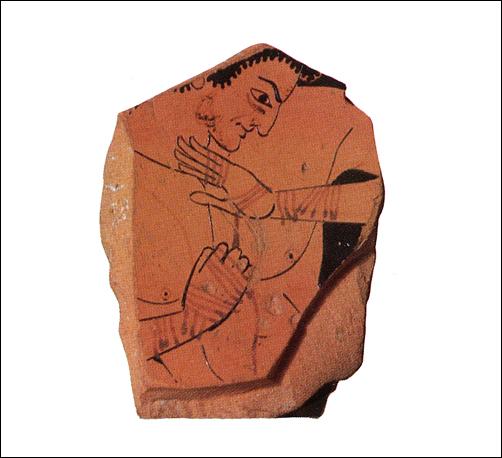
Fragmentary Attic cup showing Thracian boxer sold by Atlantis Antiquities.
Source: scoop.co.nz.
Discussion of the archaeological ethics surrounding the collecting of antiquities and archaeological material.
The Rome exhibition, "Nostoi: Capolavori ritrovati", contains objects from a number of sources. One of the blocks of material formed part of the Barbara and Lawrence Fleischman collection which was acquired by the J. Paul Getty Museum largely in 1996.4. Attic black-figured amphora (Type B). Attributed to the painter of Berlin 1686 (by Dietrich von Bothmer). Herakles and Geryon. Reassembled by Fritz Bürki (1988); Atlantis Antiquities (1988). Ex Malibu 96.AE.92. Bibl. Passion no. 34; Gill and Chippindale 2007, Table 6, no. 2.References
5. Attic black-figured amphora (Panathenaic shape). Attributed to the Three-line group (by Dietrich von Bothmer). Alkestis and Admetos. Fritz Bürki (1989). Ex Malibu 96.AE.93. Bibl. Passion no. 35; Gill and Chippindale 2007, Table 6, no. 3.
13. Attic red-figured cup (Type B). Attributed to the Nikosthenes painter and to the potter Pamphaios (by J. R. Guy). Robin Symes (1988). Ex Malibu 96.AE.97. Bibl. Passion no. 39; Gill and Chippindale 2007, Table 6, no. 4.
34. Etruscan antefix with maenad and Silenos. "Said to come from Cerveteri". Hunt collection. Ex Malibu 96.AD.33. Bibl. Passion no. 92; Gill and Chippindale 2007, Appendix A, no. 24.
37. Etruscan bronze mirror. Odysseus and Penelope. Ex Malibu 96.AC.132. Bibl. Passion no. 83.
40. South Italian bronze aksos in form of siren. Purchased from Lawrence Fleischman. Ex Malibu 92.AC.5. Bibl. Gill and Chippindale 2007, Appendix A, no. 26.
45. Apulian red-figured bell-krater. Attributed to the Choregos painter (by A.D. Trendall). Fritz Bürki. Ex Malibu 96.AE.29. Bibl. Passion. no. 56; Gill and Chippindale 2007, Table 6, no. 5.
48. Paestan red-figured squat lekythos. Garden of the Hesperides. Attributed to Asteas (by A.D. Trendall). Ex Malibu 96.AE.119. Bibl. Passion no. 65; Gill and Chippindale 2007, Appendix A, no. 22.
58. Roman marble statue of Tyche. Robin Symes. Ex Malibu 96.AA.49. Bibl. Passion no. 120; Gill and Chippindale 2007, Table 6, no. 1.
59. Roman fresco fragment showing mask of Herakles. Associated with a fragment in the Shelby White collection. Fritz Bürki. Ex Malibu 96.AG.171. Bibl. Passion. no. 126; Gill and Chippindale 2007, Table 6, no. 7.
65. Roman marble statue of Dionysos with goat. Ex Malibu 96.AA.211. Bibl. Passion no. 179; Gill and Chippindale 2007, Appendix A, no. 4.
Check the authenticity of the piece. Who is selling it and who has seen it in terms of scholars or experts?Perhaps the buyer needs to do a little bit more than that. Is the piece known before 1970? Is the documentation secure? Who were the previous collectors? Are they named or anonymous?
A full list of the objects that appear in the Rome exhibition, "Nostoi: Capolavori Ritrovati", has now been issued. (The numbers refer to the official handlist.)Boston, Museum of Fine Arts (12): 6, 8, 15, 17, 28, 29, 41, 42, 44, 50, 53, 67.There are also items from dealers:
Malibu, J. Paul Getty Museum (44): 2, 4, 5, 7, 10, 11, 12, 13, 18, 19, 20, 22, 23, 24, 25, 26, 27, 30, 31, 32, 34, 36, 37, 39, 40, 43, 45, 46, 47, 48, 49, 52, 54, 55, 56, 57, 58, 59, 61, 62, 63, 65, 66, 68.
New York, Metropolitan Museum of Art (5): 3, 9 [Sarpedon krater still in New York on loan], 14, 16, 51.
Princeton, University Art Museums (1): 1.
The Royal Athena Galleries, New York (5): 21, 33, 35, 38, 64.As far as the fabrics and types of object are concerned:
Robin Symes (1): 60.
PotteryIt is striking that 15 pieces were represented by South Italian pottery: Apulian (11), Lucanian (2) and Paestan (2). Seven bronzes and pots are Etruscan in style. Twenty-eight of the objects are Attic pots, both black-figured (5) and red-figured (23). Such pots are regularly found in Etruscan tombs as well as the cemeteries of the western Greek colonies.Protocorinthian: 1, 2Terracotta:
Laconian: 3
Attic, black-figured: 4, 5, 6, 7, 8
Attic red-figured: 9, 10, 11, 12, 13, 14, 15, 16, 17, 18, 19, 20, 21, 22, 23, 24, 25, 26, 27, 28, 29, 30, 31
Etruscan: 32, 33, 36
Lucanian: 41, 42
Apulian: 43, 44, 45, 46, 49, 50, 51, 52, 53, 54, 55
Paestan: 47, 48Etruscan: 34Bronzes:Etruscan: 35, 37, 38Inscription:
South Italian: 40
Campanian: 64Selinus: 39Sculpture and works in marble:South Italian: 56, 57Wall-painting: 59, 60, 63
Other: 58, 61, 65, 66, 67, 68
Ivory: 60
An exhibition, "Nostoi. Capolavori ritrovati", is about to open in the Palazzo del Quirinale, Rome (press statement; Elisabetta Povoledo, "After Legal Odyssey, Homecoming Show for Looted Antiquities", New York Times, December 18, 2007; Ariel David, "Looted Art Displayed in Rome", AP). Some 68 antiquities will be displayed. They include material returned from the J. Paul Getty Museum, the Metropolitan Museum of Art in New York, the Museum of Fine Arts in Boston, and the Princeton University Art Museums. Among the pieces is the ivory mask handled by Robin Symes and seized in 2003. Some of the objects had passed through private collectors such as Barbara and Lawrence Fleischman. Five pieces were returned from the Royal Athena Galleries.Suffice to state, only ancient coins from "secure contexts," i.e. under flooring have any real use for dating purposes. Even then, the long periods of circulation of ancient coins makes them of much less use for dating than other artifacts, notably pottery shards.Are "floors" the only archaeological sites that can be considered to be "secure contexts"? Of course not.
Source: Harvard Art Museums The repatriation of the Afrati armour from New York's Metropolitan Museum of Art has implications for other ...