Thursday, 13 January 2022

Steinhardt head from Cyrene returns to Libya

Source: Manhattan DA
The marble head of a woman has been returned to Libya after being "surrendered" by New York collector Michael Steinhardt ("D.A. Bragg: $1.2M Antiquity Seized From Michael Steinhardt Returned to the People of Libya", Manhattan DA press release, January 12, 2022). The head, dating to the mid fourth century BCE, has been valued at $1.2 million. The head is reported to have been looted from a tomb in the vicinity of Cyrene.

The head was purchased on November 10, 2000 from the Manhattan dealer Michael Ward for $1.2 million. The invoice is reported to have noted, "possibly from North Africa". 

Michael Ward also handled the "Aidonia Treasure" that was returned to Greece; a Campanian calyx-krater returned to Italy from the Dallas Museum of Art that had been acquired from Becchina; and items that have been associated with the discovery of the Korsechnica krater. 

Michael Ward had acquired an Attic black-figured hydria from the Bastis collection; this was sold to Steinhardt and will form part of the returns to Italy.
| |
Bookmark and Share so Your Real Friends Know that You Know

Tuesday, 11 January 2022

A Bothmer fragment sourced from Almagià


When 40 of Bothmer pot fragments were returned to Italy from New York's Metropolitan Museum of Art there was the statement from the museum's spokesperson, Elise Topalian, reported by Chasing Aphrodite:
Von Bothmer was a client of Almagia for many years, Topalian said. The fragments von Bothmer obtained from the dealer were returned to Italy “to serve as evidence in the investigation and possible trial of Edoardo Almagia.”
In the statement of fact relating to Michael Steinhardt's collection an example of Almagià's sales from the summer of 1994 is provided. This suggests that Almagià provided "Frammenti Attici" that had been purchased from Mauro Morani $22,000.

One of the pieces purchased by Bothmer from Almagià in 1987 was a fragment, measuring 1.9 cm, of an Attic red-figured cup attributed to the Triptolemos painter (Malibu inv. 87.AE.154). 103 fragments of the same cup were purchased in 1990 from Galerie Nefer (Malibu inv. 90.AE.35). 

Where did Almagià acquire his fragment? Where did the Galerie Nefer acquire its fragments? 

Were other Bothmer fragments in the Getty acquired from Almagià?
| |
Bookmark and Share so Your Real Friends Know that You Know

Friday, 7 January 2022

Cleveland Museum of Art: material from Latium


Two of the three antiquities returned to Italy from the Cleveland Museum of Art appear to be impasto amphorae with 'spiked handles' of the type that have been found at Crustumerium in Latium. The two pieces were acquired in 1995 (inv. 1995.64–65). 

The third piece is a Near Eastern head pendant (inv. 1994.97). 

| |
Bookmark and Share so Your Real Friends Know that You Know

Thursday, 6 January 2022

Cleveland Museum of Art: further returns to Italy

Etruscan silver bracelets
Gift of Edoardo Almagià
Returned from Cleveland Museum of Art

The Cleveland Museum of Art has returned three further items associated with Edoardo Almagià to Italy. These have been described as ("Valuable artifacts considered stolen being returned to Italy, including items from Cleveland Museum of Art", December 15, 2021 cleveland.com): 
The Cleveland Museum of Art said in a statement that it acquired three items from Almagià in 1994 and 1995, two Roman amphora with spiked handles and a tiny ancient near eastern glass bead in the shape of a head.
Are the 'two Roman amphora with spiked handles' the same as the distinctive impasto ware amphorae with spiked handles from Crustumerium in Latium? Certainly material from Crustumerium is featuring in material returned from other sources.

Back in 2010 the museum was reluctant to reveal what else had been acquired from Almagià (in addition to the pair of silver Etruscan bracelets given by him and Courtney Keep in 1996). 

There does not yet seem to be a press release about the latest returns from Cleveland. Why is there reluctance to be transparent about the objects? 

| |
Bookmark and Share so Your Real Friends Know that You Know

Broken pot fragments matter

Source: San Antonio Museum of Art

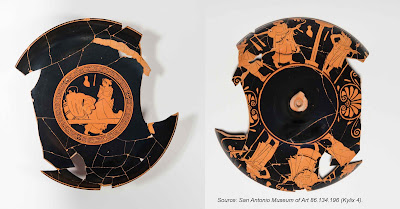
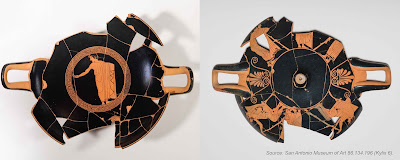
Among the material linked to Edoardo Almagià  and returning to Italy are 192 Attic cup fragments from the San Antonio Museum of Art. These are in addition to the calyx-krater fragments attributed to Euphronios that were returned from Princeton University Art Museum. 

These returns challenge the belittling of the issue by James Cuno who used the example of the 200 or so fragments acquired by Harvard as part of his attack on those who would wish to see a more rigorous approach to museum acquisitions. Harvard will no doubt be looking again at the histories of the fragments. Were any acquired from a New York based dealer? Have connections been made with fragments in other collections?

|
Bookmark and Share so Your Real Friends Know that You Know

Wednesday, 5 January 2022

Barbarano Romano: the Attic fragments

Source: San Antonio Museum of Art

The San Antonio Museum of Art will be returning 192 fragments of Attic black-figured, red-figured and black-glossed cups to Italy. They are reported to have been found at Barbarano Romano to the south of Viterbo and were sold to Gilbert M. Denman, Jr. by Edoardo Almagià in 1985; Denman gave the fragments to the museum the following year (inv. 86.134.196). 

The Steinhardt legal papers cite two pieces of correspondence about pottery fragments from Barbarano Romano: the recipient is clearly in Texas. Almagià states the findspot and explained how the fragments were removed to Switzerland, and then moved to New York where they were cleaned and grouped with the help of a vasologist. Further fragments from the site were then noted, though they remained in Italy. 

It is unclear if the San Antonio fragments and the Texas letters are linked. But this does raise issues about other pot fragments that were handled by Almagià and those associated with him. 

| |
Bookmark and Share so Your Real Friends Know that You Know

Saturday, 1 January 2022

Looting Matters 2022: Looking Ahead


What ideas will be explored in 2022? 

First, the detail of the objects returned from the Michael Steinhardt collection and Fordham University will provide material for discussion. There will be the potential to look at the way that the histories of objects can be fabricated as they pass through the market.

Second, the returns of the Steinhardt and Fordham objects have pointed to other material that may be contested. I have been particularly struck by objects derived from Latium.

Third, the Almagià returns have reminded us of the issue of figure-decorated pot sherds. Were pots broken up with the intention of reuniting the fragments? This has been explored before; for example, a discussion of the Nussberger donations to the Getty.

Fourth, it is over 10 years since the invited Forum Piece on the Portable Antiquities Scheme for the Papers from the Institute of Archaeology. My review article of 50 Roman Finds raised some issues about the reliability of information relating to findspots. What are the differences between the removal of small finds from sites in England, and parallel acts in, say, Mediterranean settings?

Fifth, I am looking forward to working on a more collaborative piece of research on the protection of heritage in England. 

I would like to wish readers of LM all my best wishes for a more hopeful 2022.

| |
Bookmark and Share so Your Real Friends Know that You Know

Krater fragments in Princeton

Greek, Attic, probably by the Kleophrades Painter, ca. 490–480 BCE, Two non-joining fragments from a calyx-krater (mixing bowl) depicting ar...