Rendlesham exhibition

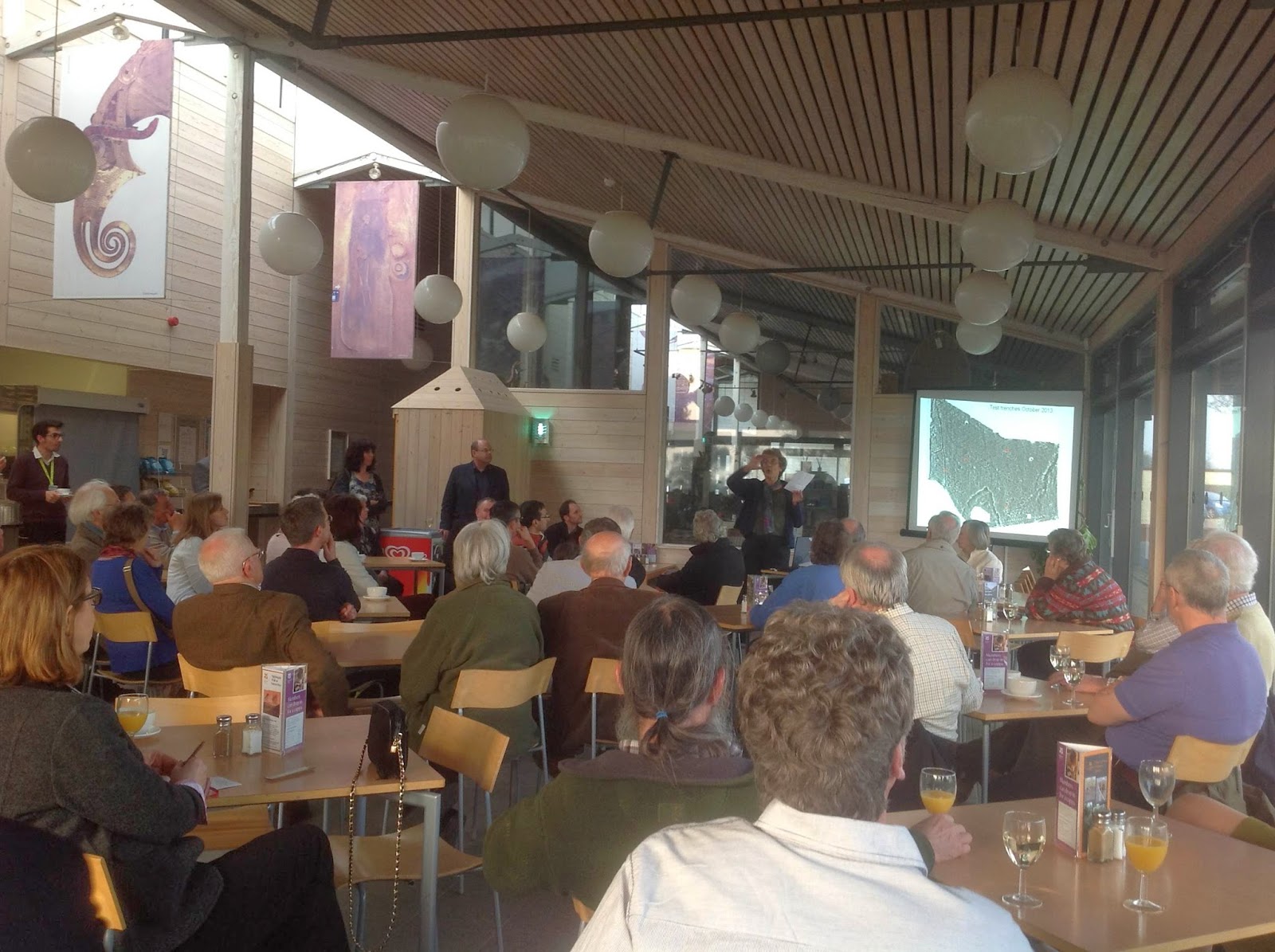
Rendlesham opening at Sutton Hoo © David Gill
I attended the opening of the exhibition of finds from the Anglo-Saxon site at Rendlehsam last night. This took place at the National Trust's Sutton Hoo visitor centre. It was a glorious evening with talks on the discovery of the site and its interpretation.

It was stressed that Rendlesham was the elite site — perhaps the location of King Raewald —whereas Sutton Hoo related to "death and memory". It looks as if we now have two major Anglo-Saxon sites in close proximity.

What became clear during the evening was the damage that had been sustained to the site by "nighthawkers". (Before anybody comments, three local metal-detectorists were present at the event as they helped to map small finds in the vicinity of the site.)

There is more on the Rendlesham site from BBC News. The Ipswich Star has been commenting on the damage sustained to the site [press].

We need to recognise that this internationally significant site has been damaged by illicit activity. Information has been lost. It is another reminder of the intellectual consequences of unscientific "exploration" of archaeological sites.

Bookmark and Share so Your Real Friends Know that You Know

Comments

Anonymous said…
Professor Christopher Scull came to talk to us about Rendlesham at the University of Reading last week. It is a truly incredible site, partially ruined by nighthawks, but the team have done a fantastic job to salvage what they can and discourage future activity.

Such high profile instances of this activity should hopefully serve to increase public awareness of the problem.

Great post, thanks for writing it.

Popular posts from this blog

The scale of the returns to Italy

I have been busy working on an overview, "Returning Archaeological Objects to Italy". The scale of the returns to Italy from North American collections and galleries is staggering: in excess of 350 objects. This is clearly the tip of the iceberg when it comes to the material that has surfaced on the market without a history that can be traced back to the period before 1970. 

I will provide more information in due course, but the researcher is a reminder that we need to take due diligence seriously when it comes to making acquisitions.

Stele returns to Greece

The Hellenic Ministry of Culture has announced (Saturday 8 September 2018) that a stele that had been due to be auctioned at Sotheby's in London in June 2017 has been returned to Greece (Friday 7 September 2018). The identification had been made by Cambridge-based forensic archaeologist Dr Christos Tsirogiannis.

It appeared that the stele had been supplied with a falsified history as its presence with Becchina until 1990 contradicted the published sale catalogue entry. It then moved into the hands of George Ortiz.

A year ago it was suggested that Sotheby's should contact the Greek authorities. Those negotiations appear to have concluded successfully.

The 4th century BC stele fragment, with the personal name, Hestiaios, will be displayed in the Epigraphic Museum in Athens. It appears to have come from a cemetery in Attica.


"Beating sites to death"

Policy decisions for protecting archaeological sites need to be informed by carefully argued positions based on data. Dr Sam Hardy has produced an important study, “Metal detecting for cultural objects until ‘there is nothing left’: The potential and limits of digital data, netnographic data and market data for analysis”. Arts 7, 3 (2018) [online]. This builds on Hardy's earlier research.

Readers should note Hardy's conclusion about his findings: "they corroborate the detecting community’s own perception that they are ‘beat[ing these sites] to death’".

Pieterjan Deckers, Andres Dobat, Natasha Ferguson, Stijn Heeren, Michael Lewis, and Suzie Thomas may wish to reflect on whether or not their own position is endangering the finite archaeological record. 

Abstract
This methodological study assesses the potential for automatically generated data, netnographic data and market data on metal-detecting to advance cultural property criminology. The method comprises the analysi…