Tuesday, 7 August 2012

Sarcophagus from Aquino

Source: Omniroma
I am grateful to Livius (of the History Blog) for seeking clarification of the link between Robert Hecht and the recovered sarcophagus stolen from the church at Aquino.

Antonino Grincia, the mayor of Aquino, reported on the discovery in mid-November 2011 ("Sarcofago romano rubato ad Aquino e trafugato all’estero, ritrovato dalla Guardia di Finanza", Il Punto November 14, 2011). He did not disclose the details but said:
Mi era stato chiesto di mantenere il riserbo ancora per un pò data la delicatezza della fase di recupero ancora in corso, ... ma dato il momento particolarmente adatto, e dato anche che il sarcofago è ormai recuperato anche se non ancora in Italia perché il ritrovamento è avvenuto all’estero, ho ritenuto opportuno annunciarlo in questa occasione.
Robert Hecht's trial in Rome expired in January 2012, and he died in February 2012.

A press release about the sarcophagus was released in July ("Torna in Italia il sarcofago delle quadrighe; capolavoro romano recuperato da GDF, era in lista dei ricercati", ANSA July 19, 2012). It reviewed the theft of the sarcophagus in September 1991. The report noted that the presence of the sarcophagus in London had been identified in the summer of 2011 ("avvenuto l'estate scorsa a Londra"). It appears that Hecht had negotiated to return several objects, including the sarcophagus ("Hecht aveva cominciato a trattare per la restituzione di alcune delle opere in suo possesso, tra cui il sarcofago"). Hecht was also reported to have purchased the sarcophagus in 1991 ("Pare che il collezionista l'avesse comprato, proprio nel '91, pagandolo oltre un miliardo di lire"). The final phase of negotiations continued between the Italian authorities and Hecht's executor (who delivered the sarcophagus to the Italian embassy).

This report suggests that more ex-Hecht material will be handed over to the Italian authorities in due course.

Bookmark and Share so Your Real Friends Know that You Know

Monday, 6 August 2012

Shiva in Canberra: statement

The National Gallery of Australia has issued a statement about the acquisition of the bronze Shiva.
The National Gallery of Australia is aware of media reports that Indian police have arrested the New York based art dealer, Mr Subhash Kapoor, for allegedly trafficking Indian antiquities and that the case against him is currently underway. 
At this point, the Gallery has not been contacted by Indian police or any other authority regarding this matter. 
The Gallery contacted the Indian High Commission in Canberra earlier this week to ensure a fully co-operative approach will be taken if required. 
The Gallery is one of at least 18 major international art institutions including the Metropolitan Museum of Art in New York; Museum of Fine Arts, Boston; the Smithsonian’s Freer and Sackler Galleries in Washington DC and the Art Institute of Chicago that have acquired works of art through gifts or purchased from Mr Kapoor. 
‘As with all leading art institutions around the world, the Gallery is committed to strict due diligence when acquiring works of art, particularly with regards to determining provenance,’ said Ron Radford AM, Director of the National Gallery of Australia. 
The Gallery purchased its Shiva as Nataraja, Lord of the Dance from Mr Kapoor in 2008 following a thorough due diligence process regarding the quality, provenance and time of its departure from India. 
‘It is yet to be determined if this work is one of the stolen works as has been speculated about in certain media outlets. 
The Gallery has not received any advice from Indian authorities to this effect at this time,’ said Ron Radford. 
The Gallery adheres to the principles of the UNESCO Convention on the Means of Prohibiting and Preventing the Illicit Import and Export and Transfer of Ownership of Cultural Property. The Australian Government is a signatory to this Convention. 
The Gallery has commenced plans to undertake a comprehensive re-examination by a panel of internal and external art experts of the supplied documentation as well as the provenance of work acquired from Mr Kapoor, as many international Galleries are also doing. 
The Gallery is liaising closely with the Indian High Commission in Canberra to ensure that the internationally accepted protocols for dealing with such issues are followed.
There is currently no image available on the NGA website. The earlier collecting history for the piece is unstated.

Bookmark and Share so Your Real Friends Know that You Know

Shiva in Canberra

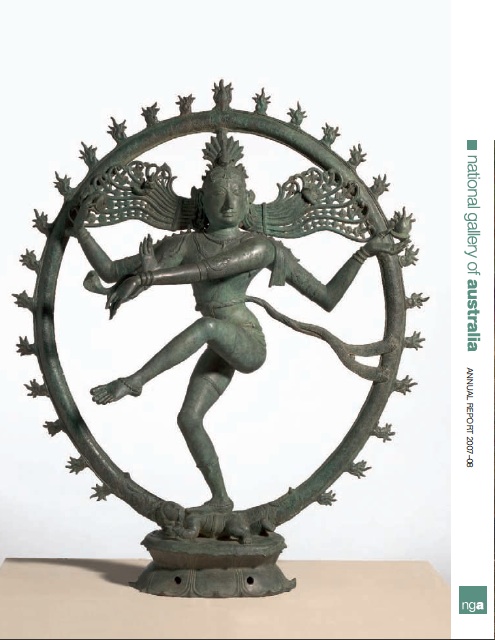
The National Gallery of Australia is finding itself being asked serious questions about its acquisition policies. At the heart of fuss is the bronze sculpture of Shiva as Lord of the Dance, acquired in 2008 with the assistance of National Gallery of Australia Foundation. The bronze appears on the back cover of the Annual Report of the NGA.

Michaela Boland ("NGA admits buying from disgraced dealer", The Weekend Australian August 4, 2012) noted
The National Gallery of Australia has admitted to acquiring 21 items from disgraced New York antiquities dealer Subhash Kapoor, who was arrested on an Interpol warrant and extradited to India, where he is being held on suspicion of trading in stolen precious artefacts. 
Among $11 million worth of antiquities Kapoor has so far admitted to trading is a large 900-year old bronze sculpture of the Indian god Shiva, which the Canberra gallery bought in 2008 and displayed prominently on the back cover of its annual report that year.
The museum seems reluctant to comment:
Gallery director Ron Radford, who was director when the statue was acquired, declined to answer questions from The Weekend Australian about the discovery or say how the gallery would address the concerns of the collecting community.
The NGA now needs to present its due diligence process and to demonstrate that the Shiva had a recorded history that could be recorded back to at least 1970.

Bookmark and Share so Your Real Friends Know that You Know

Australia and Indian antiquities

I have already noted the issue of recently surfaced Indian antiquities in North America. It is now reported that dealer Subhash Kapoor supplied six Indian objects to the Art Gallery of New South Wales ("Shady dealer sold art to AGNSW", The Australian August 6, 2012).

Among the pieces reported to be from Kapoor is a stela from West Bengal showing Varaha "rescuing the earth goddess" (inv. 164.1999). This was "Purchased with funds provided by the Art Gallery Society of New South Wales 1999". Two other pieces had been purchased in 1994, and another also in 1999.

The Director of AGNSW is Dr Michael Brand whose comments drew attention to the way that looting "destroyed the evidence used by archaeologists to build stories"..

This new revelation follows news that Kapoor also sold material to the National Gallery of Australia in Canberra. The NGA said that the acquisition of the objects was subject to a "thorough due diligence process".

The Australian makes a major point "about the lack of thorough research conducted by Australia's collecting institutions when accepting gifts and buying works".

I have had caused elsewhere to note the display of classical material in Australian collections.

Bookmark and Share so Your Real Friends Know that You Know

Eagerly waiting for bailout


The Independent Movement for the Repatriation of Looted Greek Antiquities [website] has produced a video about the return of the Caryatid removed from the Erechtheion on the Athenian acropolis.

I went to see the London Caryatid last month, tucked away behind the Lydian monuments in a cul de sac created by the closure of the Halikarnassos gallery.

Is it time for this architectural sculpture to be reunited with the other elements of the building?

Bookmark and Share so Your Real Friends Know that You Know

Thursday, 2 August 2012

'Not Praising, Burying': Cambridge Workshop

The acquisition of figure-decorated Greek pottery by museums and its display alongside fine art raises certain issues about the ancient status of such ancient objects. Even Athenian pots attributed to "high status" artists can be shown (from ancient trademarks) to have had relatively low status. So when a museum pays $1 million for an Athenian krater, does it distort our perception of ancient "art"?

Issues such as this were explored in Artful Crafts, co-authored with Professor Michael Vickers, formerly of the Ashmolean Museum, Oxford.

A workshop on the theme will be held at the Fitzwilliam Museum, Cambridge on Friday 2 November. Details are available from the McDonald Institute website.
A workshop/symposium, to be understood as an artwork, that brings together archaeology, art practice, art history, philosophy, classics and history to interrogate assumptions about status, art and culture through classical Greek pottery will take place at the Fitwilliam Museum. This talk will describe this type of art practice and its processes. A few of the workshop participants including artist and Arts and Humanities Research Council Fellow in the Creative and Performing Arts with the Museum of Archaeology and Anthropology, University of Cambridge, Alana Jelinek, archaeologist David Gill, and Kettles Yard's Sarah Campbell will present their impressions.
The following week (Thursday 8 November, 5.30 - 7.00 pm) there will be a discussion:
Alana Jelinek and Prof David Gill plus other participants will discuss the workshop process and the potential for relationships between art and archaeology and the potential of this methodology for art practice.

Bookmark and Share so Your Real Friends Know that You Know

Wednesday, 1 August 2012

Suffolk Treasure in a Dust-cart

Detail of Mildenhall Great dish © David Gill
I was discussing the display of the Mildenhall Great Dish with Dr John Blatchly earlier today. Blatchly asked me if I had read his piece in the East Anglian Daily Times ("Treasure borne by dust-cart", July 21, 2012).

Apparently the Mildenhall Treasure was removed from Ipswich to the British Museum in an Ipswich Borough Council dust-cart, escorted by William Goldsmith, the superintendent of the refuse service. It appears that this was to foil any attempt to steal the treasure between the two museums.

Bookmark and Share so Your Real Friends Know that You Know

Another Bürki object returns to Italy

Source: MMA A psykter column-krater attributed to the Troilos painter was deaccessioned by New York's Metropolitan Museum of Art in June...