- Julia Weiler-Esser, The New German Act on the Protection of Cultural Property: A Better Protection For Archaeological Heritage in Germany and Abroad?, pp. 3-10
- Uche Uwaezuoke Okonkwo & Omon Merry Osiki, Global Art Traffi cking and the Nigerian Experience: A Historical Analysis, pp. 51-55
- Christos Tsirogiannis, Nekyia. Unethical Actions, Inactions and Reactions by the Museum and Market Community to the Seizure of the Met’s Python Krater, pp. 65-68.
- David W. J. Gill, Context Matters. Recently surfaced antiquities: ignoring the evidence?, pp. 69-73.
- Jehane Regai, Fake Art on the Rise in Egypt, pp. 75-79.
- Christos Tsirogiannis, The Metropolitan Museum of Art and Illicit Antiquities in New York, p. 81.
- David Gill reviews Tiffany Jenkins, Keeping Their Marbles: How the Treasures of the Past Ended up in Museums … And Why They Should Stay There, pp. 87-90.
Discussion of the archaeological ethics surrounding the collecting of antiquities and archaeological material.
Thursday, 4 January 2018
Journal of Art Crime 2017: overview
The latest number of the Journal of Art Crime 18 (Fall 2017) has been published. There are a number of papers relating to antiquities:
Wednesday, 3 January 2018
London auctions to 2017: Christie's
Unlike the sale of antiquities in New York, Christie's has seen a growth in its sale of antiquities in London. Sales grew from £5.5 million to £7 million in 2017. This is still less than the amount realised in 2014.
However this figure for 2017 is lower than the £7.4 million for Sotheby's in London for the same year.
Tuesday, 2 January 2018
New York auctions to 2017: Christie's
This is the time of year that I try to give an overview of the auction of antiquities on the New York market (see January 2017). This year I am only returning the sales from Christie's in New York. This is the seventh year of decrease for the sale of antiquities, and the value for 2017 ($8.6 million) is only slightly better than that for 2007 ($7.9 million). This is perhaps reflecting the move of the sale of antiquities from New York back to London, worth some £7.5 million (between Christie's and Sotheby's).
Monday, 1 January 2018
Looting Matters: Looking Ahead to 2018
![]() |
| ©David Gill |
In the UK the DCMS has made it clear that it wants to work more closely with the heritage community (and this will be covered on the companion blog, 'Heritage Futures', co-written with Professor Ian Baxter). The impact of metal-detecting on scheduled and unrecorded sites continues to give some archaeological groups in the UK a cause for concern.
I would be surprised if objects known from the Medici, Becchina and Symes archives do not surface on the antiquities market. These cases now seem to be met with co-operation, perhaps tinged with resignation, by those linked to the market. It would be good to see those in the market adopting a more enhanced due diligence process.
Historic cases can drop of the agenda. It would be good to see the Michael C. Carlos Museum at Emory University negotiating the return of three disputed items with the Hellenic authorities.
There is likely to be renewed emphasis on the intellectual consequences of looting. How does the acquisition of looted archaeological material have an impact on the understanding of the past? This includes work on the problem of forged antiquities.
LM is always grateful to its readers for feedback, suggestions and comments.
Friday, 29 December 2017
Looting Matters: looking back on 2017
![]() |
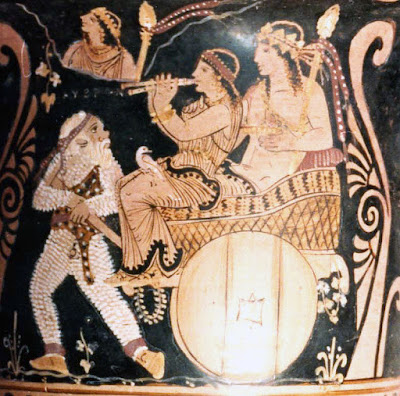
| Detail of Paestan krater Source: Dr Christos Tsirogiannis |
Seizures
The year started with the news of several thousand seizures in a Europe wide Operation Pandora. A major set of seizures were made on the collection formed by the Hobby Lobby.
Smaller seizures included sculptures from Eshmun in the Lebanon, and a fragment of a Persepolis relief.
A head of Drusus Minor was returned to Italy from the Cleveland Museum of Art after it was realised that it had come from a known excavation and had been removed from the archaeological store.
A series of objects were seized from an unnamed Manhattan gallery (Sardinian warrior, Paestan lekythos, Apulian kantharos from the 'J.M.E. collection'). Another seizure included an Attic red-figured lenythos that had formed part of the Kluge collection. An Attic red-figured amphora was seized from a Manhattan gallery after it was recognised from the Becchina archive. A sarcophagus was seized from a Manhattan gallery.
Fragments of a Roman sarcophagus from outside Rome were seized on Sardinia.
Hungary has purchased further part of the Sevso Treasure.
Surfacings
There have been several sightings of objects identified from the photographic archives. They include:
- Marble funerary markers (Becchina)
- Marble stele (Becchina)
- Attic red-figured cup (Medici)
- Attic red-figured skyphos in Toledo (Medici)
- a marble athlete (Symes)
- Scythian silver rhyton, Scythian moose, and Roman portrait head (Symes and Medici)
Metal-detecting
The police are acknowledging that there is an issue relating to illegal metal-detecting in East Anglia. An example of such activity was noted for Weeting Castle. The number of Treasure Finds in the UK has increased. The revised code of practice for metal-detecting has been issued.
Reviewing old cases
Although looting continues to be a problem, it is important to look back at historic cases that have yet to be resolved. They include the series of Roman imperial portraits looted from Bubon in Turkey and now in North American and European collections.
The process of how looted antiquities were acquired by museums and private collectors continues to be researched. One of the key figures in the acquisition of objects by the J. Paul Getty Museum was was Fritz Bürki. Until the full histories of the objects are disclosed a question mark must remain over the objects.
The Michael C. Carlos Museum at Emory University has yet to resolve the case of three disputed items that have been identified in the Greek press.
Forgeries
Forgeries continue to corrupt the market and provide false information about 'ancient art'. The problem of forging Anatolian sculptures has been discussed.
Monday, 18 December 2017
Responsible metal-detecting: a revised code of practice
![]() |
| © David Gill |
The endorsements of the revised code are notable by the absence of certain organisations:
- Amgueddfa Cymru - National Museum of Wales / PAS Cymru,
- Association of Local Government Archaeological Officers,
- British Museum / Portable Antiquities Scheme,
- Chartered Institute for Archaeologists,
- Council for British Archaeology,
- Country Land & Business Association,
- Institute for Archaeology (University College London),
- Historic England,
- National Farmers Union,
- Royal Commission on the Historical & Ancient Monuments of Wales,
- Society of Museum Archaeologists.
We are reminded that "being responsible" means:
Working on ground that has already been disturbed (such as ploughed land or that which has formerly been ploughed), and only within the depth of ploughing. If detecting takes place on pasture, be careful to ensure that no damage is done to the archaeological value of the land, including earthworks. Avoid damaging stratified archaeological deposits (that is to say, finds that seem to be in the place where they were deposited in antiquity) and minimise any ground disturbance through the use of suitable tools and by reinstating any ground and turf as neatly as possible.This is a timely reminder as we approach the third anniversary of the removal of the "Lenborough Hoard". Members of PAS could, perhaps, address the five points highlighted by the Lenborough case.
Tuesday, 5 December 2017
An athlete, Robin Symes and the Paris market
![]() |
| Source: Schinoussa archive Courtesy: Dr Christos Tsirogiannis |
The history of the statue is provided:
- Royal Athena Galleries, New York: Art of the Ancient World 4 (1995), p.75-76, lot n°236.
This does not explain why the statue appeared in the confiscated Symes archive.
Tsirogiannis has also spotted that the statue surfaced at Sotheby's in London Sotheby's on 5th of July 1982. lot 397. Who consigned the statue to that sale? Why does the Paris description fail to mention the Sotheby's information? Would it raise questions about how it surfaced?
Where was the statue between 1982 and 1995?
I understand that the French authorities have been informed about the sale.
Where was the statue between 1982 and 1995?
I understand that the French authorities have been informed about the sale.
Subscribe to:
Posts (Atom)
Another Bürki object returns to Italy
Source: MMA A psykter column-krater attributed to the Troilos painter was deaccessioned by New York's Metropolitan Museum of Art in June...
-
Source: Sotheby's A marble head of Alexander the Great has been seized in New York (reported in " Judge Orders Return of Ancien...
-
Source: ICE. There are times when you wonder if there is a lack of imagination when it comes to naming operations but 'Mummy's C...
-
Detail of the Sophilos dinos © David Gill The Sophilos dinos in the British Museum has been reconstructed from approximately 50 fragments. I...


