Tuesday, 20 December 2022

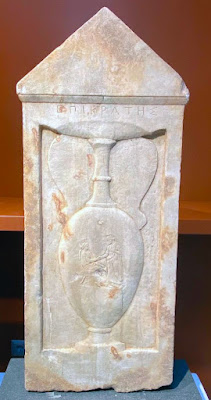
Funerary stele returned to Greece

Stele revealed at the Epigraphic Museum
Athens
It is reported that today, December 20, 2022, that a funerary stele for one Epikrates has been returned to Greece. The stele is stated that it was due to have been offered through Christie's in London (December 2021) but was identified from three photographs in the Becchina archive and was withdrawn after intervention by the Art Squad of the Metropolitan Police. Incidentally, the stele was said to have been handled by Koutoulakis, a name that should have raised concerns. 

These three photographs were considered to be sufficient evidence for the return. (I am grateful to Christos Tsirogiannis for sharing the images with me.) Yet, when photographs of a Cycladic figure were identified with a piece residing in the Stern Collection there appears to have been a reluctance for the Greek authorities to seek the immediate return. Indeed there is currently an exhibition, 'Homecoming', at the Museum of Cycladic Art in Athens that contains 15 Cycladic pieces from the Stern Collection. I understand that questions relating to this inconsistency of policy were asked at the press conference today but were deflected by the Minister. 

| |
Bookmark and Share so Your Real Friends Know that You Know

Saturday, 10 December 2022

The Forger's Tale


Our latest study on forgeries and the corpus of Cycladic figures is now available from the International Journal of Cultural Property.

Tsirogiannis, C., D. W. J. Gill, and C. Chippindale. 2022. "The Forger’s tale: An insider’s account of corrupting the corpus of Cycladic figures." International Journal of Cultural Property: 1-17 [Web].

Abstract

Many of the known Cycladic figures – the late prehistoric human-shaped sculptures from the Aegean archipelago – came from twentieth-century illicit excavations, especially in the 1960s and 1970s. It is also known that figures were being faked at the time and perhaps also earlier: a few fakes have been identified, whilst other figures are under suspicion. Interviews with a man who faked Cycladic figures in the 1980s and 1990s give us a first insider’s autobiographical account of the forging business. This article offers, step-by-step, the method that two forgers developed to create fake figures, to treat them so that they appeared ancient, and to sell them on. The forger has identified a few of these forgeries from photographs of figures; his story is consistent with other information and seems to ring true. By verifying various elements in the forger’s testimony – from names of well-known figures in the modern antiquities market to small details and dates – we have been able to evaluate the validity of the narrative; to use it in order to uncover the true paths that fake objects followed into various collections; and to highlight valuable provenance information that no one involved in trading these objects was ever willing to provide.

| |
Bookmark and Share so Your Real Friends Know that You Know

Monday, 5 December 2022

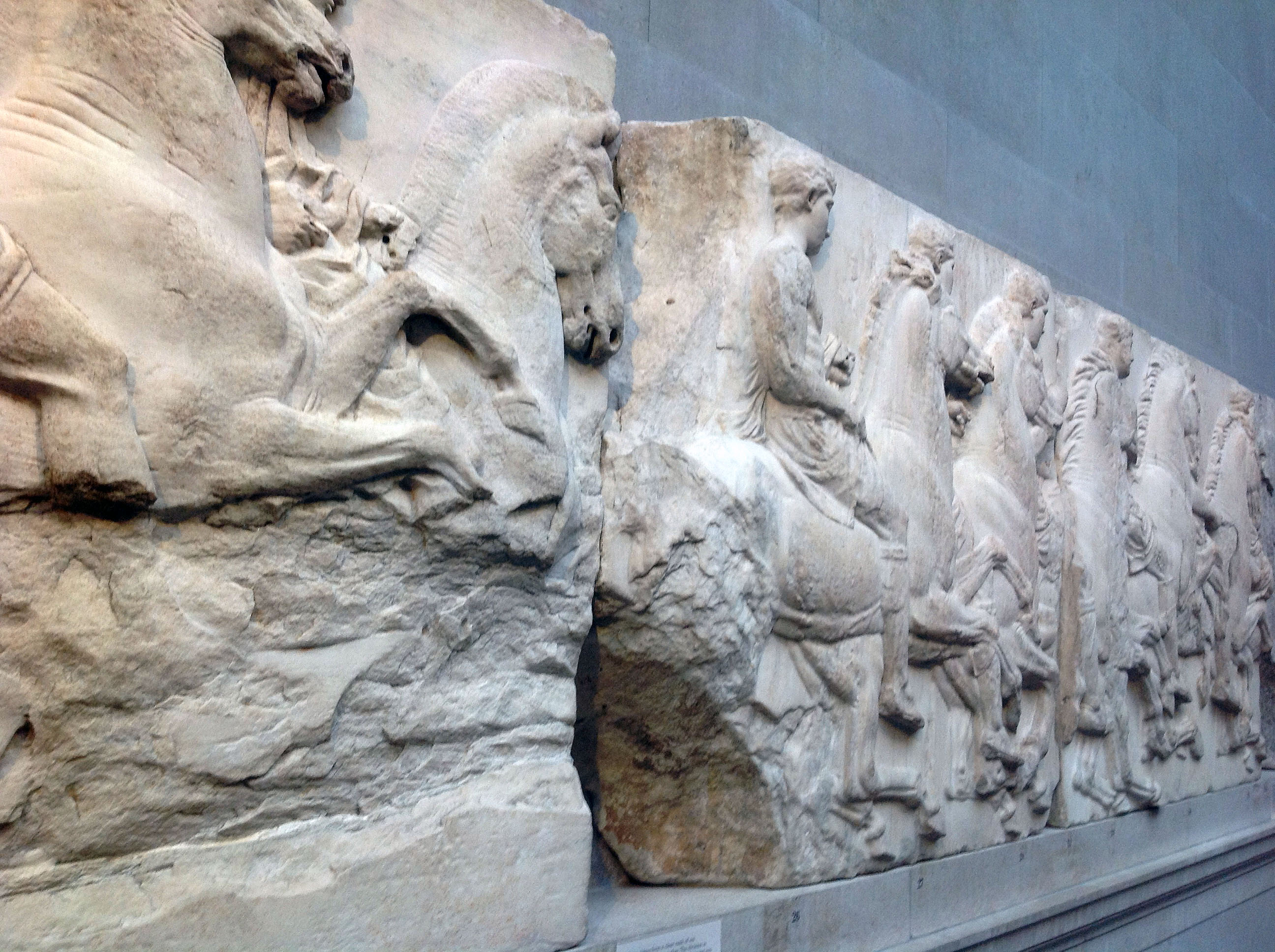
UK Prime Minister's Position on Parthenon Sculptures Clarified

Part of the Parthenon frieze in the British Museum © David Gill


The British Museum is reported to be in an advanced state of discussion with the Greek authorities over the architectural sculptures originally created for the Parthenon on the Athenian Acropolis (Katie Razzall, "Deal to return Elgin Marbles to Greece at advanced stage - reports", BBC News December 3, 2022). Discussions have been taking place between George Osborne, the chair of the British Museum, and Kyriakos Mitsotakis, the Greek Prime Minister. More recent reports suggest that agreement is far from close ("Greece, Britain discussing Parthenon Marbles return but deal not close", ekathimerini.com December 5, 2022). It notes the UK Government position:
Asked about British Prime Minister Rishi Sunak’s position on their return, a spokesman said Britain had no plans to change laws which prevent removing objects from the collection apart from in certain circumstances. 
 “Our position on this hasn’t changed. Decisions relating to the care and management of the collections are a matter for the museum and its trustees,” the spokesman said.
It should be remembered that the UK Government compiled a substantial report on the Parthenon sculptures. This is discussed in:
Gill, D. W. J., and C. Chippindale. 2002. "The trade in looted antiquities and the return of cultural property: a British parliamentary inquiry." International Journal of Cultural Property 11: 50-64. [DOI]
The sculptures form an integral part of the main temple that is part of the UNESCO World Heritage Site. 

| |
Bookmark and Share so Your Real Friends Know that You Know

Saturday, 3 December 2022

Identifications at Sotheby's in London

Image from the Becchina archive courtesy of Christos Tsirogiannis

Professor Christos Tsirogiannis has identified three objects from the Becchina, Medici and Symes archives that were due to be auctioned at Sotheby's in London on December 7, 2022. His identifications are covered in a report by Dalya Alberge, "Archaeologist urges Sotheby’s to cancel auction of ‘illicit’ artefacts", Daily Telegraph December 3, 2022.

Take for example the Roman bronze protome spout in the form of a dog or spout (lot 121). The history of the piece is provided:
  • Swiss private collection 
  • Royal-Athena Galleries, 
  • New York John W. Kluge, acquired from the above in 1989 (Christie's, New York, The Morven Collection of Ancient Art, December 10th, 2004, no. 590, illus.)
Notice on the image the annotation 'V[ia]/Jer[ome Eisenberg]' confirming the link with the Royal-Athena Galleries. The image is taken from the Becchina archive and records show that it was derived from Mario Bruno. Presumably one of these two sources is to be identified as the 'Swiss private collection'.

In the report in the Telegraph it is noted:
A Sotheby’s spokesman said that they “uphold the highest standards of due diligence”.
How did Sotheby's conduct a rigorous due diligence test on the anonymous Swiss private collection? Had they considered the possibility that Becchina or another such individual was the origin? 

Royal-Athena Galleries should also have raised an alert. Only in November three antiquities from this source were returned to Turkey: e.g. silver Apollo. Or in July this year an Attic krater from the Gallery was returned to Italy. This was among 60 antiquities from Royal-Athena Galleries. Again, had Sotheby's taken this into account as part of their rigorous due diligence process? 

In May 2017 a Paestan lekythos was provided with a nearly identical history to the bronze spout. Did this raise concern? Indeed it is clear that the Kluge collection has been linked to several antiquities that have been returned to Italy. This in itself should have alerted those preparing the catalogue entry for Sotheby's.

Will Sotheby's in London tighten up its processes? Is there a need to raise the standard of the due diligence approach to a more rigorous level?


| |
Bookmark and Share so Your Real Friends Know that You Know

Apulian Dinos Seized from NYC Private Collection

Source: Manhattan DA.

It seems that another piece displayed in the exhibition, Glories of the Past, was seized from a NYC private collection in June 2021 (though the information has only just been made available). The object is an Apulian dinos attributed to the painter of Louvre MNB 1148 (Glories no. 128). The catalogue entry by Dietrich von Bothmer notes that the dinos 'has been broken into many fragments and repaired'. Who restored the piece?

This adds to the 14 other pieces from the exhibition that have been returned to Greece, Italy or Turkey.

I am grateful to Jason Felch for pointing me in the direction of the relevant Search Warrant. 

| |
Bookmark and Share so Your Real Friends Know that You Know

Friday, 2 December 2022

The Bubon statue in the Cleveland Museum of Art

Imperial bronze in Cleveland Museum of Art
Source: Open Access

In 1986 the Cleveland Museum of Art acquired a bronze statue (Inv. 1986.5). It had previously resided in the collection of Mr & Mrs Charles Lipson of Boston (Mass.). The Lipsons were also the owners of the bronze statue of Lucius Verus that has been returned to Turkey from the Shelby White collection. Both statues are reported to have the same findspot: 'reported to be from Ibecik (ancient Bubon in Lycia), Turkey' (Fire of Hephaistos no. 50; fig. 2 under no. 54). 

Will the Cleveland Museum of Art be contacting Turkish authorities to arrange the return of this statue? 

A discussion of the issues for this statue can be found on Chasing Aphrodite.


| |
Bookmark and Share so Your Real Friends Know that You Know

$24 million worth of antiquities reported to have been seized from NYC collector

Source: BusinessTurkeyToday.com

I understand that back in April this year 18 antiquities valued at $24.393 million were seized from a New York private collection. The most valuable was a bronze statue of Lucius Verus valued at $15 million, followed by an Attic red-figured calyx-krater and a bronze bust, each valued at $3 million. Some of these items had been displayed in an exhibition, Glories of the Past, at New York's Metropolitan Museum of Art. Two of the seized items have been returned to Turkey, and others to Italy: it is unclear if and when one or more of the items will be returned to Greece.

The Art Newspaper revealed today that the objects formed part of the Shelby White collection (Claire Voon, "Looted antiquities returned to Turkey and Italy were seized from New York home of Met trustee Shelby White", December 2,  2022).

Source: Manhattan DA.


I grateful to Jason Felch for assistance with this post, and to Christos Tsirogiannis who made many of the identifications. 

| |
Bookmark and Share so Your Real Friends Know that You Know

A volute-krater with a "tremendous provenance"

A volute-krater attributed to the Syriskos painter by J.R. Guy (see BAPD 44988) is said by Michael Padgett to have been found with a psykter...