Saturday, 6 January 2018

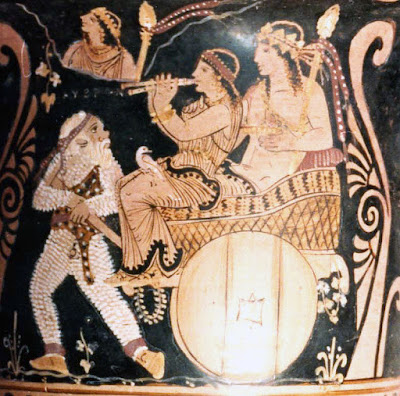
Steinhardt seizure in Manhattan

Source: Manhattan District Attorney's Office

It has been reported that at least nine antiquities were seized from the Manhattan apartment of Michael H. Steinhardt (James C. McKinley Jr., "Looted Antiques Seized From Billionaire’s Home, Prosecutors Say", New York Times January 5, 2018). The pieces included:

  • a Protocorinthian owl
  • a Protocorinthian duck
  • an Ionian ram's head
  • an Attic white-ground lekythos
  • an Attic aryballos
  • an Apulian head vase
The Attic lekythos is likely to have come from a funerary context in Attica, and should therefore be linked to activity in Greece. 

Steinhardt has been linked to material from Eshmun in the Lebanon, a gold phiale from Sicily, a tomb fragment from Paestum, a Sardinian figure, and a Faliscan askos

Which dealers were the sources for these seized objects? Are these derived from Robin Symes?


Bookmark and Share so Your Real Friends Know that You Know

Friday, 5 January 2018

The Eulenbruch honorific statue

New York, Metropolitan Museum of Art inv. 2001.443
© David Gill
The history of objects in collections are fascinating: the movement of objects between different owners. This bronze honorific statue was received by the Metropolitan Museum of Art as a partial gift from Renée E. and Robert A. Belfer in 2001, with the remainder in 2010 [online catalogue entry].

The MMA's catalogue entry (2007)  [no. 212] dates the figure to the mid-2nd–1st century BC, and identifies it as an honorific statue of a "prominent" individual. The city where this statue was erected is now unknown, although the online entry (but not the print catalogue) notes that it was "said to have come from Syria". The authority for this statement is not provided.

Paul Zanker, in his Roman Portraits: Sculptures in Stone and Bronze in the Collection of The Metropolitan Museum of Art (2016) no. 3, identifies the figure as an orator and dates it to c. 50–30 BC. Zanker observes that the folds of the drapery contain "many traces of soil" suggesting to him that the figure comes from "an excavation". The so-called excavation is not likely to have been a scientific one, or the statue would have been known. One also wonders why a statue that has been out of the ground for so long is presented as if it is fresh out of the ground. There is no mention of any analysis of the soil that could perhaps have given an indication of the findspot. Zanker suggests that the statue "presumably" was found in "western Turkey or neighbouring Syria". Does Zanker reject the MMA's view that the statue was (said to have been) derived from Syria?

The statue was purchased from Phoenix Ancient Art in 2001, the same year that it was donated (anonymously) to the MMA.

Phoenix Ancient Art has been the source of some other notable pieces:
  • The head of Drusus Minor acquired by the Cleveland Museum of Art, and now returned to Italy after it was shown to have been removed from an archaeological store; it had been provided with a history that had placed it in Algeria in the 19th century.
  • The Leutwitz Apollo acquired by the Cleveland Museum of Art; the bronze statue had been provided with a history that had placed it in Leutwitz before the Second World War. A discussion of the history can be found here.
  • The Egyptian mummy case excavated (and published) at Saqqara in 1952, and was acquired by the St Louis Art Museum; it was provided with a history that placed it in a dealer's gallery in Brussels. The full history can be found here.
It is also important to remember the Etruscan architectural terracotta that was returned to Italy from the Princeton University Art Museum. 

It is claimed both by the MMA's online catalogue entry and in Zanker, that the statue was "Reported to be the property of A. Weber of Eulenbruch, near Cologne, Germany, from the late 1970s". The word reported suggests that there is no actual authenticated evidence that it did indeed come from Herr Weber, otherwise the entry would have said something like this, "Formerly the property of ...". 

The MMA felt that it could make the further acquisition in 2010 as it had received "part" of the statue as a gift in 2001. (See the AAMD Guidelines for 2008.) The exception made was: "The work was accepted as a partial gift in 2001 and has been exhibited publicly since 2007. Such over life-size bronze statues are extremely rare, especially ones of the quality of this piece. It represents a major class of Hellenistic honorific statuary not otherwise represented in the Museum’s collection."

The history of this bronze statue in the period before 2001 appears to be unconfirmed. Should the MMA reveal the nature of its due diligence process prior to the acquisition of the bronze?


Bookmark and Share so Your Real Friends Know that You Know

Thursday, 4 January 2018

Journal of Art Crime 2017: overview

The latest number of the Journal of Art Crime 18 (Fall 2017) has been published. There are a number of papers relating to antiquities:
  • Julia Weiler-Esser, The New German Act on the Protection of Cultural Property: A Better Protection For Archaeological Heritage in Germany and Abroad?, pp. 3-10
  • Uche Uwaezuoke Okonkwo & Omon Merry Osiki, Global Art Traffi cking and the Nigerian Experience: A Historical Analysis, pp. 51-55
  • Christos Tsirogiannis, Nekyia. Unethical Actions, Inactions and Reactions by the Museum and Market Community to the Seizure of the Met’s Python Krater, pp. 65-68.
  • David W. J. Gill, Context Matters. Recently surfaced antiquities: ignoring the evidence?, pp. 69-73.
  • Jehane Regai, Fake Art on the Rise in Egypt, pp. 75-79.
  • Christos Tsirogiannis, The Metropolitan Museum of Art and Illicit Antiquities in New York, p. 81.
  • David Gill reviews Tiffany Jenkins, Keeping Their Marbles: How the Treasures of the Past Ended up in Museums … And Why They Should Stay There, pp. 87-90.

Bookmark and Share so Your Real Friends Know that You Know

Wednesday, 3 January 2018

London auctions to 2017: Christie's

Unlike the sale of antiquities in New York, Christie's has seen a growth in its sale of antiquities in London. Sales grew from £5.5 million to £7 million in 2017. This is still less than the amount realised in 2014.

However this figure for 2017 is lower than the £7.4 million for Sotheby's in London for the same year.

Bookmark and Share so Your Real Friends Know that You Know

Tuesday, 2 January 2018

New York auctions to 2017: Christie's


This is the time of year that I try to give an overview of the auction of antiquities on the New York market (see January 2017). This year I am only returning the sales from Christie's in New York. This is the seventh year of decrease for the sale of antiquities, and the value for 2017 ($8.6 million) is only slightly better than that for 2007 ($7.9 million). This is perhaps reflecting the move of the sale of antiquities from New York back to London, worth some £7.5 million (between Christie's and Sotheby's).

Bookmark and Share so Your Real Friends Know that You Know

Monday, 1 January 2018

Looting Matters: Looking Ahead to 2018

©David Gill
I attended the APPG on Cultural Property at Westminster in December and it is clear that there will be an increasing emphasis on the protection of cultural property in time of war and conflict. It is clear that the Ministry of Defence is keen to engage with the academic community to understand the potential issues and sensitivities. I anticipate that there will be some additional discussion over archaeological material moving from Syria and northern Iraq to markets in Europe. 

In the UK the DCMS has made it clear that it wants to work more closely with the heritage community (and this will be covered on the companion blog, 'Heritage Futures', co-written with Professor Ian Baxter). The impact of metal-detecting on scheduled and unrecorded sites continues to give some archaeological groups in the UK a cause for concern.

I would be surprised if objects known from the Medici, Becchina and Symes archives do not surface on the antiquities market. These cases now seem to be met with co-operation, perhaps tinged with resignation, by those linked to the market. It would be good to see those in the market adopting a more enhanced due diligence process.

Historic cases can drop of the agenda. It would be good to see the Michael C. Carlos Museum at Emory University negotiating the return of three disputed items with the Hellenic authorities.

There is likely to be renewed emphasis on the intellectual consequences of looting. How does the acquisition of looted archaeological material have an impact on the understanding of the past? This includes work on the problem of forged antiquities.

LM is always grateful to its readers for feedback, suggestions and comments.

Bookmark and Share so Your Real Friends Know that You Know

Friday, 29 December 2017

Looting Matters: looking back on 2017

Detail of Paestan krater
Source: Dr Christos Tsirogiannis
My predictions for 2017 make a good introduction: further seizures as a result of the photographic archives, heritage crime at archaeological sites in the UK, and moves in Westminster to address the protection of cultural property in time of war. I have not covered the latter on LM as some of the discussions are sensitive.

Seizures
The year started with the news of several thousand seizures in a Europe wide Operation Pandora. A major set of seizures were made on the collection formed by the Hobby Lobby.

Smaller seizures included sculptures from Eshmun in the Lebanon, and a fragment of a Persepolis relief.

A head of Drusus Minor was returned to Italy from the Cleveland Museum of Art after it was realised that it had come from a known excavation and had been removed from the archaeological store.

A series of objects were seized from an unnamed Manhattan gallery (Sardinian warrior, Paestan lekythos, Apulian kantharos from the 'J.M.E. collection'). Another seizure included an Attic red-figured lenythos that had formed part of the Kluge collection. An Attic red-figured amphora was seized from a Manhattan gallery after it was recognised from the Becchina archive. A sarcophagus was seized from a Manhattan gallery.

Fragments of a Roman sarcophagus from outside Rome were seized on Sardinia.

Hungary has purchased further part of the Sevso Treasure.

Surfacings
There have been several sightings of objects identified from the photographic archives. They include:

A Paestan krater was returned by New York's Metropolitan Museum of Art, and a marble Zeus sold by the Fleischmans to the J. Paul Getty Museum was handed over.

Metal-detecting
The police are acknowledging that there is an issue relating to illegal metal-detecting in East Anglia. An example of such activity was noted for Weeting Castle. The number of Treasure Finds in the UK has increased. The revised code of practice for metal-detecting has been issued.

Reviewing old cases
Although looting continues to be a problem, it is important to look back at historic cases that have yet to be resolved. They include the series of Roman imperial portraits looted from Bubon in Turkey and now in North American and European collections.

The process of how looted antiquities were acquired by museums and private collectors continues to be researched.  One of the key figures in the acquisition of objects by the J. Paul Getty Museum was was Fritz Bürki. Until the full histories of the objects are disclosed a question mark must remain over the objects.

The Michael C. Carlos Museum at Emory University has yet to resolve the case of three disputed items that have been identified in the Greek press.

Forgeries
Forgeries continue to corrupt the market and provide false information about 'ancient art'. The problem of forging Anatolian sculptures has been discussed.

Bookmark and Share so Your Real Friends Know that You Know

Another Bürki object returns to Italy

Source: MMA A psykter column-krater attributed to the Troilos painter was deaccessioned by New York's Metropolitan Museum of Art in June...