Thursday, 16 December 2021

Almagià and the Steinhardt Collection

The papers listed the material from the Steinhardt collection that is due to be 'surrendered' includes objects that had been handled by Edoardo Almagià.  

  • Four Etruscan terracotta panels (p. 48). Apparently surfaced in 1993 (newspaper in photograph); purchased by Steinhardt for $155,000 in August 2001. 
  • An Etruscan terracotta antefix with Maenad, from Cerveteri (pp. 48–49). Purchased from a tombarolo for $2,000; purchased by Steinhardt for $10,000 in August 2001.
  • Etrusco-Corinthian aryballos in the shape of a helmeted head (pp. 49–50). Purchased by Steinhardt for $5,000 in November 1998.
  • Attic black-figured amphora (p. 50). Purchased from a tombarolo for $6,500, and sold for $13,000; purchased by Steinhardt in 1997.
  • Two Archaic Faience Aryballoi (pp. 50–51). Apparently purchased from a tombarolo; purchased by Steinhardt for $12,000 in February 1996.
  • Faience Baboon (p. 51). Invoice from February 1996; purchased by Steinhardt for $9,000 in February 1996.
For further objects associated with Almagià:

Bookmark and Share so Your Real Friends Know that You Know

Thursday, 9 December 2021

The surrendered Steinhardt collection and the Medici dossier

Left: Medici Dossier, courtesy of Christos Tsirogiannis
Right: New York State District Attorney Office 
Research by Associate Professor Christos Tsirogiannis has made innumerable identifications of objects from the Medici Dossier. The paperwork for the Steinhardt collection makes it clear how many items had passed before the Polaroid camera of that source.

The items include:
  • Etruscan togate figure, from Perugia (pp. 16–17).
  • Two bronze figures of Pegasus (pp. 17–18).
  • Villanovan helmet (pp. 18–19).
  • Two Etruscan terracotta panels, from Cerveteri (pp. 19).
  • Attic sphinx cup, Tleson (pp. 19–20).
  • Oinochoe attributed to the Berlin painter (pp. 20–21)
  • Attic Leagros hydria (pp. 21–22).
  • Attic Antimenes hydria (pp. 22–23).
  • Attic head vase (pp. 23–24).
  • Protocorinthian duck (p. 24).
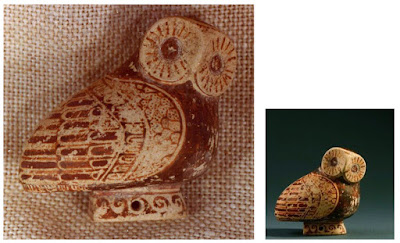
  • Protocorinthian owl (pp. 24–25).
  • Ionian ram's head (p. 25).
  • Corinthian bull's head (pp. 25–26).
  • Corinthian lion vessel (p. 26).
  • Faliscan askos (p. 27).
  • Four marble oscilla (p. 27)
  • Cycladic spouted bowl (p. 28).
It is a reminder that the 'Medici Conspiracy' continues to make an impact on cultural property issues.
| |
Bookmark and Share so Your Real Friends Know that You Know

Wednesday, 8 December 2021

Returning Athenian pottery from the Steinhardt collection

Source: Manhattan District Attorney's Office

The documentation for the Michael Steinhardt  collection identifies several Attic pieces that will be returned to their country of origin, presumably Italy and Greece.
  • Attic black-figured Sphinx cup, 'Tleson, son of Nearchos' (pp. 19–20). Identified from the Medici dossier. Symes sold to Beierwaltes (January 8, 1996); Phoenix Ancient Art (2006); Steinhardt purchased from Phoenix Ancient Art for $310,000 (2007).
  • Attic red-figured oinochoe attributed to the Berlin painter (pp. 20–21). Identified from the Medici dossier. Steinhardt purchased from Harry Bürki for $215,000 (1996); Steinhardt's records show that the oinochoe had been sold by Robert Hecht.
  • Attic black-figured hydria showing Herakles and Kyknos attributed to the Leagros group (p. 21).  Identified from the Medici dossier. Displayed by Christos Bastis at New York's Metropolitan Museum of Art (1987); Bastis died (1999); Steinhardt purchased from Michael Ward for $127,000 (2000). The paperwork omits that the hydria surfaced at Sotheby's (London) July 11–12, 1983, lot 352, and was sold at Sotheby-Parke-Bernet, New York, December 9, 1999, lot 92. [BAPD 9050]
  • Attic black-figured hydria showing women at a fountain-house attributed to the Antimenes painter (pp. 22–23). Identified from the Medici dossier. Robin Symes advertised the hydria (1983); Atlantis Gallery, New York (1987); loan to the J. Paul Getty Museum L87.AE.4 (1987–96); Steinhardt purchased it at Sotheby's for $169,411 (December 17, 1996, lot 49). [BAPD 31596]
  • African head vase (pp. 23–24).  Identified from the Medici dossier.  Displayed in the Musée d'Art et d'Histoire, Geneva (1978–81); J. Paul Getty Museum (1984–96); Symes sold the piece to the Beierwaltes (1996); Beierwaltes consigned it to Phoenix Ancient Art (2006); Steinhardt purchased it from Phoenix Ancient Art for $163,312.50 (2009). 
  • Attic black-figured eye-cup (pp. 35–36). Identified from the Becchina archive. Mario Bruno, Lugano; sold to Becchina; TL tested by Ralf Kotalla, Germany(July 1992); Robert Hecht sold it to Steinhardt for $170,750 (June 15, 2000).
  • Attic black-figured amphora (p. 50). Identified from the Almagià archive. Purchased from a tombarolo for $6,500; sold for $13,000; accessioned by Steinhardt as coming from Almagià (1997). 
  • Attic black-figured plemochoe (pp. 54–55). Identified from the Symes archive. Photographed by Dieter Widmer (1985); held as loan by Sotheby's London for Budico SA, owned by Henri-Albert Jacques (1989); stolen from Sotheby's and recovered by the police; Budico SA sold it through Sotheby's to Steinhardt for $84,083 (December 11, 2002). Note: 'Ex. Private Coll. London, RS + CM' (?Symes and Michaelides).
  • Attic white ground lekythos attributed to the Triglyph painter (p. 56). Identified from the Symes archive. Symes sold it to the Beierwalters for $360,000 (June 22, 1995); consigned to Phoenix Ancient Art (2006); Steinhardt purchased from Phoenix Ancient Art for $380,000 (December 14, 2006).
| |
Bookmark and Share so Your Real Friends Know that You Know

Tuesday, 7 December 2021

Reflecting on the Michael Steinhardt collection


The announcement that Michael Steinhardt has 'surrendered' 180 objects valued at $70 million is shocking. Tom Mashberg ("Michael Steinhardt, Billionaire, Surrenders $70 Million in Stolen Relics", New York Times December 7, 2021) has also reminded us:
Prosecutors said Mr. Steinhardt had owned and traded more than 1,000 antiquities since 1987.
Each of these objects has been removed from its archaeological context. Associations have been lost. Stratigraphy destroyed. Knowledge has been swept away and will never be recovered. 

There is cheer that these objects are being returned to their country of origin. Yet repatriation does not restore the archaeological knowledge. This debate has shifted back to the old question, 'Who Owns Antiquity?'

And Steinhardt stands in a line of private collectors, many based in New York, who have chosen to acquire recently surfaced antiquities and have turned a blind eye to the issue of looting. How did he think such objects—1,000 of them—had appeared on the market?

How many of these collectors have funded archaeological excavations? (Just think of how $70 million could have been spent.) And does support for field archaeology cancel out the destruction of those lost contexts? And what about associating the names of these benefactors with some of the great museums of the world? 

We should be concerned at the scale of the problem. But we should be more concerned about the intellectual consequences of so much destruction of the archaeological record. 

| |
Bookmark and Share so Your Real Friends Know that You Know

Ex Symes material on offer in London


Associate Professor Christos Tsirogiannis has identified two Etruscan bronze attachments that are being offered at Sotheby's, London, on December 7, 2021 (lot 68). The history of the pieces is rehearsed:
Mathias Komor, New York, inv. nos. I.514 and I.515 
Clarence Day, Memphis, acquired from the above on February 24th, 1978 (Sotheby's, New York, Antiquities from the Collection of the Late Clarence Day, December 7th, 2010, no. 15, illus.) 
acquired by the present owner at the above sale
Tsirogiannis made the identification for the bronzes in the Schinoussa archive thus showing that they had passed through the hands of Robin Symes.

The detail is provided in Dalya Alberge, "Antiquities for auction could be illicitly sourced, archaeologist claims", The Guardian December 7, 2021.
| |
Bookmark and Share so Your Real Friends Know that You Know

The Minoan Larnax at Emory University

Bookmark and Share so Your Real Friends Know that You Know

Monday, 6 December 2021

Sources for the returned Michael Steinhardt antiquities


The legal paperwork lists those who handled the 180 antiquities that have been handed over by Michael Steinhardt. Robert Hecht is top of the list with 45 objects. Other names will be familiar to those who study the return of cultural property. 

Bookmark and Share so Your Real Friends Know that You Know

Krater fragments in Princeton

Greek, Attic, probably by the Kleophrades Painter, ca. 490–480 BCE, Two non-joining fragments from a calyx-krater (mixing bowl) depicting ar...